Spironucleus muris Infection
Spironucleus muris is a common intestinal flagellate of many rodents, including hamsters. Clinical signs attributable to spironucleosis appear to be restricted to laboratory mice, usually in mice that have been recently weaned, coinfected with mouse hepatitis virus, or are immunocompromised.
The organism has been identified frequently in hamster stocks from commercial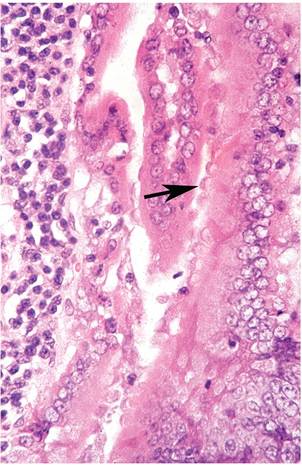
FIG. 3.22. Duodenal mucosa of a hamster with chronic giardiasis. Note the Giardia organisms associated with the surface of the villi (arrow) and infiltration of the lamina propria with mononuclear leukocytes.
suppliers. Concomitant infection with Giardia sp. has been reported, in which large numbers of S. muris organisms were present within hyperplastic crypts of the jejunum. The organisms normally feed on intestinal bacteria, and their presence is an incidental finding. These flagellates have been found in the peripheral blood of hamsters with enteritis. There appears to be a strong degree of host specificity for various S. muris isolates. Reciprocal interspecies transmission has been shown using clones of S. muris isolated from mice and Syrian hamsters, but not between these species and rats. Isolates from European hamsters were shown to be infectious for Syrian hamsters, but not rats or mice, including severe combined immunodeficient mice. Diagnosis of S. muris infection can be confirmed by demonstration of the flagellated organisms in tissue sections and mucosal wet mounts, examination of feces for banded cysts, or by fecal PCR.