Polyarteritis Nodosa
Polyarteritis is frequently seen in aging rats. The prevalence is higher in males. Arterial lesions most frequently occur in medium-size arteries of the mesentery, pancreas, kidney, pancreaticoduodenal artery, testis, and most other organs, except the lung.
The disease most frequently occurs in the Sprague-Dawley and spontaneous hypertensive rat (SHR) strains, and in rats with latestage chronic nephropathy. At necropsy, affected vessels are enlarged and thickened in a segmental pattern, with marked tortuosity, particularly in the mesenteric vessels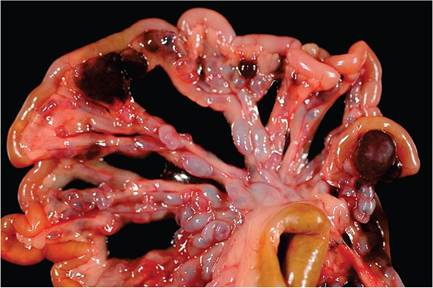
FIG. 2.58. Mesentery and intestines of an aged rat with polyarteritis. Note the nodular dilation and tortuosity of the mesenteric vessels. (Source: D. Imai, University of California, Davis, CA. Reproduced with permission from D. Imai.)
(Fig. 2.58). On microscopic examination, there is intimal fibrinoid degeneration and thickening of the media of affected arteries, with smudging of the normal architecture. Infiltrating leukocytes consist of mononuclear cells, with a few neutrophils (Fig. 2.59). There are marked variations in the size and contours in the lumen of affected vessels, and thromboses, occasionally with recanalization, may occur.
More on the topic Polyarteritis Nodosa:
- Polyarteritis Nodosa
- Vasculitic Syndromes
- Streptococcal TSS
- Conclusion
- BIBLIOGRAPHY FOR AGE-, MISCELLANEOUS-, ENVIRONMENTAL- AND DRUG-RELATED DISORDERS
- 18 Autoimmune Disease in Pregnancy
- Agrawal M.. Textbook of Pediatrics. 3rd ed. — CBS Publishers,2025. — 973 p., 2025
- Macrovascular Complications of Diabetes Mellitus