Public Health Significance of BTB
The public health significance of M. bovis is poorly defined in Rwanda because of the very limited available data. However, from the little information that is available, it appears that the disease poses a definite public health risk (Habarugira et al.
2014; Gafirita et al. 2012).A number of risk factors are of particular importance:
• The traditional consumption of raw milk and raw milk products by Rwandans enhances the likelihood of transmission of M. bovis from cattle to humans. Some Rwandans still believe that it is taboo or culturally improper to boil (pasteurize) milk before it is consumed. They prefer to drink raw, either fresh or a traditionally fermented milk known as ikivuguto. Although it has been shown that M. bovis has a short half-life of about 12 h in souring raw milk (Michel et al. 2015), it is still unsafe to consume such milk during the early stages of fermentation without pasteurization, as viable M. bovis can be present in fermented milk despite its low pH.
• In some of the remote areas of Rwanda, particularly in the Eastern Province where the farming is mostly extensive, cow’s milk is consumed on farms where there are no or only rudimentary pasteurization facilities (Karenzi et al. 2013). Although studies have not been carried out to ascertain it, the increased prevalence of extra-pulmonary tuberculosis in humans in Rwanda would suggest the likelihood of M. bovis being the causative agent, following ingestion of infected milk (Lorent et al. 2008, 2011).
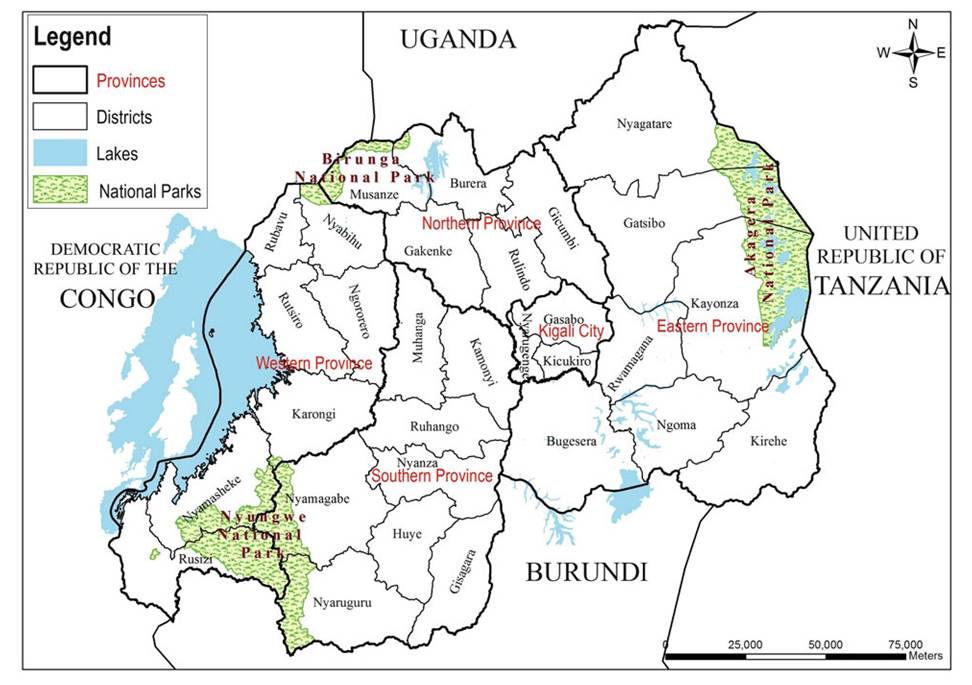
Fig. 18.1 Map of Rwanda showing its borders with Tanzania and Uganda, and the location of the national parks (Map by courtesy of Itegere Basile)
382 G. Habarugira et al.
• Considering the occurrence of BTB lesions in meat (Awah Ndukum et al.
2010; Bekele and Belay 2011; Teklu et al. 2004; Youssef and Ahmed 2014), there is potential for acquiring the infection through the consumption of raw and/or undercooked meat.• With the increasing trend of zero grazing, animals are now kept in backyards in many households in Rwanda. This practice contributes to an increased closer contact between owners and their cattle (Nzeyimana et al. 2015) that may facilitate the transmission of zoonotic infectious diseases such as BTB.
In Rwanda, the presence of BTB has direct and indirect socio-economic consequences. Meat condemnation not only has a direct economic impact, but it also contributes to the loss of animal protein that is a scarce commodity in the country. According to meat inspection data collected from 2009 to 2014 at Nyabugogo Abattoir located in the Capital City, 11,174.5 kg of tissues and offal were condemned because of the presence of BTB-like lesions. Considering the protein content of 22.3% of raw beef (FAO 2007) and an animal protein requirement of 56 g/ day for a sedentary average man of 70 kg body weight (Trumbo et al. 2002), the condemned meat would be enough to provide the required protein for 122 adult men for a year.
18.4
More on the topic Public Health Significance of BTB:
- Prevention and Control of BTB in Sudan
- Diagnosis of Bovine Tuberculosis in Zambia
- Introduction
- Control of BTB in Ethiopia
- Historical Perspective of BTB in Nigeria
- The Epidemiology of BTB in Malawi
- The Lesions and Diagnosis of BTB in Sudan
- Zoonotic Tuberculosis in Zambia
- Conclusion and Recommendations
- Molecular Epidemiology of Bovine Tuberculosis in Uganda