Germany
id="Picutre 114" class="lazyload" data-src="/files/uch_group77/uch_pgroup301/uch_uch7195/image/image112.jpg">
Cyclical and structural challenges weigh on growth prospects
| GDP | USD4072.2bn (World ranking 4) |
| Population | 84.1mn (World ranking 19) |
| Form of state | Federal Republic |
| Head of government | Olaf Scholz (Chancellor) |
| Next elections | 2025, Legislative |
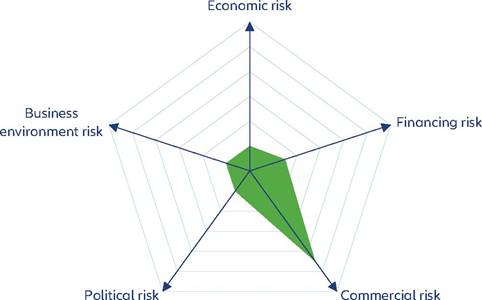
Strengths & weaknesses
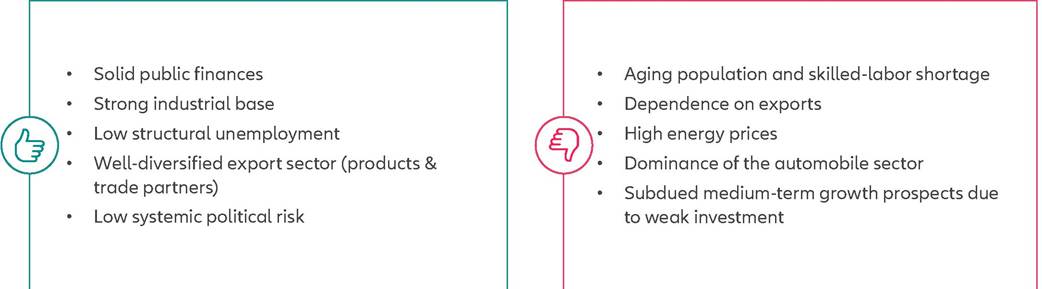
Economic overview
The German economic engine is sputtering
Despite a +3.1% recovery in 2021 and GPD expanding by +1.9% in 2022, pre-crisis GDP levels were only reached in early 2022, whereas the Eurozone aggregate already hit that milestone in late 2021.
The German economy has barely grown since the Covid-19 setback. But the German government has intended to revive the engine through the 10-point economic plan. At its core, the growth and opportunity act provides concrete impulses for growth and competitiveness as well as funding that should make Germany more attractive as a businesslocation, along with climate and transformation funds. The pact for planning, approval and implementation acceleration phases out more than 100 single regulations and the tax reform on electricity prices for the industry will lower electricity prices for business.Announced fiscal measures will amount to around 2.5% of GDP.
However, the German economy is struggling with cyclical and structural headwinds which pushed the German economy into recession in 2023. It will not recover until 2024 (+0.5%) and will grow by +1.7% in 2025.
Next to dim short-term prospects, the medium-term outlook is also concerning. In addition to high energy costs, the headwinds for the German economy come primarily from weak global demand, especially for highly cyclical goods such as cars, machine tools and chemicals. In addition, the lopsided global growth in services compared with goods is causing problems for the local economy. Germany is also facing structural challenges, including labor shortages, high energy costs, a heavy regulatory and tax burden, creeping digitalization and political uncertainty.In Germany insolvencies are again on the rise due to the reinstatement of the insolvency laws after the temporary suspension to file for insolvencies and overall tighter financing conditions. They will however remain below 2019 levels despite a rebound in 2023 that reached +22% y/y i.e., +3 210 firms to 17 800 cases. The sectors most under scrutiny are trade, hospitality and construction. We expect the government to remain ready to act in a targeted way, as they did to rescue several most-hit utilities.
Inflation - no return to 2% target before 2024
Mirroring other Eurozone economies, German inflation pressures are easing in the energy and food sectors despite short-term volatility. Inflation came in at 5.9% on average in 2023 and we expect it to slow further to 2.6% and 2.2% in 2024 and 2025, respectively. However, core inflation also looks set to settle well above average mainly because of services inflation. Supply bottlenecks have diminished but could rise again due to ongoing geopolitical uncertainty. At the same time though labor cost pressure will remain high while the green transition will generate additional costs. Overall inflation will decline markedly, albeit remain above 2% - both headline and core - even in 2025.
Fiscal outlook: Budget consolidation turns fiscal spending more restrictive
The German government has been bypassing its debt brake of 0.35% as structural debt in relation to potential GDP, particularly to finance its program to combat climate change.
But the Federal Constitutional Court's ruling in November 2023 has stripped the government of the financing for climate and industrial policy projects: at least EUR60bn (costing -0.7pp of GDP spread over 2023-2027) and potentially a further EUR200bn set aside to aid the economic recovery from the economic stabilization fund are at stake. This situation also illustrates how Germany has managed to control its public debt. While government spending in relation to GDP was 45% in 2019, it is currently 48% (after over 50% in 2020 and 2021). This means that almost half of economic output is still funneled through public coffers, which leaves enough room for maneuver. But the German government has struggled to find consensus on setting priorities in its 2024 budget as it will have to comply with the debt brake and fiscally consolidate its structural balance at least in 2024 until further notice. This leaves it with EUR17bn savings from the core 2024 budget and EUR12bn from the Climate and Transformation Fund (KTF) in 2024, which adds up to a total of 0.7% of GDP.This gap was now announced to be financed by various measures such as the early expiry of the e-car purchase premium, a reduction of solar subsidies and environmentally harmful subsidies on fossil fuels, as well as labor market measures. At the same time, revenue for the KTF is to be increased by raising the CO2 price to EUR40 from 2024, which is EUR5 more than previously planned. As Germany faces a challenging economic environment, this creates further uncertainty for firms and households. If the savings measures do not deliver what they promise, it could shave off approximately -0.3pp of GDP in 2024 and potentially prolong the recession in an already very weak environment as it cuts competitiveness and torpedoes a catch-up effect of public and private investments. Germany's fiscal impasse highlights the need to prioritize investments on par with current consumption and find a way to finance necessary investments in the years to come.
More on the topic Germany:
- NUMERICAL PROBLEMS
- REFERENCES
- The Cognitive (R)evolution: The End?
- Kuwait
- The Constant Measure of Value and a Nave Reasoning of Technology
- KARAITES
- Development of New Paratuberculosis Vaccines
- Oman
- Index
- Introduction: The Separation of Powers and Its Implementation