In 1572, the 15-year-old Dona Beatriz Clara Coya, daughter of the Inca emperor Sairi Tupac, who died resisting the Spanish conquerors, married the conquistador Don Martin Garcia de Loyola, Knight of the prestigious Order of Calatrava and Governor and Captain-General of the Kingdom of Chile (see Figure 12.1).
The union was remarkable for Martin had defeated Beatriz’s uncle, Tupac Amaru I, who had succeeded her father and was executed by the Spaniards. Beatriz’s status and wealth were not the only motives behind the match, orchestrated by the Viceroy of Peru to nullify the possibility of future unrest flowing from her inherited rights as Inca descendant; the Crown had earlier invalidated her illegal marriage to a wealthy Spaniard of suspect loyalty.
Despite her being 9 years old at the time of her illegal marriage, the putative husband was rumoured to have ‘forced’ Beatriz, who subsequently returned to the convent where she had spent her early childhood, until her marriage to Martin. The Jesuits commissioned a painting of her marriage to the conqueror of her kin that vividly represents the continuity of Inca grandeur into the colonial era. Beatriz’s daughter went on to receive the titles of ‘Adelantado [Conqueror] of the Valle of Yupanqui’ and Marchess of Oropesa.During the age of European empire-building in the Americas (c. 1530-1880), indigenous women found occasional opportunities to exert power and authority within the new order. Although within a limited range of political offices, some indigenous women, especially in Iberian America, maintained inherited privileges throughout the colonial period. This chapter explores ways in which these women inserted themselves into power networks within colonial societies. A comparison of the experiences of women from the heartlands of the former Aztec (Mexico) and Inca (Peru) Empires—subjected to Spanish rule from the early sixteenth century—with those of women living beyond the northern frontiers of Mexico (in the present-day United States and Canada), indicates that no normative experience of women across cultures existed. Rather, women’s gendered roles present ‘almost limitless cross-cultural variation’.1 Hence, any claims about indigenous women’s access to positions of power or authority need to be viewed within specific contexts.
The vicissitudes of indigenous women’s colonial lives and their ability to exercise power need to be appreciated against the background of a continuous transformation of the political landscape. European intervention in the Americas added fuel to the inter-tribal conflicts of the pre-contact era. The process of incorporating indigenous peoples of the New World into empire, which began in the wake of Columbus’ first landfall in 1492, was protracted and uneven. France, England and Holland joined the imperial competition for
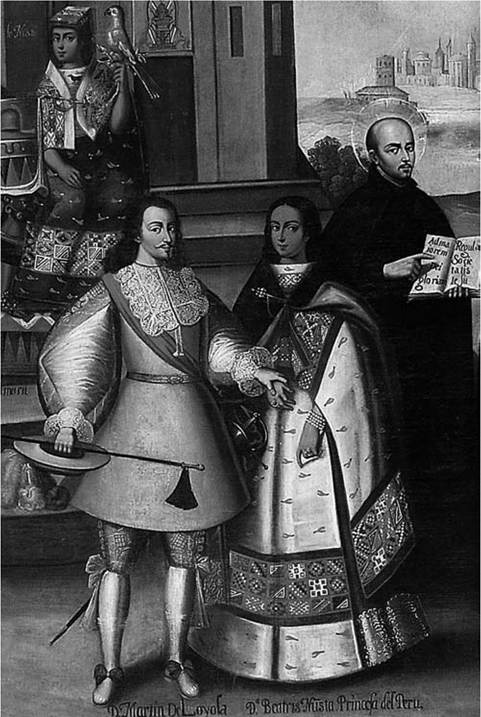
Figure 12.1 ‘Marriage of Don Martin de Loyola and Dona Beatriz Nusta. Oil on canvas. Cusqueno School. Anonymous. End XVII C. Church of la Compania, Cusco'. Maria Concepcion Garcia Sàiz. ‘Una contribucion andina al barroco americano', in Ramon Mujica Pinilla, Coord., El Barroco Peruano (Lima: Banco de Credito, 2002), pp. 208-209.
the unexplored and unconquered territories initially claimed by Spain and Portugal. The fragility of imperial claims, however, can be appreciated from the Spanish experience in Mexico. The conquest of Tenochtitlan and the establishment of the Viceroyalty of New Spain in 1535 represent the beginning of a long era of consolidation and expansion which, in peripheral areas such as Florida and Texas (then part of New Spain), was still underway in the early nineteenth century.2 Similarly, as late as the 1850s there remained in the North American West autonomous polities yet to be subjugated by any empire. Many First Nations—or ‘Indian tribes' as described in the early historiography—had not experienced the full effects of colonisation even though their lifeways had been modified by the introduction of the horse, commodities available through the European fur trade and pathogens (smallpox being the most deadly). Among these First Nations in the 1800s were those occupying the territories beyond the trading centre of St Louis, on the Missouri River, including buffalo hunters of the Great Plains (or Plains Indians) such as the Shoshone, Nez Perce, Absaroka (Crow), Blackfoot and the confederacy formed by the Nakoda, Dakota and Lakota—often referred to by the misnomer of ‘Sioux’.
Likewise, the Comanche and Apache in the present-day U.S. South-west remained to be subdued. In strictly legal terms, by the late nineteenth century all of these First Nations would become colonial subjects as ‘domestic dependent nations’ of the United States, or ‘wards of the state’ in Canada.Analysing women’s power throughout the empire-building era is rendered difficult because of their relative absence in early sources, which are more concerned with the feats of men. Colonial history often excludes even women’s names, referring to them merely as someone’s daughter or wife. Europeans interpreted the prevalence of polygyny, that is, men (especially powerful ones) having multiple wives, as indicative of the low position of women, always bound to one husband. They also took it as evidence of the lower morality of indigenous Americans as compared with their own Christian selves. Rather than recognising the strengths of women, Europeans viewed female participation in agriculture as a sign of indigenous males being ‘lazy’, and of women being ‘drudges’.3
The highest political office in pre-contact empires in the Americas belonged to men. In the Andes, the Capac Inca—believed to descend directly from the Sun—ruled the Inca Empire, and in Mexico a Huey Tlatoque headed its Aztec counterpart. When the first settlers arrived in the Chesapeake Bay (Virginia) in 1608, a paramount Algonkian chief (werowance) ruled the Powhatan Empire. Women of these polities, however, also occupied positions of authority, especially those who belonged to leading families. In the Andes, the Qoya, the principal wife of the Capac Inca, was an indispensable partner for her husband’s ascent to the throne, not least because of political alliances she brought into the marriage. In Mexico, a woman hereditary ruler (cihuatlatoque) named Xiuhtoztzin, recognised as head of a town (altepetl) in 1340 on the death of her father who left no male heir, established a lineage of rulers ‘no one disparaged’ for being born in the female line.4 Likewise, women became hereditary chiefs in New England, the best known being Quaiapen, chief sachem among the Narragansett (1657).
In similar circumstances, women (cacicas or kurakas, and capullanas) inherited rule of chiefdoms (cacicazgos or kurakazgos) in pre-contact and colonial Iberian America. While the protracted consolidation of Spanish rule allowed for some women in rural areas to retain authority until independence, this was not the case in New England, where women chieftains disappeared from view from the early colonial era.The authority of women in the matriarchal Iroquois League illustrates female power in pre-contact North America. The Iroquois or Haudenosaunee (People of the Longhouse) occupied territories around the Great Lakes, in current-day New York, Ontario and Quebec. The League originally consisted of fifty clans unevenly distributed among the Mohawk, Oneida, Onondaga, Cayuga and Seneca peoples, joined by the Tuscarora in 1772. The clan mothers, the eldest women of certain lineages, elected the fifty male chiefs of the League and thus exercised a ‘culturally legitimized’ form of institutionalized power, even though this is not ‘the same thing as authority’.5 Unlike women in New England, Peru and Mexico, Iroquois women did not become chieftains—the pinnacle of formal political power.
The fluid landscape of empire-building afforded First Nations women few opportunities to occupy positions of authority. Focussing on indigenous women’s power during the colonial era unavoidably leads to comparison with the experiences of elite women. Not only are such women more visible in historical sources, they also enjoyed greater opportunities to exert authority vis-à-vis their non-elite counterparts. Non-elite women’s contributions to empire, especially through economic activities, seldom earned them historical recognition or access to positions of power; colonial documents created the fiction that ‘men were the agents of production’.6 If women’s economic activity, for which evidence must have been abundant to early chroniclers, went mostly unrecorded, other aspects of their colonial experience have come into clearer focus.
More on the topic In 1572, the 15-year-old Dona Beatriz Clara Coya, daughter of the Inca emperor Sairi Tupac, who died resisting the Spanish conquerors, married the conquistador Don Martin Garcia de Loyola, Knight of the prestigious Order of Calatrava and Governor and Captain-General of the Kingdom of Chile (see Figure 12.1).:
- In 1572, the 15-year-old Dona Beatriz Clara Coya, daughter of the Inca emperor Sairi Tupac, who died resisting the Spanish conquerors, married the conquistador Don Martin Garcia de Loyola, Knight of the prestigious Order of Calatrava and Governor and Captain-General of the Kingdom of Chile (see Figure 12.1).
- Putative Title