1932-1933: Convergences
On March 1, 1932, a new empire arose in the Far East: Manchukuo. At this moment, it was considered by the rest of the world to be little more than a Japanese puppet state. But in the long run, Manchukuo represented a break in the history of imperial rule.
In 1939, on the eve of the Second World War, the American journalist William Henry Chamberlin wrote: “It becomes increasingly clear in retrospect that the seizure of Manchuria [... ] was much more than an episode of annexation. [... ] It was a turning point in Japanese history comparable with Mussolini’s march on Rome or Hitler's accession to power.”[2549] Indeed, Manchukuo was a turning point for Japan, East Asia, and the international world order. It represented something hitherto unprecedented, as military conquest, industrialization programs, and mass migration were combined in new ways, while at home in Japan the empire served to mobilize society on a military, political, and economic level. This so-called total empire was the size of Central Europe, and its annexation had virtually doubled the size of the Japanese Empire at a stroke.[2550] The new state upset the fragile geopolitical balance of power in the region and, by way of the radical novelty it postulated, simultaneously questioned the imperial world order per se.In the interwar years, against the background of ideas about a more benevolent imperialism that would allow for some kind of national self-determination, new kinds of imperial projects had emerged which were as ambivalent as they were contradictory. Scholarship on Manchukuo has referred to an “imperialism of free nations” or an “imperialism after imperialism.” [2551] Both descriptions are fitting as they point at the rejection of traditional colonial characteristics of the “Age of Empire” (1875-1914). Through Manchukuo, Japan promoted a benevolent, pan-Asian imperialism which would purportedly create free nations in place of suppressed colonized peoples.
Japan’s territorial claim to Manchuria in the early 1930s was not entirely new. Immediately following the Japanese victory over Russia, the South Manchurian Railway (mantetsu) had started to set up an ever-denser network of micro-colonies
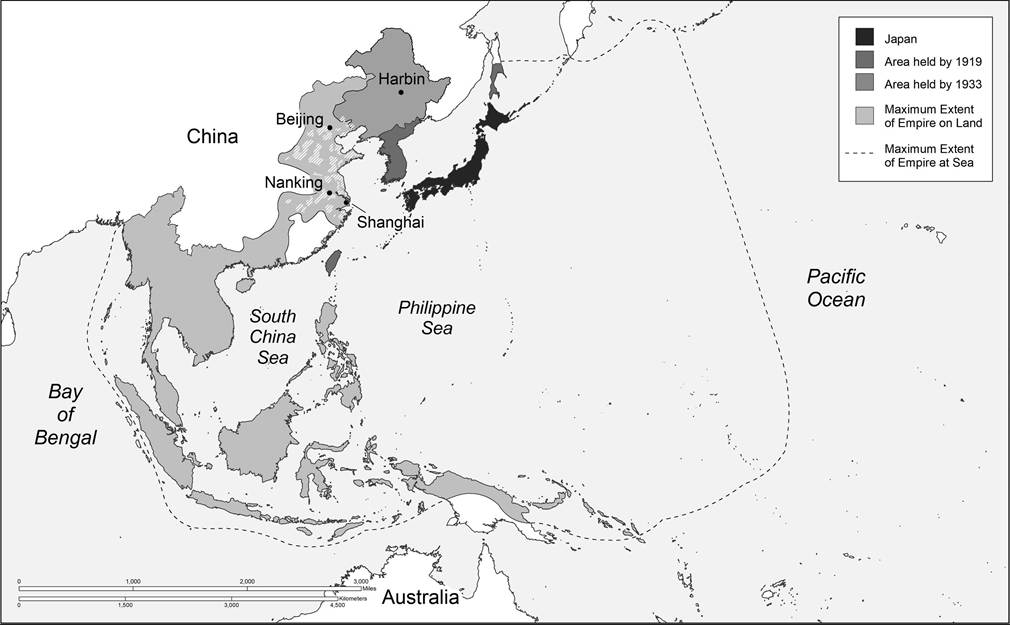
Map 41.2. The Japanese Empire.
Copyright: Moritz von Brescius and Daniel Hedinger with Jonathan Weiland.
THE GERMAN AND JAPANESE EMPIRES 1139
throughout the region. However, it was a bomb attack against the railway staged by the Kwantung Army that supplied the bogus justification for occupying Manchuria in September 1931 and thus shifted the emphasis from economic penetration and informal occupation to territorial conquest. The army had long had a great deal of leeway in the imperial periphery. What was new at the beginning of the 1930s was that radical officers were now openly revolting.
Japan paid a high political price on the international stage for the Manchurian experiment. The League of Nations condemned Japan's actions, even though the Western powers, weakened by the Great Depression, could not bring themselves to intervene. But since the Stimson Doctrine (i.e., the United States would refuse to recognize changes born of aggression), which claimed for international nonrecognition of Japan's conquest, was adopted by most countries, Manchukuo was not recognized by international law. Subsequently, the battle lines were quickly drawn, and in February 1933, Matsuoka Yosuke, a future foreign minister (1940— 1941), pulled Japan out of the League of Nations—a good half year before National Socialist Germany also left. Matsuoka viewed Manchuria as “Japan's lifeline.” He was hardly alone in this view. Ishiwara Kanji, responsible for the strategic leadership of the Kwantung Army, had also called for the annexation of Manchuria and Mongolia for strategic geopolitical reasons.[2552] Influenced by apocalyptic Buddhist ideas, he believed that the world was on the eve of a final hundred-year-long global war, in which ultimately Japan and the United States would end up battling each other for world domination.
As a new, industrialized, and just state, Manchuria was to be the base of this struggle.In the crisis of the early 1930s, German and Japanese imperial ambitions started to converge for the first time, yet at this point there was still little direct interaction or ideological transfers between the two powers. But barely a year after Manchukuo's birth, equally dramatic developments took place in Germany as the Weimar republic ceased to exist. In place of the first German democracy, a violent, racist political movement had assumed power over the state, determined to overthrow the existing European state system and to erect a new racial order on the continent. Through threats, manipulation, and brutal internal violence, its leader, Adolf Hitler, had quickly managed to consolidate his position after the “seizure of power” in January 1933. This gave him, in agreement with the German army (Reichswehr) and the Foreign Office, the possibility to launch the secret rearmament of Germany in preparation for wars to come.
During the Great War, Hitler had initially held positions widely shared in conservative, ethnic-chauvinist, and anti-Semitic milieus in the early 1920s. The National Socialist Program of 1920 (the 25-point Plan) included, for instance, the demand that all ethnic Germans should be united within a greater Germany, a position that facilitated the rise of the NSDAP (Socialist German Workers' Party/National- Sozialistische Deutsche Arbeiterpartei). He also demanded the revocation of the terms of Versailles and the restoration of Germany's former colonies. When Hitler published his programmatic book Mein Kampf in 1925, he had by then changed and drastically radicalized his thoughts on race and imperial enlargement.[2553]
To increase the power of a racially purified German nation and also achieve economic autarky, it seemed imperative for Hitler to gain new Lebensraum. Through new “living space,” Hitler's envisioned empire would be able to secure important resources and to feed a growing population.[2554] Hitler left no doubt that the realization of his plans to radically reorder the space of Europe could only be achieved through war and would, in his words, “happen to the detriment of Russia.” Here, it becomes evident that there was a fundamental contradiction inherent in the Nazi worldview from the start: the future Reich had to be volkisch, but at the same time imperial— meaning that it had to be multiethnic in its composition.
It was this tension that can be seen as the root of the extreme violence of the Nazi Empire.In breaking with Germany's colonial past, Hitler dismissed the former system of weak and dotted overseas colonies, which would scatter precious German blood all over the world. What he demanded instead was a contiguous and autarkic territorial empire: “We will finally wind down the colonial and trade policies of the pre-war period and go over to a land policy for the future.” This would include the settlement of ethnic Germans in the East as a “healthy peasantry” that would both preserve the “Volk” and act as a protective wall against “Bolshevism.” What made his imperial aspirations radically new was the fact that Hitler rejected even forced assimilation, or any potential Germanification of subjugated peoples in the East. Former strategies of imperial rule, including the granting of limited autonomy or the cooperation with indigenous elites, were dismissed. He rather sought German expansion “for the sake of racial homogeneity and the expulsion or destruction of racial inferiors.”[2555] This inhumane logic meant that, unlike in the case of the former African possessions, genocidal practices and ethnic cleansing were defining parts of the Nazi program of expansion from the start. Hitler and his allies in 1933 still lacked the means and military resources to try to implement their brutal visions. Therefore, preparations for military expansion started immediately, while for the time being the “Third Reich” put on a distinctly peaceable appearance. At first glance, the developments in Europe and Asia appear to have had little in common. In the first half of the 1930s, it was not obvious how the imperial projects in Germany and Japan would soon converge. From the German perspective, Japan was still primarily one of the victors of the world war that stood in the way of its own expansionist ambitions. Furthermore, in light of the crisis at home, Germany was preoccupied with itself and reacted for the most part with “indifference” and “disinterest” to the Manchurian crisis.[2556] More important appeared at first to be the dynamics that the question of empire elicited in each country.
Imperial ambitions proved to be important factors in the revolutionary upheaval on the domestic front and likewise in terms of radicalization of foreign policy and consolidation of these countries' dictatorships. In both regimes, the “colonial question” served an integrative function. In Japan, one did not necessarily have to approve of the unauthorized actions taken by the military in order to welcome the more forceful imperial presence on the mainland. In Germany, the inherent albeit ambiguous attitude toward imperial expansion found in National Socialism linked the new regime to strong conservative and backward-looking groups during this early, critical phase of its rule.All in all, in 1932-1933, amidst all political turmoil, there was little transfer, interaction, or even cooperation between the countries. One reason is that, measured against all international standards, the new power holders in Berlin were terribly provincial when it came to geopolitical-global contexts. But Adolf Hitler did comment at least once sympathetically, even favorably, on Japan's actions in Manchuria in an interview with the newspaper Asahi in January 1932.[2557] Shortly before the Nazi “seizure of power,” Japanese experts thus thought that Hitler tended to lean toward the side of Japan, at least in the Manchuria issue.[2558]
In the long run, however, the mutual interest and even the reciprocal admiration increased as it became evident that the effects of Manchukuo as a “total empire” were not confined to East Asia. Germany followed Japan's colonial experiment with great interest. The future ally was particularly impressed by Japan's industrialization programs and by its policy of economic self-sufficiency. Moreover, Italian and German experts—who later traveled to Asia increasingly frequently for study purposes—were concerned with the question of the relationship between internal radicalization in Japan, on the one hand, and expansionism and imperialism on the other. Still, the point here is less a matter of one country needing the other as a model. More important was that, against the backdrop of the “seizure of power” and the establishment of Manchukuo, similarities and parallelisms between them would become increasingly evident in the years that followed.
IV.
More on the topic 1932-1933: Convergences:
- From Famine to the Holodomor, 1932-1933
- What was the Holodomor (the Ukrainian Famine of 1932-1933), and was it genocide?
- The Famine of 1932–33
- Letter from the Collective Farmer Mykola Reva to Joseph Stalin about the Famine of 1933 in Ukraine
- CHAPTER 2 THE FAMINE OF 1932-33
- De-kulakization, Collectivization, and the Famine, 1929-1932
- One of the most insightful and moving eyewitness accounts of the Holodomor, or the Great Ukrainian Famine of 1932-33, was written by Oleksandra Radchenko, a teacher in the Kharkiv region of Ukraine.
- Red Terror of 1918-22 and Literary Rhetoric of 1932-34
- Working independently of each other, A. J. Lotka (1932) and Vito Volterra (1926) both modeled competition by modifying the logistic equation.
- Stalinism and The Holodomor
- Ukrainization Reconfigured
- The Holodomor—Non-Event or Genocide by Starvation?
- Britain and the Japanese invasion of Manchuria