1940: Expansion
German empire-building in Europe may have started late, but it was then implemented at breathtaking speed: one year after the annexation of Austria in 1938, the Reich already included much of Czechoslovakia.
Another year later, in the summer of 1940, Poland and large swaths of western and northern Europe had been added. Then, parts of southeastern and eastern Europe followed. In 1941, around half the population of Europe lived in Hitler's empire. This imperial impetus, which emanated primarily from Germany, first ensured the survival of the Axis and then enabled it to become eventually a war alliance.At first it was uncertain if the Axis would survive the outbreak of war in Europe, because the Hitler-Stalin Pact of 1939 had dealt a deathblow to the Anti-Comintern Pact and, so it seemed, thereby the entire alliance. The euphoric expectations of the Axis countries since 1936 had been left unfulfilled, and Japan and Italy (initially) distanced themselves from the war. Even in Germany, the war was unpopular at first.[2566] Not only the country's leadership, but also a large segment of the population was quite aware that Germany could not win a long war of attrition against the Western allies. Therefore, the triumph in the battle against France in the spring of 1940 acted as a catharsis. Never before and never after would the popularity of the “Führer” be as great.[2567]
Now it became obvious that imperial success proved important for domestic mobilization, as was the case in Italy after the victory in Ethiopia in 1936, or in Japan 1931-1932 and then again in 1937. For many who otherwise kept a critical distance from the regime, imperial dreams plainly offered an important source of refuge. If Fascism involved such a thing as consensus, this was most fully realized in terms of imperial adventures. Especially in Germany, the broad consensus in support of the regime's efforts to “bring Germans home to the Reich,” to create Lebensraum in the East, and/or to reclaim the lost colonies, was all the more important for the National Socialists.
Statements made by German prisoners of war indicate that colonialism or imperialism was indeed an important part of National Socialist mobilization efforts: many prisoners of the British stated that they had fought for “Lebensraum in the East” or for “colonies” more generally.[2568] The situation was very similar in Japan. A broad consensus existed among both the elite and the general population about the necessity of imperial expansion.As we have seen, when war broke out in Europe in September 1939, the future of the German-Japanese alliance was unclear. However, the resounding success of the Germans in Poland and then in northern Europe (Denmark/Norway) temporarily assured the continued survival of the Axis, because the shared aim of imperial expansion was enticing and had noticeably re-energized the exponents of a Germany- friendly policy in Japan already by the turn of the year 1939-1940. Among these exponents was also Ishiwara Kanji, who expressed his enthusiasm for Germany's imperial expansion and predicted the creation of global blocs.[2569]
The Wehrmacht's victories in the West not only shook Europe, but also the colonial world and its global order. The short-term consequences were immediately obvious in East Asia because the defeat of France and the fall of Great Britain, which only seemed a matter of time in the summer of 1940, also changed the geopolitical situation there fundamentally. Now, the Japanese elite began to discuss seriously what to do with the imperial colonial inheritance left behind by the Dutch, the French, and, in what seemed a foreseeable time, the British.
These new possibilities for further Japanese expansion reignited a decisive point of contention within the Japanese leadership. While there was consensus for the
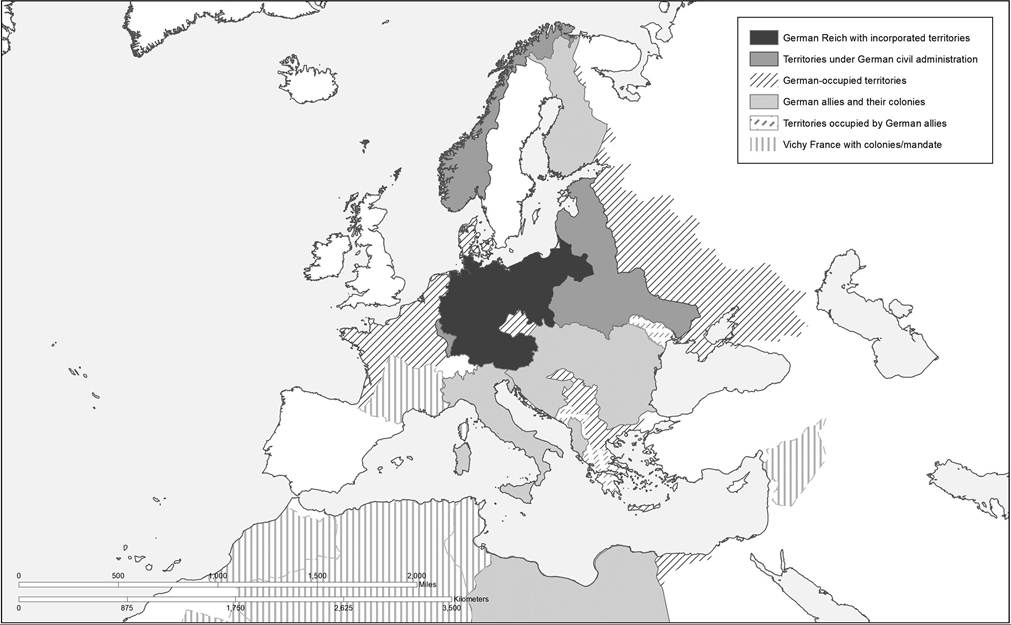
Map 41.3. The German Empire.
Copyright: Moritz von Brescius and Daniel Hedinger with Jonathan Weiland.
THE GERMAN AND JAPANESE EMPIRES 1147
most part about China and the necessity for further expansion, the question concerning the direction of the main advance of this expansion had not been answered. For some, the overthrow of the Soviet Union in Asia was the primary war aim, but for others the main cause was to push into Southeast Asia. Consequently, proponents of a “North Expansion” Hokushin-ron) squared off with those favoring a
“South Expansion” (W®^ Nanshinron). As war with the United States and Great Britain became more probable,[2570] planning authorities increasingly emphasized that Manchuria alone would not be a sufficient source of raw materials for a war against the Western powers.[2571] French Indochina and the Dutch East Indies were also needed—the latter primarily for its oil. This argument decisively favored the South Expansionists in the debate during the spring of 1940.
However, these domestic developments within Japan cannot be reduced simply to geopolitically determined realpolitik. Rather, against the backdrop of Germany's military successes, strategic considerations of realpolitik once again conjoined with ideological premises in a way that was for the actors apparently meaningful during the summer and early fall of 1940. This nexus is evident in relation to the origins of the East Asian Co-Prosperity Sphere.[2572] Exhilarated by German successes, Japanese prime minister Konoe Fumimaro proclaimed the end of the old world order and at the same time the beginning of a new one.[2573] Now, in the summer of 1940, decisionmaking processes focused on strengthening the Axis. The creation of the East Asian Co-Prosperity Sphere started in the immediate wake of the German victories in Europe and developed parallel to the formation of the Tripartite Pact, which was signed by Germany, Japan, and Italy on September 27, 1940. This pact “integrated Japan's efforts to build a Greater East Asia Coprosperity Sphere with World War II in Europe.”[2574] In this sense, the Tripartite Pact featured an imperial dimension on both the global and regional levels. In the regional context, the alliance also structured the imperial setting of each region by including smaller partners like Manchukuo, the Reorganized National Government of the Republic of China, Finland, Bulgaria, Romania, or Denmark. In this sense, these pacts were an international diplomatic expression of the Grofiraum (“greater space”) concept, advanced by German and Japanese geopoliticians simultaneously.
VI.
More on the topic 1940: Expansion:
- Perfecting Coercion in an Era of State Consolidation, c. 1870 to c. 1940
- Phase 5: Contraction, 1940-80
- The Second World War, 1940-45
- Quotidian Violence in the French Empire, 1890-1940
- CHAPTER 2 Patterns from the Guardians of Neutrality: Women Social Democrats in Sweden and Their Resistance against Civil Defense, 1939-1940
- The Expansion of Europe
- Russian Expansion
- Other Explanations of Islam’s Expansion
- Polish Expansion into Ukraine
- Gentlemanly capitalism and British expansion in Asia
- Revolution and expansion
- Lithuanian Expansion into Ukraine
- ECONOMIC DIMENSIONS OF EXPANSION
- Phase I: Expansion, 1415-1773
- DEMOGRAPHIC AND SOCIAL DIMENSIONS OF EXPANSION
- Phase 3: Expansion, 1824-1912
- Expansion and Contraction of Maritime Power
- European Requirements and Colonial Expansion