CHAPTER I Imagining the Indian Ocean
For many years the Indian Ocean was the least studied of the world’s great oceanic systems. This situation is now changing. Historians know that there have been major economic and cultural exchanges across its waters and around its coasts that date back at least seven thousand years and that these were greatly accelerated following the rise and expansion of Islam from the seventh century ce.
Among the many challenges to understanding the dynamics of this important world region is how best to define it, for unlike continental land masses oceanic boundaries are, literally, more fluid. One way to approach this problem is to read what various travelers have written about sailing its waters.“It was the first week in December when we sailed from Aden, and the northeast monsoon was blowing very quietly.” Thus writes sailoradventurer Alan Villiers as he began his voyage from Kuwait aboard the Triumph of Righteousness in 1938, headed toward the East African coast and returning around the coast of Arabia. His ship was a boom, a large type of Arab sailing vessel that plied the waters of the Indian Ocean in the twentieth century. “I knew this was the kind of vessel in which I wished to sail,” he recalls. “The atmosphere of true adventure and romance lay heavy on her graceful hull, and the very timbers of her worn decks were impregnated with the spirit of colorful wandering.”1 Villiers lamented: “It seemed to me, having looked far and wide over twenty years of a seafaring life, that as pure sailing craft carrying on their unspoiled ways, only the Arab remained. Only the Arab remained making his voyages as he always had, in a wind-driven vessel sailing without the benefit of engines. Only the Arab still sailed his wind ships over the free sea, keeping steadfastly to the quieter ways of a kinder past.”2
Two decades later, in the 1950s, early in the Southwest Monsoon, American journalist William M.
Holden sailed the return journey from Zanzibar to Oman on board the Indian dhow Harisagar. Although a landlubber, Holden’s first impressions of sailing the ocean echo those of the experienced sailor Villiers. “I lay awake for hours, listening to the sounds of the ship versus wind and sea, and the snoring sounds of our passage. Just as sailing ships have from times earlier than written records, Harisagar was adventuring far out onto the primeval sea—sail swollen with wind, teak deck heaving, timbers creaking. Spindrift touched flesh like cool fingertips. We would sail thousands of miles across the Indian deep, through whatever caprices of monsoon weather lay in store.”3Although both Villiers and Holden wrote in the twentieth century, their sentimental observations recapture a pattern of maritime trade that marks the entire history of the Indian Ocean. Traders exchanged goods, and sailors manned the boats that carried those goods along the coasts of the northwest Indian Ocean long before the rise of Islam in the seventh century ce and the kind of seafaring the passing of which Villiers regrets. From the Harappa civilization of the Indus Valley (c. 2600-1900 bce), coasting vessels transported goods from what is today the coast of modern Pakistan to the Arab or Persian Gulf— hereafter simply the Gulf—to the Red Sea, and eventually to Egypt. Also, the Indonesian settlement of Madagascar bears witness to the reality that the entire circumference of the Indian Ocean littoral was probably being traversed as early as the first centuries ce. As early as about 100 bce there exists archaeological evidence of trade between the Mediterranean world and that of the Indian Ocean in the form of Roman coins and amphoras (ceramic vessels for carrying wine and olive oil). By about 50 ce there is documentary evidence confirming that the Greco-Roman sailors and merchants had discovered knowledge of the monsoon winds, perhaps eight centuries after sailors within the Indian Ocean region had mastered them, which determine seasonal sailing patterns in the Indian Ocean.
This document was written by an unknown Alexandrian Greek and is called the Periplus of the Erythraen Sea. It reveals to the reader the commercial wonders to be had beyond the waters and shores of the Red Sea, branching out to the coasts of both Africa and the Indian subcontinent.While the Periplus provides invaluable insight into the workings of the Indian Ocean trading system of two thousand years ago, including goods traded, the major ports of trade, and an outline of both economic and cultural exchanges between different peoples, it does not convey what it meant to sail upon the ocean itself or to experience the cultures of the Indian Ocean. To gain a more complete sense of the Indian Ocean region, we must turn instead to other travelers to conjure up its immensity. The thirteenth-century Venetian traveler Marco Polo, for example, writing in the third person, claims for himself and his companions that “they sailed over the Indian Ocean fully eighteen months before reaching their destination. And they observed many remarkable things, which will be described in this book.”4 Even as he described the Indian Ocean, however, Polo’s outlook remained Venetian and Mediterranean. By contrast, the Indian Ocean that the intrepid fourteenth-century Moroccan traveler Ibn Battuta describes in his Travels reveals a largely Islamic world that was outward looking, interconnected, and multiethnic. It was a world that for Ibn Battuta focused on the major entrepots or trading port cities right around the circumference of the Indian Ocean like Aden, in modern Yemen; Mogadishu, in Somalia; Kilwa, off the coast of mainland Tanzania; Zafar, in southern Arabia on the border of modern Yemen and Oman; New Hormuz, located on a desolate island off the coast of southern Iran; Calicut, modern Kozhikode, in southwestern India; Pasai, on the northern coast of Sumatra; and Zaytun, modern Quanzhou, in southern China.
Like Villiers and Holden, both Polo and Ibn Battuta were outsiders to the Indian Ocean world.
More than a century after Ibn Battuta, the learned Omani navigator Ahmad ibn Majid wrote his monumental treatise on Arab navigation in the Indian Ocean. Ibn Majid’s Fawa’id is the most comprehensive treatment of the Indian Ocean in the premodern era, but like the Periplus, it is a practical manual rather than a work of imagination. Nevertheless, Ibn Majid was also a poet, and he regularly intersperses his technical advice with verses that render some idea of what it meant to embark on these waters in the late fifteenth century. He writes, “When the author has finished expounding all the more important properties of the lunar mansions, rhumbs, routes, bashis, stars and their seasons... he should begin to explain the signs for landfalls (isharat) and the management and the organization of the ship and its crew, for although this is not in itself scientific it is characterized by this science.” Ibn Majid then concludes several paragraphs of such advice with the following verses:If I remain with those who follow not in my steps
It is more bitter than the dangers of a stormy sea.
Give me a ship and I will take it through danger,
For this is better than having friends who can be insincere.
At times I will accompany it through difficulties,
At others I will divert myself with society and late nights.
If there is no escape from society or from traveling
Or riding [the ship] then we have surely reached our final end.
This [ship] is a wonder of God, my mount, my escort.
In travel 'tis the house of God itself.5
Another Muslim writer, the anonymous early sixteenth-century author of the Indonesian text Sanghyang Siksakandang Karesian, describes an Indian Ocean world that is defined by the different “ways of speaking” around its shores. Among the total of fifty-five locations mentioned in the text, the author identifies the four most “distant realms”—China, southern India, Persia, and Egypt—which might be regarded as the four corners of the Indian Ocean world, at least from the perspective of insular Southeast Asia.
Yet, for this learned individual, just as the Periplus provides no descriptions beyond the South Asian subcontinent, the Indian Ocean did not extend to eastern Africa, including even Madagascar.A different premodern outsider who attempted to capture this elusive Indian Ocean region for his readers was Luis de Camoes, a poet of the Portuguese seaborne empire in the East. Camoes spent seventeen years in Goa, Macao, and Mozambique before returning home in 1570 to publish his jingoistic narrative poem, The Lusiads, two years later. His Indian Ocean world was still significantly Muslim, but it was now marked by bitter conflict between the Portuguese Empire and local Muslim potentates that was part military, part commercial, and part religious. Camoes was not sympathetic to the peoples whom the Portuguese encountered in the Indian Ocean, but he does nicely catch the initial curiosity of the Portuguese themselves that was provoked by their intrusion into this unfamiliar world. Vasco da Gama's fleet reached Mozambique Island in January 1498. Although he initially did not intend to put in there, he changed his mind because, as Camoes tells us,
On the instant from the island nearest
The main there came in close company
Several small feluccas skimming
The wide bay under their broad sails.
Our people were overjoyed and could only
Stare in excitement at this wonder.
“Who are these people?” they kept exclaiming,
“What customs? What beliefs? Who is their king?”6
Camoes concludes this episode with lines that evoke the verses of Ibn Majid and again emphasize the enormity of attempting to gain both physical and imaginative control of this vast oceanic world.
On the sea, such storms and perils
That death, many times, seemed imminent;
On the land, such battle and intrigue
Such dire, inevitable hardships!
Where may frail humanity shelter
Briefly, in some secure port,
Where the bright heavens cease to vent their rage
On such insects on so small a stage?7
Whether they were insiders or outsiders, each of these early writers struggled with the challenge of conveying the vastness and complexity of the Indian Ocean world.
This was inevitable, considering the many different societies that were a part of the region’s history. More significant, each cannot escape the ties that bind him to the place from which he viewed the Indian Ocean world.When historians attempt to define the Indian Ocean for modern readers, they need to realize that it is not simply a substitute for a continental land mass that possesses clearly identifiable boundaries. Nor is it likely to be dominated by the political states or nations that have come to occupy center stage in the writing of most modern histories. In fact, one of the challenges of studying the history of any ocean is to determine its meaningful geographical, cultural, and political boundaries during different periods in time. Oceans usually serve to mark the frontiers of continents or of historically significant islands, such as the British Isles or Japan, rather than being the subject of historical inquiry on their own. In this book, the first task is to determine what is meant when we speak of the Indian Ocean, so that its history over time can be appreciated.
Like a land mass, an ocean has its own physical characteristics that shape its character and provide the setting for its history. Unlike a continent, an ocean’s geography does not consist of plains, mountains, and rivers that determine how men and women traversed it; nor does it possess the kinds of apparent flora and fauna or mineral resources that a land mass provides its human settlers to build society. But oceans do have currents and winds that determine how humans can sail upon their waters, as well as coastlines that connect them to land masses that do possess such resources and settled societies. Oceans also yield proteinrich fish and salt, two of life’s real necessities. In the case of the Indian Ocean, it is the way in which these elements combine during different historical periods that give shape and meaning to its history.
As a geographical region, a glance at a globe or an atlas should make it clear that the Indian Ocean is bifurcated on its northern frontier by the Indian subcontinent. This continental intrusion effectively divides the Indian Ocean into two related halves: one dominated on its northwestern side by the Arabian Sea, the other on its northeastern side by the Bay of Bengal. Whether viewed from eastern Africa or Southeast Asia, India is what some scholars have called the fulcrum around which the Indian Ocean gravitates. Over time, however, the Indian Ocean and the coastal world that it washes emerged as a coherent, if multicentered historical unit whose ports were connected by oceanic travel. Nevertheless, the Indian Ocean presents several definitional problems, as a quick reference to different modern maps reveals. First, where does it begin and end? What are its boundaries? How far south does it extend? How far east? Are the Red Sea, the Gulf, the South China Sea part of the Indian Ocean world? Is Australia, which does not enter meaningfully into the region’s history until the nineteenth century, to be included? So, we can see right away that even modern maps do not tell us the whole story. The simple answer is that it encompasses everything from the Cape of Good Hope into the Red Sea, across to the South China Sea, and down to Australia, but as one begins to think about the Indian Ocean as a historical region it is useful to keep in mind that both the reality and the idea of the Indian Ocean have changed over time.
Travelers from Polo to Villiers and Holden sailed in vessels that depended upon the winds and currents in a vast oceanic expanse on which men and their ships seemed small and vulnerable. Appreciating how these winds and currents operated in the Indian Ocean is critical to understanding its history. At first, maritime travel was undoubtedly limited to coasting along the shore or across more enclosed bodies of water that are a part of the larger Indian Ocean system, such as the Red Sea, the Gulf, or the Strait of Melaka and the Java Sea in Southeast Asia. For as long as people have inhabited the coastal regions of the Indian Ocean, they have fished its waters, but by and large the range of their vessels was limited. As coastal communities connected over time, however, a pattern of maritime travel by always keeping the coast in sight evolved that continued to predominate even after the evolution of larger sailing vessels. Various kinds of small craft developed locally, with the most complex maritime technology evolving in insular Southeast Asia, which is dominated physically by thousands of islands in close proximity to each other and, in many cases, to the Asian continent. Still, this kind of maritime travel did not make for an oceanic system of transportation and travel. The key discovery that finally made it possible to integrate the Indian Ocean region came sometime in the first millennium
bce when some unknown Indian Ocean sailors figured out the operation of the seasonal regime of monsoon winds.
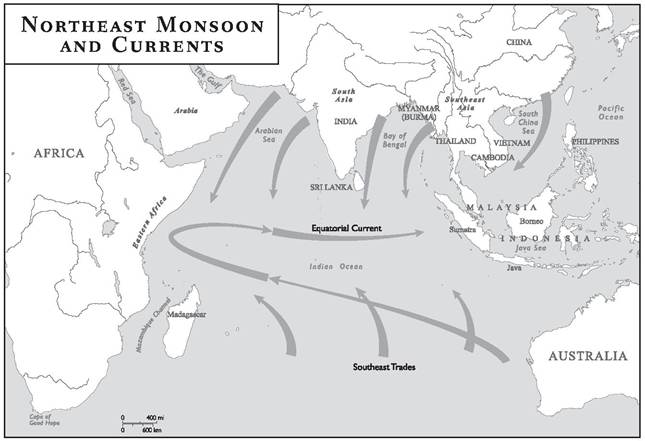
The monsoon, a name that appears in similar form in different languages around the rim of the Indian Ocean from East Africa to Indonesia, refers to both the winds and the seasons that accompany these winds. Their regular, predictable appearance semiannually is what makes them so critical for both sailors and farmers who till the lands that surround the oceanic basin. From November through January high pressure builds up over continental Asia and blows dry winds down from Arabia and western India toward eastern Africa and from China toward Southeast Asia. This Northeast Monsoon is accompanied by surface currents that accelerate the movement of ships from north to south around the entire Indian Ocean region, including in the South China Sea.
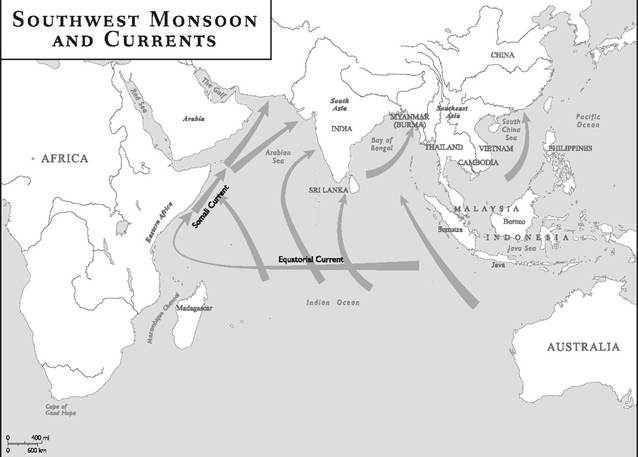
From April into August this process is reversed, as high pressure zones in the southern hemisphere push strong winds toward the north, once again accompanied by currents that complement the monsoon. The Southwest Monsoon also brings heavy rains to the forested regions of South and Southeast Asia upon which its farmers depend. In general, the Southwest Monsoon blows so strongly in June and July that nearly all dhow sailing was interrupted and some ports in western India and western Malaysia simply closed down during these months. At the same
time, even the monsoons could be fickle, as Holden discovered when the dhow on which he sailed was becalmed in the Arabian Sea. “Would the wind ever blow again? You could never tell by looking at the sky. Never knowing when a breeze will stir the sails is the most maddening thing about being becalmed. The never-knowing. One glances at the water— smooth and unruffled; glances at the sails—hanging limply; examines the sky—clear and blue, not a cloud to be seen.”
Finally, to Holden’s great relief, “After three endless days of stagnation, in the pearly light of an early morning, a fresh breeze filled our sails. We moved!”8 Sailing the Indian Ocean, as sailing everywhere, was not all romance. Deep knowledge of the winds and currents, hard repetitive work, and luck all played a part in traveling across its waters.
The discovery of this seasonal dramatic shift in the wind regime that dominates the Indian Ocean was the secret to long-distance travel across the breadth of the region, while the very different environments and natural resources that characterize the lands bordering the ocean gave merchants and sailors reason to exchange goods beyond the immediate confines of coasting. The monsoon system did, however, have its limits. Its effect in the western Indian Ocean reached only as far south as the northern Mozambique Channel, where contrary winds and prevailing currents disrupted the ability of ships to make a complete roundtrip from the coasts of southern Africa and Madagascar in a single year. Likewise, as enclosed seas within the greater Indian Ocean, both the Red Sea—with its prevailing northerly winds from the Gulf of Aqaba to Jidda and its dangerous shoals—and the Gulf—which has its own problems of navigation that include powerful tides—stand at least partially outside the navigational provisions of the monsoons. Similarly, the great distances involved and the regional peculiarities of the monsoons rendered traveling uninterrupted from one extremity of the Indian Ocean world to the other virtually impossible in the era of sail, with South Asia being the obvious location for an intermediary resting point. The existence of several critical choke points that exist within the Indian Ocean also affected travel. Most notably these include the Bab el Mandeb— meaning “Gate of Grief” in Arabic—between the Red Sea and the Gulf of Aden; the Strait of Hormuz, which commands the passage between the Gulf and the Arabian Sea; and the Strait of Melaka, which controlled oceanic movement between the eastern Indian Ocean and the Java Sea, that is, the route linking the Spice Islands and China to the Indian Ocean basin.
In addition, the annual change in the direction of the Equatorial Current influenced how ships sailed the Indian Ocean. During the period of the Northeast Monsoon this current moves west across the Indian Ocean from Australia, skirting across northern Madagascar, and then back in a more northerly stream toward southern Java; during the Southwest Monsoon it runs directly west from Java toward Madagascar and Africa, where it divides both north and south. Although the Equatorial Current was never the preferred way to sail across the Indian Ocean, it may have facilitated Indonesian migration to eastern Africa and Madagascar.
In geological time the current configuration of the Indian Ocean is relatively recent. About fifteen thousand years ago sea levels were some one hundred meters above current levels; ten thousand years ago they were still forty meters above current sea levels. The history explored in this book reaches back perhaps seven thousand years from the present day, when the Indian Ocean attained its current levels. Since then there has been some gradual raising of sea levels and these are now being accelerated by global warming, threatening the very existence of some of the smaller islands in the Indian Ocean, but overall a more or less steady state for this historical period has existed. A rather different environmental feature that has had important effects during this long period is the silting up of certain rivers as a consequence of seasonal flooding, so that over time some seaports became inaccessible from the sea.
To grasp the idea of an Indian Ocean world one needs also to consider the lands that surround the ocean itself. The most meaningful way to do this is to focus on what geographers call the littoral, the coast that links ocean to land. The idea of an Indian Ocean littoral serves as a means to ensure that only those areas of the surrounding land masses that are effectively connected to the Indian Ocean world are included in its history. Geographers suggest one way to determine these linkages is by employing the terms foreland, to designate the overseas communities with which a particular coastal settlement or town interacts; umland, to indicate the immediate mainland with which the town regularly exchanges goods and shares social relations, including marriage; and hinterland, to refer to the mainland zones beyond the umland upon which that settlement draws for its exports and to which its imports are distributed. While the umland will always be circumscribed by the size of the coastal community itself, both the foreland and the hinterland are elastic insofar as both may depend on long-distance trade for its supply of imports and exports. Indeed, relationships based on trade between specific Indian Ocean littorals and hinterlands developed and changed over time.
The basis for any system of exchange is the uneven distribution of both natural and manufactured products. What begins as the simple exchange of local goods produced within different environments, for example, sea salt for agricultural products harvested in the umland, or dried fish in one town for ceramic pots from another, may eventually extend into much wider and deeper forelands and hinterlands. A Tamil poem from south India dating to about two thousand years ago reveals how fishermen produced salt at the coast “where they take fat pearls [salt] from the spreading waves and divide them on the broad shore,” to evaporate the water, while a Tamil love poem recounts how salt production already was an engine for coastal and hinterland exchange:
She is the loving innocent daughter of the salt merchant who goes through mountain passes in summer in his fast bullock cart goading his oxen with a stick, to sell his white grainy salt, made without ploughing in the salt pans, near the seashore with a small settlement of fishermen who hunt the big ocean for fish.9
The Indian Ocean is characterized by many such uneven distributions. To take one example, the desert regions of the Horn of Africa and greater Arabia—the latter rich in dates and pearls, but poor in wood—are flanked by the savannah and forested regions of eastern Africa and western India, both of which have abundant supplies of wood as well as many other desirable goods for exchange, such as ivory from Africa and cotton textiles from India. Similarly, the great attraction of insular Southeast Asia was its precious spices, while China—at the far reaches of the Indian Ocean commercial system—was a major source of silk textiles and other luxury goods. The historical development of these commercial exchanges brought with them in their turn various cultural transformations.
Finally, if the monsoons and currents of the Indian Ocean made it possible to travel across its vastness, and the different products of its surrounding land masses and islands provided a reason to trade such distances, it follows that both people and ideas—ways of thinking and doing—also moved along these watery highways. The inevitable time spent in Indian Ocean ports and on board ships—which themselves formed an essentially male floating society—by sailors, traders, and travelers as they awaited the monsoon encouraged such exchange. Over time these developing social networks nurtured both the evolution of hybrid cultures and cosmopolitan communities. These exchanges and the shifting factors that influenced them form central themes of Indian Ocean history.
One sign of human ingenuity is the varieties of indigenous craft that transported men and their cargoes around and across the Indian Ocean. Before steamships, and today’s massive container ships and tankers, seaworthy boats took a variety of forms that evolved over time. The earliest known and most widespread boats from the Indian Ocean region are dugout canoes, probably powered initially by poling, the simplest form of both riverine and coasting vessel. Paddles and oars undoubtedly evolved not long after, as poling could only propel a dugout in shallow waters. Bark boats were a different kind of small craft that were fashioned from trees along parts of the African coast and insular Southeast Asia. Wood rafts are known from the Gulf of Aden and southeast India, but where there were few or no trees, as on the Arabian Peninsula, other natural materials were utilized to construct early boats. Reed boats sealed with bitumen, a form of naturally occurring asphalt, connected the marshlands of southern Iraq to the Arabian shores of the Gulf from as early as circa 5000 bce. Bladder rafts constructed of inflatable animal skins also existed. While these very different sorts of boats were useful for coasting, none of these small crafts were capable of open sea travel. As larger ships developed, however, and transoceanic voyages linked distant ports together, these smaller boats assumed a new role as lighters to load and unload larger ships where there was no natural harbor and as tugs to guide and sometimes tow big ships that could not navigate by themselves up river deltas or around dangerous shoals.
An early exception to these limitations of size were the large vessels utilized by the ancient Egyptians to sail the Red Sea, although these ships reflect a technology transfer from the Mediterranean and the Nile River rather than from within the Indian Ocean. Most notably there is a panel on the memorial temple to Queen Hatshepsut (r. 1473-58 bce) at Deir el-Bahri, near Luxor, commemorating the Red Sea voyages she sent to the land of Punt on the Eritrean coast that depicts large galleys with both sails and oars, as well as a side-stern rudder-paddle. These boats probably embarked from Wadi Gawasis, on the Red Sea coast of Egypt, where archaeologists have discovered both coils of rope and the remains of cedar planks. However, there is no evidence that they ever ventured beyond the confines of the Red Sea.
In the western Indian Ocean open seafaring was made possible by the evolution of a category of ship called dhows. In fact, this term covers a very broad range of Arab, Indian, and Swahili double-ended keel ships, from small coasting vessels to quite large sea-going ships. Built from the keel up, dhows were carvel-built, that is, planks were laid edge to edge and then sewn together with coir or reed rope, after which they were caulked with bitumen or vegetable matter; no nails were used in construction. The preferred woods used were usually teak or coconut. Deepwater Arab and Indian dhows eventually came to feature construction with a square stern that most scholars believe reflects sixteenth-century Portuguese ship construction, although it is possible that Chinese junk hull design also played a part in this development. Their lateen or roughly triangular sails were set on fore-and-aft, that is, lengthwise from front to back, and were manufactured out of either reed matting or canvas. While lateen sails dominated the open sea shipping of the western Indian Ocean and over to Indonesia, there also existed a type of square-sailed ship in this region. The earliest image of this kind of square-rigged ship is painted on a wall at the Ajanta Caves, a major Buddhist shrine about 200 miles northeast of Mumbai, in western India, that dates to the first half of the sixth century ce. Another example from Mesopotamia of this kind of ship is illustrated in al-Harari’s Maqamat, which dates to 1237 ce. A third variety of square-rigged boat was the Swahili mtepe. The interested tourist can now see a full-scale modern reconstruction of an mtepe in the Zanzibar National Museum. Although these ships used square instead of lateen sails, like dhows they were all constructed with sewn planks.
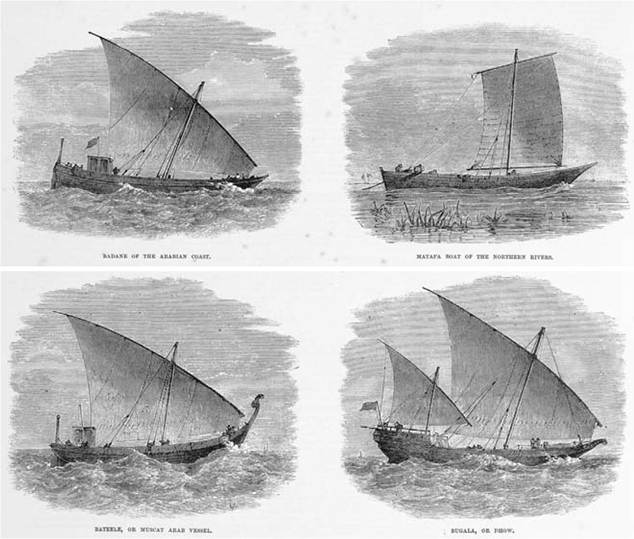
Among depictions of three different dhows with characteristic lateen sails used in the nineteenth-century East African slave trade there also appears a rectangular- sail mtepe, which represents an older type of sail rigging in the Indian Ocean. The original image appeared in the Illustrated London News, March 1, 1873. Courtesy Bodleian Library, University of Oxford
There exists a significant folklore about ships and sailing the sea, an example of which is the poem by the distinguished Swahili poet from Mombasa, Kenya, Ahmed Sheikh Nabhany, written in the traditional heroic utendi form with the specific purpose of recounting how to build an mtepe:
I shall tell you my aim that I have in mind, it is in brief to tell you the story of the ship.
The sambo, you must know, is a vessel built in the past, you must understand, by a prophet, and he was Noah.
The people of the coast imitated this in their yards, building the useful mtepe to carry the cargo.
The mtepe, you must know, was built in Pate by the Bajun folk to enable them to travel.
Daradaki is a tool used in the building, and the fibres of the doum- palm are pressed in to make a tight joint.
It was beautifully built by skilled craftsmen without the use of nails but fastened only with cords.
It was sewn with cord—each plank—without any bulge—every crack being filled so as to leave no space.
The sail was a mat hoisted like an ushumbi-sail and the ropes were of both coir and doum-palm fibres.10
In the eastern Indian Ocean three very different categories of seagoing sailing vessels developed over time: outrigger canoes and their evolved forms in insular Southeast Asia that are generally grouped together under the name of perahus; the Indonesian vessel known as a jong; and Chinese junks in the South China Sea. Like dhow, perahu became a catch-all name for many specific types of outrigger canoe across insular Southeast Asia. Outrigger canoes represent an innovation to improve the stabilization of dugout canoes and, later, larger sewn, edge-to-edge plank canoes. They evolved in insular Southeast Asia into two forms: the double outrigger and the single outrigger. Most authorities agree that the double outrigger is the older form that was pioneered by Austronesian sailors within the closed Java Sea and that the second outrigger was abandoned as they ventured farther out into open seas, where the single outrigger provided greater stability. Early evidence of outriggers on medium-size ships, rather than canoes, can be found in the five bas-reliefs at the world’s largest Buddhist stupa, a mounded structure containing sacred relics, at Borodudur, in central Java, which dates to circa 800 ce. One of the principal pieces of evidence of Austronesian voyages in the Indian Ocean is the distribution of both types of outrigger in Sri Lanka and southern India, along coastal eastern Africa, in the Comoros, and at Madagascar. The same maritime technology also enabled other Austronesian sailors to populate the island world of the Pacific Ocean.
The largest ship of the Indonesian archipelago, which also appears to have evolved from the first millennium on, however, was the jong, which did not have outriggers. Its construction features included dowel (as distinct from sewn) planking, thereby giving greater rigidity to the hull; multiple sheathing of the hull for strength; through boards for additional strength; two side rudders; and unusual rectangular (not lateen) multiple balance lug sails. Both archaeological and Chinese literary sources provide the evidence for the development of the jong, while lug sails and side rudders are also illustrated on the Borobudar reliefs. Like dhows, no iron was used in their construction.
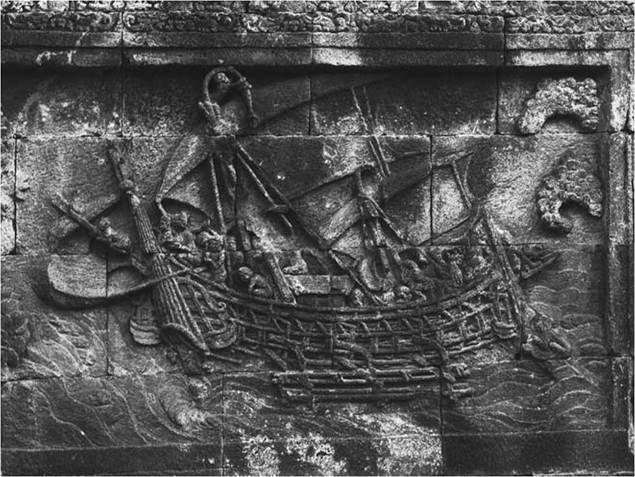
This bas-relief shows that outriggers, square sails, and rear-mounted rudders were all employed on medium-sized ships in insular Southeast Asia. This image is on the port side of the ship at the eighth-century Borobudur stupa in central Java, Indonesia. Mararie, “Ship Relief,” September 18, 2012. Photo courtesy of Marieke Kuijjer
The Chinese junk is a very different model for an ocean-going ship. The name possibly derives from the Indonesian word “jong,” which itself may come from a Chinese word for “floating house.” With origins in the wide, navigable rivers of continental China, ocean-going junks did not begin to appear until late in the first millennium ce.
Junks were flat-bottomed, high-sterned vessels with square bows. Multiple sheathing was common and planks were joined with iron nails and clamps. They utilized two or three masts with lugsails of linen or stiff matting with horizontal battens or strips of wood. The beam of a junk was equal to about one-third the length of the ship and its hull was divided by watertight bulkheads running lengthwise and crosswise. These bulkheads both strengthened the ship and protected it from sinking; they were also valuable for protecting trade goods. As a flat-bottomed boat the junk had no keel, using a steering oar or a single stern-post rudder to stabilize it as it sailed the seas. Of all the premodern ships that sailed the waters of the Indian Ocean, the largest were junks, although their size varied significantly.
One final word about Indian Ocean indigenous shipping concerns the concept of “traditional” culture. While it is true that certain smaller types of boats remained stable right into modern times, so that, for example, simple outrigger canoes can still be seen today along the Mozambique coast, around the Comoros and Madagascar, and in Indonesian lagoons, as well as in the Pacific, larger ocean-going vessels continued to evolve as sailors and shipwrights drew ideas for improvement from other maritime cultures. One example is the technological exchanges implicit in the development of the Indonesian jong and Chinese junk; the arrival of European ships in the Indian Ocean is another, as revealed in the case of the largest Arab and Indian dhows. What is more, the coming of steamships and then motorized boats by no means signaled an immediate end to the viability of these older types of ship.
Just as there were many different types of ships historically, the various sailors of the Indian Ocean world developed and then dispersed different navigational techniques. Understanding the monsoons and currents of the Indian Ocean demanded sophisticated knowledge of the ocean’s geography. Coastal sailing required deep knowledge of the topography of the coast and the landmarks by which one sailed, not to mention shoals, sandbars, and tides. In open waters, navigation by the stars and by the technology of Arab science—like the kamal, constructed of wood and knotted string to measure the height of the North Star— became important, while Austronesian sailors—who did not share in that technology but could expertly read the stars—were equally skilled at reading oceanic waves. For their part, Chinese sailors also developed important navigational skills and instruments—notably the compass— although most of these were acquired from Persian and Arab captains who came to China. Ibn Majid’s Fawa’id is the most important navigational text from this premodern era, but by no means is it the only one. After the European invention of the octant around 1730 for calculating celestial navigation, and the subsequent refinement and first manufacture of the sextant in 1757, the latter instrument was also adapted by some Indian Ocean sailors.
Another way humans sought to master the dimensions of the Indian Ocean was through cartography. In about 150 ce the Greek geographer Ptolemy produced a world map that was a major influence on both European and Arab maps for centuries to come. Ptolemy identified two major bodies of water, the Mediterranean Sea and the Indian Ocean, around which the known land masses were situated. He was also the first mapmaker to use longitudinal and latitudinal lines to help locate map positions, even though these were inaccurate. Although Ptolemy left descriptions of the known world, no copies of the original map exist. Eventually, manuscript copies were found in Europe from about 1300, at the beginning of the European era of global exploration, and printed versions began to appear as early as 1477. Without question Ptolemy’s world map shows that Europe had possessed a basic notion of the countries of the Indian Ocean basin from the late medieval period. However, the discovery in 2000 of a remarkable cosmological treatise known as the Book of Curiosities written by an anonymous Egyptian author sometime between 1020 and 1050 shows that four centuries earlier Arab knowledge of the Indian Ocean world was far superior to that of the West. This astonishing illustrated manuscript includes a rectangular world map that is the first ever to name cities, rather than just regions, among which are included major Indian Ocean ports. A separate Indian Ocean map from the Book of Curiosities provides even greater detail of specific places from China to East Africa, including, for example, the Swahili name for the island of Zanzibar,
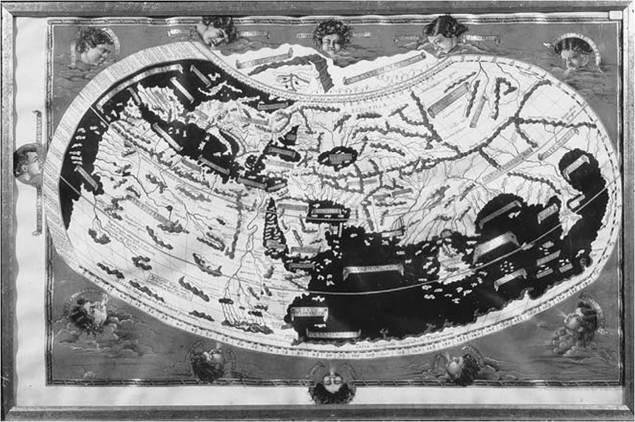
Both the Red Sea and the Gulf appear clearly, if not entirely accurately, in this Renaissance rendering of Ptolemy’s world map by Henrius Martellus Germanus, as do the coastlines around the Arabian Sea. Based on second-century ce knowledge, it shows how Europeans conceptualized the Indian Ocean prior to the Portuguese intrusion at the end of the fifteenth century. Gianni Dagli Orti/The Art Archive at Art Resource, NY, Marine Museum Lisbon
Unguja. Possibly as early as 1389 an unknown Ming cartographer created a world map known as the Da Ming Hun Yi Tu, or Amalgamated Map of the Great Ming Empire, in which Southeast Asia, India, and Africa are represented with varying degrees of accuracy.
Following Portuguese pioneering of the oceanic route around the Cape of Good Hope into the Indian Ocean at the end of the fifteenth century, European knowledge of this vast region increased dramatically. Already a map produced in 1519 by Jorge Reinal shows how quickly the first Portuguese voyages increased Western knowledge of the shape of the Indian Ocean over its representation in Ptolemy’s world map. By the time Flemish cartographer Abraham Ortelius published the first world atlas in 1570, the Indian Ocean appears almost in its modern form. Further refinement came at the end of that century in the 1598 map published by Dutch traveler Jan Huyghen van Linschoten. Advances in scientific navigation gradually made possible more refined projection of positions by latitude and longitude, so that the 1750 map by the French royal cartographer Jacques-Nicholas Bellin comes very close to the appearance of modern maps of the Indian Ocean. The final push to map the entire region and its coastlines was an integral part of the expansion of British imperial power in the nineteenth century, while mapping for undersea resources continues today.
Imagining the Indian Ocean world, then, also involves visualizing how it is mapped, as well as factoring in movement across time and space of people, things, and ideas. It further requires appreciating the significance of the thousands of years of historical change from about 5000 bce to the present that has created a meaningful Indian Ocean world. Weaving these very different perspectives together makes it possible to imagine an Indian Ocean world that makes sense historically and contemporaneously.
More on the topic CHAPTER I Imagining the Indian Ocean:
- Discovering the Red Sea
- 14 Lions, Deer and Hunting Dogs
- You may have a favorite national park, such as Everglades in Florida, Grand Canyon in Arizona, Bialowieski in Poland, or the Great Barrier Reef in Australia.
- 9 I am about to cross the Great Ocean
- Geography and Naming
- Conclusion
- WHY COLONIALISM?