Company Control
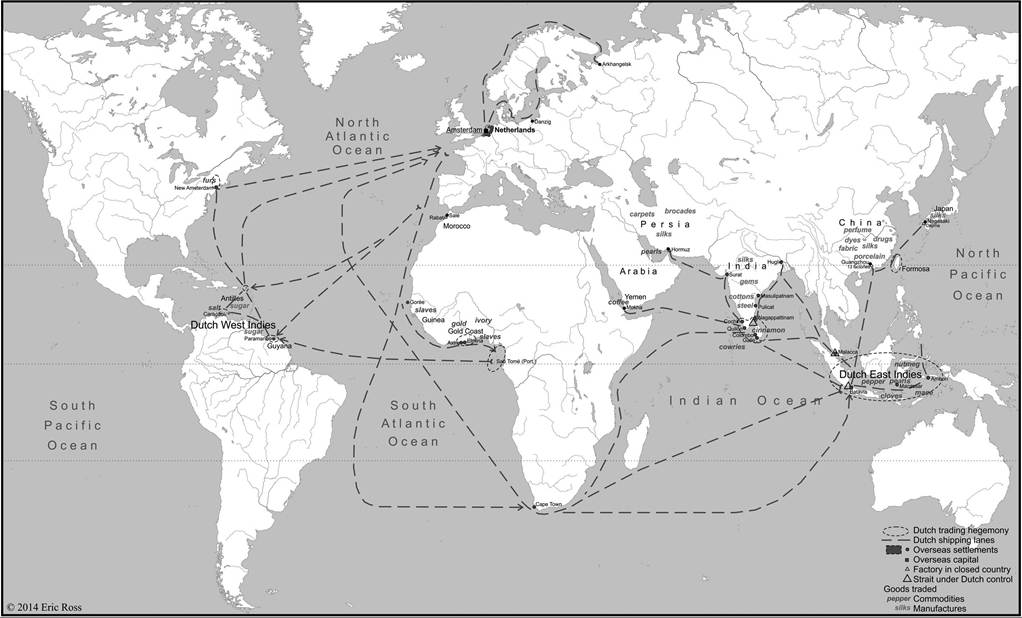
Seventeenth-century visitors were awed by the military and commercial supremacy of the Dutch in the Indonesian Archipelago. With its large fleet and numerous trading factories, the VOC was the greatest maritime power in Asia of that age, overshadowing all of its European and Asian rivals.
The VOC tightly controlled the Spice Islands. It directly governed the coastal regions of Java and Ceylon and indirectly governed the native kingdoms on those islands, respectively Mataram and Kandy. The pacification of the Moluccas in the first half of the seventeenth century was achieved at high cost. It was thereafter continued at great expense with numerous fortresses and garrisons which had to be maintained. The expansion of VOC rule over Java and Ceylon occurred piecemeal over a longer period of time as the Company was gradually pulled into power struggles at the courts of these realms. On Java three protracted wars of succession (1677-1707, 1719-1722, 1749-1755), in which the VOC steadfastly sought to assist those princes whom they deemed to be legitimate pretenders to the throne,
874 LEONARD BLUSSE
Map 31.1. Mercantilist Empire of the Dutch, 1665.
https://ericrossacademic.files.wordpress.com/2015/10/08-dutch-world- 1665.jpg. Copyright: Eric Ross.
gradually brought the northeast coast under direct Company control and ended in the three-way partition of the Mataram kingdom in 1755. On Ceylon a massive revolt against VOC hegemony by the Kingdom of Kandy in 1765 was suppressed after much bloodshed. From then on, the local rural economies of Java and Ceylon thrived and the Company derived great profits from tropical export crops of the region. However, just as the Dutch Republic was suffering under the impact of European conflicts in the course of the eighteenth century, the VOC was also gradually being outdone by its greatest rival, the EIC. The British conquest of Bengal and Coromandel, from 1757 onward, began to severely impact VOC trading operations on the Indian subcontinent.
In the already referred to Histoire philosophique des deux Indes (1770) Labbe Raynal agreed that the political position of the Dutch Republic within Europe had declined, but he still admired the Dutch Republic as a powerhouse of commerce. He warned the Company's directors to stop distributing lavish dividends while profits were declining and exhorted them to return to the prudent policies of their predecessors for fear that their enterprise might go bankrupt. Raynal felt that the periwigged oligarchy of the urban elite he observed had little in common with the frugal, ordinary-dressed Dutch burghers of yore.
His warnings went unheeded. Although the Dutch East India Company eventually went bankrupt owing to the tremendous losses suffered during the fourth Anglo- Dutch war (1780-1784), innate corruption and long-term irresponsible financial policies also contributed to its fall. So it was that contemporary critics offered another explanation for the acronym VOC: Vergaan Onder Corruptie, sunk by corruption.
By the end of the eighteenth century the VOC had turned from a commercial enterprise deriving its greatest profits from the intra-Asian and Asian-European trade into a de facto territorial power exploiting agricultural resources from vast possessions in the Cape of Good Hope, Ceylon, Java, and the Spice islands. After the invasion of the French revolutionary army in 1795, the almost bankrupt VOC was nationalized by the newly formed government of the Bataafse Republiek. Yet the measures that were debated to revive the East Indian trade were all planned in vain, because the once proud overseas empire of the VOC fell into British hands within a few years' time.
More on the topic Company Control:
- STUMBLING DOWN THE AUDIT TRAIL
- Theory of the firm
- Country risk Methodology
- The first of the five phases was by far the longest, lasting roughly three and a half centuries.
- When Crisis Comes to the Newsroom
- 40 The Nordic Indies
- Admitting Evidence into the Proceedings
- European Influence on Indigenous Forms of Ritualised Violence and Sacrifice
- The Open Corporation
- The Delhi Sultanate, the Mogul Empire and the Modern States