Concluding Remarks and Future Research
In this paper, we have described ABS and discussed its application in relation to historical and archaeological literature. We presented a simple model and extreme settings aimed at enhancing understanding of the factors affecting the behavior of the simulation results.
Our results showed that in the case of initial coexistence of a large number of native Jomon people and a small number of immigrants, people with immigrant traits became the majority group a few hundred years later. Based on the simulation results, we offered three conjectures, or new falsifiable hypotheses for further discussion. The first relates to the following hypotheses: the population density of immigrants was high, and only a section of the neighboring native Jomon people made contact with them. Immigrants were polygamous and primarily male. Another conjecture related to the hypothesis that when an agrarian culture diffused among the native Jomon people, it was mostly Jomon people and only a few immigrants who played a formative role in the establishment of an agrarian culture.Regarding the hypothesis that the population density of immigrants was high and that only a section of the neighboring native Jomon people made contact with them, there is no archaeological evidence that indicates the existence of an immigrant-only colony (Fujio 1999; Nakahashi and Iizuka 1998). However, our results relating to this hypothesis could be explained by an extremely low population density of Jomon people at the time that resulted in immigrant settlements
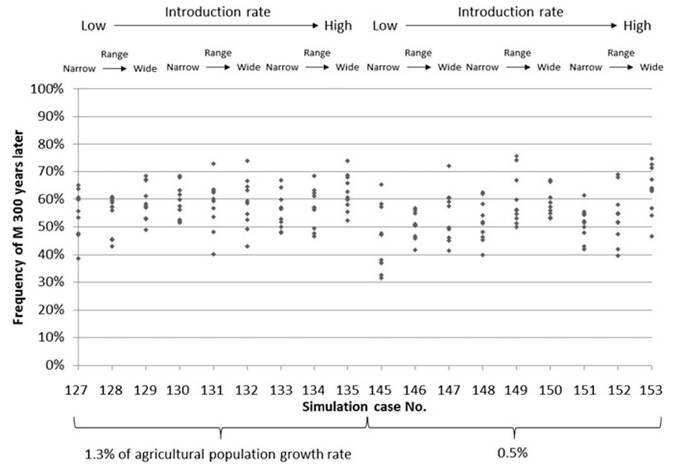
Fig. 10.12 Frequencies of macrohaplogroup M after 300 years in cases with equal numbers of males and females
(Kataoka and Iizuka 2006). There is also the possibility that the Jomon population significantly decreased, as evidenced by the small number of remains of the late Jomon period (Koyama 1984).
The discovery of bone remains of people with Jomon traits, along with artifacts verifying the existence of an agrarian culture, could support the hypothesis that when agriculture diffused among native Jomon people, it was mostly Jomon people and a few immigrants who played a formative role in the establishment of an agrarian culture. In fact, although agricultural artifacts have not been found, human bone remains characteristic of Jomon people were discovered in a Korean-style tomb at the Otomo site in Northern Kyushu.
Our simulation results indicate that mostly Jomon people and a few immigrants played a formative role in the establishment of an agrarian culture during the Yayoi period. This finding shows that within a context in which even a small number of immigrants generated demographic transition (Nakahashi and Iizuka 1998, 2008), the idea that agricultural society was a collaborative process initiated by both Jomon people and immigrants making up a living population (Fujio 1999) is highly plausible.
The hypotheses examined in this study have only offered some probabilities. The results of our simulation were generated through the application of a model based on several assumptions, with some of the simulation parameters based on those of Nakahashi and Iizuka (1998, 2008). These include the following: pottery was
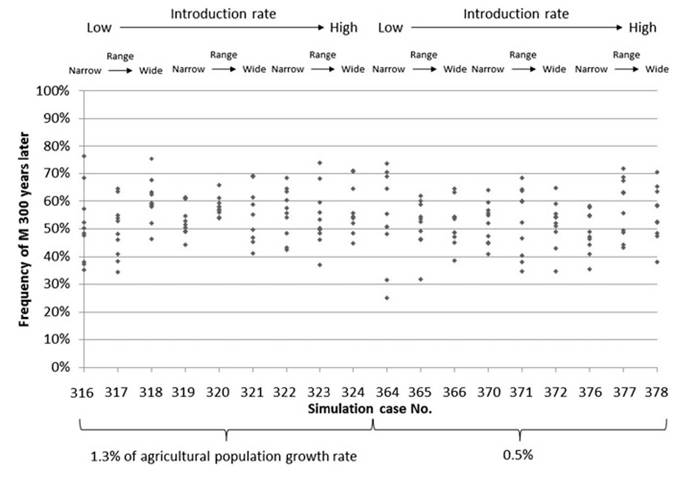
Fig. 10.13 Frequencies of macrohaplogroup M after 300 years in cases with more males than females
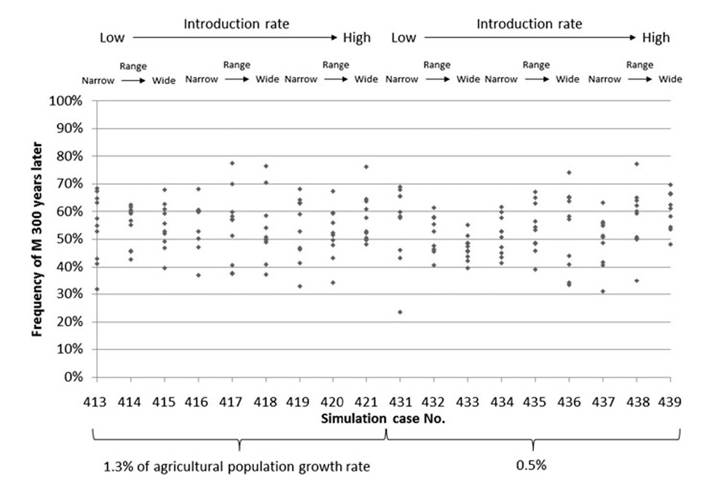
inherited matrilineally, monogamy was the marriage institution within Jomon society, polygamy necessitated highly productive agriculture, and cultural transmission was based on a very simple pattern vis-à-vis the SI model of infectious diseases. These results could change if we employed different assumptions. These assumptions require further discussion as future issues.
In the near future, some assumptions will be clarified through the analysis of ancient DNA. Specifically, an analysis of the diversity of Y chromosomes (paternally inherited) and mitochondrial DNA (maternally inherited) from human remains within a settlement will answer the question of whether the marriage institution within Jomon society was monogamy, polygamy, or polyandry. Additionally, the percentage of immigrants after 300 years, a prerequisite of our simulation, relied on the results of Nakahashi and Iizuka (1998). Therefore, any variation of the discriminant used in their study would require a different interpretation of the results of our study. It should be noted that demographic transition may also be caused by plague and war in addition to differing population growth rates. However, because there is no archaeological evidence to support these events (Nakahashi and Iizuka 1998), they were not considered in our simulation model.The first objective of this study was to explore new simulation cases that matched the archeological evidence, and to investigate their underlying processes. Therefore, this paper does not include a detailed discussion of the validation work related to the exploration of the parameters. However, to investigate which conditions accord with archaeological evidence, further parameter tuning should be performed. These include developing regression trees with a random forests algorithm that could uncover which variables are more or less important, as well as Bayesian approximation methods that could isolate relevant parameter combinations. We have also proposed the pattern-oriented inverse simulation method in another history simulation study of ancient Chinese empires, which uses advanced evolutionary algorithms and high performance computation techniques (Yang et al. 2012). These methods are promising in terms of strengthening the application of our ABM approach to historical studies. The application of these advanced techniques offers considerable challenges to be addressed in our future work.
In conclusion, we believe that the ABS model and results of this study are widely applicable beyond the time frame and region of our investigation. The present study engages with the universal theme of population dynamics that unfolded after the introduction of agrarian culture. Furthermore, this study is the first to apply ABS to this anthropological and archeological issue in Japan. Within Japanese anthropology and archaeology, it is difficult to apply the ABS developed in famous pioneering studies on factors relating to the residential transition of the Anasazi tribe (Dean et al. 2000). For most anthropological and archaeological studies in Japan, the required data, especially paleo-environmental records, are not widely available as for these studies. However, even if there are less data available, as for the current study, ABS is able to compensate for this paucity of data. Therefore, it has the potential to become a powerful tool within Japanese anthropology and archaeology.
More on the topic Concluding Remarks and Future Research:
- Concluding Remarks and Future Directions
- CONCLUDING REMARKS
- CONCLUDING REMARKS
- Concluding remarks
- Concluding remarks
- CONCLUDING REMARKS
- Concluding remarks
- Concluding remarks
- Concluding remarks
- Concluding remarks
- CONCLUDING REMARKS
- CONCLUDING REMARKS
- CONCLUDING REMARKS