Results and Discussion
Of the 441 simulated cases, 111 demonstrated that more than 80 % of people exhibited immigrant traits after 300 years (steps). In the case of the representative example of a simple increase of calculation provided by Nakahashi and lizuka (1998), based on the assumption that numbers of Jomon people and immigrants increased separately without random mating and cultural exchange occurring between them, 78.9 % of people had immigrant traits.
This case did not include random mating and cultural exchange between native Jomon people and immigrants. The simulation result was very similar to the numerical calculations of Nakahashi and Iizuka (1998) based on the same population growth rate. Therefore, the result showed that the calculation of our simulation model was consistent with that of the mathematical model and that the initial absolute number of agents was appropriate.In the following sections, we refer to differing results for cases relating to the spatial placement of the initial immigrants, the marriage institution, speed of the diffusion of agriculture, and sex ratio. Consequently, we only describe the results of cases combining inheritance of the food production system from the mother and 100 % determination of JT mixed individuals as those with immigrant traits.
10.4.1 Spatial Placement of the First Immigrants
In cases where both the initial Jomon people and immigrants were uniformly randomly placed, less than 80 % of people had immigrant traits. This could be used as a measure of demographic transition (Figs. 10.1 and 10.2). A summary of the results for cases combining a 1.3 % agricultural population growth rate and a dispersed distribution of the spatial placement of the initial Jomon people and immigrants is presented in Fig. 10.1. Considering other simulation results, even if these were each run 10 times, the stochasticity would not significantly change the ratio of people with immigrant traits after 300 years and we would observe less than 80 %.
In general, cases in which the speed of the diffusion of agrarian culture was slow (e.g., a narrow [one cell] range of diffusion cells and a difficult introduction rate
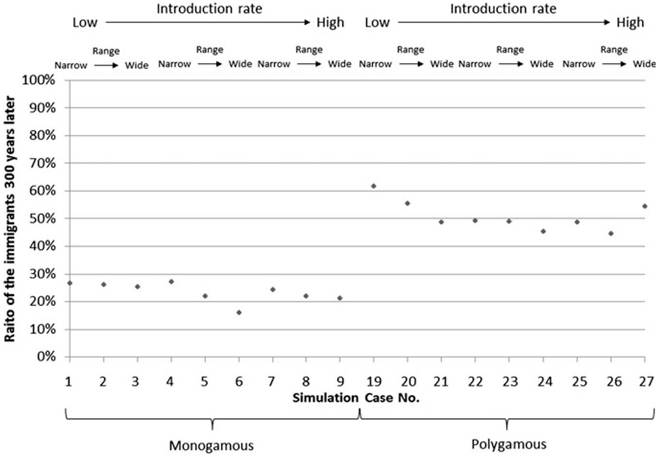
Fig. 10.1 Percentages of people with immigrant traits after 300 years in cases combining dispersed distribution, a 1.3 % agricultural population growth rate, and equal numbers of males and females
[0.1 %]) indicated a higher ratio of people with immigrant traits. Conversely, cases in which the speed of the diffusion of agrarian culture was rapid (e.g., a wide [five cells] range of diffusion cells and an easy introduction rate [1 %]) indicated a lower ratio of people with immigrant traits.
Some cases indicated the dense distribution of immigrants, with 80 % of people exhibiting immigrant traits 300 years later. This served as a measure of the demographic transition (Figs. 10.3 and 10.4). The immigrants in these cases were all polygamous. We elaborate on these cases in the following sections.
Demographic transition did not occur in cases where both the initial Jomon people and immigrants were uniformly randomly placed because there were many points of diffusion of agrarian culture. During an early stage, agrarian culture diffused among the native Jomon people and there was a high rate of increase of agriculturalists within the Jomon population. Therefore, even when the population growth rate of agriculturalists differed, the same result was obtained (Figs. 10.3 and 10.4). To generate demographic transition in which people with immigrant traits reached 80 % 300 years later, our results show that population densities of immigrants were probably high and that only a section of the neighboring native Jomon population made contact with them.
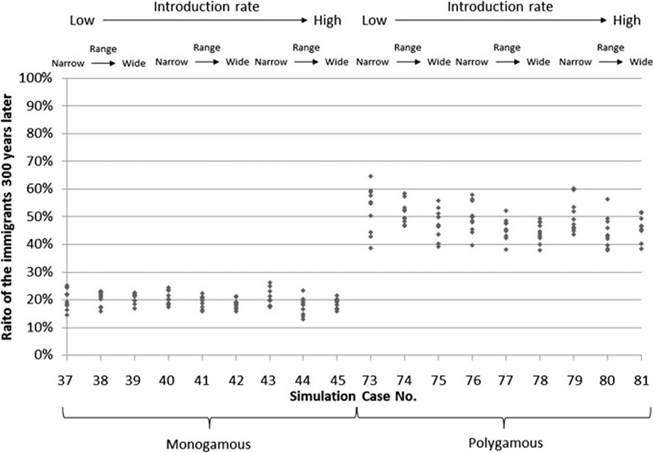
Fig. 10.2 Percentages of people with immigrant traits after 300 years in cases combining dispersed distribution, a 0.5 % agricultural population growth rate, and equal numbers of males and females
10.4.2 Marriage Institution and Speed of Agricultural Diffusion
10.4.2.1 Cases of Monogamous Marriage and Diffusion
from Neighboring Agents
For cases combining dense distribution of immigrants, monogamous marriage, and the diffusion of agriculture from neighboring agents, the percentage of people with immigrant traits, 300 years later, was below the 80 % figure that indicated demographic transition (Figs.
10.3 and 10.4). The reason is the same as that described earlier. Once an agrarian culture had diffused among native Jomon people at an early stage, their population increased at the high rate of agricultural population growth. Therefore, cases entailing the slow diffusion of agrarian culture also indicated a high ratio of people with immigrant traits, while cases entailing the rapid diffusion of agrarian culture evidenced a low ratio of people with immigrant traits. Considering these results, even if we assume that preferential marriage occurred within the population, because the agrarian culture was diffused among native Jomon people, when the trait gene was diffused only within the population, demographic transition would not have occurred.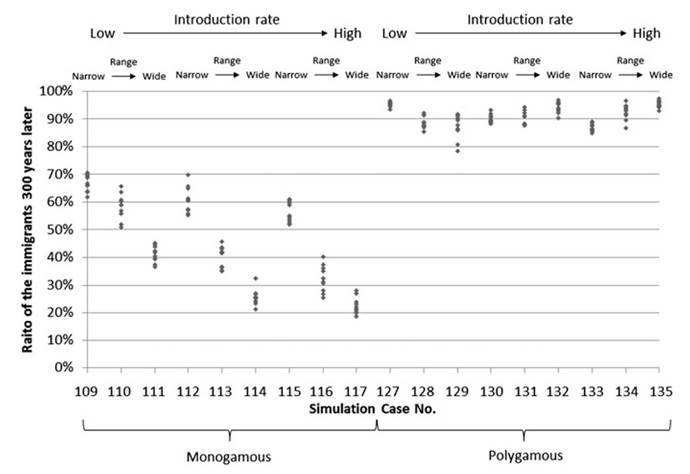
Fig. 10.3 Percentages of people with the immigrant traits after 300 years in cases combining dense distribution, a 1.3 % agricultural population growth rate, and equal numbers of males and females
10.4.2.2 Polygamous Marriage and Exclusive Inheritance
from a Parent Agent
There were cases entailing polygamous immigrants and inheritance of the agrarian culture from only a parent agent (not diffused from a neighboring agent). Even with a lower growth rate (0.5 %) of the agriculturalist population, in some cases of immigrants reached the 80 % 300 years later (Fig. 10.4, No. 194). If the initial immigrants were polygamous, demographic transition would be probable. Additionally, considering these results, even if the population growth rate of agriculturalists was low (0.5 %), it would be sufficient to infer that demographic transition had occurred. That is, demographic transition in which people with immigrant traits came to constitute the majority a few hundred years later could occur through the diffusion of the trait gene within polygamous marriage, assuming the low population growth rate of agriculturalists. Given that agricultural technology had not attained maturity at this time, a 1.3 % agriculturalist population growth rate may be considered too high.
Therefore, these results indicate high consistency for demographic transition even with a low growth rate of the agricultural population. Additionally, as described above, if we accept the hypothesis that the inception of the Yayoi period was 500 years earlier than commonly thought, even the lower rate of population growth could generate demographic transition.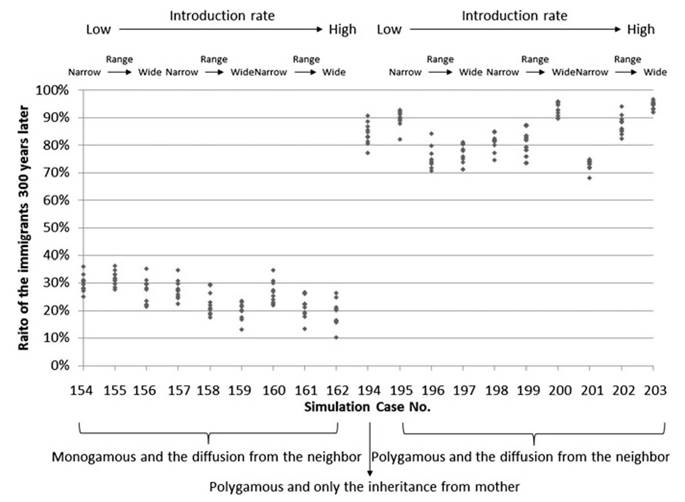
Fig. 10.4 Percentages of people with immigrant traits after 300 years in cases combining dense distribution, a 0.5 % agricultural population growth rate, and equal numbers of males and females
However, in these cases, the diffusion rate of the agrarian culture was very low (about 25 %) after 300 years, because the agrarian culture was only inherited from either the father or mother. Moreover, the composition ratio of descendants of these agriculturalists consisted of immigrants or both immigrants and Jomon people. These cases suggest, as our first hypothesis, that immigrants played a formative role in the establishment of agrarian culture.
10.4.2.3 Polygamous Marriage and Diffusion from Neighboring
Agents
We now turn to cases entailing polygamous immigrants and agriculture that was not only inherited from a parent agent, but also diffused from neighboring agents. In such cases, the percentage of people with immigrant traits after 300 years varied depending on the speed of the diffusion of agrarian culture. When the population growth rate of agriculturalists was 0.5 % (the lower rate), some cases of slow-speed diffusion of agrarian culture did not attain the 80 % figure for people with immigrant traits after 300 years (Fig. 10.4). By contrast, cases demonstrating a significant speed of agrarian culture diffusion evidenced 80 % of the population with immigrant traits after 300 years. When the population growth rate of the agriculturalists was 1.3 % (the higher rate), regardless of the speed of the agrarian culture diffusion, 80 % of individuals in all cases evidenced immigrant traits after 300 years (Fig.
10.3). Nevertheless, the rapid speed of the diffusion of agrarian culture exceeded the percentage of people with immigrant traits 300 years later.These results demonstrate that in cases in which polygamous marriage was combined with the diffusion of agriculture, demographic transition was facilitated by the wider diffusion of agrarian culture. This could be attributed to a time lag between the diffusion of agrarian culture and polygamous marriage, which influenced the increasing populations of Jomon people and immigrants. Specifically, the density distribution of immigrants meant that the number of immigrants increased during the earliest stage, and that in this process, the agrarian culture diffused among the Jomon people. However, polygamous marriage remained an immigrant trait because it was inherited from fathers. Consequently, the neighboring Jomon people came to possess an agrarian culture. Furthermore, in a situation in which immigrant neighbors, engaged in an agrarian culture, displayed a higher population growth rate, the immigrant trait gene type was diffused through polygamous marriage. That is, for wider diffusion of the immigrant trait gene type to occur, it was necessary for immigrant neighbors to demonstrate an agrarian culture and a higher population growth rate.
The composition ratio of descendants of those practicing an agrarian culture showed a slight degree of mixing of Jomon people and immigrants in cases that entailed slow diffusion of the agrarian culture at the early stage. Both groups of descendants thus came to account for most of those engaged in an agrarian culture by marriage (Fig. 10.5). These results suggest, as our second hypothesis, that immigrants played a formative role in the establishment of agrarian culture.
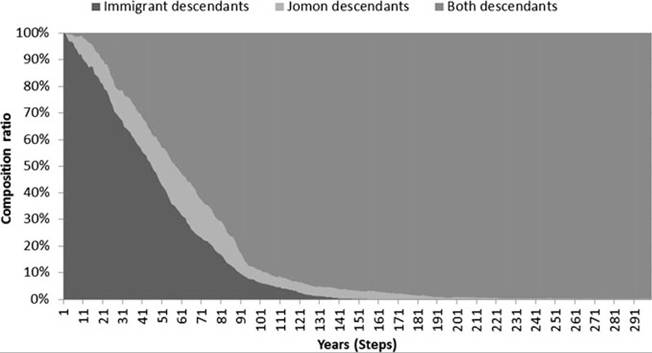
Fig. 10.5 Composition ratio of agrarian culture holders (No. 196)
In contrast, for cases demonstrating significant and rapid diffusion of the agrarian culture, and demographic transition, at the earliest stage, only the descendants of immigrants were the holders of the agrarian culture.
However, shortly thereafter, Jomon descendants constituted the majority (Fig. 10.6). Consequently, both immigrant and Jomon descendants became the majority group through marriage. These results indicate that it is probable that even if the agrarian culture was widely diffused among the Jomon people, demographic transition could occur. These results suggest, as our third hypothesis, that Jomon people played a formative role in the establishment of agrarian culture.10.4.3 Sex Ratio of Initial Immigrants
In general, cases involving primarily male immigrants demonstrated a slightly higher ratio of individuals with immigrant traits after 300 years than cases with equal numbers of males and females (Fig. 10.3 Nos. 127-135, Fig. 10.4 Nos. 195-203, Figs. 10.7 and 10.8). This was irrespective of the population growth rate of agriculturalists and the inheritance of agriculture either from the father or mother. However, regarding immigrant-style pottery, cases in which immigrants were primarily male after 300 years showed a lower ratio (Figs. 10.9, 10.10, and 10.11). Conversely, these results showed that even if the number of female immigrants was small, immigrant-style pottery predominated after 300 years. In our simulation study, we only considered the vertical transmission of a pottery style. Had we also considered horizontal transmission, the diffusion of the immigrant-style pottery
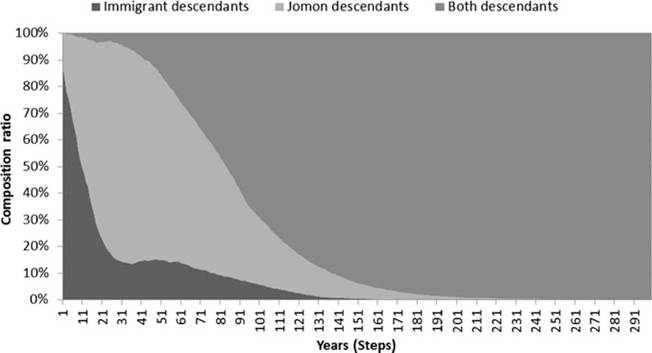
Fig. 10.6 Composition ratio of agrarian culture holders (No. 203)
would, in this case, have evidenced wider distribution than was indicated in our study. This would have more closely approximated the actual situation.
Moreover, regarding the frequency of the mtDNA macrohaplogroup, we found no clear difference between cases in which immigrants were primarily male and cases entailing equal numbers of males and females (Figs. 10.12, 10.13, and 10.14). The reason for this result was that the frequency of the mtDNA macrohaplogroup was largely influenced by random genetic drift. Conversely, these results show that when the immigrants were primarily male, the haplogroup frequency of the maternal mtDNA could significantly change. Our results indicate that even when the number of female immigrants was one-tenth that of female Jomon people, the frequency of the mtDNA macrohaplogroup changed significantly when the number of immigrants increased.
Based on these findings, it is evident that our simulation did not provide clear results regarding the sex ratio of the initial immigrants. On the one hand, when we examine the simulation results for the percentage of people with immigrant traits after 300 years, our results support the hypothesis that the immigrants were primarily male. On the other hand, when we examine the simulation results regarding the prevalence of immigrant-style pottery after 300 years, our results do not support the hypothesis that the immigrants were primarily male.
However, we only considered the vertical spread of the pottery style through inheritance from the mother. We did not consider the horizontal spread of a pottery
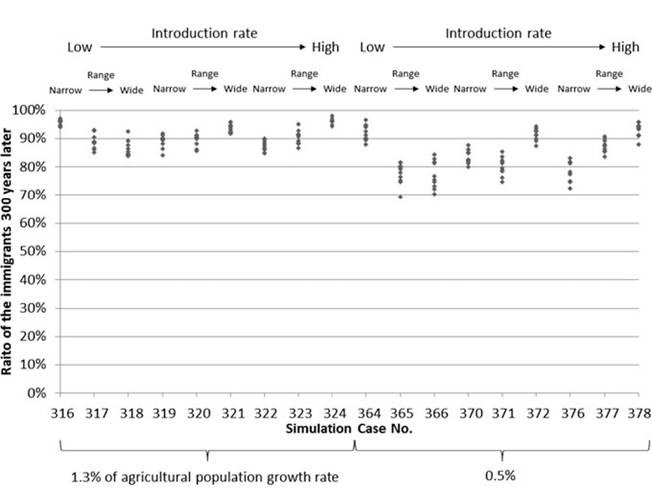
Fig. 10.7 Percentages of people with immigrant traits after 300 years in cases with more males than females
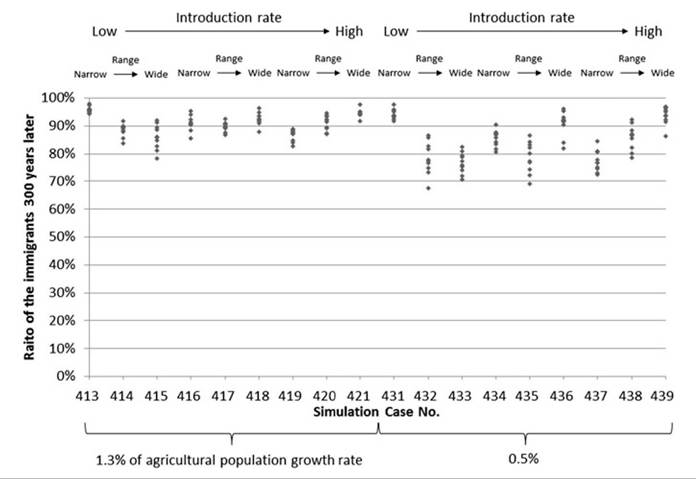
Fig. 10.8 Percentages of people with immigrant traits after 300 years in cases with a majority of males
style through diffusion from neighbors. Therefore, considering only the vertical spread of a pottery style in our simulation model led to a clear finding of a higher ratio of immigrant-style pottery 300 years later compared with the model described in our study. Much remains unknown regarding the manner of diffusion of a pottery style. Thus, our simulation model was inadequate in this regard, leaving room for improvement.
Therefore, considering the other more conclusive findings, our simulation results support the hypothesis that the immigrants were primarily male.
10.4.4 Who Played a Formative Role in the Establishment of Agrarian Cultures?
We now return to the problem of who played a formative role in the establishment of agrarian cultures during the Yayoi period. We simulated a situation initially entailing the coexistence of a large number of native Jomon people and a small number of immigrants, and the subsequent predominance of people with immigrant traits who accounted for 80 % of the total population a few hundred years later. The results of our simulation indicated the three probable cases described above. In the first, immigrants were polygamous and the agrarian culture was only inherited from
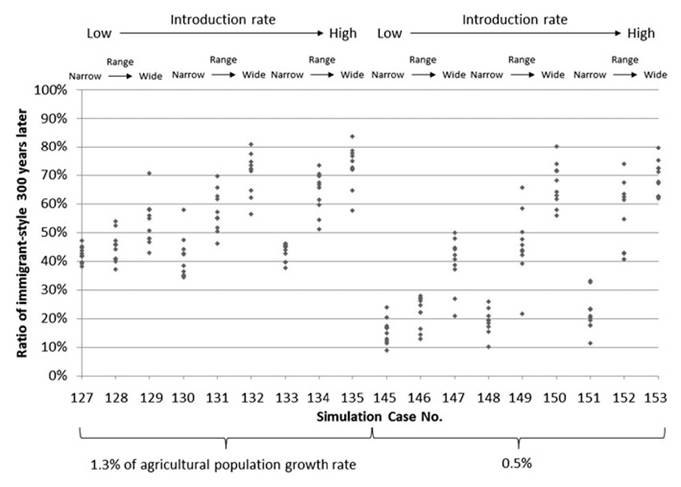
Fig. 10.9 Percentages of immigrant-style pottery after 300 years in cases with equal numbers of males and females
a parent agent (not diffused from neighboring agents). In this case, the descendants of agriculturalists at an early stage were either immigrants or both immigrants and Jomon people. Thus, immigrants played a formative role in the establishment of an agrarian culture. In the second case, immigrants were polygamous and the agrarian culture was inherited from a parent agent as well as diffused from neighboring agents. However, the diffusion of the agrarian culture occurred slowly. In this case, the descendants of the agriculturalists at an early stage were mostly immigrants with few Jomon people. As in the first case, immigrants played a formative role in the establishment of an agrarian culture. In the last case, the diffusion of the agrarian culture was significantly more rapid. In this case, the majority of descendants of agriculturalists were immigrants at the earliest stage, but shortly thereafter, Jomon descendants were evident during a subsequent early stage. Here, mostly Jomon people and a few immigrants played a formative role in the establishment of an agrarian culture.
Of these three probable cases, the last is the most consistent with anthropological and archaeological evidence for the following reasons. In the first case, the diffusion rate of agriculture was too low. Considering that the diffusion of agrarian culture began in the North Kyushu region, it is implausible to assume that the diffusion ratio at the place of origin of agriculture in Japan was low. Comparing the second and third cases, even when the population growth rate of agriculturalists was high, the rapid speed of diffusion of the agrarian culture was higher in the percentage of
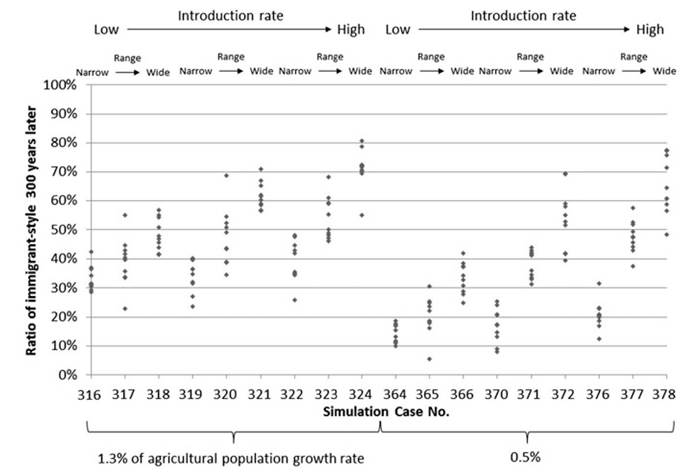
Fig. 10.10 Percentages of immigrant-style pottery after 300 years in cases with more males than females
people with immigrant traits after 300 years. When the population growth rate of agriculturalists was low, some of the cases demonstrating slow diffusion of the agrarian culture did not attain the 80 % figure in relation to immigrants after 300 years. As previously mentioned, considering that agricultural technology had not reached maturity at that time, the 1.3 % population growth rate of agriculturalists may have been too high. Therefore, the highest consistency occurred regarding cases in which even a lower population growth rate could generate demographic transition through rapid diffusion of the agrarian culture. Additionally, our investigation of immigrant-style pottery after 300 years revealed that the number of cases of rapid diffusion of agrarian culture exceeded that of cases demonstrating slow diffusion (Figs. 10.9, 10.10, and 10.11). However, in relation to immigrant-style pottery after 300 years, there were slightly fewer cases in which immigrants were primarily male (Fig. 10.3 No. 127-135, Fig. 10.4 No. 195-203, Fig. 10.7, and Fig. 10.8). However, of note is the finding that even when only inheritance of pottery style from the mother was considered, and the number of female immigrants was small, our simulation results indicated the predominance of immigrant-style pottery after 300 years.
Thus, our simulation results are consistent with anthropological and archaeological evidence that people with immigrant traits became the majority. In cases of rapid diffusion of agrarian culture, even if immigrant males constituted a majority and females were a minority, the immigrant-style pottery prevailed.
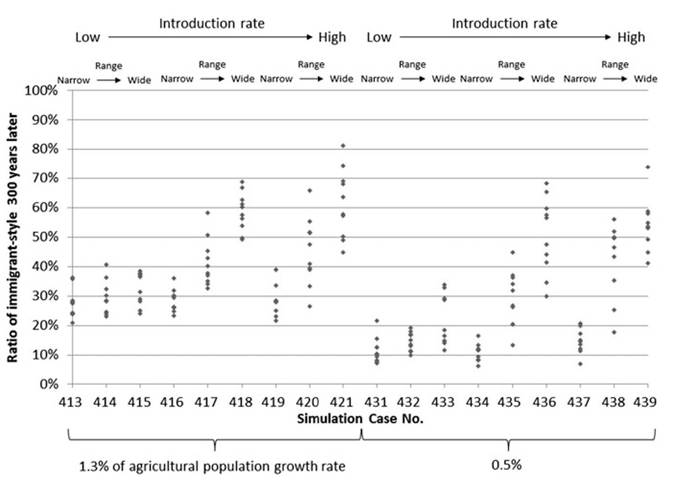
Fig. 10.11 Percentages of immigrant-style pottery after 300 years in cases with a majority of males
10.5
More on the topic Results and Discussion:
- The Netherlands and the UK: The Witteveen Reports and their contradictory results
- Opponents of Triple Talaq Law and Their Claims
- Comparability across People and Dimensions
- Risks and sources of policy failure
- Rhode to Croghan
- Shari'ah and custom in the formative period
- REVIEW OF FORENSIC ASSESSMENT INSTRUMENTS
- FIVE COMPONENTS OF LEGAL COMPETENCIES
- THEORETICAL CONSIDERATIONS
- The Danish colonial project on the Gold Coast