A Dynasty of Righteous Persecutors
In order to understand the calamity that befell foreigners in Constantinople in 1182, it is useful to review the earlier commingling of political, juridical and religious forms of power under the empire's rulers.
During antiquity, the Roman empire had employed the promise of citizenship as a means by which to establish territorial control and achieve the cultural and political incorporation of the subjugated, granting full citizenship in 212 to all free men within the empire. After the conversion of Constantine I and the adoption of Christianity as the state's official religion by Theodosius I in the fourth century, Romanisation became interdependent with Christianisation. Imperial rule was interpreted as a benevolent mission extending to the ends of the earth and lasting for all human time: first, to civilise and enlighten the nations; and second, to protect the growing community of the faithful.[537]The problem was a lack of consensus over what precisely the Christian faithful believed. In the imperial capital, one observer commented, ‘everything' was ‘taken up' by ‘discussions: the alleyways, the marketplaces, the broad avenues and the city streets'. Ordinary people did not hesitate to pronounce on doctrine:
If you try and change money, someone will philosophise to you about the Begotten and Unbegotten. If you inquire about the price of bread, the reply comes: ‘The Father is greater and the Son is a dependent.' If you should ask: ‘Is the bath prepared?', someone will reply, ‘The Son was created from non- being.'[538]
Over time, as state authority gathered momentum, freewheeling curiosity regarding doctrinal matters was increasingly identified as disruptive, and theological discussion became limited to certain classes of believers. Despite resistance from congregations - expressed in cries to ‘Cast out the edict! Nobody believes by an edict!'- the concepts of orthodoxy and heresy were incorporated in imperial legislation, and enforced via prosecution and sentencing in the courts.
The authority of the state in religious affairs, and the role of the emperor himself as supreme arbiter and guardian of orthodoxy, became established as axiomatic.[539]It is possible to identify periods during which imperial intervention intensified. In the fourth century, Constantine I convened councils that defined the emerging religion of the state. In the sixth, Justinian I instituted legislation by which believers who did not adhere to the faith as recognised by the emperor could be marginalised. In the ninth, Theodora and her son Michael III oversaw the creation of an official register of heresies and heretics, in what was subsequently referred to as the ‘Triumph of Orthodoxy': the condemnation of earlier iconoclastic policies and the reinstatement of the veneration of icons.[540]
Modelling himself upon these predecessors, Alexios I Komnenos (10811118) promoted himself as the primary overseer and arbiter of doctrine, commissioning the compilation of a substantial treatise from a trusted monk, Eugenios Zigabenos, under the title Dogmatic Panoply (Panoplia dogmatike). The work contained a sequence of three of illustrations emphasising Alexios' decisive role in the process of textual production. The emperor was depicted receiving the writings of the Church Fathers directly from them, then in turn offering the book that resulted from the study of these texts to Christ, who responded by praising him for making the fruits of his learning concrete through government, and by instructing him to continue to reign in the same manner (Figures 14.1-14.3).[541] [542] [543]
The treatise dealt primarily with actions it portrayed the emperor as having taken to expurgate certain errors that had appeared during his reign. Its claims are borne out by surviving court records, which indicate that the emperor initiated extensive legal proceedings against heretics - proceedings in which he ordered interrogations, oversaw the formulation of charges, selected the tribunals to hear cases at the palace, and even controlled the pronouncement of judgement and subsequent sentencing.11 The existence of a policy of heresy trials is also confirmed by bulletins, pamphlets and other ephemera, intended for circulation throughout the empire, that publicised and interpreted the outcome of individual cases.
These materials promoted the notion of an ongoing struggle, of critical importance to the survival of the faith, in which cruelty and bloodshed were not merely permissible, but righteous. Announcing that the emperor had ‘recently' overseen the conviction and punishment of a ‘heresiarch', one typical religious tract sponsored by the regime celebrated the news that the ‘head of the serpent' had been destroyed, declaring that the ‘other parts' awaited ‘day by day' a similar fate. It concluded by assuring imperial citizens that ‘not even the tail' would ‘escape the due search of the most God-loving emperor', who could be counted upon to catch all the heretics ‘in his hunting 12 nets'.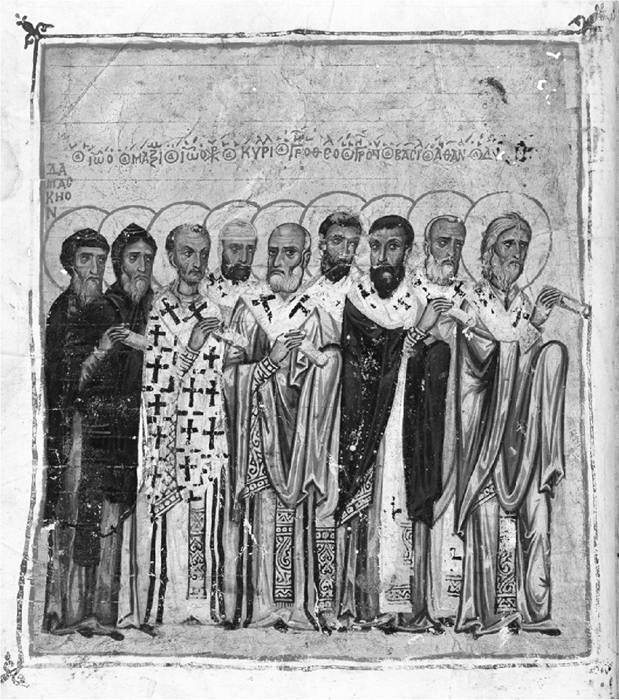
Figure 14.i Vatican City, Codex Vaticanus Graecus 666, eleventh-twelfth century, fo. iv. Illustration in the front of the presentation copy of the Dogmatic Panoply, a work against heresy commissioned by Emperor Alexios Komnenos from his courtier, the monk Eugenios Zigabenos. The assembled Church Fathers entrust their writings to the emperor.
More on the topic A Dynasty of Righteous Persecutors:
- A SEEING NO SHARIA IN AMERICA— (SELF-RIGHTEOUS) IGNORANCE UBER ALLES?
- The Ming Dynasty, 1368-1644
- Selling a Dynasty
- Protecting the Dynasty
- The Tang Dynasty (618-907)
- The Askia Dynasty
- The February 1917 Revolution swept away the Romanov dynasty
- The Song Dynasty (960-1279)
- The Zhou Dynasty and the Early Textual Traditions
- The Mongols and the Yuan Dynasty (1279-1368)