Protecting the Dynasty
Despite enduring stereotypes about China's lack of a military tradition or force's marginal role in East Asia foreign relations, the Ming state, like its predecessors and successors, never doubted the critical importance of armies, armaments, generalship, logistics, or the efficacy of coercive force.
The Ming dynasty's military is thought to have ranged between one and two million men, organized into roughly 300 garrisons (each staffed in theory by 5,600 soldiers).[1404] Concentrated most heavily around the capital and along the northern border, they extended throughout the empire. As one would expect in a large, diverse polity like the Ming, military institutions varied considerably according to time and place. During the early Ming, hereditary households responsible for providing an able-bodied male for military service each generation formed the core of imperial armies, which were to support themselves through farming on state-provided lands.[1405] However, by the late fifteenth century, in the face of changing military needs and socioeconomic developments (most notably greater commercialization of the economy, monetization of tax and labor obligations, and shifting land tenure patterns), mercenaries, militias, and tributary forces grew increasingly important.[1406] Ming forces fought in many theaters, each with its particular logistical demands, from the unforgiving, arid borderlands of the north, the often mountainous, semi-tropical jungles of the south, the open seas, winding coastal line, and complex river systems of the eastern seaboard, the distant wind-swept plains and mountain ranges of the west, and a nearly infinite variety of environments in between.[1407] Ming forces ranged from contingents of a few hundred men to vast hosts of several hundred thousand troops. They engaged in conflicts that lasted anywhere from a few days or weeks to months or years. They fought Mongolian and Jurchen cavalry, royal regulars and guerrilla forces from Dai Viet (today's northern Vietnam), sea marauders, mounted warriors from the Islamic Moghul khanate in Central Asia, large-scale Japanese forces armed with long swords and the newest firearms adopted from Portugal, and a wide array of domestic foes that fought on horseback and on foot, on land and on sea, on the plains and in the mountains.[1408]In a word, the Ming dynasty resembled most other empires in that it faced a variety of military challenges and logistical demands on a regular basis and maintained a correspondingly large and diversified set of military forces and institutions that responded to shifting demands and changing socioeconomic circumstances. The dynasty devoted substantial economic resources to the military (2.6 million taels of silver per annum in 1578 according to the Ministry of Revenue), supplying increasing levels of direct financial support for border garrisons (no less than two million ounces of silver each year during the dynasty's final century), subsidizing the transport of grain from the hinterlands to arid border areas of limited agricultural productivity, and issuing bonuses (“gifts from the emperor”) to boost soldiers' morale during crises.[1409] Major campaigns accelerated spending, but overall levels seem less than those of western Europe at the time.[1410]
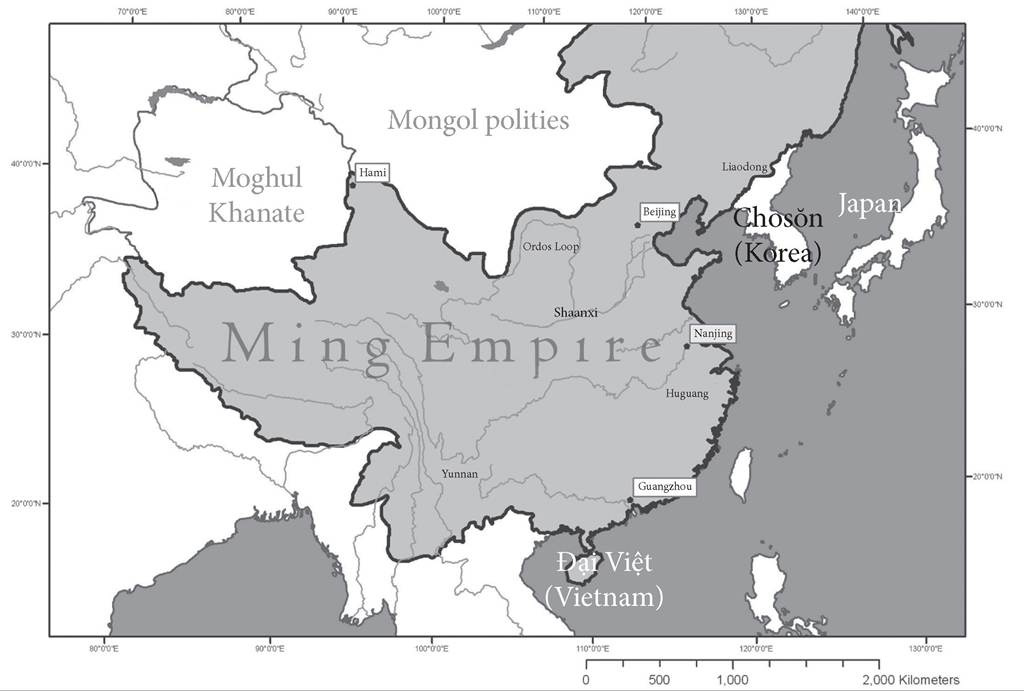
Map 19.1. The Ming Empire.
Copyright: Oxford University Press.
THE MING EMPIRE 543
More on the topic Protecting the Dynasty:
- PROTECTING CLIENTS’ IDENTITIES FROM COLLEAGUES
- CASE 234: Protecting Women in Financial Matters
- Protecting biodiversity is important for both practical and moral reasons
- The Ming Dynasty, 1368-1644
- Selling a Dynasty
- I made a mistake in presuming that the self-interests of organizations, specifically banks and others, were such as that they were best capable of protecting their own shareholders and their equity in the firms.
- The Tang Dynasty (618-907)
- The Askia Dynasty
- The February 1917 Revolution swept away the Romanov dynasty
- A Dynasty of Righteous Persecutors
- The Song Dynasty (960-1279)
- The Zhou Dynasty and the Early Textual Traditions
- The Mongols and the Yuan Dynasty (1279-1368)
- The core of the Russian Empire was the small principality of Moscow, ruled over in the thirteenth century by a minor branch of the Rurikid dynasty.
- With neither its power, its wealth nor its population having been equalled by any predecessor, the dynasty known in history as Tang (618-907) enjoys a legacy much admired amidst all of those collectively constituting the imperial Chinese cultural heritage.
- At its peak in the mid eighteenth century, the Chinese Qing dynasty (1644-1911) was arguably the world's strongest, wealthiest and most flourishing polity.
- Over the last three decades a resurgence of interest in Chinese legal history and the opening of archives for the Qing dynasty (1644-1911) has contributed to an outpouring of scholarship on interpersonal violence, homicide and capital punishment in eighteenth-century China.
- The Hanafijurist Abu Zayd al-Dabbusi (d. 430/1039) hails from the eastern part of the Islamic world, where he served as qadi in Bukhara’ under the Samanid dynasty in Transoxania.[421]