The Definition of Heresy
Alexios appears to have been concerned that trials for heresy held under his auspices should follow the foundational principles and due process of
Society in Byzantium under the Comneni, 1081-1261 (Cambridge: Cambridge University Press, 1995), p.
487.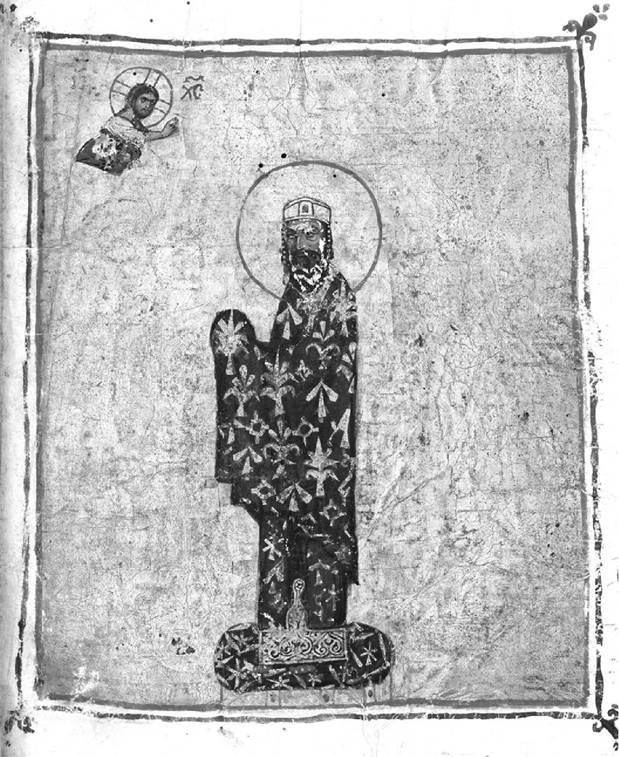
Figure 14.2 Vatican City, Codex Vaticanus Graecus 666, eleventh-twelfth century, fo. 2r. Emperor Alexios Komnenos, with head slightly bowed and hands covered out of reverence, receives the writings of the Church Fathers.
late Roman law as enshrined in the Latin legislation of Justinian's Body of Civil Law (Corpus iuris civilis) and the Greek legislation of Basil I's and Leo VI's Imperial Laws (Basilika). An important feature of these law codes was their conflation of sacrilege (hierosylia) with high treason
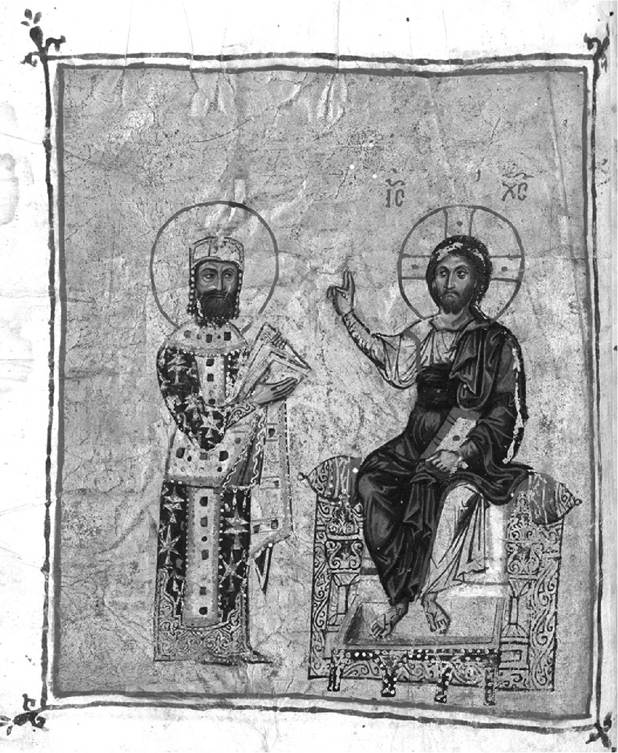
Figure 14.3 Vatican City, Codex Vaticanus Graecus 666, eleventh-twelfth century, fo. 2v. Emperor Alexios Komnenos offers the Dogmatic Panoply he commissioned from Eugenios Zigabenos to Christ and receives His Blessing in return.
(kathosiosis).[544] According to this perspective, since the empire had been founded and the emperors appointed by God, attacks on the sacred also compromised the state, and risked provoking divine wrath. This semantic association is illustrated in one contemporary lexicon, which defined ‘treason' as behaviour directed ‘against the holy, namely the emperor'. Beyond its most obvious manifestation - an assassination attempt against the emperor - treason was identified with any action that threatened the security of the state and its government, such as admitting enemy troops into a city or fortress of the empire; abetting the enemy by assisting in the escape of prisoners or the provision of arms, horses or money; deserting an assigned military post; seizing a fortress or other strategic location; forging or misrepresenting imperial instructions or other state correspondence; and finally, counterfeiting imperial coinage.[545] [546] Because the charge of treason applied even to actions not yet implemented, but merely planned or intended, the crime could be discerned in any ‘cunning or foolhardy opinion intended against...
the emperor'. Heresy was counted among such errant opinions. If the emperor's pursuit of the divinely sanctioned imperial project aimed to secure both the earthly future of the body politic and the salvation of the community of the faithful, the heretic's radicalism threw this work into jeopardy. A lavishly illuminated manuscript commissioned in the mid ninth century represented those accused of the iconoclast heresy as having carried out, through their attack on images, a second crucifixion of Christ - a sin equivalent to proselytising for paganism, and requiring its perpetrators to be trampled into the dust (Figures 14.4 and 14.5). 15Legislative tradition thus defined heresy as a crime against the state. Heretics were divided into three categories: those who taught doctrines alien to the church; those who through simplicity and guilelessness were led astray by such teachers; and even those who merely happened to find themselves in the company of such men, and remained for some time in order to hear what they had to say. The range of recommended punishments for the crime included the severest sentences at the government's disposal. At the very least, heretics should lose the right to vote, and be barred from the political processes of decision-making open to citizens of good standing. But they might face the penalty reserved for high treason: hanging or, still worse, burning at the stake. Yet even though the ‘old law' prescribed death, under
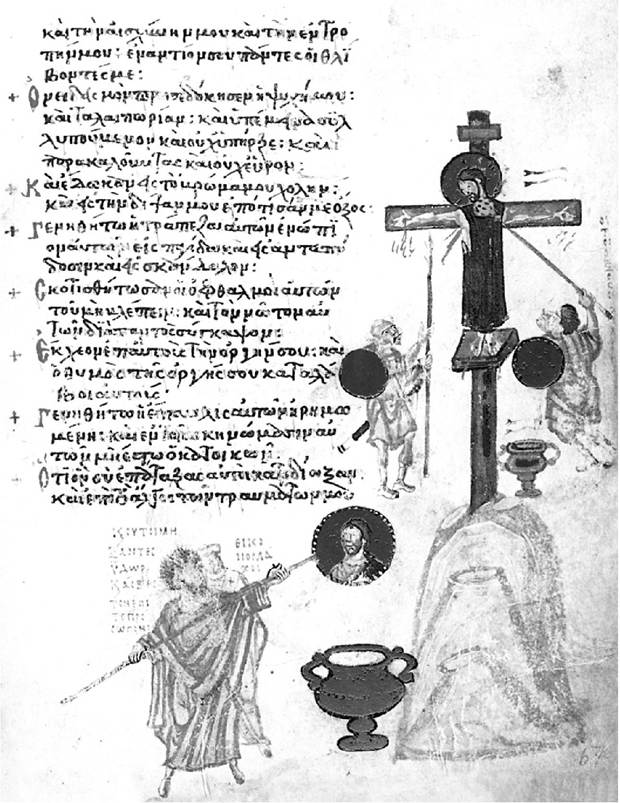
Figure 14.4 Moscow, Historical Museum, MS. D.129, ninth century, fo. 6yr. Illustration from the Cludov Psalter depicting the actions of iconoclasts John Grammatikos and Anthony I. Their attack on an icon of Christ (below) is equated with a second crucifixion of Christ (above).
the tenth- and eleventh-century Macedonian dynasty authorities had not upheld that law's letter, finding it ‘neither right nor fitting' for the reputation of Christianity.
Their reluctance reflected the abiding hope that all deviants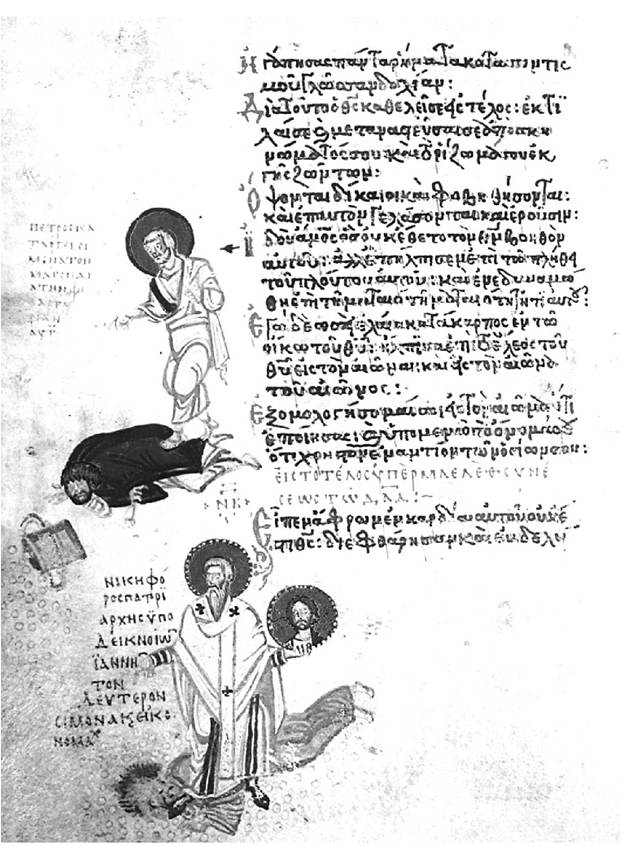
Figure 14.5 Moscow, Historical Museum, MS. D.129, ninth century, fo. 5iv. Illustration depicting the actions of iconodules. The iconodule Patriarch Nikephoros I holds an icon of Christ triumphantly and tramples underfoot an iconoclast, John Grammatikos, who has dropped the coins he received for a betrayal of Christ that is presented as similar to that by Judas (below). The iconoclast's punishment is equated with that appropriate to pagans (above).
could be led back to the righteous path, and either be readmitted into the congregation after a brief spell as excommunicates or, if their error was greater, be reconfirmed or rebaptised.[547]
As late as the third quarter of the eleventh century, emperors had sought to patrol people's thoughts and speech without resorting to corporeal chastisement. Investigations in Constantinople into heresy had resulted in the condemnation of nine doctrinal positions as theologically unsound, and in the anathematisation of their proponents, but not in the imposition of physical punishment. Attempts to bring the inhabitants of the towns of Antioch and Melitene to heel had included burning heretical religious texts, but not heretical human flesh.1[548] Under Alexios, however, the threat of the stake - what one imperial decree described as ‘red-hot, fiery' chastisement - began to loom larger injudicial proceedings.[549]
More on the topic The Definition of Heresy:
- Definition and the Ordering of Guardians Definition of the child
- Heresy
- From Heresy Trials to Mass Violence
- Heresy and Banditry: Religious Violence in China since 1850
- Apostasy, Ridda, Irtidad, Blasphemy, Heresy, Freedom of Religion
- What should the definition be?
- Implications of the definition
- Definition of Certainty
- 2 Definition of agricultural ‘waste’
- The Legal and Social Definition of Police in the United States
- DEFINITION AND MEASURES OF MONEY SUPPLY
- The Definition
- Definition of the Metabolic Syndrome in Non-HIV-Infected Patients
- A Definition and causes of divorce
- Definition of Terrorism