The Identification of Heretics
The two most important clusters of heresy trials under Alexios were those of John ‘the Italian' (Italos) and Basil ‘the Bogomil' (Bogomilos), along with their respective adherents.
Beginning in 1082 and concluding in 1118, these trials were high-profile events, held for maximum impact in the capital, Constantinople. As one commentator later observed, whether ‘whole towns and villages' should actually ‘go astray and die in their heresy' was of little concern; rather, the entire focus was on trying and convicting the heretic ‘in the Queen of Cities', where he could receive exemplary, widely publicised punishment.[550] The two sets of trials shared a common overall organisation, with the same imperial prosecutor assigned to both, and similar indictments of impious dogma and atheism. But they diverged in the details of the hearings, with the proceedings framed in such a way as to ensure that, following conviction, sentences of unequal severity ensued. In John's trial, the accused, after having correct dogma demonstrated to him, was said not to have sought to advance counter-arguments, but rather to have ‘eagerly' condemned the beliefs attributed to him, so that he arrived at acknowledgment of their error without requiring prompting. Having been presented as penitent, he was granted a relatively mild sentence, which required him to denounce his purported teachings before a congregation that echoed the anathemas after him, then to retire from his university chair to a contemplative monastic life.[551] By contrast, in Basil's trial, the accused was portrayed as an inveterate sinner glorying in offences so grave as to be erasable only through the dissolution of his body. Allegedly having declared himself ‘ready to step into fire and die a thousand times over, and not renounce his faith', Basil was considered to have condemned himself out of his own mouth to the very punishment that was meted upon him. He was duly burned alive in the hippodrome, the public space near the palace used for sporting events, assemblies and executions.[552]Perceptions regarding the differing identity of those prosecuted appear to have decisively affected these two trials. The narrative subsequently composed by Alexios' daughter, Anna Komnene, identified inJohn's alien origin a reason for exercising greater tolerance. According to Komnene, John had hailed ‘from Italy' and grown up in areas that opposed Byzantine rule, then been taken to the imperial capital to be indoctrinated. This effort had not immediately been successful, since dispatch back to his homeland on a diplomatic mission had led him to seek to betray his adoptive country, but patient handling in the form of repeated correction eventually achieved the desired result, and he became a model imperial subject and believer. According to Komnene, Basil posed a far more pernicious danger. She identified him as the enemy within - a member of a shadowy sect that had spread throughout the empire, corrupting the citizenry and contaminating even the ‘greatest houses' before finally being brought to light ‘as one charms a snake out of a hole'. A particularly strong connection was intimated between Basil and seditious activity in the cities of Mosynopolis and Philippopolis (Plovdiv), located in the south-eastern Balkan hinterland of the imperial capital.[553]
The association of the accused respectively with southern Italy and the Balkans reveals the trials to have been reflections of larger geo-political developments. They spanned four decades that saw the establishment in southern Italy of the Norman adventurer Robert Guiscard and the dispatch of his son, Bohemond of Taranto, to begin expansion across the Adriatic in 1081, as well as Bohemond's second invasion of the Balkans in 1107. They also fell on either side of the launch in 1095 of the First Crusade.[554] The mass armed pilgrimage drummed up by Pope Urban II had been intended to provide aid to Byzantium, but soon turned against it, largely under the influence of Bohemond.
In 1098, when Bohemond and his forces took Antioch, the former centre of Byzantine military operations in the Levant, he refused to surrender it to Alexios, instead complaining of the presence in the city of ‘heretics’ - the most prominent of them ‘Greeks’ - and urging Urban to come east so that ‘with your authority and our strength you may eradicate... all heresies'. During the Norman-Byzantine war that followed, Bohemond sought to have his campaigns recognised by Urban's successor, Paschal II, as a continuation of the crusading enterprise, branding the Byzantine emperor an ‘infidel and enemy of Christians' and arguing that war was the only way the false teachings ‘of the Greeks' could be ‘purged'. Propaganda asserted that the army of the First Crusade, as it had crossed Byzantine territory in the Balkans, had encountered ‘heretics' and responded by sacking ‘a certain castle' of theirs and consigning its inhabitants to the flames.[555] Such stories justified continued military aggression by the Normans across the Adriatic by depicting the empire as a breeding ground for religious dissent.25 Moreover, campaigning against the Byzantine emperor came to be presented not merely as the eradication of heresy, but also as vengeance for the martyrdom and persecution by heretics of true believers. Illustrations contained in the Italian version of a Greek chronicle depict a figure wearing imperial garb, and ordering the arrest, torture and execution of Christians. The apparent function of depictions of such scenes was to provoke outrage such as evinced by the reader who scratched out the emperor's features (Figure 14.6).26As a response on the part of Byzantium, the trial of Italos served to warn that Constantinople was still powerful - and to reassure those on the western frontier that they would be treated leniently if they submitted themselves to imperial authority. By the time of Basil's trial, however, it was important in addition to dissuade the papacy from promulgating a crusade against imperial territory.
One way for Alexios to do so was to cast himself as a defender of the faith and launch a vehement attack in the judicial courts against a religious group, associated with the contested zone of the Balkans, whose reluctance to follow the organised church could be cast as deviance so pernicious that it threatened to destroy Christianity. The theological texts produced at the imperial court confirm that underlying the persecution of ‘Bogomolism' was the aim of rapprochement with the papacy. Expounding at length on the fact that the leader of the ‘Bogomils', who had led many people to perdition, had been outwitted, out-argued and exposed by the wise emperor, these texts downplayed disagreements on matters of rite and doctrine - such as the filioque, the dogma that the Holy Spirit processes from the Father ‘and the Son' - between the eastern and western churches, relegating such disagreements to the distant past and denying the existence of ongoing schism.27vol. x, pp. 536-9; R. I. Moore, The Origins of European Dissent (London: Penguin, 1977), pp. 23-45; B. Stock, The Implications of Literacy: Written Language and Models of Interpretation in the Eleventh and Twelfth Centuries (Princeton: Princeton University Press, 1983), pp. 106-19; M. Frassetto, ‘The Heresy at Orleans in 1022 in the Writings of Contemporary Churchmen', Nottingham Medieval Studies 49 (2005), 1-17.
25 Epistulae et chartae ad historiam primi belli sacri spectantes: die Kreuzzugsbriefe aus den Jahren 1088-1100, ed. H. Hagenmeyer (Innsbruck: Wagner'sche UniversitätsBuchhandlung, 1901), p. 164; Gesta Francorum, ed. R. Hill (London: Nelson, 1962), p. 8; W. Holtzmann, ‘Zur Geschichte des Investiturkreises. 2. Bohemund von Antioch und Alexios I', Neues Archiv der Gesellschaft für Ältere Deutsche Geschichtskunde 50 (1935), 270-82, at 282.
26 Madrid, MS Graecus Vitr. 26-2, fo. 28v.
27 PG 130, cols. 1,173-360; Shepard, ‘Hard on Heretics, Light on Latins', p. 775.
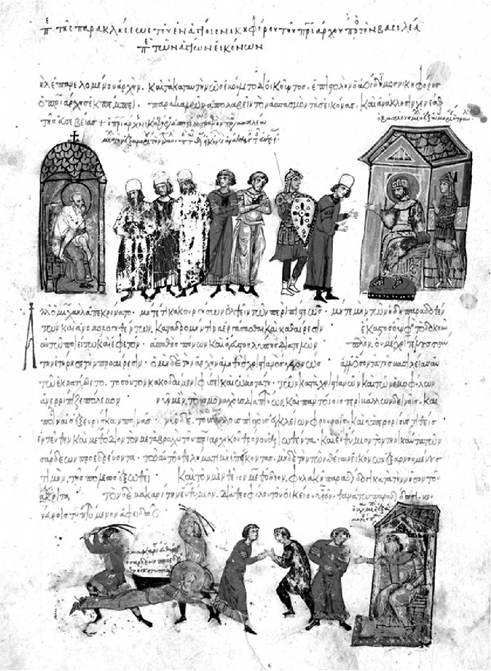
Figure 14.6 Madrid, Graecus Vitr. 26-2, twelfth century, fo. 28v. Illustration in a copy of Skylitzes' Chronicle produced in Italy. The iconoclast Emperor Michael II orders the arrest, torture and execution of the iconophile Euthymios of Sardis. The depiction appears to have enraged a reader or readers, who scratched out the emperor's features.
The Spread of Persecutory Practices
After Alexios' death, his descendants John II (1118-43) and Manuel I (1143-80) continued to encourage the exchange of delegations between Constantinople and Rome in the name of ecclesiastical union.[556] It became convenient in this context to imagine the existence of a heresy originating with the Manichaean dualism condemned by the ecumenical councils of the early church, and surviving among the Paulicians of the upper Euphrates before being transferred to the Balkans. A recrudescence of this heresy was ostensibly spreading across Europe, borne hither and thither by the ‘Bogomils' and others related to them, such as the ‘Cathars' and ‘Patarenes'. If it was to be suppressed, the two churches needed to reconcile their differences and mount a concerted effort.[557] The treatise Against the Patarenes (Contra Patarenos) by Hugh Eteriano bears out the attraction of such joint action against heretics during the third quarter of the twelfth century. In his work, Eteriano - an Italian who resided in Constantinople and was well connected to the imperial court, but who later returned to take up an ecclesiastical office in Rome - fulminated against a ‘wicked sect' that had established itself ‘around the Hellespont' and elsewhere in the ‘world'. He argued that the sect's members deserved death because they were guilty of nefarious actions and opinions incompatible with ‘the holy church of God of the Latins and Greeks'.[558]
Certainly, the papacy lent ever greater support to the use of the pyre as punishment for heretics.
The first example of the implementation of this sentence was the hanging and posthumous burning in 1155 of Arnold of Brescia, after a trial in which charges of heresy and treason were combined. By the time groups of heretics were burned in 1163 at Cologne and 1167 at Vezelay, the practice, if not quite yet routine, was sufficiently uncontroversial that prominent churchmen felt comfortable recommending it.[559] This development cannot be attributed solely to eastern influence, since a handful of cases had already made a brief appearance in western contexts a century earlier. Yet recourse to the pyre as an established means of execution, together with the development of highly legalistic justifications, did coincide with extensive diplomatic contact, initially spearheaded by Manuel and Pope Hadrian IV, between the imperial court and the papal curia.[560] There was a strong resemblance, furthermore, between the language of late Roman law regarding treasonable and sacrilegious conduct found in Komnenian pronouncements and the formulations that the papacy would adopt by 1199 in presenting extreme forms of religious persecution as a legitimate response for the church.[561]To view the popes as potential partners in the rooting-out of heresy represented a risky strategy for the emperor, since it exposed him to criticism and rival claims from within the eastern church. Already under Alexios, prelates in Constantinople had been ‘whispering that they were doubtful' about the trials, suspicious that ‘matters had not been investigated properly or accurately'. In 1143, opposition coalesced around Patriarch Michael II, who convened a synod without imperial prompting that condemned two bishops, Leontios of Balbissa and Clement of Sasima, as ‘Bogomils', and deposed and anathematised them. Within a few years, Michael went further, overseeing not merely his synod's conviction of a group of laypeople for ‘Bogomolism', but also their sentencing to the stake. After Michael's death, the emperor sought to recover lost political ground by organising a tribunal that turned the tables on the ecclesiastical establishment, condemning the successor to the patriarchate, Kosmas II, as himself a ‘Bogomil'. This intervention proved inconclusive, and trials and counter-trials proliferated of supporters respectively of the emperor and the patriarch.[562]
The problem the Komnenoi faced was that, while emperors had long sought to define the relationship between canon and civil law through codification that placed both under imperial control, such a framework did not remain stable. Over the second half of the twelfth century, the ecclesiastical branch of the judiciary extended its purview, gaining greater autonomy. Although hardliners such as Eteriano continued to identify the ‘most Christian' emperor as duty-bound to ‘intervene devoutly' and persecute ‘false apostles, heretics, antichrists' who were ‘divided and separated from the holy church' by ordering them ‘to be sent to the fiery furnace' so that they might ‘begin to burn here who will be burned in the everlasting fires of hell', opinion was shifting. Advisers close to the emperor had begun to question the wisdom of holding religious trials that dispatched people by ‘hanging and fire', asking whether they ought to allow the ‘imperial enactment' that punished heretics to ‘become ineffective'. Eventually, the emperor himself displayed reluctance to order the black symbol of death to be inscribed on the foreheads of men of even a ‘most damnable sect'.[563]
In any case, by this point trials for heresy were losing their usefulness as a means by which to contain western expansionism across the Adriatic, not least because that expansionism itself was changing. One of the measures the Komnenoi had taken to counter the Normans had had unintended consequences. The dynasty had approached the maritime city of Venice, offering trading privileges in return for naval support in the struggle against marauding fleets from southern Italy and Sicily.[564] The agreement had spurred an influx of Venetians into imperial territory, in time altering the demographic composition of the empire. Spreading outside ‘the residential area granted them by the emperor', the incomers dispersed ‘throughout the Roman empire', taking ‘for themselves Roman wives' and dwelling ‘in homes like those of the Romans', so that they came to be ‘looked upon' practically as ‘natives and genuine Romans'.[565]
Imperial government reacted by attempting to define more precisely the juridical status of the incomers, carefully distinguishing between those who ‘came by way of trade' to the empire and were there temporarily on business, and those who, settling down, lived in the empire more permanently and ought consequently to perform to the state the duties of residents. Of the latter group, an oath of allegiance was demanded, requiring them to ‘maintain loyalty to the Romans so long as they lived'. Those who pledged themselves were designated as bourgesioi, a hybrid term conveying not only the notion of foreign origin but also that of local citizenship.[566]
More on the topic The Identification of Heretics:
- Identification of MAP in Cultures
- The Dioscuri and Their Roman Identification
- IMPAIRMENT IDENTIFICATION IS FACILITATED BY SUBDIVIDING THE GAIT CYCLE
- Violence against Christian Heretics
- 60 Disqualification of Jews and Heretics as Witnesses Against Orthodox Christians
- 59 Pagans, Jews, and Heretics Are Forbidden to Possess Christian Slaves
- This chapter focuses on violence against heretics and witches in Europe, above all in the western part, from the eleventh to the eighteenth centuries.
- Christian Violence against Heretics, Jews and Muslims
- 54 Policy in Regard to Jews, Samaritans, Pagans, and Heretics
- 49 Renewed Confirmation of Policy towards Jews, Pagans, and Heretics
- 62 Restrictions and Prohibitions on Pagans, Jews, and Heretics in Africa
- Violence towards Heretics and Witches in Europe, 1022-1800