Early Ottoman Cultural Syncretism and the Muslim Sunni “Confessionalization”
Another feature typical of the early Ottoman state was its highly pragmatic attitude toward Christians and Jews. The Ottomans did not encourage massive conversions to Islam, as that would lead to diminishment of treasury incomes, in part composed of special taxes imposed on non-Muslims.
In some regions of the Balkans, Christians even prevailed among provincial Ottoman cavalry, as the members of local petty nobility were re-granted their own lands as timars without a formal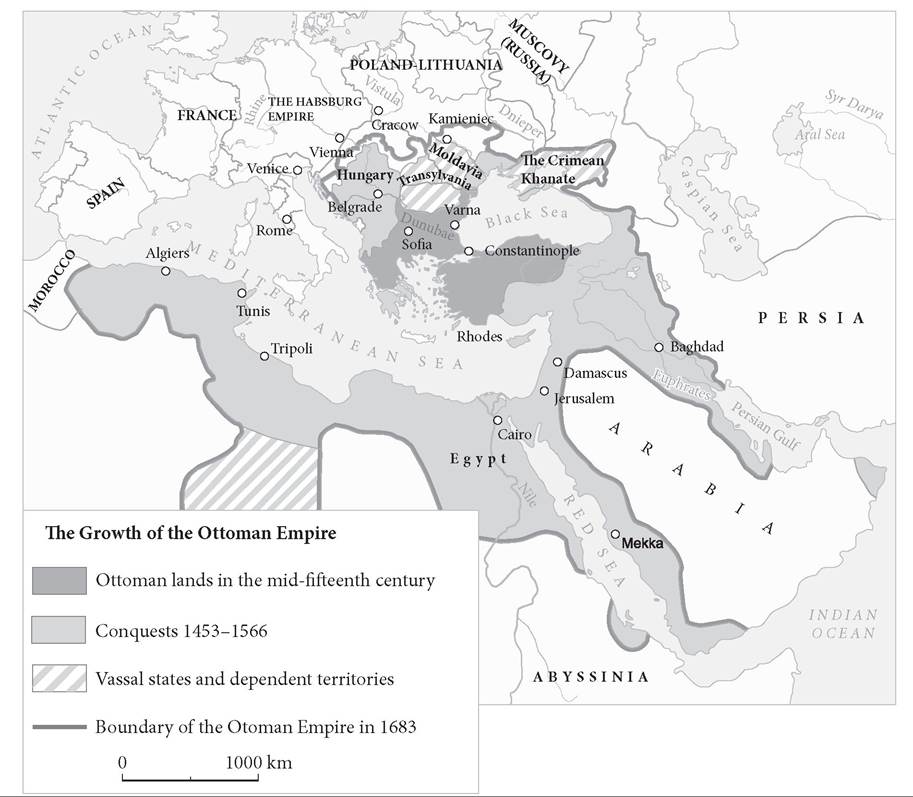
734 DARIUSZ KOLODZIEJCZYK
Map 26.1. The Growth of the Ottoman Empire.
Source: Zielinska and Kolodziejczyk, 2003, Poznajemy dzieje cywilizacji. Historia i spoleczenstwo. Podr^cznik dla klasypiqtej szkolypodstawowej. Copyright: Wydawnictwa Szkolne i Pedagogiczne.
requirement of conversion.[1829] Many young members of the Greek and Balkan aristocracy, including members of the imperial Palaiologan dynasty, were forcibly converted and trained in the sultan's palace to be subsumed into the highest administrative and military echelons of the empire.[1830] Also the system of levy of Christian children into the palace service and janissary corps, known as dev^irme, assured the constant flow of non-Turkish newcomers, often of humble origin, to the top posts in the imperial structure. Although the careers of these newcomers were linked with forced conversion, they were not barred from maintaining contacts with relatives who remained Christian and who could make parallel careers in the Orthodox Church hierarchy or in trade. Perhaps the best known is the case of Mehmed Sokollu, a dev^irme adept and Muslim convert from the Serbian petty noble family of Sokolovici, who in the sixteenth century ascended to the post of grand vizier and remained in power during the reigns of three successive sultans.
At the same time, he invested state funds in his native Bosnia, restored the Orthodox patriarchate of Pec, and promoted his brother Makarije to the post of patriarch.[1831] Stephan Gerlach, a member of the Habsburg embassy to Constantinople in 1577, reported that Mehmed Pasha was often visited by relatives and friends who enjoyed free access to his palace while those among them who wished to remain Christians could do so without prejudice.[1832]The examples of swift careers at the Ottoman court accomplished by strangers of humble origin made a huge impression in feudal Europe. Several writers of the Italian Renaissance idealized the Ottoman realities and presented the Ottoman court as ruled by purely meritocratic standards. Some European authors and artists dedicated their works to the sultan in the hope of gaining his patronage, while others—including the great Leonardo—considered entering his service.[1833] Some sultans, most notably Mehmed II, “entered the game” by extending patronage to Greek writers, Italian artists, and by commissioning commemorative medals and jewels in Western workshops. The adoption by Mehmed II of the formal title kayser-i Rum (“Caesar of Rome”) after the conquest of Constantinople was the best proof of his universal ambitions extending to both the eastern and western Mediterranean. Until the early sixteenth century, the Ottoman chancery displayed purely cosmopolitan ambitions, issuing documents in Ottoman Turkish, but also in Persian, Greek, Latin, Italian, Serbian, and Church Slavonic, addressed to domestic as well as foreign communities and their leaders.[1834]
Older historiography often perceived Mehmed II as the paragon of Ottoman ruler who set lasting standards for the state organization, typical of the “classical age” of the empire.[1835] Yet, his rule was hardly typical. The conquest of Constantinople gave him such great charisma in the eyes of his subjects that he could openly defy the Muslim clergy and almost openly ignore Muslim law.
No other sultan before or after him so often debased the silver coinage, realizing substantial gains for the state treasury to the equally great detriment of Ottoman subjects.[1836] By reclaiming state lands which had been illegally turned into pious foundations (vakfs), he deprived the Muslim clergy of a large share of its incomes, thus setting an unconscious precedent for secularizing rulers of the European Reformation. Finally, the acquisition of many new lands inhabited exclusively by Christians required from the sultan a policy of appeasement toward non-Muslims, even at the cost of upsetting some of the more rigid ulema.These unusual circumstances had already ceased under Mehmed's son and successor Bayezid II (1481-1512). His rule was repeatedly challenged by his younger brother, who was able to find refuge first in Mamluk Egypt, then on Rhodes, and finally in Rome. Forced to seek legitimacy, Bayezid endeared himself with the Muslim clergy, restored the pious properties confiscated by his father, and earned— as the only sultan in Ottoman history—the honorary title of Veli (lit. “Saint”) which referred less to his devotion than to his dependency on the ulema. Not by coincidence, Bayezid's reign also witnessed the naissance of Ottoman court historiography whose adepts aimed to depict the past sultans as infallibly pious warriors and the protectors of Islamic law.
The Ottomans' Sunni Muslim identity was further strengthened during the reign of Selim I (1512-1520). His military confrontation with Shah Ismail, who imposed Shiite Islam as the state religion of Iran, resulted in the brutal persecution of Shiites in Asia Minor, suspected by the sultan of maintaining secret contacts with the shah. As the result of two brilliant campaigns against the Safavids and the Mamluks, marked by the victorious battles at Qaldiran (1514) and Marj Dabik (1516), within less than four years the Ottomans became masters of eastern Anatolia, greater Syria, Egypt, and the Hejaz.
Three Muslim holy cities—Jerusalem, Medina, and Mecca— and the two former seats of caliphate—Damascus and Cairo—found themselves under the rule of the Ottoman sultan, soon to be joined by yet another ancient Muslim center—Baghdad, conquered in 1534 by Sultan Süleyman (1520-1566). Whereas Mehmed II's ambition was to rebuild the empire of Rome, Süleymans major ambition became the restoration of the Muslim caliphate, although he did not entirely give up his universal claims in Europe, especially during the first years of his rule, when he was twice stopped short of capturing Habsburg Vienna (in 1529 and 1532). The influx of Arab Muslim clerics to Constantinople and the simultaneous revival of Muslim scholarly centers in the Middle East under Ottoman patronage led to a further Muslim Sunni “confessionalization” of the Ottoman state. With the help of a Muslim scholar and jurist Ebus-su‘ud, raised to the post of great mufti of Istanbul, Süleyman, posthumously nicknamed “the Lawgiver” (Kanuni), tried to reconcile the Ottoman customary and imperial law with the Muslim Shar‘ia. The Ottoman sultan's self-image as the universal defender of Sunni Muslims against infidels was further strengthened due to the confrontation with Spain in the Maghreb and western Mediterranean, and with Portugal in Ethiopia, Yemen, Oman, Indian Gujarat, and even distant Sumatra.[1837]
More on the topic Early Ottoman Cultural Syncretism and the Muslim Sunni “Confessionalization”:
- I implications of the Sunni constitutional theory for modern Muslim-majority states
- As far back as we can trace it, Roman religion was multi-cultural. Archaeological evidence demonstrates that in terms of religion and other cultural components early Rome was influenced by Etruscans, Greeks and even Carthaginians.
- Syncretism
- Reforming the Sharita Courts at the Close of the Ottoman Empire: an Ottoman Project in the Spirit of Western Colonialism
- THE “TOLERANT” MILLET SYSTEM— FROM OTTOMAN JIHAD TO OTTOMAN DHIMMITUDE
- Religious Dynamics and the Politics of Violence in the Late Ottoman and Post-Ottoman Levant
- Netherlands, 1930s: van der Leeuw's re-confessionalization
- Except for the fact that it was the seat of an Ottoman serasker (governor) and the major listening post on the Ottoman Empire’s sensitive northern frontier, Bender, a dusty, provincial town on the Dniester, had little to distinguish it.
- ISLAMIC KINGDOMS, SYNCRETISM, AND LOCALCUSTOMS
- Democratizing Muslim Legal Pluralism? Parity and Muslim Dispute Resolution
- Varieties of Islam: The Sunni and the Shi‘a