Ecology of the Straits of Melaka
The Straits of Melaka (900 kilometers long) are shaped like a funnel: 300 kilometers wide at the north end, narrowing to 25 kilometers at the southern tip. The Riau- Lingga Archipelago stretches a further 350 kilometers along the Sumatran coast, to Palembang, before a gap in the islands creates a relatively unobstructed course northeast toward China.
The Straits are fringed by a belt of swampy forest which until recently covered 75,000 square kilometers, so flat that tides are felt 120 kilometers inland. Acid soil conditions favor the formation of iron nodules for metal-working. In the Musi drainage, permanent freshwater pools called lebak cover 5,000 hectares. During the rainy season, they expand to 500,000 hectares, and provide important sources of food.[1116]The coasts of the Straits, plus southeast Sumatra and western Borneo, form the homeland of the modern ethnic group called Malay. This region is sometimes termed alam Malayu, “Malay Realm,” in recognition of the cultural affinity which cuts across the division between four modern nations (Indonesia, Malaysia, Singapore, and Brunei). A common pottery style spread throughout this area about 500 ce. A polity called Malayu appeared in a Chinese source in the early seventh century. Its modern connotation as an ethnonym evolved through a complicated process.[1117] The oldest inscriptions of Sumatra (from the seventh century) are written in a language ancestral to modern Malay, albeit with many terms derived from Sanskrit.
Malay identity evolved in tandem with an ecological adaptation to the intertidal zone which favored the development of an intermediary role, mediating exchanges between collectors of products from the sea on one side, the highlands on the other. Within this zone, the major obstacles to population growth have been the lack of fresh water, malaria and other tropical diseases, and lack of arable land. The evolution of specialized economic activities led to the formation of three ethnic identities in the Malay Realm.
In addition to the Malay identity, a second consists of a nomadic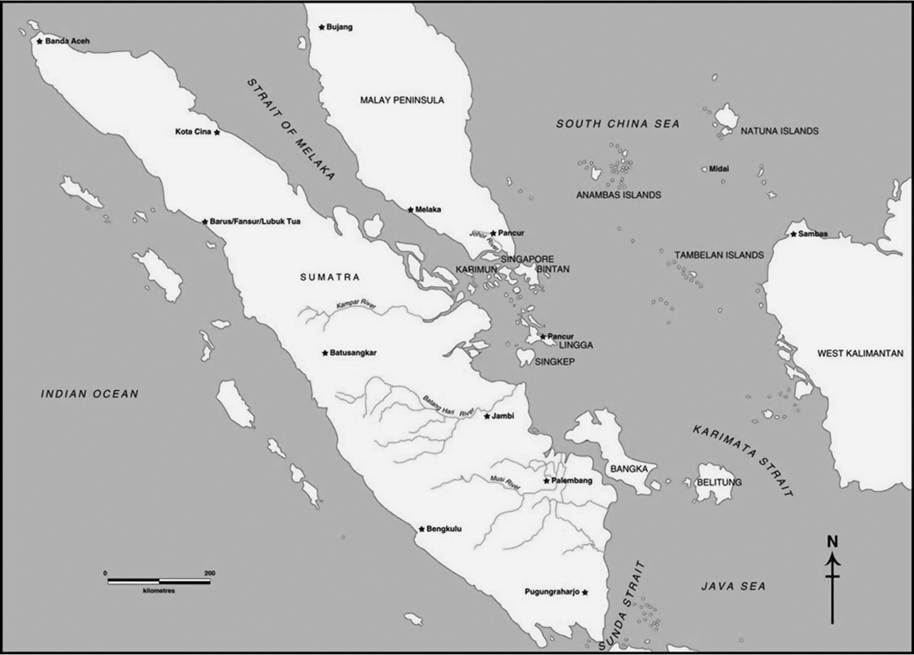
Map 14.1. Singapore, Riau, and Important Archaeological Sites.
Source: Miksic, 2013, Singapore and the Silk Road of the Sea, 1300-1800, figure 1.06a. Copyright: John N. Miksic.
SRIVIJAYA 403
boat-dwelling way of life pursued by groups collectively termed orang laut, “sea people” in Malay, who became efficient gatherers of fish and also luxury items sought all over Asia, such as pearls, coral, and tortoise shell. The people of the Sumatran hinterland are descended from the same Malayo-Polynesian ancestry as Malays, but have diverged into a mosaic of ethnolinguistic groups.10 Like the seas, the uplands yielded a cornucopia of materials sought after by elites thousands of kilometers away, such as gold, ivory, and incense.11
A symbiotic economic network evolved between the highlanders, the sea people, and the Malays. By 2,000 years ago, Malays added a fourth component to their network by forging links with mainland Asia. Rulers of Malay entrepots could offer imported luxuries and necessities to highlanders and sea people in return for local products which foreign elites avidly sought. The estuaries yielded no goods of interest to long-distance traders, but their strategic position between resource zones led to the formation of Indonesia’s first empire. This situation is analogous to the lowland Yucatan Peninsula at the formation of Mayan civilization.12 As Asian maritime trade grew, Malay rulers created more elaborate sociopolitical institutions.
More on the topic Ecology of the Straits of Melaka:
- From the Opening of the Straits to Steam Navigation
- Ecology, Sixth Edition, is available in Oxford Insight. Oxford Insight delivers the trusted content of Ecology within a powerful, data-driven learning experience designed to increase student success.
- Brief history of Ecology
- Ecology
- Ecology as a multi-disciplinary science
- In this book, ecology is defined as the scientific study of interactions between organisms and their environment.
- Theory’s roles in ecology and competition
- What we know about ecology is always changing
- Public and professional ideas about ecology often differ
- The early history of ecology is a study of succession