Empires and power
Before studying the political and economic evolution of the colonial world in the period up to 1945, it is important to examine the state of the European overseas empires at the start of the twentieth century.
In 1913 the British Empire extended across more than 12 million square miles, some 24 per cent of the world's land mass, taking in the Dominions of Canada, Australia, New Zealand and South Africa, the Indian subcontinent and large stretches of South-East Asia, Africa and the West Indies. The second largest empire belonged to France, which controlled just less than 5 million square miles, about 9 per cent of the world's land mass, including Indochina and much of North, Central and West Africa. Meanwhile, the lesser imperial Powers, Germany, Portugal, Belgium, Italy, Spain, Holland, Japan and the United States, controlled a range of overseas colonies extending across the globe.Some colonial possessions had already been in the hands of the European Powers for more than four centuries, but the nineteenth century brought a great transformation in the European empires. While declining Powers, such as Spain and Portugal, lost control over South America, the industrializing countries, and in particular Britain and France, rapidly extended their possessions, particularly in the latter part of the century. Thus in Asia, Britain gained control over Malaya and Burma, France seized Indochina, and the Dutch moved out from their established bases in Java and Ambon to exercise control over the Indonesian archipelago. In addition, and perhaps most famously, this period saw the ‘scramble for Africa' in which the vast majority of that continent was divided up between the Powers within the space of two decades.
The motives for this sudden expansion of empire have been much discussed by historians, leading to great disagreement over whether strategic or economic gain was the primary objective.
What is clear, however, is that once the colonies had been subjugated, they provided the imperial Powers with many material advantages. The fact that empires could add to a nation's power was ably demonstrated in the First World War. During this conflict the British Dominions contributed just over one million troops to the struggle, India provided another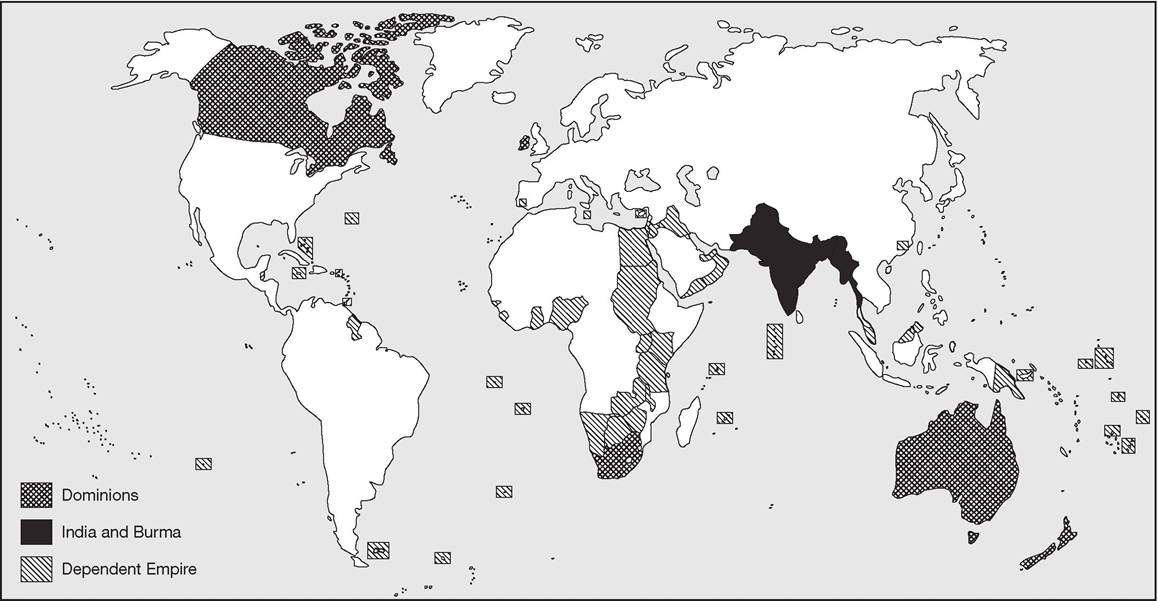
Map 4.1 The British Empire in 1922
Source: After Brown and Louis (1999)
800,000 soldiers, and West Africa contributed 80,000. Added to this was the mobilization of large numbers of Indians and Africans for service in labour corps. The British Empire, however, did not just provide men; it also acted as an essential source of raw materials, food and, in the case of Canada, munitions. For France too, its empire provided an essential pool of extra resources, namely 600,000 troops and 200,000 labourers. In peacetime as well, the colonies added greatly to the power of the metropolitan country. One vital contribution was that the production and export of raw materials assisted with the development of the metropolitan economy and, moreover, boosted the empire's foreign currency earnings. For example, the Dutch prospered from their possession of the East Indies, which, owing to their wealth of raw materials, accounted by the 1930s for 14 per cent of Holland's national income. In addition, colonies could act as useful markets for metropolitan industries that were no longer internationally competitive; in the inter-war era, this was particularly true of the textile industries in the Western European countries. The colonies also continued to act in peacetime as a valuable source of manpower. The British Empire, for example, relied extensively on the use of the Indian army as an imperial police force that could be used to defend interests in South-East Asia and the Middle East.
The fact that the mobilization of colonial resources could add significantly to an imperial Power's strength and international prestige meant that the latter had a considerable interest in modernizing and developing its possessions.
This drive for development became one of the key themes in twentieth-century imperialism, but it proved to be a double-edged sword, for one can argue that, ironically, it was this very desire to rationalize and develop the empires that sounded their death-knell. The reason for this is that the effort to bring about modernizationDebating the origins of modern Western imperialism
Political thinkers and historians have been divided about the motives behind the drive for empire in the late nineteenth century ever since this wave of expansion took place. Various competing explanations exist. One idea that can be seen in the works of A. J. P. Taylor, The Struggle for Mastery in Europe (Oxford,1954) and William L.Langer, The Diplomacy of Imperialism (New York, 1951) is that imperialism was an inevitable consequence of the tensions that were building up in Europe during that period, and that imperialist expansion became a zero-sum game,in which one country's strategic gain was inevitably another's loss. Linked to this is the argument that colonialism can be seen as a reflection of the belief in the late nineteenth century that the possession of empire was a symbol of Great Power status. However, such interpretations raise serious problems. For example, if strategic imperatives and prestige were so important, why did this great wave of expansion not provoke a war?
After all, scholars of the origins of the First World War largely agree that the reasons for this conflict lay in Europe, not in competition in Africa.
In contrast to the explanations that dwell on strategy and prestige, a number of contemporary critics of empire, such as J. A. Hobson and V. I. Lenin, argued that imperialism was caused by economic factors, such as the desire to capture new markets for trade and investment.This theory has been countered by the observation that industrialists stood to gain far more from markets in Europe, the United States and Latin America than from Africa, thus demonstrating that the argument that imperialism is a product of capitalism is a chimera.
However, in recent years Peter Cain and Anthony Hopkins have forcefully restated the case for economic factors, at least in Britain's case. In their book British Imperialism 1688-2000 (London, 2002), Cain and Hopkins argue that British imperialism came about to serve the interests of a 'gentlemanly capitalist' elite that dominated both the City of London and Whitehall, and that it consisted of both a formal empire, that is the possession of colonies, and an informal empire, in other words economic spheres of influence.This is at first glance a persuasive argument, but, once one begins to think about the anomalies, it raises as many questions as it solves, particularly again in the case of Africa.Another interpretation of imperialism, which has been put forward by,among others, Ronald Robinson (1972) and David Fieldhouse (1973), is that far too much stress has been put on decision-making in Europe rather than on events on the periphery. They have emphasized in their work on informal and formal empire that the shift towards formal control was often as a result of local factors and the interactions between indigenous elites and European communities. While this view has some validity, it also fails to provide a complete explanation, for if peripheral problems were the main cause of expansion, why is it that they all occurred around the same time in the late nineteenth century? Surely the only answer to this lies in the rising European pressure on these societies, which then takes us back to looking at European economic and strategic motives.
As with most areas of study, all these arguments have some elements of truth in them, and thus it is wise to conclude in the end that strategic, economic and local factors were important. However, it is also vital not to overlook the fact that the military technology and administrative innovations of late nineteenth-century Europe provided the imperialists with a marked superiority over those they sought to conquer. Nor should one ignore the fact that the idea of a 'civilizing mission', as exemplified by the evangelical Christianity of both Protestant and Catholic missionaries, provided an ideological justification for imperial gain.
The drive for empire was therefore a complicated process, and to attempt to describe it by referring to a mono-causal explanation is to fail to do it justice.necessitated heightened intervention in colonial societies, and that the resultant destruction of the status quo unleashed the forces of indigenous nationalism.
protectorates
Territories administered by an imperial state without full annexation taking place, and where delegated powers typically remain in the hands of a local ruler or rulers. Examples include French Morocco and the unfederated states in Malaya.
In order to understand the drive towards modernization and why it proved so problematical, it is important to see that at the start of the twentieth century the controls that the European Powers exercised over their colonial possessions varied greatly in terms of both their nature and efficiency. The most advanced form of imperial governance existed in the British settler colonies, Canada, Australia, New Zealand and South Africa, which had achieved a substantial degree of selfgovernment as Dominions within the empire. The vast majority of colonies, however, were either ruled directly by the imperial government through the appointment of viceroys and governors, or controlled as protectorates, where a native ruler was left to exercise power over domestic affairs, but only on the advice of representatives from the imperial Power. Protectorates had the advantage that they made imperial control relatively cheap by keeping power over many domestic matters in local hands, but at the same time this devolution of authority created problems, for it weakened the ability of the colonial power to bring about the profound economic and social changes required for modernization.
Princely States
The states in British India that remained formally under the control of local rulers rather than direct British administration. They included states such as Hyderabad and Kashmir.
Complicating the situation even further was that different types of colonial rule could exist within what we now think of as one colony.
In India, a sizeable area of the subcontinent remained under the nominal control of local rulers; these Princely States included such substantial areas as Hyderabad and Kashmir. In Senegal, the French practice of encouraging assimilation meant that from the 1870s the four original communes were allowed to return one Senegalese representative to the National Assembly in France, but the newer additions to the colony had no representation. A particularly bewildering mixture existed in Malaya, where three different types of state existed: the directly governed Straits Settlements, the partially directly ruled Federated Malay States and various indirectly ruled non-federated protectorates.Another important fact that made utilization of imperial resources difficult was that most of the colonies were comparatively recent acquisitions. Even as late as the 1900s the European Powers were still expanding their existing colonies and adding new territories to their imperial portfolio. For example, Britain merged the Ashante kingdom into its Gold Coast colony only in 1902, the Dutch conquest of the sultanate of Aceh in northern Sumatra was completed in 1903, and France gained its protectorate over Morocco in 1912. All these colonies had to be digested, made to pay for their own upkeep and then readied to contribute to the wider imperial cause.
The complex mixture of self-government, direct rule and indirect rule that existed within the barely suppressed territories that constituted the empires clearly complicated the task of colonial administration and acted as an obstacle to economic development. It was therefore only natural that the imperial Powers sought in the early twentieth century to simplify and improve colonial governance in Asia and Africa so that power could be exercised with more authority. However, as the imperial Power believed that the colonies should be largely self-supporting, modernization was to be brought about mainly through the mobilization of indigenous resources. Development therefore involved two key things: first, higher taxation within the colony to pay for economic and social improvements, and, second, the employment by the colonial state of greater numbers of indigenous bureaucrats, police, lawyers and doctors. These requirements led in turn to major changes in colonial rule, namely the introduction of representative government, which was necessary to legitimize higher taxation, and increased education provision, which was needed to train the indigenous population to assist in the development process.
The difficulty with the reforms that were designed to underpin the drive towards modernization was that they unintentionally raised expectations that could not be fulfilled. Once representative government had been conceded in cities, towns and provinces, there was clearly going to be a desire for this to be extended to the national level. Meanwhile, Western-style education led to the new urban elite being exposed to Western notions of political rights, such as universal suffrage and self-determination, which could not be satisfied by the colonial state. The result, not surprisingly, was that liberal education frequently led to the appearance of nationalist dissatisfaction, which then posed a political challenge to empire. Moreover, these changes also created the problem that they threatened the position of the traditional collaborators, such as the chiefs, sultans and kings, who benefited from indirect rule, and inevitably led to resistance from these groups. The desire to rationalize thus led to cries of discontent from two constituencies: first, from the traditional elites, who had little to gain from political change, and second, from the nascent nationalist movements, who felt frustrated that the reforms did not go far enough.
Reinforcing these problems in the early twentieth century were outside pressures, for the wars between the Great Powers, the rise of new ideologies and the workings of modern capitalism also buffeted the colonial system. The major external influence prior to 1939 was the First World War, which for many reasons had a deleterious impact on the future of empire. The key effects can be broken down into three problem areas. The first was that the sheer magnitude of the mobilization of imperial resources, both economic and military, stimulated discontent within the empires, and that this could be satisfied only by political concessions. The second problem was that by the end of the war, the Allied Powers ostensibly sought the defeat of Germany in order to promote the principle of self-determination and to bring an end to unwarranted territorial aggrandizement. Accordingly, it was decided at the Paris Peace Conference that the former Ottoman territories in the Middle East and the German colonies in Africa and Oceania should be transferred to the victors not as colonial possessions but as trusteeships in the form of League of Nations mandates. These mandates were to be ruled in the interests of the inhabitants with self-determination as the eventual goal. This clearly had broad implications for the future of all European colonial possessions, for it implied that trusteeship should be the fundamental principle guiding imperial rule. Accordingly, it helped to incite the rise of nationalist agitation for greater self-government. The third problem, again connected to the collapse of the Ottoman Empire, was that the harsh treatment meted out to the Ottoman sultan, who as Caliph acted as one of the leading Islamic spiritual leaders, led to outrage in the Muslim world. The reaction, from Morocco to the
self-determination
The idea that each national group has the right to establish its own national state. It is most often associated with the tenets of Wilsonian internationalism and became a key driving force in the struggle to end imperialism.
League of Nations
An international organization established in 1919 by the peace treaties that ended the First World War. Its purpose was to promote international peace through collective security and to organize conferences on economic and disarmament issues. It was formally dissolved in 1946.
mandates
The colonial territories of Germany and the Ottoman Empire that were entrusted to Britain, France, Japan, Australia and South Africa under the supervision of a League of Nations Commission.
see Chapter 19
Khalifat Movement
The protest movement that swept through the Islamic world from 1919 to 23 in opposition to the harsh treatment meted out by the Christian powers to the Ottoman sultan, who as Caliph was one of the protectors of the faith.
Dutch East Indies, was the rise of the Khalifat Movement, which marked the beginning of Islamic resurgence, but which also played an important part in the development of nationalism and anti-imperial sentiment.
Other international factors also created difficulties for the imperial Powers. As early as 1905 Japan showed in its war in Russia that non-Europeans could resist Western encroachment, and in the inter-war era this impression was reinforced by Kemalist Turkey's defiance of Britain in the early 1920s and by the rise of Chinese nationalism later in that decade. In addition, the establishment of the Soviet Union and its espousal of a virulently anti-imperial ideology inspired resistance, while the Great Depression brought ruin to many colonial economies, thus provoking an interest in political salvation.
Under the influence of the drive for development and the changed international environment, the inter-war years were to prove an important transitory period in the history of the colonial empires. In those colonies, such as India and Indonesia, where the development process was already well advanced, imperial rule now entered into a running battle with indigenous nationalism, while in others, such as those in Africa, where political and economic transformation was only beginning, the storm clouds started to gather. Moreover, instability was sparked by the fact that the rise of print and broadcast media and the spread of literacy meant that reports of unrest or even imperial retreat in one part of the European empires could inspire disturbances elsewhere. However, in order to understand events in the key imperial possessions in Asia and Africa, it is necessary to look first at the highly volatile conditions in Ireland and the Middle East.
More on the topic Empires and power:
- Cattle Movement Networks in Uganda
- Index
- Nigeria: mission ahead of empire
- Algeria
- Conclusion
- The British in the Coral Sea: Fiji
- Cossack Tatar Fighters
- REVIEW OF FORENSIC ASSESSMENT INSTRUMENTS