Introduction
When thirteen American colonies, clustered on the Atlantic Coast of North America, declared independence from the British Empire in 1776, Indian people and European imperial powers controlled the vast expanses of the North American continent.
The American Revolution was a landmark event in the history of empire, an explicitly anti-imperialist rebellion that successfully replaced imperial governance with a republican political framework. The patriots who led the revolt were unified in the assertion that empires were inherently corrupt, and their successes proved inspirational to oppressed colonial subjects around the world. The newly United States of America offered a clear rebuke to imperialism.1Yet the same men who decried empire in 1776, and emerged as the leaders of the newly independent United States in 1783, almost immediately embarked upon a program of territorial expansion, acquiring and settling new territory through the agency of their new government. It was no coincidence that these republican citizens called themselves Americans, a name that theoretically embraced two continents. They had vast ambitions, and from the beginning were relentlessly mobile, moving with a frequency that astounded European observers. Just 80 years after independence, the United States embraced a continental empire, and at the close of the nineteenth century, formally governed colonies in the Caribbean and Pacific Ocean.2
What is perhaps most remarkable about America's dramatic territorial growth is that it occurred in a nation that continued to vehemently disavow imperialism. For the vast majority of the nineteenth century, national political leaders, and the white men who elected them, loudly, and for the most part sincerely,
1 Portions of this chapter are based on Greenberg 2005, 2012. Full documentation can be found in those works.
2 Seymour 2012, 1-3; Wood 2009, 357-399.
Amy S. Greenberg, US Expansionism during the Nineteenth Century In: The Oxford World History of Empire. Edited by: Peter Fibiger Bang, C.A. Bayly, Walter Scheidel, Oxford University Press (2021). © Oxford University Press.
DOI: 10.1093/oso/9780197532768.003.0037.
1012 AMY S. GREENBERG
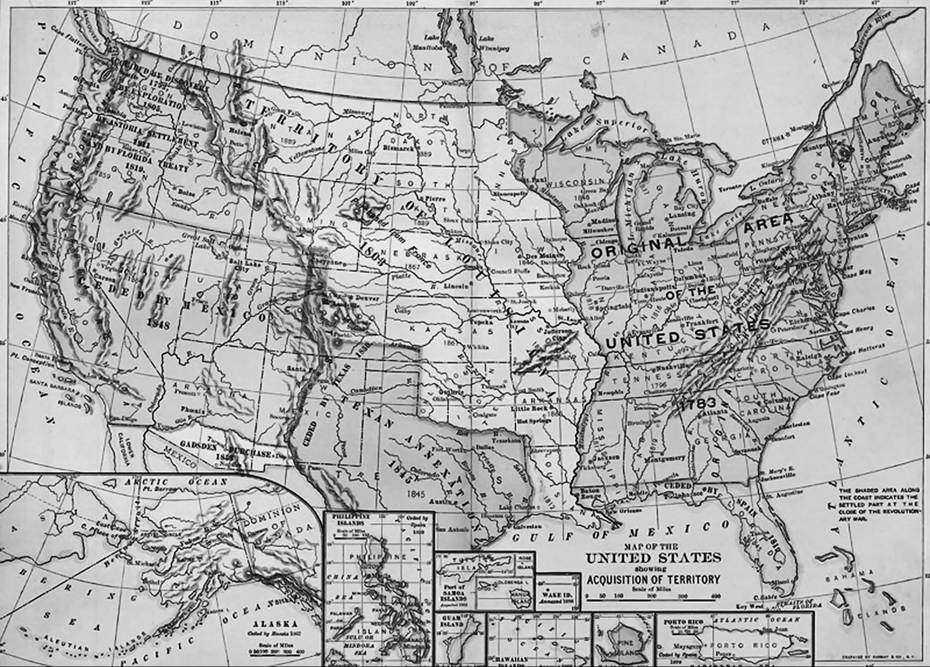
Map 37.1 Expansion of the United States.
Source: http://www.legendsofamerica.com/photos-americanhistory/westernexpansionmap.jpg. Copyright: Bormay & Co., 1906, Map of the United States Showing Acquisition of Territory.
condemned current and previous empires, along with the colonialism and other political evils they believed inherent in imperialism. The pursuit of empire was necessarily believed to lead to political corruption and internal collapse. The United States set out to be a nation unlike any other: a republic governed by an educated citizenry for the good of all, and a significant minority believed extended territory incompatible with republican government. Yet there was nothing accidental about the growth of the United States. Territorial expansion involved concerted effort on the part of politicians and settlers, treaties with European nation-states and native peoples, and the forced dislocation of Indian people from their land.
Americans were able to simultaneously disavow and build an empire thanks to a mid- nineteenth- century ideology known as Manifest Destiny. In the 1840s Manifest Destiny accelerated western settlement and provided a rationale for continued continental expansion. It cast western expansion as natural and predetermined, and justified a policy of brutal racially based warfare against both Indian people and Mexicans. Starting in the late 1830s, American politicians asserted, and many citizens believed, that God had divinely ordained the United States to grow and spread across the continent.
The course of American empire, supporters insisted, was both obvious (manifest) and inexorable (destined). Not everyone believed that the United States had a Manifest Destiny, of course. But by the 1840s the majority of American citizens seemed to agree that the growth of their nation to the Pacific Ocean was natural and inevitable. They turned to war to achieve that goal in 1848. In the 1850s, with a continental empire firmly in place, the idea of Manifest Destiny had become both more expansive and ambiguous. Some Southerners claimed the Manifest Destiny of a Caribbean slave-holding empire, while expansionist Northerners looked longingly at Hawaii and Canada. Many Democratic politicians and journalists, hoping to hold the two halves of their party together, suggested in the 1850s that America's destiny might encompass the annexation of the entire Western Hemisphere.The fracturing of the national consensus over the future of America's Manifest Destiny in the 1850s was directly related to the rise of the sectionalism that territorial expansion helped unleash. When Northerners and Southerners refused to compromise over the status of slavery in newly won territories, the only thing still manifest was the inevitability of a Civil War. After the war, Manifest Destiny went into eclipse. For 30 years after the Civil War, Americans remembered Manifest Destiny as an antebellum relic, and American nationalists pushed to control international trade rather than foreign land. But the ideology experienced a rebirth in 1898 when supporters of war with Spain claimed that America's Manifest Destiny had worldwide dimensions. This chapter will provide an overview of how Manifest Destiny helped create a North American empire that was at once very familiar, and in other ways strikingly different from those that had come before.
More on the topic Introduction:
- Introduction
- Introduction
- Introduction
- Introduction
- INTRODUCTION
- Introduction
- Contents
- Contents
- Contents
- AVIAN CHOLERA