Introduction
see Chapter 19
al-Qaeda (Arabic: Base)
Islamist umbrella organization established by Osama Bin Laden drawing upon the network of international jihadists established during the Afghan War to support the mujahedeen.
Founded as early as 1988, al-Qaeda emerged into the public eye in 1990.In 2001 Afghanistan, a state which had sunk back into isolation and relative obscurity following its high profile in the closing decade of the Cold War, suddenly became the focus of the world's attention. The reason for this was that the attacks on the World Trade Center in New York and the Pentagon in Washington on 11 September 2001 were quickly traced back to al-Qaeda, headed by Saudi-born Islamic militant Osama Bin Laden, who had been provided with sanctuary by Afghanistan's ruling Taliban movement. Determined to seize Bin Laden and destroy al-Qaeda, an American-led military campaign was launched to dislodge the Taliban. Together with the broader ‘war on terror', which focused on cutting the logistical and financial links between Islamic militants, this resulted in the capture or arrest of hundreds of terrorist suspects (some of whom were sent to, of all places, the American base in Guantanamo Bay, Cuba). America's NATO allies, invoking Article 5 of the Alliance's charter for the first time in history, quickly lined up with the United States.
In the period following the events of11 September 2001 the troubles with the ‘war on terror' have proved manifold. In a few years the United States went from being the champion of a righteous cause to occupying a position where many in the world saw it as being the major source of much of the globe's problems. One reason for this was that the Bush administration's basic stance towards international affairs was summed up in the immortal phrase of the president: ‘you're with us or you're against us'. In other words, no grey zones were to be allowed as the United States and its willing allies went on a modern crusade to extinguish terrorism and spread democracy to the Middle East.
Thus, the Bush administration, buoyed by an electorate craving action against what former US Secretary of Defense Donald Rumsfeld once characterized as ‘evil-doers', brushed aside international organizations and those stressing the need for diplomacy and multilateralism.Unfortunately, there were, by 2008, few signs that this largely unilateral effort to reshape global politics was succeeding and that the ‘evil-doers' were approaching extinction. By this date the United States had more than 150,000 troops in Iraq and faced a chaotic situation that brought back memories of the debacle in Vietnam, not least to American public opinion which began to turn against the war effort. Meanwhile Afghanistan was witnessing a resurgence of the Taliban, which in turn put the NATO alliance under strain, as many of its members were reluctant to commit troops to this distant and inhospitable battlefield. To be sure, there had been no further terrorist attacks on the United States, but other countries, including Britain and Spain, were the victims of indiscriminate bombings. Moreover, as the United States began to experience what looked like a much overdue economic downturn, its dominant global position was increasingly challenged not only by the economic rise of China, India and even a resurgent Russia, but also by the perception that it was wasting precious resources fighting an enemy that simply could not be defeated through military means.
Taliban (Arabic: students) Term used to refer to the fundamentalist Muslim militia of Pashtun Afghans and Pakistanis that overthrew the Afghan ethnic coalition government of Ahmad Shah Masood in 1998.
North Atlantic Treaty Organization (NATO)
Established by the North Atlantic Treaty (4 April 1949) signed by Belgium, Canada, Denmark, France, Great Britain, Iceland, Italy, Luxembourg, the Netherlands, Norway, Portugal and the United States. Greece and Turkey entered the alliance in 1952 and the Federal Republic of Germany in 1955. Spain became a full member in 1982.
In 1999 the Czech Republic, Hungary and Poland joined in the first postCold War expansion, increasing the membership to nineteen countries.Z From 9/11 to ‘Iraqi Freedom'
The 11 September 2001 attacks fundamentally changed the American outlook on national and international security. While terrorism was not, of course, a new phenomenon, terrorist attacks on American targets up to this point had either been small scale or relatively unsuccessful. Moreover, when the United States had been a target, attacks had usually been on installations and personnel overseas, not strikes at the ‘heart of America'. However, the destruction of the twin towers of the World Trade Center in the heart of New York City revealed the ability of small but dedicated terrorist groups using unconventional weapons and tactics to circumvent the most sophisticated security and defence technology in order to strike at America directly. The images of the collapsing twin towers shook the world to the core. Thus, it is not surprising that the Bush administration declared that the ‘war on terror' — the ‘first war of the twenty-first century' — was a struggle that had to be fought until complete victory was achieved no matter what the cost. Many even spoke of the ‘war on terror' as a new Cold War, a new struggle between good and evil.
The trouble was, however, that whereas during the Cold War the front lines were seemingly clear and the sources of danger and insecurity relatively easily
weapons of mass destruction (WMD)
Commonly understood to be nuclear, chemical and biological weapons. The uses of bacteriological agents and chemicals in warfare pre-date the twentieth century, but nuclear weapons made their first appearance at the end of the Second World War. Of the three, nuclear bombs are the only weapons genuinely capable of the ‘mass' destruction of life and property. The term WMD denotes the stigma associated with the development and use of these particular weapons, however, more than offering an accurate description of the scale of their destructive effects.
Some experts suggest that chemical, biological and radiological weapons (dirty bombs) should in fact be described as ‘weapons of mass terror'.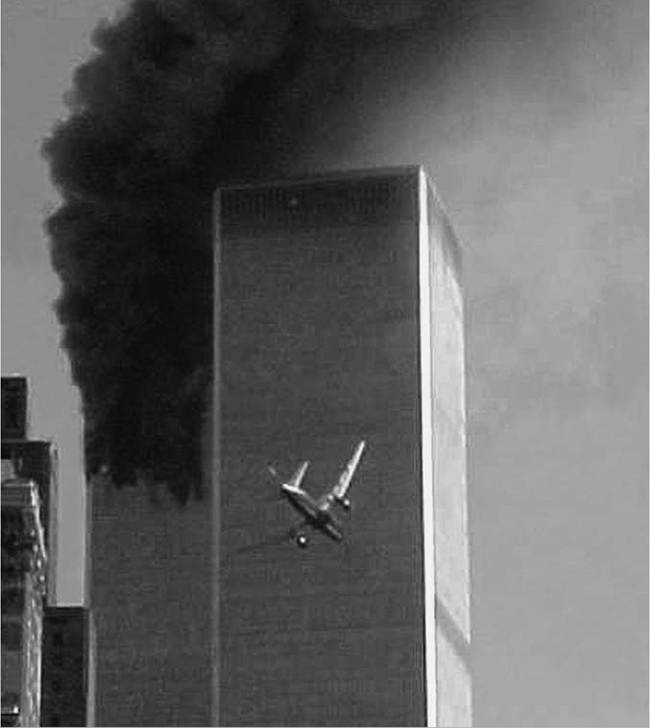
Plate 22.1 New York, 11 September 2001. Plane approaching one of the twin towers just before impact. (Photo: Carmen Taylor, AP/PA Photos)
(although sometimes mistakenly) identified, this new conflict was not only unpredictable, but also essentially borderless and global. While destroying the Taliban stronghold in Afghanistan in the initial campaign of the ‘war on terror’ proved relatively easy, how to follow up this offensive was far from clear. The most obvious move was to call on friendly states around the world to clamp down on the dozens, if not hundreds, of terrorist organizations in operation and to act to deny them arms, money and any form of sanctuary. That still left, however, the problem of what to do about unfriendly states that either might directly, through overt or secret assistance, or indirectly, by creating regional instability, provide sustenance to terrorists.
Among those states perceived as unfriendly, the United States was most concerned about those that it believed were pursuing the acquisition of weapons of mass destruction (WMD). This was in part because they were perceived as potentially representing a direct threat to American soil, but also because it was held that they might assist terrorist groups in gaining a WMD capability. Unnerved by the events of 11 September, the United States announced in December 2001 that it intended to withdraw from the 1972 Anti-Ballistic Missile Treaty so that it could build a new missile defence system capable of protecting itself from limited nuclear strikes by ‘rogue states'. The Bush administration was not, however, thinking only of passive defence, for the president began to argue, in what eventually became known as the ‘Bush Doctrine', that the United States reserved to itself the right to take pre-emptive action against potential security threats.
In his 2002 State of the Union Address, he went further, accusing Iran, Iraq and North Korea of constituting an ‘axis of evil' that presented a clear threat to the international community. The question then was against whom would preemption be used first.Eventually in the autumn of 2002, the Bush administration singled out Iraq from among these pariah states as its main target. It accused Saddam Hussein, who was still reigning supreme despite twelve years of the economic sanctions that had been imposed after the 1990—91 Gulf War, of harbouring WMD and of seeking once again to achieve a nuclear capability. In fact, the Bush administration had been focusing on Iraq even before 11 September, for many among its senior personnel believed that the president's father, George H. W. Bush, had erred in 1991 when he failed to push on to Baghdad and overthrow the Saddam regime. The unfortunate result was that Saddam had been left in power as a constant thorn in the side of American interests in the Middle East. The terrorist attacks in September 2001, however, made the need for action even more pressing, for the removal of Saddam was now seen potentially as a panacea that might alleviate some of the reasons for America's unpopularity in the Middle East. One rationale for acting to remove Saddam was that the ‘liberation' of Iraq might initiate a swing towards more democratic government in the region, which would, in turn, generate greater international political stability. In addition, it was felt that the introduction of democracy might produce states that were more receptive to the need for social and economic reform and thus able to address and blunt the frustrations that led people to support the radical Islamist groups. Another issue was the concern that as long as Iraq remained an unpredictable pariah state, then the United States had to maintain large military forces in Saudi Arabia. This was a problem because it allowed al-Qaeda to generate support by declaring that ‘infidels' were defiling the country that contained Mecca.
see Chapter 20
see Chapter 19
In addition to the sense that the overthrow of Saddam might have positive benefits, there was a feeling that failure to act might only lead to a worsening of the situation. The problem from this perspective was that the sanctions regime that had been overseen by the United Nations (UN) since 1990 was coming under increasing international attack for being an ineffective and immoral instrument that hurt ordinary Iraqis while doing nothing to undermine Saddam. The prospect was thus looming into sight of UN sanctions ending and Saddam then being freed from their vice-like grip and being given the space to reactivate his WMD programmes. The combined effect of these considerations, allied to the fact that Bush had overwhelming domestic support for any action that might enhance American security, thus pushed the administration towards the fateful decision to invade Iraq. In October 2002 Bush requested and received the permission of both the House of Representatives and the Senate to use force against Iraq.
United Nations (UN)
An international organization established after the Second World War to replace the League of Nations. Since its establishment in 1945, its membership has grown to 192 countries.
Document 22.1
The Bush Doctrine - Excerpts from the National Security Strategy of the United States, 22 September 2002
The United States possesses unprecedented — and unequaled — strength and influence in the world. Sustained by faith in the principles of liberty, and the value of a free society, this position comes with unparalleled responsibilities, obligations, and opportunity. The great strength of this nation must be used to promote a balance of power that favors freedom.
For most of the twentieth century, the world was divided by a great struggle over ideas: destructive totalitarian visions versus freedom and equality.
That great struggle is over. The militant visions of class, nation, and race which promised utopia and delivered misery have been defeated and discredited. America is now threatened less by conquering states than we are by failing ones. We are menaced less by fleets and armies than by catastrophic technologies in the hands of the embittered few. We must defeat these threats to our Nation, allies, and friends.
This is also a time of opportunity for America. We will work to translate this moment of influence into decades of peace, prosperity, and liberty. The US national security strategy will be based on a distinctly American internationalism that reflects the union of our values and our national interests. The aim of this strategy is to help make the world not just safer but better. Our goals on the path to progress are clear: political and economic freedom, peaceful relations with other states, and respect for human dignity.
And this path is not America's alone. It is open to all. To achieve these goals, the United States will:
• champion aspirations for human dignity;
• strengthen alliances to defeat global terrorism and work to prevent attacks against us and our friends;
• work with others to defuse regional conflicts;
• prevent our enemies from threatening us, our allies, and our friends, with weapons of mass destruction;
• ignite a new era of global economic growth through free markets and free trade;
• expand the circle of development by opening societies and building the infrastructure of democracy;
• develop agendas for cooperative action with other main centers of global power; and
• transform America's national security institutions to meet the challenges and opportunities of the twenty-first century.
Source: http://www.whitehouse.gov/nsc/nss.html
The United States did not, however, wish to launch the attacks on Iraq without support from the international community. Thus, Washington, acting under considerable pressure from Britain, took its case to the UN. By taking this route it was, however, putting itself in an awkward position, for if it desired a UNsanctioned attack against Iraq, then it had to rest its case entirely on the argument that Saddam was clearly guilty of ignoring UN Security Council resolutions pertaining to WMD. It could not make reference to the additional motives for
taking extreme action, such as the desire for ‘regime change', for this would have been against the terms of the UN Charter. On 12 September 2002 President Bush made his initial case for the overthrow of Saddam Hussein in a speech to the UN Security Council in which he argued that Iraq, which had refused to co-operate with UN weapons inspectors since 1997, was continuing to develop WMD. However, he failed to obtain UN authorization to use force, for influential countries, including France and Germany, were sceptical of the American claims. As a result in November the UN Security Council hammered out a compromise: instead of an invasion, Security Council Resolution 1441 authorized further inspections and threatened ‘serious consequences' for Iraq in case of noncompliance. Headed by the Swedish diplomat Hans Blix, the UN's new inspection team arrived in Baghdad on 18 November 2002.
Over the next four months the noose around Iraq tightened. American, British, Australian and selected other countries' troops began arriving in the Persian Gulf region; by mid-March 2003 they numbered about 200,000. In February 2003 Secretary of State Colin Powell made a strong effort to persuade the UN Security Council that authorization for disarming Iraq, which was a euphemism for invasion, was necessary. Powell presented evidence, much of which was later discredited, of an ongoing Iraqi chemical and biological weapons programme as well as outlining Saddam's supposed links to al-Qaeda and other terrorist organizations. The United States, supported by Britain and Spain, then submitted a resolution authorizing the use of force. Faced with a likely veto from France and Russia, the Americans later withdrew the resolution, but the preparations for invasion still went ahead, and on 17 March Bush publicly demanded that Saddam Hussein and his two sons leave Iraq within two days. They did not. However, the remaining UN weapons inspectors took the hint and exited the country.
On 20 March 2003 the American-led attack on Iraq — ‘Operation Iraqi Freedom' — commenced despite massive European, and even domestic American, scepticism over the necessity and wisdom of such an undertaking. The military success of the invasion was unquestionable. On 9 April American forces entered Baghdad and on 15 April the invasion was officially deemed to have achieved its goals. On 1 May 2003 President Bush made this clear by giving his infamous ‘Mission Accomplished' speech in which he asserted that combat operations were over. He spoke much too soon.
More on the topic Introduction:
- A Introduction
- Introduction
- This essay provides an introduction to the philosophy of chemistry with a focus on ontological, epistemological, methodological, and ethical issues.
- Introduction
- Introduction
- Introduction
- Introduction
- AVIAN CHOLERA
- Hare C., Neo D. (eds.). Trade Finance: Technology, Innovation and Documentary Credit. Oxford University Press,2021. — 417 p., 2021
- Harker C., Horschelmann K. (Eds.). Conflict, Violence and Peace. Springer,2017. — 456 p., 2017