Making an Impression
Fashion reports in the media contributed both negative and positive images of the brides. On arrival, fashion, clothes, and appearance were interpreted as indications of war brides' suitability and adaptability, but conservative attitudes quickly became apparent and sent mixed messages to newly arrived brides.
In spite of undeniable widespread interest in their overseas clothes, hair styles, and shoes, war brides found they often transgressed local dress codes. Their breaches of local conventions were closely and, sometimes, critically observed. A war bride, who attended a tea party at the Victoria League in Auckland, felt underdressed because all the local women had hats and gloves, which, she said, “we had long since given up in Britain.”49 When they arrived in New Zealand, war brides found outdated codes of dress that accentuated the gap in fashion between postwar Britain, where style had “moved on,” and New Zealand, which was “stuck in the 1930s.” This illustrates something of the clash between the metropolis and the periphery that was the remnants of the British Empire: war brides perceived that New Zealand did not match up to the Britain they had left behind, and curiously, New Zealanders perceived that war brides did not match up to the image that the conservative elements in that society perpetuated as “British” standards.When the media championed war-bride marriages by extending desirable attributes to women including those from countries that had been wartime adversaries, it compounded the ambivalence of the public toward the brides. This was equally true when they overemphasized national stereotypes in describing the women. For example, in 1946, Mrs. Biddick, wife of an ex-POW, was deemed to be “unmistakably a German girl, her hair worn high in the German style with four combs, and youthful.”50 This report simultaneously drew attention to her German origins (possibly negatively received) and her youth and fashionable appearance combined with her willingness to learn English, which were positive features.
This positive image was assisted by the fact that her family had sheltered the man she married when he escaped from a prisoner-of-war camp. British women came under the same scrutiny and were acclaimed for being demurely dressed, which implied acceptability.51 In addition, they were praised for overcoming the strict rationing of clothes in Britain and arriving in New Zealand “all smartly turned-out.”52 Canadian and American brides and fiancees arriving in New Zealand on the Monterey in February 1946 were described in the press as “dressed quietly without any attempt to appear glamorous for the sake of effect.”53 However, images of neatly dressed constrained women were in competition with those of popular avant-garde fashions of war brides encouraged in the cinema newsreels and newspapers. War brides trod a thin line between presenting exciting new styles and being regarded as risque.54Just as the interest in fashion cast war brides as attractive “packages,” the commodification of these women was compounded by the discourses of international “trade” in brides. There was a popular view that “war bride” was an epithet for prostitute and that they could be “acquired” by a simple exchange of goods.55 The treatment of women who became war brides in this manner was encapsulated in a cartoon showing a New Zealand soldier about to be repatriated from Italy at the end of the war. The cartoon illustrated an Italian woman and a New Zealand private attempting to board the transport. The New Zealand soldier is addressing his commanding officer as he is about to be repatriated at the end of the war: “But Sir! Why can't I take her home? I hocked all my gear for HER instead of a CAMERA!” (figure 3.1).
In view of the fact that Italian women were portrayed in this way, it is not surprising that Italian war brides faced hostility when they arrived in New Zealand. However, senior members of the defense forces involved in the repatriation of war brides expressed the opinion that these women were making gigantic decisions to migrate to New Zealand, often in opposition to their families, and that they should be supported as much as possible.56 This counterview was supported by letters to the editor of the New Zealand Herald.
A returned serviceman wrote that “our admiration for the greater number of European girls was compelled by their bearing under great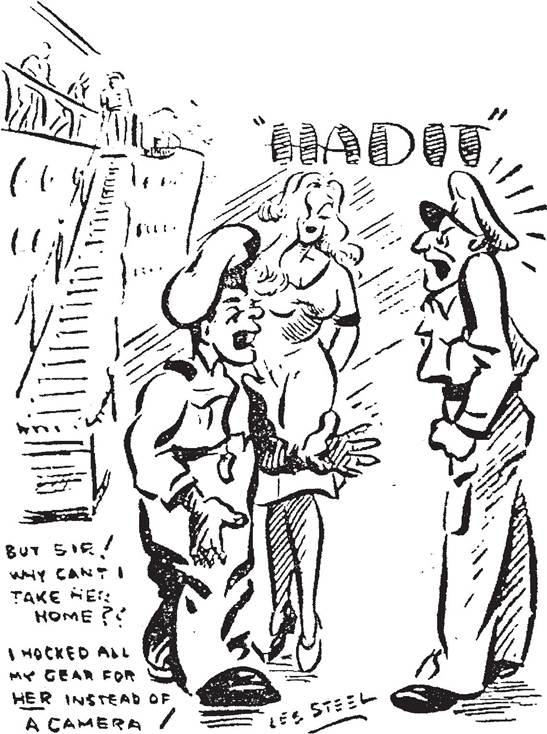
Figure 3.1 This cartoon depicts a New Zealand soldier about to be repatriated at the end of the war addressing his commanding officer.
Source: Cartoon by Les Steel, printed in The Tattler (troopship magazine of the SS Tamaroa^ (February/ March 1946), p. 11, Archives New Zealand/Te Rua Mahara o te Kawanatanga, Wellington Office.
adversity, their loyalty to those separated by war from them, their dignity and many other virtues which, alas, did not seem to emanate in similar degree from so many back home here.”57 However, in spite of such positive protests on their behalf, the belief that women could be bartered for the price of a camera or the lure of a better life lingered. In the New Zealand context, Brigadier Stevens echoed these sentiments when he wrote in support of averting war marriages between 2NZEF personnel and Italian women:
[I]t is probably true that the Italian people clearly recognise that after the war conditions of life will be infinitely more difficult in Italy than in New Zealand. Italian people have been very prone to emigrate at any time, consequently there is no widespread dislike to leaving Italy.58
New Zealand's immigration policy gave pause to a government obliged to facilitate the repatriation of dependents but anxious to control the entry of “non-British stock.”59 In general, the New Zealand authorities expected that cultural integration would be easier for women from “appropriate” and “complementary” backgrounds to their New Zealander husbands. The government also saw the benefits of acquiring a self-selecting population of women compatible with the projected immigration-promotion policy envisaged for the postwar period. Tensions existed because such a selection included women of diverse ethnic and religious populations, especially from North Africa and the Middle East.
However, although the tensions never entirely evaporated, the rights of servicemen to marry whom they pleased were protected by law, and in the postwar period the emphasis was on reuniting and rebuilding strong family units regardless of the background of the wives.60 In this context, then, there seems to have been a common acceptance that “typical English milk- and-roses complexions and fine, fair, silky hair” would make for quick integration into New Zealand society.61 These attributes could be extended to women from various backgrounds. The Weekly News reported that twenty-year-old Helene Bryant from Cairo had “the same kind of Greek beauty as the Duchess of Kent: oval face, brown eyes and soft, light brown hair.”62 Being “fair” was a visible signifier of the common British heritage the New Zealand government and community at large were keen to foster and indulge in as a part of their “national” identity. The woman who did not visibly disrupt this Anglo-Celtic imagined community was far more likely to be perceived as “bride” than whore.
More on the topic Making an Impression:
- B The Hypothesis in Science Education
- PERSUASION IN THE CONTEXT OF CONFLICT RESOLUTION
- AN OVERVIEW OF PERSUASION THEORY AND RESEARCH
- B Find the Hypothesis
- Proper Legal Uses of the Sources Unconnected to Constitution-Makers
- Critical Assessment
- Judicial Review
- THE PROBLEM
- C Kinds of Science: Objectives and Methods
- From the Inside of Science: Experimental Method and Metaphysics