Narrative Outline
The immediate origins of the Caliphate lay in the interactions between Rome, Iran, and the tribes of the Arabian Peninsula in late antiquity. In Arabia, as on other frontiers, the two rival empires sought to use diplomacy to secure their borders and to gain strategic advantage over one another.
These interactions in turn generated new political formations, with enhanced military capacities. From the fourth century, the Romans had tended to make alliances sanctioned by the Christian God; in contrast, the Sasanians of Iran were wary ofwhat approximated to a Roman ideology. Nonetheless, Christianity was spreading within the multi-confessional Sasanian Empire and among its clients.[1000] The political complexities of this late antique world are reflected in articulations of identity in vernacular monotheist scripture: in the sixth-century Middle East, Greek, Syriac, Coptic, Armenian, Hebrew, Aramaic, and Ge‘ez were all scriptural languages of the Judeo-Christian religious tradition.[1001]Islam began to take shape in this late antique world, where political and ethnic identities were often tied to variants of Judaism and Christianity. The first extant Arabic monotheist scripture—the Qur'an—is now inextricably associated with the Prophet Muhammad (ca. 570-632).[1002] Muhammad lived in the western Arabian highlands known as the Hijaz, beyond the direct influence of Rome and Iran. Not well received in his hometown of Mecca, Muhammad took his reformist message to Yathrib (later Medina), 350 kilometers to the north. There, in the 620s, he established a community of monotheist faithful. Then, having gained the support of a number of desert tribes, he negotiated the surrender of Mecca in 630, claiming its shrine, the Ka‘ba, as Abrahamic—and in so doing appeasing his own tribe, the Quraysh, who controlled the Meccan temple and its revenues.
Mecca became the site of an annual pilgrimage, while Medina remained the political center of the new polity.That Muhammad's prophetic career (ca. 610-632) coincided very closely with a catastrophic war between Rome and Iran (602-630) is not mere chance.[1003] Muhammad's prophecies about the war are in the Qur'an,[1004] and his apocalyptic tone echoes the way that it was understood across the Middle East. As a result of this “world crisis,” Muhammad's successors were able first to consolidate Hijazi leadership ofthe Arabian tribes, and then to turn the tribes' energies against the newly vulnerable empires. By the 640s, Hijazi governors had been appointed in post-Roman Egypt and Syria, and in post-Sasanian southern and central Iraq, where they oversaw the division of the spoils and continued expansion east, into Iran and Central Asia, and west, into North Africa and Anatolia. By the 670s, garrisons had been established at Qayrawan in Roman Byzacena (Tunisia), at Merv in Sasanian Khurasan (Turkmenistan), and at Dabil/ Dwin in Armenia. However, within two more generations, the momentum of the initial expansion had died: the Sasanian Empire had been overwhelmed, but the Roman capital of Constantinople had resisted a prolonged siege in 717-718; in the 720s, the Franks proved resistant to Muslim raids in the west, just as the Khazars and Turgesh were effective adversaries in the north and east.
The strategic mobility of the Arabian tribes, and their ability to gather intelligence and exploit weakness in the settled civilizations, were probably key factors in their military success.[1005] What gave the conquests an unprecedented cultural impact, uncharacteristic of most nomad empires, was their leadership by settled tribesmen who brought with them a religious and linguistic identity that could survive encounters with the civilizations they defeated.[1006] In political terms, a key consequence was the persistence of the idea that a member of Muhammad's tribe of Quraysh should lead a united Muslim polity.
However, which member of Quraysh should lead the Muslims was a source of recurrent conflict. In the first decades after Muhammad’s death, the Hijazis united around two of Muhammad’s fathers-in-law, Abu Bakr (r. 632-634) and ‘Umar (r. 634-644). But the next generation, which belonged to two sons-in-law, descended into war. ‘Uthman (r. 644-656) was a scion of the powerful Umayyad clan within Quraysh. ‘Uthman’s attempt to assert greater central control over the conquered provinces, and his tendency to use his tribal connections to do so, provoked his assassination, followed by the promotion to the caliphate of a second son-in-law of Muhammad, ‘Ali (r. 656-661). However, ‘Ali’s rule was a period of continual internal conflict, now remembered as the first civil war (fitna). On ‘Ali’s assassination in 661, Mu‘awiya, the governor of Syria and a second cousin of ‘Uthman, was in a position to seize power, using the military resources of the Romano-Syrian tribes to intimidate potential opposition.
Mu‘awiya (r. 661-680) is remembered as the founder of the Umayyad dynasty, whose members ruled the Islamic world from Syria for most of the period 661-750. This is somewhat misleading: ‘Uthman had been an Umayyad too. Furthermore, although Mu‘awiya was indeed the first caliph to successfully pass power to a son, Yazid (r. 680-683), the succession ended in an Umayyad interregnum when Yazid died prematurely. In the mid-680s, most of the empire was once again ruled from the Hijaz, by Ibn al-Zubayr (r. 683-692), whose tumultuous reign is now remembered as the second civil war.[1007] However, the military and political resources of Syria won out: a second cousin of Mu‘awiya, Marwan (r. 684-685), and then Marwan’s son, ‘Abd al-Malik (r. 685-705), restored Syrian, and Umayyad, rule. ‘Abd al-Malik was succeeded by sons, grandsons, and nephews in the 45 years from 705-750, collectively known as the Marwanid sub-dynasty of the Umayyads.
Although the Marwanid Umayyads presided over the continued expansion of the empire and the consolidation of a distinctively “Islamic” state, they lost power in 750, to a combination of internal conflict, ideological failure, and demographic change.
The latter was of the greatest long-term significance: the consolidation of the Muslim Empire in the first half of the eighth century had transformed relations between the colonizing elite and the much larger colonized populations: the conquered peoples were being drawn into the provincial and imperial elites as bureaucrats and soldiers; there was also now an extensive subaltern class on the frontiers, for whom the best prospects of legitimating any attempt to seize a greater share of imperial resources lay in adopting Islam.[1008] In 739, these developments were manifested in the “Berber” revolts in North Africa, whose leaders adopted the secessionist and tribally oriented Kharijite strand of Islam. In Iraq and Iran, revolts tended to assume the character of bids for power at the imperial center: a series of rebellions against the Umayyads in the 740s were supported by aggrieved elements in the Arab armies and in the wider Persian population; all took a proto-Shi‘i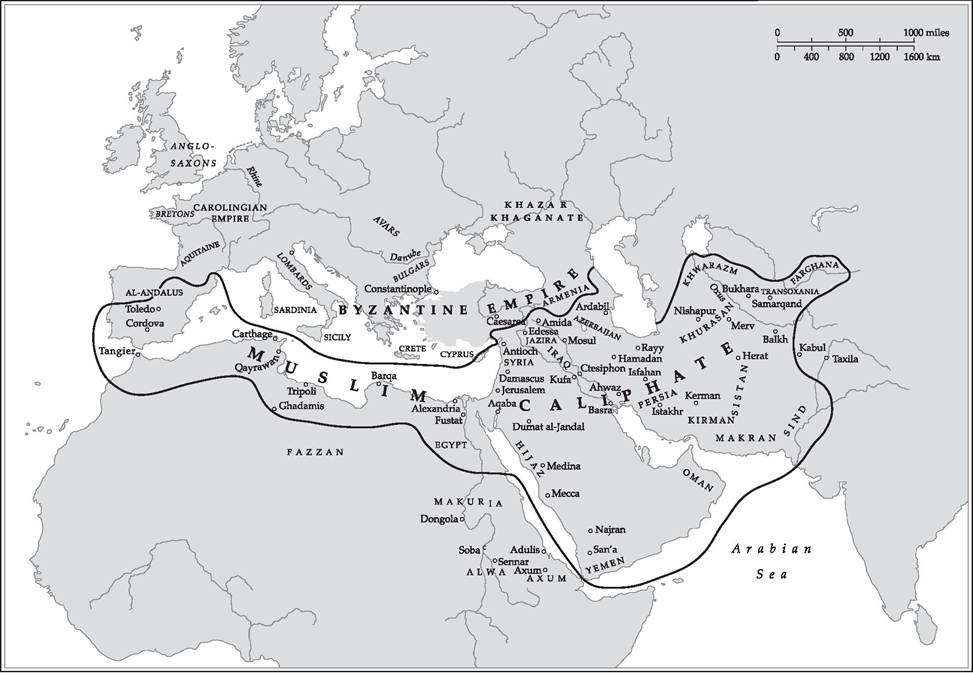
Map 12.1. Limits of Muslim Rule in 750 ce.
Source: Howard-Johnston, 2010, Witnesses to a World Crisis: Historians and Histories of the Middle East in the Seventh Century, p. xxxiv. Copyright: Oxford University Press.
the caliphate 359
orientation (that is, they emphasized close kinship with the Prophet Muhammad as the basis of caliphal legitimacy).
In 747 one of these eastern rebellions broke out near Merv, in the province of Khurasan (modern eastern Iran, northern Afghanistan, and southern Turkmenistan). It was timed to exploit the third civil war—a violent dynastic conflict that had split the Umayyads and their Syrian armies since 744. In the wake of sweeping victories by the rebels, Abu al-‘Abbas al-Saffah, from the Abbasid branch of Quraysh, was installed as caliph at the congregational mosque in Kufa, Iraq. Shortly afterward, the last Syrian Marwanid caliph was killed as he fled west through Egypt.
Abu al-‘Abbas (r. 750-754) was succeeded by his brother al-Mansur (r. 754-775), the founder of Baghdad and the ruler from whom all Abbasid caliphs during the next 504 years were descended. Both men were great-great grandsons of al-Abbas, an uncle of the Prophet Muhammad, and so could appeal to the proto- Shi‘i sentiments of the revolutionaries.Following the Abbasid Revolution, the descendants of al-Mansur presided over the consolidation and development of what would become the classical institutions of Islamic government. At the same time, the Abbasids exchanged their proto-Shi‘i stance (which could always be outflanked by those who claimed direct descent from the Prophet) for an alliance with the scholars of an emergent traditionalist Sunni Islam. The traditionalist Sunnis placed less emphasis on the caliph's bloodline and charismatic leadership, and instead stressed consensus among Muslim scholars in the interpretation of religion, particularly as embodied in the sharia, or religious law, as derived from traditions about the Prophet and his Muslim contemporaries, the Companions.[1009]
The Abbasids of the eighth and ninth centuries were the last genuinely imperial caliphs. Apart from provinces in the far west, which were never under Abbasid control, the Abbasid Caliphate initially retained and reinforced the empire's political integrity. However, corrosive interactions between political ambitions in the provinces and within the ruling dynasty began to erode it: already by 800, al- Mansur's grandson, Harun al-Rashid (r. 786-809), had to cede independence to the governors of Ifriqiya (Tunisia); on his death, civil war pitted the imperial center at Baghdad against the northeastern frontier of Khurasan. In a repetition of the pattern established by the Abbasid Revolution, Khurasan defeated the center. However, the conflict was prolonged, and only in 819 did the victor, al-Ma'mun, return to Baghdad from Khurasan. After this war, the Abbasid caliph no longer appointed his relatives to the provinces.
Instead he relied upon local dynasts and, from the 830s, upon members of a new elite cavalry force recruited from Central Asia (“the Turks”), whose factions, garrisoned at the new capital of Samarra, quickly came to dominate the imperial apparatus, competing over the choice of caliph.The assassination of al-Mutawakkil (r. 847-861) by a Turkish faction triggered a decade-long crisis, often referred to as the “Samarran anarchy” (861-870). Unrest at the center prompted secession at the periphery, where local elites came to recognize that there was little to be gained from anything but the most notional loyalty to the caliphs. With declining tax revenues from the provinces, and damage wreaked upon Iraqi agriculture by civil war, came a downward spiral of decline. Autonomous military elites sprang up across Iran, some of whom threatened Iraq itself. At the same time, the Abbasids faced the challenge of the formation of the rival, Shi‘i, Fatimid Caliphate in North Africa (909-1171).[1010]
After a brief revival of their fortunes in the late ninth and early tenth centuries, the Abbasids were subsumed by warlords—first by the Khazari Turkish general Ibn Ra'iq, in 936, and then after 945, by the Shi‘i Buyid dynasty, from northern Iran. However, the collapse of the empire had left behind a patchwork of successor states, all of them, except Armenia, ruled by Muslims—testimony to the transformations wrought by the former empire. It is to the structures and dynamics of power within this empire that we can now turn, beginning with the economy.
More on the topic Narrative Outline:
- Toward a New Narrative?
- Women in the Sacred Landscape of Early Christian Narrative
- Outline of This Book
- The Narrative of National Liberation
- Viking Raiding in Outline
- An Outline of a Theory of Propositional Vagueness
- Narrative Construction of Individuals and Groups
- AN OUTLINE OF EXISTING LITERATURE ON MONEY SUPPLY
- ARCHAEOLOGY AND THE STUDY OF RELIGION: A HISTORICAL OUTLINE
- Empire as a Geopolitical Variable: A Historical Outline