PART V ANOTHER WORLD
The Separate but Parallel Path of Imperial Formations in the Precolonial Americas
Peter Fibiger Bang
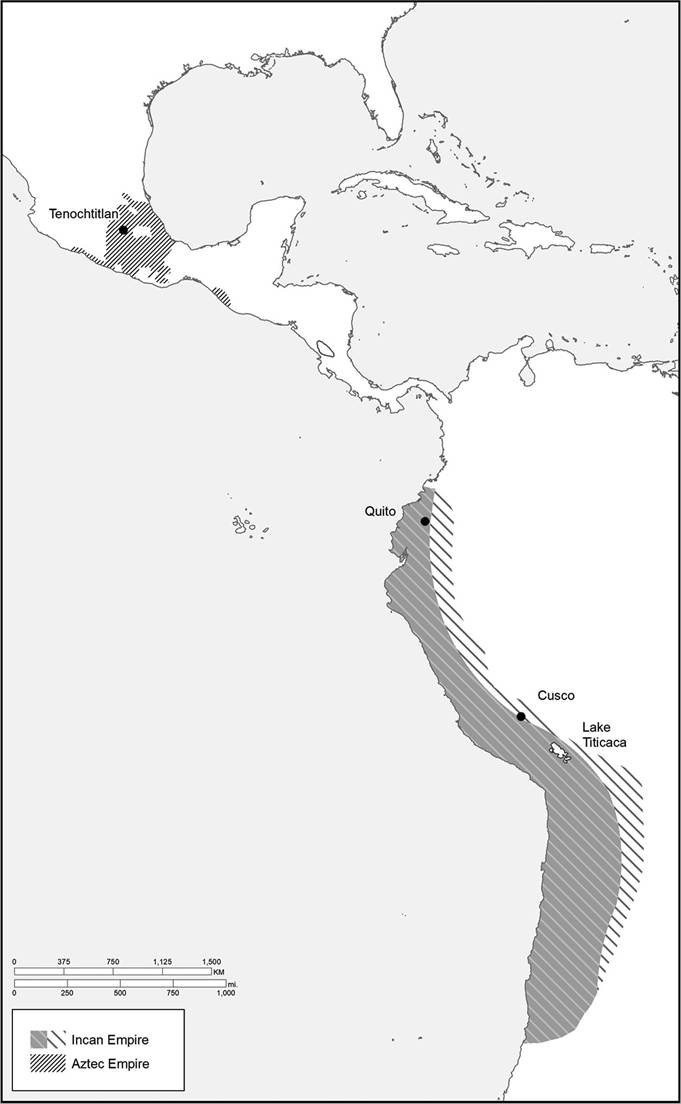
MapV.
Another World: The Separate, but Parallel Path of Imperial Formations in the Precolonial Americas.
Among the more surprising treasures held by the Royal Library in Copenhagen is a manuscript written in Peru and sent from Lima to King Philip III of Spain around 1616. The author was a Felipe Guaman Poma de Ayala, a man of Indian noble lineage. In his veins ran the blood of two indigenous royal dynasties, including that of the Incas—at least so he claimed—as well as that of a man who in a previous generation had earned distinction by saving the life of one of the early conquistadors. Here, clearly, was someone worth listening to: a man anchored in the Inca past, an asset for the Spanish future. Even so, Guaman Poma had to wait a long time until he found his audience. The court of Philip paid scant attention to the more than a thousand pages analyzing and criticizing conditions in colonial South America. Whatever the reason—a failure of patronage, the lack of polish in the command of Spanish, the intensity of the protest—the ambitious treatise and its hundreds of fascinating illustrations of life in the New World did not find a publisher, and indeed may not even have been read. Instead the manuscript, possibly acquired by an ambassador to the Spanish court, gathered dust in the library of the Danish king from the mid-seventeenth century until the twentieth, when it was finally taken out, dusted down, and made available to a wider public.[1696]
What the reader found, belatedly, was a rare indigenous voice, offering precious information on the character of Amerindian society before the conquest and during the first decades of Spanish rule.[1697] The objective of Guaman Poma had been to carve out a better place for the Indian population and its leaders within the order of their new imperial masters.
The histories of the two societies had to be brought together. “Huascar died at twenty-five years of age and thus ended the line of Inca kings,” Poma observed. This statement may perhaps come as a surprise to the modern reader, who will know Huascar only as the penultimate ruler of the Inca Empire and the last incumbent of the dynasty whose reign had predated the arrival of Francisco Pizarro and his troop of Spanish soldiers in 1532. But then, Poma added the clarifying and significant remark: “the legitimate capac apo who ruled under the laws of this kingdom of Peru.” Therefore, the chronicler could now go on to put forward the remarkable assertion that at the death of Huascar “the royal mascapaycha crown was left to our lord his holy Catholic majesty the king, who rules the whole world.”[1698] Poma thus denied to Atahualpa—the brother of Huascar, who had won the throne in a civil war and was captured and executed on the orders of Pizarro—any legitimacy, simply bypassing him and granting the succession directly to Spain. The fiction of a translatio imperii may have been in keeping with Spanish claims. But, as Poma insisted, it equally enabled the Indian nobility seamlessly to transfer its allegiance to its Iberian masters. The social order of the Andean world was far from incompatible with the new dispensation, Poma insisted, and the Spanish overlord ought to rely more on the elite segment of indigenous society in governing his American territories, to curb abuse and enable society to prosper.The attempt to inscribe the conqueror into local history and the local into metropolitan culture is a classic strategy employed by subject elites across the world history of empire in order to claim a position of power, influence, and authority for themselves in relation to their rulers. Parallel examples, with varying degrees of emphasis, can easily be found. Remember Josephus, the Roman Jew discussed in Chapter 1 of Vol. 1, who wrote a history of a rebellion that had gone fatefully wrong.
Among his writings is also a copious compendium of antiquities, seeking to write the religious and cultural customs of Jewish society into a wider history of imperial Hellenism.[1699] Likewise, Poma set out to align the history and oral traditions of Andean society with the Roman Catholic civilization of the new Iberian rulers. Only here he faced the added problem that the two cultural universes had developed in absolute separation from each other. Since the end of the last Ice Age and the closing of the Bering land bridge between Asia and Alaska around 9000 bce, the bands of hunter-gatherers that had populated the Americas had been cut off from the rest of humanity. Even so, the imperial language of Roman Christianity, the only one available to the Spanish, turned out to serve Guaman Poma and others like him well enough. The Indian population could be presented as a sort of natural Christians, originally practicing monotheism before they had strayed into polytheist heresy; their history could be rearranged in relation to defining moments in biblical chronology, such as Noah's Ark and the birth of Jesus, or occasionally reigns of Roman emperors.[1700]While these efforts established a basic commonality between the New and the Old World, modern scholarship has shifted the preferred focus of comparison from the Romano-Catholic experience to reach further back in time to the age of early stateformation in the ancient Near East.[1701] It has mainly been the task of archaeology to open the Pre-Columbian past of the Americas. Little material in written form was produced by the societies of the New World before the time of European reconnection and conquest in the early sixteenth century, and that which exists has only slowly yielded to attempts at decipherment. Yet, when we take into account that the historical development of human societies in the Americas took place in isolation from the Afro-Eurasian world, the paths taken are surprisingly similar, although with one qualification: empire emerged as a relatively late outgrowth of social evolution in Amerindian society, confined approximately to the last millennium before the arrival of Columbus in 1492.
Still, where populations began to grow denser, sedentarization and more intensive forms of agriculture followed, often through the construction of extensive systems of terraced fields. When population becomes dependent on such productive fixtures, mobility is much restricted, and forms of social complexity begin to develop in tandem with the heightened potential for elites to control producers. '1 he first signs of the development of ritual centers date to the third millennium bce, while state formation takes its first slow steps in the first millennium bce. Archaeologists debate the precise character of these polities, chiefdoms, or states, but by the first millennium ce, the Moche culture in northern Peru, or the Maya in Mesoamerica with their urban pyramid temples discovered in the jungles, leave little doubt that a world of small state-entities had emerged. As scholars have begun to decode Maya hieroglyphic inscriptions, it has become increasingly clear that this was a world of “warring states.” Rulers were frequently locked in military confrontation with each other, and bigger, more powerful cities often fought to have a “friendly” king installed as ruler among their neighbors.
Eventually, as was to be expected, bigger imperial entities began to coagulate out of the fluid rivalries of these state-forming central regions. The process was far from even, punctuated by state-collapse, and difficult to describe in historical detail. Even so, it would be a mistake to see the rise during the fifteenth century of the Aztec and Inca empires (Smith and Sergheraert, Chap. 24 and Covey, Chap. 25), the two large political entities that the Spanish invaders encountered on the mainland, as having emerged on a blank canvas. They had smaller-scale, more ephemeral predecessors, such as the Wari Empire (ca. 750-1000) in Peru. Students accustomed to conditions in the Old World may be struck by the lack of technologies such as wheeled transport, iron, or horseback riding, as well as the relatively low number of domesticated animals.
Yet, the significant conclusion to draw from these observations is not so much about the relative weakness of American state-formation prior to the Iberian conquests, but rather the opposite. Apparently, none of these things mattered decisively to the basic fact of empire, as long as there was a population base sufficiently strong to make conquest sustainable and allow a ruling elite to extract a surplus from the wider population.[1702]Bibliography and Guidance
On the long pre-Columbian development of social complexity and state-formation in Meso- and Andean South America, expert surveys are offered by Foster (2002), Nichols and Pool (2012), and Moore (2014). The identification, by Robert Carneiro (1970) on the basis of pre-Columbian American examples, of “circumscribed” agricultural resources as a crucial enabling factor behind state-formation remains classic and provides the basis for the analysis of the emergence of the state by Michael Mann (see Part I). When people are unable to move away from their resource base, they may be dominated and become the targets of military conquest. See Stanish and Levine (2011) for a more recent reaffirmation of the significance of warfare in the development of states in the Peruvian Andes.
Bibliography
Alcock, S., et al., eds. 2001. Empires: Perspectives from Archaeology and History. Cambridge.
Ayala, F. G. P. de. 2009. First New Chronicle and Good Government: On the History of the World and the Incas up to 1615. Edited and translated by R. Hamilton. Austin, TX.
Bang, P. F. 2010. “Imperial Ecumene and Polyethnicity.” In A. Barchiesi and W Scheidel, eds., The Oxford Handbook of Roman Studies, 671-684. Oxford.
Carneiro, R. L. 1970. “A Theory of the Origin ofthe State.” Science 169, no. 3947: 733-738.
Covey, R. A. 2017. “Kinship and the Performance of Inca Despotic and Infrastructural Power.” In C. Ando and S. Richardson, eds., Ancient States and Infrastructural Power: Europe, Asia, and America, 218-242.
Philadelphia.Feinman, G. M., and J. Marcus, eds. 1998. Archaic States. Santa Fe, NM.
Foster, L. W. 2002. Handbook to Life in the Ancient Maya World. Oxford.
Kritovoulos. 1954. History of Mehmed the Conqueror. Translated by C. T Riggs. Princeton, NJ. MacCormack, S. 2001. “Cuzco, Another Rome?” In S. Alcock et al., eds. Empires: Perspectives from Archaeology and History, 419-435. Cambridge.
McC. Adams, R. 1966. The Evolution of Urban Society, Early Mesopotamia and Prehispanic Mexico. Chicago.
Moore, J. D. 2014. A Prehistory of South America: Ancient Cultural Diversity on the Least Known Continent. Denver, CO.
Nichols, D. L., and C. A. Pool, eds. The Oxford Handbook of Mesoamerican Archaeology. Oxford. Ross, J. C., and S. R. Steadman. 2017. Ancient Complex Societies. London.
Stanish, C., and A. Levine. 2011. “War and Early State Formation in the Northern Titicaca Basin, Peru.” Proceedings of the National Academy of Sciences of the United States of America 108, no. 34: 13901-13906.
Wachtel, S. 1971. “Pensee sauvage et acculturation: Lespace et le temps chez Felipe Guaman Poma de Ayala et l'Inca Garcilaso de la Vega.” Annales 26, no. 3-4: 793-840.
Yoffee, N. 2005. Myths ofthe Archaic State: Evolution ofthe Earliest Cities, States and Civilizations. Cambridge.
More on the topic PART V ANOTHER WORLD:
- Part 1 WESTERN EUROPE AND THE WORLD
- The Arctic Ocean is an unusual part of the world of seas.
- PART EIGHT World War I and the Struggle for Independenc
- Part Eight World War I and the Struggle for Independenc
- PART TEN World War II and the Postwar Year
- PART TEN World War II to Independent Ukrain
- PART V: WORLD RELIGIONS AND GROWING PLURALISM, 1850-PRESENT
- PART III WARFARE, COLONIALISM AND EMPIRE IN THE MODERN WORLD II
- PART II A Nineteenth-Century World of Caveat Emptor (1810s to 1880s
- The Hanafijurist Abu Zayd al-Dabbusi (d. 430/1039) hails from the eastern part of the Islamic world, where he served as qadi in Bukhara’ under the Samanid dynasty in Transoxania.[421]
- Europe has always had an interest in and fascination with the part of the world today called “the Middle East,” the lands to its south and east, which have since the seventh century been the heartlands of the Realm or House of Islam (Dar al-Islam).
- Part IV of this handbook applies theories and accounts of collective responsibility to real-world problems, including collective responsibility for: war, global poverty, climate change, conspiracy theories, environmental injustice, and institutional racism.
- We argued in Chapter 0 that credit constraints are an important part of life, especially in the developing world. In this chapter we argue, based on Aghion-Angeletos-Banerjee-Manova (AABM), that the presence of credit constraints can help us understand why volatility is so costly for growth.
- In Part Two, we looked at the first part of Gaius' institutional scheme, the law of persons. It now remains to us to consider the law of things.
- India, the seventh largest country in the world, is the most populous country in the world.
- On 4 February 2005, military guards welcomed guests arriving at the Livadia Palace near Yalta, as they had done sixty years earlier on the first day of the Yalta Conference, which brought together Franklin D. Roosevelt, Winston Churchill, and Joseph Stalin to discuss the shape of the world after the Second World War.
- Whilst the previous part considered some of the difficulties that have dogged documentary trade finance, Part II looks to the future. Given the technological advances that have occurred since the advent of the documentary letter of credit, the former is increasingly threatening to eclipse the latter.
- 12.109 In addition to permitted development rights granted by Part 6 (above), permitted development rights also apply in England under Part 3 (change of use) of the GDO for the conversion of agricultural buildings to some non-agricultural uses.142
- Classical Rome had a very liberal divorce policy (as did Greco-Roman Egypt; see Part III). By the first century B.C.E., women who were not married with manus [see Chapter 1, Part II.B.] had the right to divorce their husbands unilaterally, and eventually the same right was enjoyed by women married with manus.