The Arctic Ocean is an unusual part of the world of seas.
As oceans have entered an historiographical centre stage in recent years, part of what has been called the ‘new thalassalogy’,1 the Arctic Ocean has remained to a large extent on the margins.
Historical scholarship on the oceans has importantly noted that meta-geographical entities such as the Pacific, the Atlantic, the Caribbean and others are of relatively recent date and that such ‘basin thinking’ can be seen as a product of high imperialism of the post-Enlightenment period and in some cases has gained real currency even later.[753] [754] This is true for the Arctic Ocean as well, perhaps to the extent that this region stands out as a case of ocean exceptionalism. It is a sea which until the twentieth century almost no one had crossed, that was not used for trade or contact, and that was more or less inaccessible apart from very small groups of local inhabitants - who furthermore knew nothing of the extent of their northern ocean, beyond what they could reach on their hunting and fishing tours. After millennia of human occupation on its shores, its ice-covered core areas were still quite unreachable for Western explorers as well, although hunters and whalers visited frequently, and cruise ship tourism was emerging from the latter half of the eighteenth century.Hence, as a meta-geographical ocean project it arrived very late and with a number of peculiar features, including the very opposite of the core notion of Fernand Braudel’s vision of the Mediterranean, despite its many boundaries and divisions, as a common space marked by trade and relations. Since the late Middle Ages, the Arctic Ocean was an ocean mostly in a figurative and imaginary fashion. It was brought into the globalising meta-geography of oceans only with the geopolitics of the twentieth century and especially the tensions of the Cold
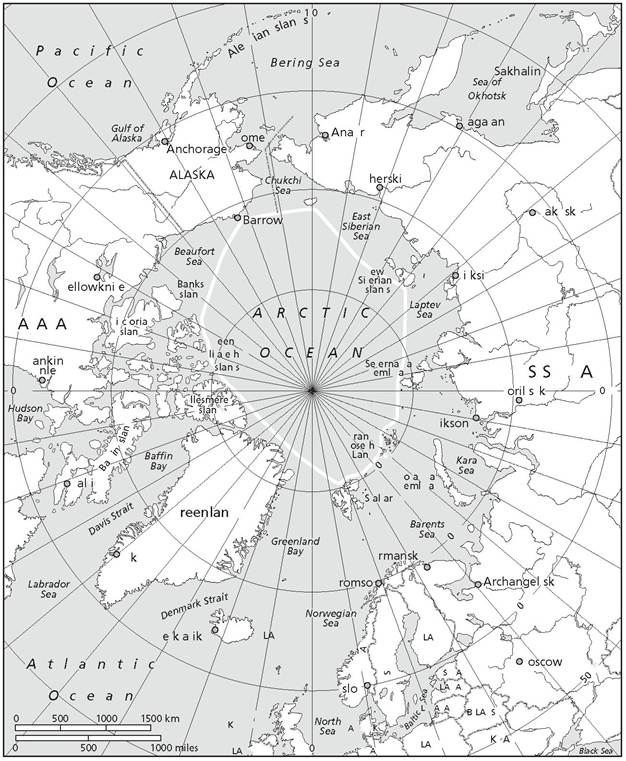
Map 10.1 The Arctic Ocean
War, when the Arctic finally entered a broader discourse as an entire ocean, with a spatial and political significance. It was formally recognised as an ocean by the International Hydrographic Organisation, founded in Monaco in 1921.
In 1953 it was further delineated from northern coastal seas in an elaborate remaking of the 1937 map of ‘Limits of oceans and seas’ to make up only the sea north of any land, including islands, extending from continental territories and of the lines connecting these points.[755] In further revisions of these limits the Arctic Sea was joined with the smaller northern seas, then called ‘subdivisions’, into an extended Arctic Ocean space in 1986.[756] In practice, the waters surrounding all shores of the region are called ‘the Arctic’, yet another phenomenon that gained currency around and after the Second World War, especially in North America, although it had an older history as well.[757] Despite no human being crossing the ice-clad waters, the Arctic Ocean was neither an empty space, nor a silent one. It was a more-than-human world with a more-than-human world’s history of subtle changes over epochs and aeons, recordable only through layers left behind for latecomers to register if we can. Even in our time, recording this fine-tuned ‘cacophony’ requires a hydrophone, as the one lowered on a summer day, seemingly ‘utterly silent’, but far from it:The tremolo moans of bearded seals. The baritone boom of walrus. The high- pitched bark and yelp of ringed seals. The clicks, pure tones, birdlike trills, and harmonics of belukhas and narwhals [...] the whine and fracture of sea ice, and the sound of deep-keeled ice grounding in shallow water.[758]
The Arctic Ocean ‘before history’ had its own history of life.