SECTORAL INSTITUTIONS: SPECIALIZATION AND SPATIAL STRETCH
Social action in European countries was highly institutionalized. In all three sectors could be found formal organizations, each with its internal hierarchy, procedures, norms, sources of revenue, personnel recruitment policies, and mechanisms to reward and punish people impacted by its work.
Institutions create power by pooling, coordinating, and directing the efforts of many human beings. The density and variety of institutions in European countries generated an enormous potential to exercise power. To the extent that institutions elsewhere were less numerous, formalized, complex, and adaptable, Europeans found it relatively easy to enter other societies, to gain influence quickly, and eventually to undermine or outflank indigenous structures.European institutions had a high capacity to absorb and channel for their long-term benefit what the “imperial entrepreneurs” noted in this chapter accomplished. They were thus the crucial links between individuals and the larger units— country, system, region—on which attention has so far been focused. Sectoral institutions were the workhorses of empire. That so many of them flourished after transplantation overseas is the key to any effort to explain the origins and duration of European dominance.
These institutions tended toward specialization of tasks. This point should not be overstated, for functional overlap was a recurring feature of this story. Government employees routinely used public power to amass private wealth. Merchants deployed wealth to influence government decision making. An official church was in some respects part of the public sector. Churches acted as private entrepreneurs when managing land and other property bequeathed to them.1 A certain amount of overlap may have increased the overall effectiveness of European institutions at home and abroad. Still, a broad division of labor among governmental bureaucracies, merchant houses, banks, and religious bodies was widely recognized and accepted.
The division of labor enabled sectoral institutions to dispatch agents in pursuit of specific goals, whether power, profit, or proselytization. The result was a greater impact on non-European societies than if each sector had waited for others from the same country to devise a joint plan before itself taking action.Specialization facilitated recruitment. There were careers abroad for those who wanted to dominate and to serve; for the gold hunter and the ascetic; the lustful and the chaste; the idealist, the dispenser of justice, the cynic, and the sadist; the loner and the deal maker. Europe exported its best and its worst.2 That such a wide range of motivations could be tapped strengthened the drive for expansion by enlarging the pool of recruits for it.
The existence of many specialized sectoral institutions allowed Europeans to tap an array of sources to finance early overseas initiatives. Supplementing government tax revenues were the investable capital of private entrepreneurs and donations of Christians eager to support missionary work The extractive capacity of European institutions, taken together, was sufficiently high to cover imperialism’s initial operating expenses before gains from exploitation of colonial resources were realized.
European rulers had extra resources to spend on overseas initiatives because of what nonstate sectors did at home. Productive activities of profit-seeking individuals and institutions generated substantial tax revenue, while religious institutions carried out social service tasks—education, health, care for the poor and aged—that might otherwise have been performed and financed by government. As a bonus, nonstate sectors could be expected to perform similar services overseas once a colonial administration was in place. European or settler-run enterprises could generate taxable revenue. Official outlays for education and health could be kept low because
mission agencies were willing, for their own reasons, to deploy funds as well as personnel for schools and clinics.
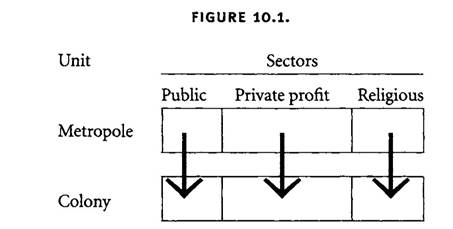
Fiscal incentives were thus tipped toward government engagement overseas.Sectoral institutions headquartered in Europe were able to extend their reach outward, maintaining communication links and lines of authority across thousands of miles. The metropole’s institutions penetrated its colonies. Once there they began to shape colonial sectoral life. But even as they were domesticated in new settings their accountability upward and outward remained. The spatial stretch of sectoral institutions is presented visually in figure 10.1.
The first step in asserting a presence abroad was to recruit individuals from the metropole as a sponsoring institution’s agents. Before departure recruits were instructed what to do to realize their sponsor’s objectives. But the sponsor, whatever its sectoral specialty, faced a problem. To use principal-agent terminology, people whom the principal designated as agents enjoyed unusually high levels of autonomy after reaching their overseas destination. The physical distance between principal and agent, the difficulty if not impossibility of communicating quickly between continents, the agent’s need to respond at short notice to rapidly changing local conditions, serendipities built into cross-cultural encounters—all these factors gave people on the scene far greater leeway to set goals and decide how to reach them than principals wanted to acknowledge. The danger from the latter’s perspective was that the agent might neglect the principal’s goals and (mis)use autonomy to advance the agent’s own interests. Even more serious than this risk of “moral hazard” was the possibility that the agent might openly rebel, claiming power and legitimacy the principal believed it alone possessed.3 Recruitment for overseas careers might in fact attract precisely the kind of person inclined to reject the principal’s authority once rejection became a viable option.
There is ample evidence that the self-interest of agents posed serious, recurring problems for sponsoring institutions.
This was true above all early in phase i and whenever wealth was readily available. Royal appointees in Portuguese India, for example, routinely abused their posts for personal gain.4 Field employees of phase i chartered companies frequently diverted company funds into unreported personal consumption, with a predictably negative impact on corporate profits. This pattern affected even the tightly run voc and was a major reason the company eventually (in the late eighteenth century) declared bankruptcy.In striking contrast, the more serious danger of agent rebellion never materialized. The Spanish conquistadors were perhaps the extreme examples of individuals able to do whatever they wanted after indigenous armies and rulers were decisively defeated. Yet Hernan Cortes did not assert authority over conquered Aztec domains in his own name. Neither did he proclaim himself founder of a breakaway royal dynasty. Instead Cortes penned lengthy letters to Emperor Charles V assuring that all had been properly done in the emperor’s name and urging New Spain’s incorporation into Habsburg domains. A letter written in 1524 begins, “At the time when the city of Tenochtitlan and surrounding country were recovered for your Majesty two other provinces became subject to the imperial crown.”5 Later, charged with misusing power, Cortes traveled to Spain to clear his name. On returning to the scene of his conquests he did not resist serving another man the emperor appointed viceroy.
Francisco Pizarro, whose Andean exploits took him even farther afield, could have declared himself lord of the Inca realms without fearing counterattacks from forces loyal to the Spanish Crown. But Pizarro, who had taken care to secure royal appointment as governor of kingdoms he planned to conquer, set aside the “royal fifth” of the loot from Cajamarca and sent it to Seville. He felt honored when Charles, in return, appointed him a marquis. In the mid-i54os one of Pizarro’s brothers, Gonzalo, led a rebellion against Charles’s viceroy.
The viceroy was killed, and Gonzalo became for a time the most powerful man in Peru. J. H. Parry reflects thatHad [Gonzalo] repudiated his allegiance altogether, as his grim camp-master Carbajal advised, he might have established an independent kingdom. Habits of loyalty to the Crown, however, though loose, were strong. Gonzalo attempted to negotiate for royal recognition of his authority, and the consequent delay enabled [the previous viceroy’s] successor... to land in Peru... and eventually to raise an army which defeated him. Gonzalo and his principal lieutenants were beheaded in 1548.6
In these situations the sponsoring institution’s hold on its agents went beyond the limited penalties and rewards at its disposal. More important was the subjective factor: agents’ interpretations of the meaning and purpose of their own actions. Cortes and the Pizarro brothers fully acknowledged that legitimate authority over conquered New World lands lay in the hands of Charles V—and ultimately the pope, whose edicts sanctioned royal initiatives. The Spanish state and the Roman Catholic Church extended their authority across vast distances because a group of unruly,
impetuous soldiers insisted upon acting on behalf of emperor and pope. In the final analysis the remarkable spatial stretch of European sectoral institutions was due to their agents’ worldview and values.
Another aspect of spatial stretch is the emigration of settlers. In many instances a government agency or chartered company was responsible for their recruitment and transportation.7 Once arrived in a new land, which settlers knew would have to provide their livelihood, they almost immediately began to act in their own interest rather than as agents of whomever had sponsored the voyage. Their presence reflected not so much the extension of European sectoral institutions as the relocation of fragments of metropolitan society. Settlers typically approached life in their new home with the explore-control-utilize syndrome that underlay the European expansionist project.
In setting up a colony’s private profit sector they employed technologies and practices from the country they or their forebears left. Whether settlers acknowledged allegiance to European religious authorities depended on the form of Christianity they practiced. At one end of the spectrum, Roman Catholics were part of a complex hierarchy culminating in the Vatican. At the other end, Calvinists and Baptists stressed local congregational autonomy.The presence of settlers posed a potential danger to governors of colonies in which they lived. Because settlers were not agents of metropolitan institutions and did not perceive themselves as such, they enjoyed a great deal of autonomy when deciding how to make a living and manage their local affairs. With autonomy went capacity to organize and lead successful movements for independence. This was of course what eventually occurred in phase 2, then more subtly in phase 4 with Britain’s white dominions.
Adding to the problem colonial governors faced, settlers threatened the indigenous population. Given their intense interest in appropriating land and using it in new ways to make a profitable living, settlers were generally far more destructive of indigenous ways of life than even the most exploitive of governors. Indeed, officials in pure and mixed settlement colonies often felt that in order to maintain peace and assure some measure of justice they had to limit settlers’ proclivities to undermine if not exterminate indigenous societies. In such situations tensions developed between colonial bureaucrats, whose power reflected the spatial stretch of a European government, and a community whose presence marked the spatial diffusion of Europe’s activist way of life.8
That these risks and tensions were inherent in state-sponsored settlement schemes makes all the more striking the willingness of early settler communities to place themselves under metropolitan authority. Had they not done so, Europe’s global impact might have been quite different. A stream of emigrants might have founded polities that were independent from the outset or that broke away a few years after the first settlers arrived. Large portions of the world would still have been dominated by people of European descent—but not by European countries. That settlers acknowledged their subordination to distant rulers, despite grievances over specific policies rulers promulgated, demonstrates the spatial stretch of metropolitan public sectors. A settler presence, in turn, enhanced the credibility of metropolitan claims that an overseas territory was effectively, not just nominally, under its jurisdiction.
When sectoral institutions stretched overseas they tended to arrange themselves along national lines. This is self-evident for soldiers and administrators sent out by a monarch or central government But the point is not obvious for the other two sectors. For, as argued in chapter 8, one reason European merchants, manufacturers, and religious leaders enjoyed substantial autonomy from their governments was that the territorial unit with which their activities were identified was not coextensive with the state but rather smaller or larger than it. In fact, in early phase i merchants and financiers from cities in one part of Europe assisted the imperial designs of monarchs located elsewhere. One sees this in private sector actors in Italian city-states and in the rulers of Castile and Aragon. Portugal’s royal court negotiated with Antwerp merchants to sell the spices Portuguese sailors brought from Africa and Asia. A Roman Catholic missionary order like the Jesuits, operating from a pan-European institutional base, managed to avoid takeover by the governments in whose colonies its priests worked.
Increasingly, however, nongovernment actors organized overseas activities around national identities and loyalties. In part this was in response to developments within European countries, notably the growth of central government power from phase i onward and the spread of nationalist sentiment in phases 2 and 3. In part it was due to the tendency of merchants or missionaries to identify with their homeland when overseas work brought them into competition with people from other countries.
The nationalization of overseas economic activity can be seen in the mercantilist policies of phase 1 metropoles, restricting private trade and production in their empires to ventures run by their own citizens. In return, officials tried to limit what citizens could do outside imperial boundaries. Mercantilism strengthened mutually dependent ties between a country’s public and private profit sectors. The national character of these ties is evident in the structure and names of chartered companies: English and Dutch East India Company, for example.9 The British government in phase 3, though formally opposed to mercantilism and committed to free trade, was far more partial to British business than to merchants from other countries. Royal charters were granted only to enterprises directed by British citizens, for example, Cecil Rhodes, George Taubman Goldie, and William Mackinnon.
To varying degrees the overseas work of missionaries was nationalized as well, most obviously in state-supported Protestant denominations: the Church of England and Dutch Reformed Church. But Roman Catholicism was hardly unaffected by the growing power of European governments and the growing appeal of nationalism. That the Catholic Church was a thoroughly transnational institution did not gainsay the fact that Catholicism was the official religion of specific states. The Spanish Crown was especially effective at controlling recruitment of clergy and missionaries sent to Spain’s colonies.10 This meant that the majority of religious personnel in the empire was of Spanish birth, and that regardless of birthplace one’s tenure in a post depended on the disposition of the royal court. In the phase 3 scramble for Africa the White Fathers, a missionary order founded by Cardinal Lavigerie, functioned in some places as an arm of French imperial interests, in much the same way that the (Anglican) Church Missionary Society (cms) did for Britain’s. Field agents of the White Fathers and cms might more accurately be called Gallo- and Anglo- than Euro-Christians.
More on the topic SECTORAL INSTITUTIONS: SPECIALIZATION AND SPATIAL STRETCH:
- NONGOVERNMENT SECTORAL INSTITUTIONS
- SECTORAL INSTITUTIONS
- SECTORAL INSTITUTIONS: ROLES AND INTERRELATIONSHIPS
- EUROPEAN SECTORAL INSTITUTIONS: ROLES AND INTERACTIONS
- Sectoral Institutions and Techniques of Control
- CROSS-SECTORAL LINKS
- Specialization, trade and diminishing returns
- SECTORAL AUTONOMY
- COOPERATION ACROSS SECTORAL LINES
- Sectoral Banks
- Patterns of species diversity at different spatial scales are interconnected