The 1948 war
On 14 May 1948 the British mandate came to an end and the state of Israel was proclaimed in the territory allocated to the Jews by the UN partition plan. The following day, 15 May, the armies of Egypt, Jordan, Syria, Lebanon and Iraq started their attack on the newly established state of Israel.
An estimated 6,000 to 7,000 Arab volunteers constituting the Arab Liberation Army crossed the border to liberate Palestine and to destroy Israel. During the early period of the war Israel was on the defensive, literally fighting for its survival. By far the biggest problem for Israel was the arms embargo imposed after the partition resolution, which made it difficult to procure sufficient weapons. This military weakness was further compounded by its numerical inferiority and the difficulties of streamlining a fighting force composed of well-trained local Jews and untrained, physically weak European Holocaust survivors, who often had no knowledge of Hebrew. Israel's weaknesses and the high morale of the Arab fighters, who had been promised a quick and easy war, explain the Arab successes during the first phase of the war, in which Palestinian irregulars or fedayeen effectively laid siege to the Jewish part of Jerusalem, while the Arab Liberation Army isolated a number of Jewish settlements in Galilee.fedayeen (Arabic: guerrillas; suicide squads)
Originally associated with the Ismaili ‘Assassins' in medieval history. After 1948 the term was used to describe Palestinian guerrilla groups.
The turning point in the war came with the UN-decreed cease-fire on 11 June 1948. While the UN mediator, Count Folke Bernadotte, explored the possibilities of a compromise solution, the Israelis and Arabs rearmed, regrouped and prepared for the next confrontation. It was at this point that Israel began to gain the upper hand, for while the Arab forces started to suffer from low morale, lack of coordination and logistical support, and, above all, a lack of unity caused by mutual suspicion of each other's political and territorial aims, the IDF steadily increased not only its manpower to 65,000, as opposed to the Arab force of 25,000, but also
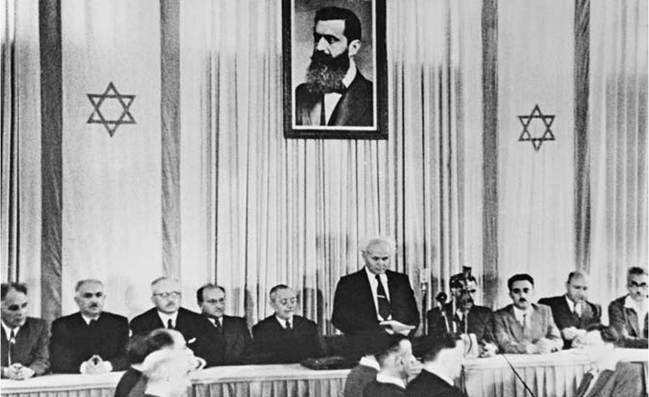
Plate 5.1 Declaration of the State of Israel, Tel Aviv, Israel, 14 May 1948.
The first Israeli prime minister, David Ben Gurion, stands under a huge portrait of Theodor Herzl, the founder of political Zionism, surrounded by members of the National Jewish Council to officially proclaim the state of Israel. On the same day Israel received de facto recognition from the United States, and the Arab states of Lebanon, Syria, Jordan, Egypt and Iraq invaded Israel with their regular armies. (Photo: AFP/Getty Images)its firepower. Indeed, during the truce Israel imported a significant number of rifles, machine-guns, armoured cars, field-guns, tanks and ammunition, despite the UN embargo. Consequently when fighting resumed on 8 July, Israel started to make its first territorial gains, including seizing the town of Nazareth. By December Israel controlled most of Galilee, and its forces had crossed into Lebanon in the north and broken the Egyptian blockade in the Negev in the south.
see Map 5.2
In January 1949, when it became clear that the Arabs would not win the war, armistice negotiations began on the island of Rhodes under UN auspices. First Egypt, then Lebanon, Jordan and Syria concluded agreements with Israel. On the territorial side both Israel and the Arab states gained. Israel increased its territory by 21 per cent and gained a contiguous and defensible border. Egypt gained the Gaza Strip and Transjordan the West Bank. The Palestinians, in contrast, lost the territory that they had been allotted under the UN partition plan. An estimated 150,000 Palestinians came under Israeli rule, 450,000 under Transjordan and 200,000 under Egypt. Between 750,000 and 800,000 Palestinians had become refugees at the end of 1948, dispossessed and homeless. While the territorial gains were perceived as a clear benefit, the armistice agreements left the political situation unsettled in many ways. The Arabs had lost the war and with it a considerable amount of prestige. This blow to their legitimacy had a destabilizing effect, leading to military coups, social ferment and revolution. The victor, Israel, fared only marginally better.
It had failed to gain what it needed most: recognition and legitimacy in the eyes of its neighbours. Thus it was only a matter of time before what was referred to as ‘no-war no-peace' turned once again into war.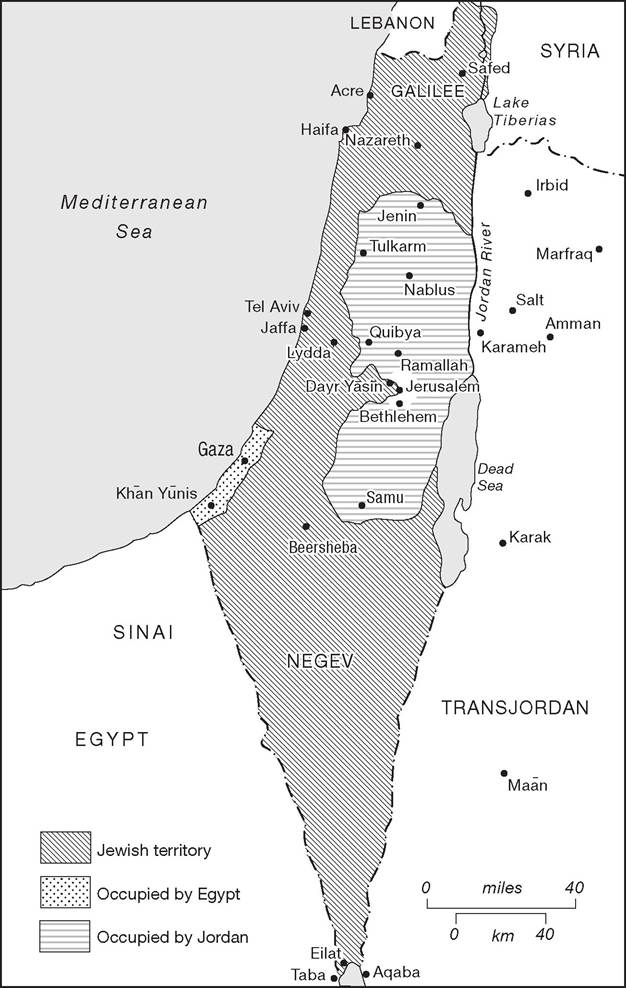
Map 5.2 Post-war Israel, 1948
Source: After Schulze (1999)
Debating the 1948 war
naqba (Arabic: disaster)
Term for the Palestinian experience in the 1947-49 Arab-Israeli war, alluding to the Arab defeat and the Palestinian refugee situation.
The 1948 Arab-Israeli War, known by Israelis as the War of Independence and by Palestinians as al-naqba (the disaster), has become the subject of a heated historiographical debate. This war has been described in conventional Israeli historiography as the heroic struggle of a weak and embattled infant nation rising from the ashes of the Holocaust to fight against the overwhelming odds of Arab numeric superiority, British collusion with the Arabs, lack of international support, an unjustly imposed arms embargo and the blockade of Palestine. Like the biblical victory of David over Goliath, Israel's victory has been portrayed as a miracle, becoming part and parcel of Israel's national discourse. Since the opening of new archives in the late 1980s, this account of the 1948 war has been challenged by the so-called 'new historians'such as Avi Shlaim (1988), Benny Morris (1987), Ilan Pappe (1994 and 1999) and Simha Flapan (1987) with respect to six specific areas:
1 The role of the United Kingdom. Traditional historians have argued that the British were anti-Zionist and pro-Arab as evidenced by their handover of many of their military installations in Palestine to the Arab Legion. Revisionist historians assert that British policy was neither anti-Zionist nor pro-Palestinian but determined by their support for the Hashemite Kingdom of Transjordan.
2 Israel's victory. According to the new historians it was not a miracle but the result of a favourable military balance.
With the exception of the first phase of the war, Israel's forces were better trained, better equipped, better motivated, better organized and better armed.3 The Palestinian refugee problem. Israeli traditionalists claim that the Palestinians left of their own accord and thus Israel bears no responsibility for the refugee problem, while Arab historians have traditionally asserted that the Palestinians were expelled and consequently have the right to return. Israeli revisionists have added a further dimension to this politically charged debate, stating that there is no evidence of Arab broadcasts that encouraged the Palestinians to leave or of blanket expulsion orders. Instead, the refugee problem was the result of the war, of the protracted bitter fighting, and fear.
4 Israeli-Jordanian relations.These became the subject of controversy when 'new' historians maintained that the Zionists had colluded with King Abdullah between 1947 and 1949 by agreeing to divide Palestine between Israel and Jordan, thus depriving the Palestinians of a state. Such collusion, of course, challenges the image of Israel as a nation without allies and with only hostile Arab neighbours. It also shows that Abdullah had few qualms about betraying his fellow Arabs, in general, and the Palestinians, in particular, when he could expand Jordanian territory and influence.
5 Arab war aims. The traditional account of the Arab fighting against Israel has focused on the claim that the goal was to destroy the fledgling Jewish state totally. While this is supported by the rhetoric coming from the Arab camp, new research has shown that the Arabs were far less united than has been assumed. In fact, each of the Arab states was far more concerned with increasing its own influence and gaining control over the territory allotted to the Palestinians under the partition plan, so much so that the result was a general 'land grab'rather than the liberation of Palestine.
6 The search for peace. It has often been asserted that the lack of peace following the 1948 war was the result of Arab intransigence. Revisionists, however, have shown that Israel was equally intransigent when it came to making the compromises necessary for peace.
More on the topic The 1948 war:
- 3 Agreements made before 1 March, 1948
- Geographies of Genocide: The European Rimlands, 1912-1948
- 9.23 The 1986 Act imposes a code of compensation rights that supersedes customary claims for compensation – except in the case of ‘old’ improvements begun before 1 March 1948, in respect of which claims may be made under custom or agreement.
- ‘Roman way of war' in the title of this chapter is a variant of ‘Western way of war', the theory first articulated by Victor Davis Hanson that has been the subject of much critique, and which I do not accept.1
- CHAPTER 9 The War at Home: Toys, Media, and Play as War Work
- From European war to World War
- Capabilities for War and Operations Other than War
- during the russian-ukrainian war, which began in early 2014 and was somewhat misrepresented in Western media as a kind of Ukrainian “civil war,” rather than a Russian invasion, there emerged a number of supposedly new images of Ukrainian warriors.
- 50 War and Peace, and More War
- The state made war but war did not make the state
- No one is fool enough to choose war instead of peace—in peace sons bury fathers, but in war fathers bury sons.—King Croesus of Lydia (Herodotus I: 87)
- War or Just War
- Cold War Divisions
- WAR AS A SOVEREIGN RIGHT
- JUSTIFICATION OF WAR
- The First Gulf War
- THE JUST WAR DOCTRINE
- THE NEO-JUST WAR DOCTRINE