The 1973 October War
The defeat of the Arab states in 1967 set in motion some far-reaching changes in the Arab world. The war had shown the failure of Arab unity and as a result strengthened local nationalisms over pan-Arabism.
Political disillusionment, moreover, was coupled with widespread economic problems following the war,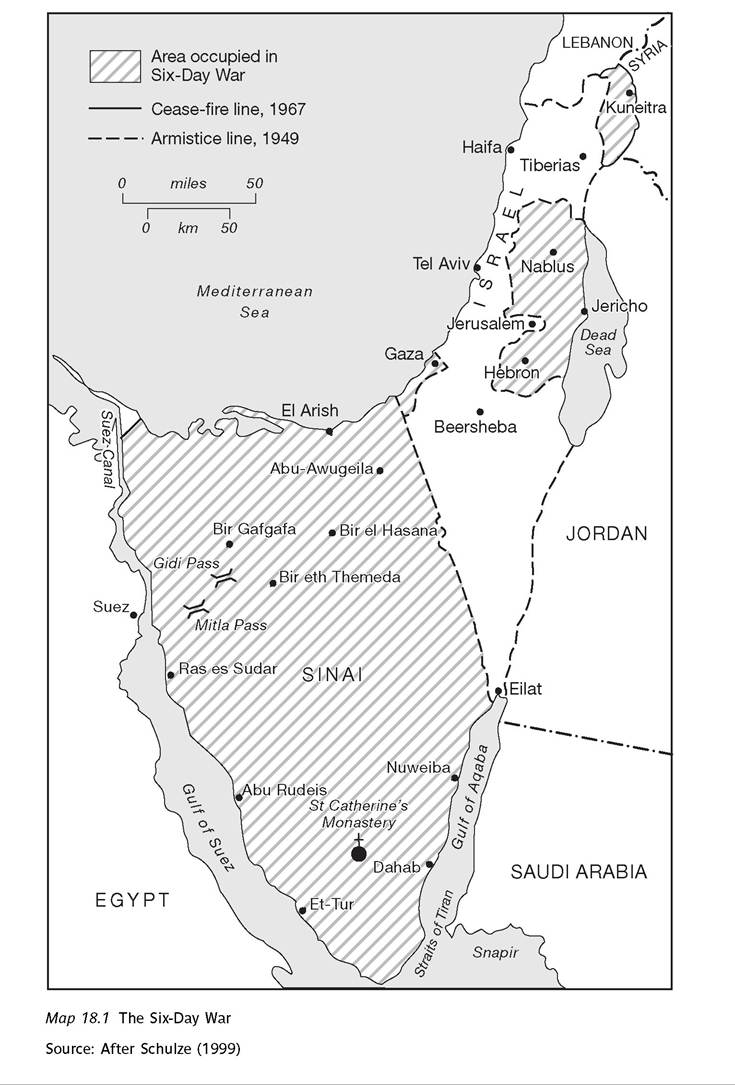
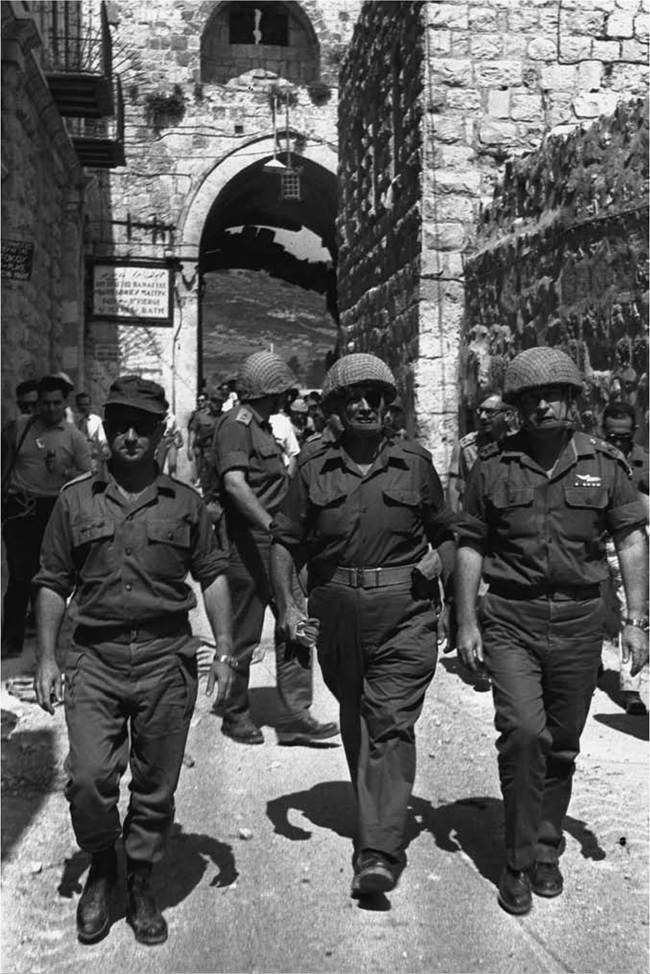
Plate 18.1 Israeli Defence Minister Moshe Dayan, centre, flanked by army chief of staff, Yitzhak Rabin, right, and General Uzi Narkiss, enter the Old City of Jerusalem through the Lions Gate after its capture from Jordanian forces in the June 1967 Middle East War. (Photo: Israeli GPO/Newsmakers/Getty Images)
providing the seeds for ideological reorientation, resulting, on the one hand, in the emergence of political Islam and, on the other, in economic and political liberalization, in other words, a transition to capitalism and limited democracy.
see Chapter 19
The response of the Arab states in the context of the ongoing conflict with a now dramatically stronger Israel can loosely be divided into three categories. The first path was that of negotiation to end the conflict and to achieve political and economic parity. This was the option adopted by Egypt under Anwar Sadat, who took over the presidency in 1970 following Nasser's fatal heart attack. The second was further militarization, seeking strategic parity and ultimately a military solution. This path was chosen by Syria, which in 1970 came under the leadership of Hafez al-Asad. The third option was to pursue neither open confrontation nor official negotiations, but de facto to withdraw from the conflict while still paying lip-service to the liberation of Palestine. As internally weak states, Jordan and Lebanon fell into this category, out of necessity rather than choice.
Ironically, Sadat's search for peace and willingness to negotiate with Israel led to the next Arab-Israeli war in October 1973. Shortly after Sadat succeeded Nasser in September 1970 he made contact with American officials to test the waters for both realigning Egypt with the West and negotiating with Israel. The driving force behind Sadat's decision to change the direction of Egyptian foreign policy was his desire to distance himself as far as possible from his predecessor, Nasser, on the one hand, and to improve the country's failing economy, on the other. Sadat believed that peace with Israel would allow him to regain the Sinai. It would also result in the reduction of Egypt's defence burden, create the stability required to attract foreign investment and hopefully pave the way for American economic aid. Consequently, Sadat in 1971 offered to open the Suez Canal, to declare a cease-fire and to negotiate a peace agreement on the basis of UN Resolution 242. His proposal, however, was rejected by Israel which believed that its new boundaries were vital for its national security. As a result of this rejection, Sadat started planning another war in order to persuade Israel to make peace on terms acceptable to the Arabs and in order to garner the attention of the United States which was preoccupied with detente. An attack on Israel, it was hoped, would also break the defeatist attitude of the population, boost Egypt's regional standing and allow Sadat to emerge from Nasser's shadow.
see Chapter 11
detente
A term meaning the reduction of tensions between states. It is often used to refer to the superpower diplomacy that took place between the inauguration of Richard Nixon as the American president in 1969 and the Senate’s refusal to ratify SALT II in 1980.
In order for the manoeuvre to have the desired effect, Egypt could not attack Israel alone. Once the decision to go to war had been taken on 30 November 1972, Sadat initiated a series of private meetings with Syrian President Asad.
On 31 January 1973, Syria and Egypt's armed forces were placed under joint command. Detailed planning began in March, followed by intricate deception manoeuvres aimed at lulling Israel into complacency, and culminating in the Egyptian-Syrian surprise attack on 6 October 1973.The October War went down in history as one of Israel's greatest intelligence failures. It revealed how Israel had underestimated Arab frustration over its occupation of the Golan Heights, Sinai, West Bank and the Gaza Strip. Israel had perceived the Arabs as weak and not ready for another war. Intelligence analysts had also failed to take into consideration the possibility of limited war, while political and military decision-makers had grown complacent, convinced of their own invincibility. As a result, Egyptian forces were able to cross the Suez Canal and Syrian forces invaded the Golan Heights. In the first few days Israel was close to defeat and the tide only started to change during the second week of the war when Israel had recouped and moved towards a counter-offensive, aided by a massive American airlift which replenished its firepower. Despite the fact that Israel was able to drive back the Arab forces and the cease-fire agreed on 22 October reaffirmed the 1967 boundaries, Arab and particularly Egyptian confidence had grown dramatically while Israel's had been severely shaken. Sadat had captured Israeli and American attention, had restored Egyptian pride and was now able to negotiate as an equal. Israel realized that territory was no substitute for peace. Israel's new weakness and Egypt's new strength closed the power gap sufficiently to bring both sides to the negotiating table. The disengagement talks that began in 1973 eventually resulted in the first Arab-Israeli peace treaty in 1979 on the basis of land for peace. Egypt not only recovered the Sinai, but also used the process to move from the Soviet camp into the American camp, as well as laying the foundation for economic and political liberalization.
This peace, however, came at a high price. Egypt was immediately expelled from the Arab League and, in 1981, Sadat was assassinated by militant Islamists.While Egyptian-Israeli relations improved, Israeli-Syrian relations escalated into an arms race. Asad had no intention of following Sadat into negotiations as his decision to go to war in 1973 had been motivated by his wish to regain the Golan Heights, to legitimize himself domestically, to strengthen his regional position in the bid for Arab leadership and finally to prove to the USSR that he was a worthy ally. Negotiations were not part of the equation. In fact, Syria, unaware of Sadat's plans for limited war, had pursued a military strategy of all-out confrontation, followed by a disengagement agreement at the end of the fighting which served the purpose of rearming and regrouping for the next round.
Palestine Liberation Organization (PLO) Founded by Nasser in 1964, it comprises the Palestine National Council as its supreme body, the Palestine Executive Committee for everyday affairs, and the Palestine Liberation Army. Initially chaired by Ahmad Shuqairy and after the 1967 war by Yasser Arafat. In 1989, the PLO Central Council nominated Arafat as Palestinian president with the PLO assuming the role of government in exile until the 1993 Oslo Accords.
More on the topic The 1973 October War:
- § ON 2i October 1999,a boy working in a factory producing cigarette lighters in the southern West Bank town of Hebron dropped a box of lighter fluid he was carrying to a second-storey workroom (Al-Ayyam, 23 October 1999).
- On 25 October 1714, Charles XII set out on his famous ride across Europe. Riding at breakneck speed and incognito, he covered the distance between the Ottoman outpost at Pitesti and the Swedish fortress in Straslund in an incredible thirteen days and four and a half hours.
- ‘Roman way of war' in the title of this chapter is a variant of ‘Western way of war', the theory first articulated by Victor Davis Hanson that has been the subject of much critique, and which I do not accept.1
- From European war to World War
- CHAPTER 9 The War at Home: Toys, Media, and Play as War Work
- Capabilities for War and Operations Other than War
- during the russian-ukrainian war, which began in early 2014 and was somewhat misrepresented in Western media as a kind of Ukrainian “civil war,” rather than a Russian invasion, there emerged a number of supposedly new images of Ukrainian warriors.
- 50 War and Peace, and More War
- The state made war but war did not make the state
- No one is fool enough to choose war instead of peace—in peace sons bury fathers, but in war fathers bury sons.—King Croesus of Lydia (Herodotus I: 87)
- War
- 45 Soviet Ukraine after World War II
- War or Just War
- Cold War Divisions
- WAR AS A SOVEREIGN RIGHT