The German question
Federal Republic of Germany (FRG) The German state created in 1949 out of the former American, British and French occupation zones. Also known as West Germany. In 1990 the GDR merged into the FDR thus ending the post-war partition of Germany.
Marshall Plan
Officially known as the European Recovery Programme (ERP). Initiated by American Secretary of State George C. Marshall’s 5 June 1947 speech and administered by the Economic Cooperation Administration (ECA). Under the ERP the participating countries (Austria, Belgium, Denmark, France, Great Britain, Greece, Iceland, Italy, Luxembourg, the Netherlands, Norway, Sweden, Switzerland, Turkey and West Germany) received more than $12 billion between 1948 and 1951.
Germany was the vital but downtrodden centre of Europe. Yet while the division of Germany (and Berlin) came to symbolize the division of Europe in decades to come, it is worth asking whether the division was inevitable. Was there room for compromise and unity as the victorious Powers grappled with the ruined enemy and defined its future role? One problem in answering such questions is the sheer ambiguity that tended to surround the agreements over Germany’s future during the war. In the two major ‘Big Three’ conferences in 1945, the Americans, Soviets and British concurred on a number of principles and practical steps regarding the post-war status of Germany. In order to prevent the rise of a future German threat to European peace and security, the Allies agreed on a programme that comprised four elements: denazification, demilitarization, decartelization and decentralization. At the same time, they agreed that Germany and Berlin would be divided into four separate occupation zones — with the French taking the fourth piece of German territory — and that the military governor from each occupying country would have supreme authority in his zone.
A separate Allied Control Commission (ACC) was set up in Berlin. In addition, it was decided that, while administratively divided, Germany was to be treated as a single economic unit.These broad principles might have worked had there not been a number of issues that caused friction between the various occupying Powers. Perhaps the key one was the Soviet demand for $10 billion in reparations. In principle this had been agreed at Potsdam, but in 1945—46 it became increasingly clear to the Soviets that, despite the original understanding, no significant reparations deliveries were to be expected from the western zones. While this was in large part owing to the occupation costs incurred by the Western Powers, which made such reparations deliveries impracticable, the Soviets were naturally suspicious. They were further disheartened to learn in the autumn of 1946 that the British and the Americans were holding discussions regarding the fusion of their two zones; the Bizone that resulted from these talks came into being on 1 January 1947.
As the establishment of the Bizone was the first concrete step towards the eventual creation of the Federal Republic of Germany (FRG), it might be assumed that the Anglo-American agreement reflected a determination to establish an independent West German state and deny the resources of the major part of Germany to the Soviet Union. However, it is important to realize that to a substantial degree this move was a result of growing American and British concern over Soviet practices in the latter’s zone. For example, in the spring of 1946 the Soviets had forced a merger between the East German Communist and Social Democratic parties and handed the key administrative powers to the newly created Socialist Unity Party (SED). To many American observers this seemed a clear indication that the Soviets would only agree to a central administration for the whole of Germany if they felt they could control it.
After the fusion of the British and American zones the trend towards a formal division gradually accelerated.
In 1947 the decision to include western Germany among the recipients of Marshall Plan aid was a clear signal of the American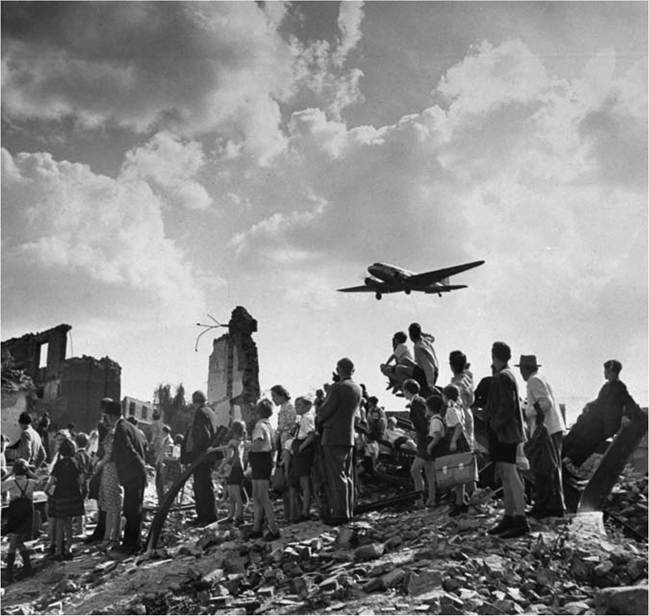
Plate 9.1 Germany, 1948. A US C-47 cargo plane flies over locals amid ruins, approaching Tempelhof Airport with food and other relief supplies as part of the Berlin airlift to break the blockade of overland routes imposed by the surrounding Soviets. (Photo: Walter Sanders/Life Magazine/Time & Life Pictures/Getty Images)
intent to integrate the defeated enemy into Western Europe as much as possible. Meanwhile, the Soviets moved to clamp down even further on democratic principles in their own zone. When all three western zones instituted a currency reform in the spring of 1948, the Soviets responded by closing off all land routes to West Berlin in June 1948. The Berlin blockade did not, though, make the United States and its Allies abandon their goal of creating a separate West German state. Instead, a massive airlift of supplies to Berlin in 1948—49 allowed the western zones of the city to continue existing within East Germany. The end result was a hardening of the East-West divide and, eventually, the creation of the Federal Republic of Germany in 1949. The Soviets countered this by organizing the German Democratic Republic (GDR). The two Germanies — and the two Berlins — that would symbolize the post-war international system in Europe until the late 1980s had thus been created.
German Democratic Republic (GDR)
The German state created in 1949 out of the former Soviet occupation zone. Also known as East Germany. The GDR more or less collapsed in 1989—90 and was merged into the FRG in 1990, thus ending the post-war partition of Germany.
From take-overs to conformity: the USSR and Eastern Europe
In addition to the division of Germany, the area that came to symbolize the onset of the Cold War was Eastern Europe. For many in the West, the communist takeovers in this region between 1944 and 1948 were seen as a frightening and gradually escalating sign of Stalin’s true intentions.
Winston Churchill, for example, had in October 1944 been willing to divide Eastern Europe into British and Soviet spheres of influence in the so-called ‘percentages agreement’. About a year and a half later, however, Churchill — who was voted out of office during the Potsdam Conference — had changed his mind. In early 1946 the former prime minister declared in a speech in Fulton, Missouri, that an Iron Curtain had descended from the Baltic to the Adriatic. Calling for the Anglo-Americans to resist the expansion of Soviet-communist power, Churchill not only sounded the alarm about Soviet intentions but also expressed the public rationale for much of the Western policy that was to follow.The fate of Eastern Europe provides important insights into the puzzle of the origins of the Cold War. In all likelihood, Soviet policies were driven by a complex set of motives in which ideology, security and concerns about the possible repetition of earlier suffering played a role. It would also be naive to assume that Western rhetoric and policy did not affect the thinking of the Soviet leadership. An additional point to stress is that the imposition of Soviet and/or communist hegemony in Eastern Europe did not take place overnight. Much depended on the specific conditions in the various East European countries, such as the strength of the local Communist Party, the position of the Red Army, the depth of anti-Russian sentiment, and the presence (or lack) of an ACC. In addition, geographical location made a difference, for while Poland, given its location in between Germany and the USSR, was central to the Soviet quest for security and had little chance of escaping Russian hegemony in the post-war years, Finland, which shared a long border with the USSR but lacked strategic significance, managed to avoid the fate of Eastern European nations.
The importance of local conditions was highlighted by the first two Eastern European communist take-overs. In Yugoslavia and Albania, the local communists established their rule in 1944—45 as patriots who had fought, often heroically, against the German invaders.
In Albania, Enver Hoxha’s National Liberation Movement faced little resistance when it deposed King Zog in May 1944 and established its rule firmly after the Germans left the country at the end of the year. Perhaps ironically, in the years to come, the major threat to Hoxha’s rule would emanate from neighbouring Yugoslavia, where during the war Marshal Tito had manoeuvred himself and his partisans into a powerful position. After a brief coalition with the royalists, Tito’s Popular Front quickly organized an election in November 1945 in which it received an astonishing (and unquestionably flawed) 96 per cent of the vote. Tito formally deposed King Peter and proclaimed the creation of the Federative People’s Republic of Yugoslavia on 31 January 1946. To the increasing fury of Stalin and the growing concern of his neighbours, however, Tito harboured dreams of creating a larger Balkan Federation, which would include the neighbouring countries to the south and east. To further such goals the newly created Yugoslavia, independently of (and contrary to) Moscow’s wishes, pressed Hoxha’s Albania to align with Belgrade and supported the communists in the Greek Civil War.While Tito’s independent actions would later spark the first serious internal post-war crisis of the communist movement, his path to power was in many ways an exception. In Poland, for example, the communists’ route to government was far more complicated and prompted by much greater Soviet involvement. The Soviets recognized the Polish Workers Party’s ‘Lublin committee’ as the provisional government in late 1944. As a precondition to British and American recognition, however, the Lublin government was enlarged in the spring of 1945 to include some token representatives from other parties, most significantly the Polish Peasants Party (PPS). Over the next two years the communists, headed by Wladislaw Gomulka and Boleslaw Bierut, gradually marginalized the other political parties and forced the PPS leader, Stanislaw Mikolajczyk, to choose between exile or imprisonment.
In the autumn of 1947 he chose the former, thus removing the last effective opposition to the communists.In many ways, the Polish opposition parties had poor cards to begin with, for among other things the communists were far better organized than their opponents. Moreover, the Germans had decimated the local industrial elite, thus making the post-war nationalization of the Polish economy much easier to accomplish. Territorial gains from Germany (the Oder—Niesse line) also meant that Gomulka (who was in charge of the new territories) could redistribute the properties of eight million departing Germans. The PPS could hardly match such largess and, in fact, split into two in late 1945. As later events were to show, however, Poland was a special case; indeed, some historians argue that it escaped the extreme Sovietization that befell some of its southern neighbours. This was, probably, the result of a number of interrelated factors. As the gateway to Germany, Soviet domination of Poland was considered absolutely indispensable for post-war security, and this sense was reinforced by concern over nascent Polish Russophobia. To minimize the potential for future unrest, therefore, the Soviets gave the local communist leaders comparatively more leeway than their counterparts in other Eastern European countries. As a result, the Polish communists were careful in their application of socialist ideals, allowing the Catholic Church, for example, to retain its property until 1950.
The priority accorded to securing socialist control in Poland affected Soviet policy in other countries. In Hungary, for example, Stalin felt compelled to hold back the local communists from seizing power immediately after the war. Between 1945 and 1947 the Hungarian Communist Party thus respected election results and participated in coalition governments. Meanwhile, the communist control of the Ministry of the Interior and, in particular, use of the Hungarian security police worked to marginalize political opponents one by one. In a classic example of the so-called ‘salami tactics’, Laszlo Rajk, the young communist minister of the interior, directed a campaign that succeeded in discrediting or removing from office several key leaders of the Smallholders Party (SHP), which, in 1945, had won 57 per cent of the popular vote. Strengthened by the presence of the Red Army, the security police became involved in selected assassinations, the sabotage of the opposition parties’ offices and the closure of Catholic youth organizations. The Ministry of the Interior also blocked the SHP’s plans to establish peasants’ labour organizations in 1946. Yet it was only after the conclusion of the Hungarian Peace Treaty and the exit of the ACC from Hungary in 1947 that the communists moved to establish complete supremacy. Elections in April 1949 were held without opposing candidates and were followed by the adoption of a new Soviet-style constitution.
By this time Bulgaria and Romania had also become socialist republics. In Bulgaria, the local communist leaders had, in fact, constituted a respectable party prior to the Second World War and were included in a coalition government that was formed in September 1944. As in Hungary, the take-over was gradual, in part due to the presence of the ACC and the need to maintain order until a peace treaty had been signed. In September 1946 Bulgaria formally became a republic (eleven-year-old King Simeon II was sent into exile). In the following month, the Bulgarian Communist Party’s leader Gheorghi Dimitrov, who had spent the war in Moscow, became head of a coalition government. From then on the communists moved quickly: in the summer and autumn of 1947 they removed major opposition figures and destroyed their organizations; in December 1947 they introduced a new constitution.
In contrast to Bulgaria, the Romanian communists had an extremely weak organization at the end of the war; by most accounts its membership was fewer than a thousand in August 1944. As a result, the Communist Party of Romania worked slowly to increase its standing, with the help of growing Soviet influence. The latter was in part a result of Soviet demands for reparations, which allowed the USSR virtual control over Romania’s shipping and its oil and timber industries. However, the Soviets, who occupied Romania at the end of the war, also apparently threatened direct intervention on several occasions and by doing so empowered their Romanian allies to enact land reform that amounted to virtual nationalization in 1945—46. Meanwhile, the civil service was purged and the leaders of other parties were gaoled. The final outcome was thus clear well before King Michael abdicated in late 1947, although a complete end to Soviet occupation did not arrive until 1958.
The last European country to fall under communist rule was Czechoslovakia. Indeed, for quite some time after the return of the pre-war president Eduard Benes in April 1945 Czechoslovakia appeared likely to remain a liberal democracy. To be sure, the Czech communists, under the leadership of Klement Gottwald, won 38 per cent of the popular vote in the May 1946 elections and occupied a number of key posts in the post-war coalition cabinet. However, the lack of any Red Army presence after December 1945 and the existence of a friendship treaty with the USSR seemed to make Czechoslovakia a special case, for the Czech communists did not resort to the strong-arm strategies or salami tactics of their Eastern European counterparts. In the second half of 1947, however, the picture began to change. Under Soviet pressure the Czech government declined to participate in the Marshall Plan, sending the Czech communists’ already declining popularity into a severe downward spiral. In response, while the Red Army amassed troops on the Czech borders, Gottwald and his party staged a coup d’etat in February 1948. Between 12 and 22 February President Benes, probably assuming that no Western help was forthcoming, failed to take advantage of obvious popular anti-communist sentiment and effectively allowed the communists to take control of the state apparatus. Jan Masaryk, the non-communist foreign minister, was soon found dead, Benes was forced into permanent house arrest (until his death in September 1948), and Gottwald became president. The new government quickly moved to enact socialist reforms and block any opposition.
The Prague coup of February 1948 was the last addition to what would for four decades be known as the Soviet bloc. Rumours that a similar coup was under way in Finland — which, under severe pressure, signed a ‘Friendship Treaty’ with the USSR in April 1948 and had previously declined the offer to join the Marshall Plan — proved false. Instead of further expansion of the bloc, the Soviet Union moved to impose conformity on Eastern Europe. In practice this meant that the Soviet bloc underwent a series of purges and show trials during which a number of national communist leaders, who were accused of Western sympathies or ‘national deviation’, were sent to their deaths or removed from office. Between 1948 and 1952 figures such as Rajk in Hungary, Kostov in Bulgaria and Slansky in Czechoslovakia were executed; others, including Gomulka in Poland and Patrascanu in Romania were ‘merely’ purged. Meanwhile, the Eastern European economies were subjugated to the Soviet economy through a series of joint Soviet-East European companies and by the imposition of Soviet-style five- year plans to promote the development of heavy industry. An organization for economic co-operation, the COMECON, was established in 1949 to control trade and industry further in the Soviet bloc. Following the Soviet model, Eastern Europe’s agriculture was partially collectivized. Police forces, armies and internal security services were closely linked to the USSR’s central command, even to the extent that East European officials’ uniforms were modelled on those worn by their counterparts in the USSR. All in all, the late 1940s and early 1950s saw a clear move towards conformity behind the Iron Curtain.
COMECON
The Council for Mutual Economic Assistance, a Soviet-dominated economic organization founded in 1949 to co-ordinate economic strategy and trade within the communist world.
The Soviet Union’s increasing stranglehold on Eastern Europe can be viewed in numerous ways. It may have been a result of a grand master plan, a diabolical scheme to take over the world in steps. This, certainly, was what many Western observers argued at the time. However, Soviet policy can also be seen as part of a chronic search for security that had been prompted by the recent experience of war and destruction. In addition, Stalin may have been concerned over the implications of the Yugoslav case. In June 1948, criticizing Tito for his independent course, the Cominform (the Communist Information Bureau, founded in September 1947 as an umbrella organization for European communist parties) expelled Yugoslavia from its ranks. It is not clear whether this decision owed more to Stalin’s own personal insecurities about a possible rival emerging within the communist world, or whether it was a response to concerns that Yugoslavia’s independent actions were jeopardizing Soviet national security. Whatever the case, the Tito-Stalin split nevertheless demolished the myth of monolithic communism, for the Yugoslav leader’s independent power base allowed him to survive all efforts to depose him and thus produced the first clear crack in the Iron Curtain. Conversely, however, it also strengthened the Soviet need to prevent any other nationalist leaders from attaining a similar independent status. Ultimately, however, the chief influence on Soviet policy was the gradual decline in co-operation with the other victorious powers, particularly the United States. In all likelihood, for example, the timing of the Soviet move from encouraging socialist take-overs to demanding subservience was linked to the developments in the West.
Cominform
The Communist Information Bureau, organized in 1947 and dissolved in 1956. The Cominform attempted to reestablish the links between the European communist parties that had lapsed since the dissolution of the Comintern. Dominated by the USSR, the major event in the Cominform’s history was when it expelled Yugoslavia in 1948.
More on the topic The German question:
- German Frustrations
- German Invasion
- German and Romanian Occupation
- German Sectarians in British America
- World War II and Nazi German Rule
- World War II and Nazi German Rule
- UPA-German Relations
- 41 The German and Japanese Empires
- The Record of German Violence
- Chapter 4 Roxolana in German Baroque and Enlightenment Dramas
- Question-oriented education
- A QUESTION OF VALIDITY