The Medes: Greek Historiography and Assyrian-Babylonian Evidence
Medes and Persians were closely linked linguistically and culturally. The dates and routes of their migrations into Iran are the topics of many studies but without consensus. From the latter centuries of the second millennium through the middle of the first, Iranian peoples spread throughout Iran, the western and southwestern
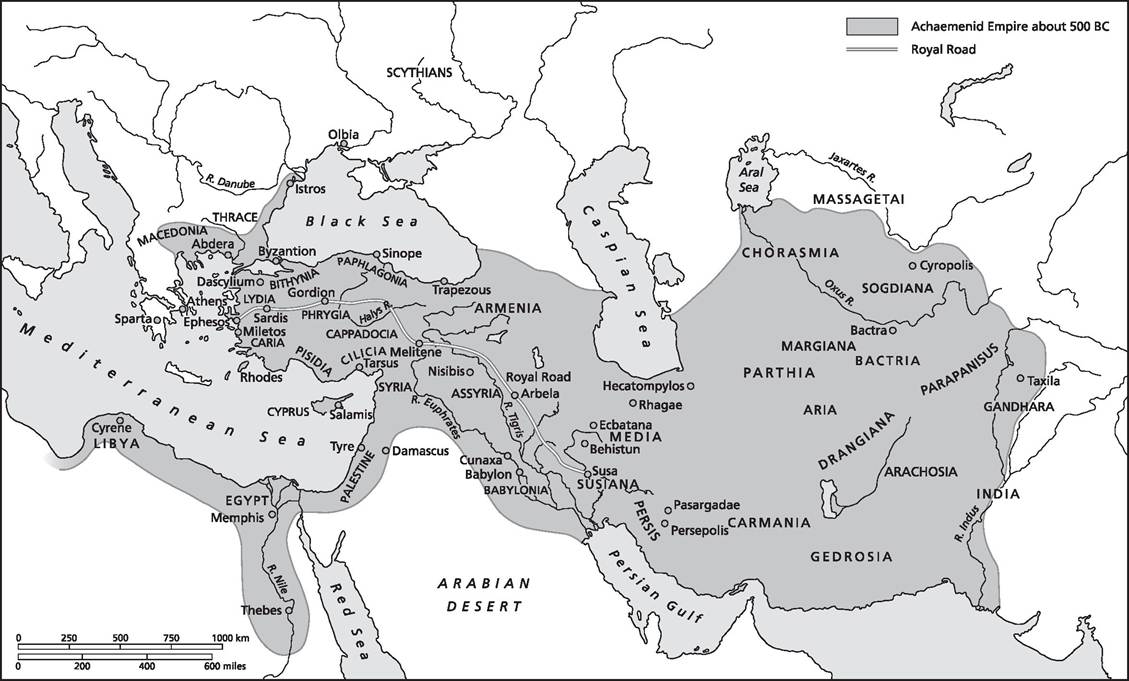
THE ACHAEMENID PERSIAN EMPIRE 113
Map 4.1.
The Achaemenid Empire.Source: Bang and Scheidel, 2013, The Oxford Handbook of the State in the Ancient Near East and Mediterranean, 200. Copyright: Oxford University Press.
parts of which are referred to today as Elam (Haltamti in Elamite). Inscriptions of the Assyrian king Shalmaneser III in the late ninth century are the first to attest to both Medes and Persians in the written record.[332] Numerous settlements of both Medes and Persians in the central Zagros were gradually incorporated into the Assyrian Empire's umbrella over the course of the eighth and early seventh centuries bce. We have no documentary evidence from the Medes themselves. Even delineating a core area of Median power is a difficult task. The modern city of Hamadan, ancient Ecbatana, served as a capital in the sixth century, as discerned from later traditions about Cyrus the Great's victory over Astyages in 550.
Understanding of the “Median Empire”—a construct traditionally viewed as a sort of proto-Achaemenid Empire—has undergone a complete re-evaluation. The Medes were clearly a force with which to be reckoned in the late seventh and early sixth centuries bce. But when the Greek legends about Median rule are compared with Assyrian and Babylonian evidence contemporary to the Medes themselves, we are able to track neither a supra-regional entity that relied (as did the Achaemenids) on an advanced, professional bureaucracy nor the successful incorporation of local elites.
The traditional picture of a Median Empire in modern scholarship is beholden mainly to Herodotus and the Classical traditions, traditions which date two centuries (or more) after the Median floruit. Whether the Medes are classified as an empire or not now seems mainly a matter of perspective. None of Michael Mann's four strategies of rule may be traced for the Medes beyond a superficial level, if even there. The lack of any indigenous or contemporary testimony to substantiate a Median “empire” as the term is generally understood—and allowing for variation in that understanding—has caused serious doubts in its very existence.[333] It is more productive to assess the Medes on a model contemporary with their origins in the Neo-Assyrian period, i.e., the chiefdoms of the Zagros Mountains, than it is to assess them on the model of the Achaemenid Persian Empire into which they were subsequently absorbed. The Classical Greek representations of the Medes are based almost entirely on the latter.
Herodotus was not unique in his consideration of the Medes' importance, but it is mainly his literary account of the Medes and their arkhe—the Greek term often translated as “empire,” but a term with a range of meanings—on which the whole modern edifice of a Median Empire is based. Herodotus's tale of the first Median kings (book 1, paragraphs 96-106) thematically matches the rise of tyrants in Greek city-states, a story with Greek imagery of the Achaemenid court superimposed.[334] According to Herodotus, a Mede named Deioces arrogated power to himself, manipulated his election as ruler (i.e., king), insisted on a bodyguard of spearbearers, and implemented construction of an elaborate, fortified capital: Ecbatana.
Deioces then removed himself from his subjects and implemented behavioral protocols. Herodotus’s remaining narrative on the Median kings emphasizes military matters, as the Medes battled Scythians and Assyrians.
Assyrian evidence tells another story, and it is one that does not involve a supra-regional entity or territorial dominion.
The Medes whom the Assyrians encountered lived in fortified settlements throughout the central and northern Zagros Mountains, especially along the Khorasan Road (the Silk Road) toward modern Tehran. The rulers of these settlements are called in the royal annals “city lords” (sg. bel ali) a term that suggests a limited scope of their power. Many of these Median city lords entered into formal treaty relationships (ade-agreements) with Assyria, with Assyria as the dominant partner. This situation maintained through the reign of Esarhaddon (681-669 bce), but after that it becomes darker.The archaeological evidence is scattered and difficult to interpret.[335] Median sites such as Nush-i Jan, Godin, and Baba Jan indicate a floruit in the late eighth and early seventh centuries bce and a decline in the first half of the sixth. It is around this time that we would expect to find a fledgling Median Empire. But Assyrian sources for political and military history ca. 640-610 bce are relatively thin, and not just about the Medes. When the Medes reappear in the narrative, by way of the Babylonian chronicles, they were attacking Assyria in 615 bce. There is no indication in the documentary or archaeological evidence how Umakistar, the Cyaxeres of classical texts, brought a Median army into such devastatingly effective use.
The phenomenon of the Medes as a major military force in this period seems beyond doubt, but the political trappings of this Median power are elusive, to say the least. The Babylonian evidence compels a reconsideration—and reduction— of presumed Median reach westward both into northern Mesopotamia as well as eastern Anatolia. The resulting deconstruction has resulted in a modified picture of the Medes: a loosely connected federation of tribes capable of overthrowing a declining Assyrian Empire (in conjunction with the Babylonians) but as an entity with neither the structural framework nor the cohesion to maintain an empire in the sense of a bureaucratic, centralized entity.
The traditional model—one of presumed continuity from Assyria through Media to Persia, for which we thank the Greek tradition—does not work.In the Book of Jeremiah, the plural “kings” is used when describing the Medes at 25.25, 51.11, and 51.27-28 in a historical context describing the late seventh and early sixth centuries bce. In Nabonidus’s inscriptions, the king of the umman- manda (i.e., the Medes) is accompanied by additional “kings going at his side” (LUGAL.MES alik idisu).[336] This and other Babylonian evidence better fits an image of a destructive force with a loose, unifying leadership but one that was incapable of imposing a structured, bureaucratic machinery that would allow more pervasive and longer-lasting control. Another passage in Herodotus—outside his rendition of the Medes' rise under Deioces and his successors—parallels Nabonidus's perspective: “The Medes ruled all together and (directly) those living nearest; and these, further, ruled their neighbors, and so again in turn, they theirs...” (1.134.3). Visualizing Median power via a system of informal rule of its neighbors offers a better model. The plurality of kings mentioned in Jeremiah (“kings of the Medes”) fits such a reconstruction: Median domination over multiple, neighboring peoples, each of whom owed allegiance, directly or indirectly, to a Median overlord without the formal structure of an organizational empire.
More on the topic The Medes: Greek Historiography and Assyrian-Babylonian Evidence:
- The letters and reports by Assyrian and Babylonian scholars to the Neo-Assyrian king provide a unique window to the relationship between a body of scholarly texts and the practice of actual scholarship.
- Marduk’s Return: Assyrian Imperial Propaganda, Babylonian Cultural Memory, and the akitu Festival of 667 bc*
- 7 READING THE TABLET, THE EXTA, AND THE BODY: THE HERMENEUTICS OF CUNEIFORM SIGNS IN BABYLONIAN AND ASSYRIAN TEXT COMMENTARIES AND DIVINATORY TEXTS
- 2.0 A TRANSMITTED LITERATURE? EVIDENCE FOR EXTISPICAL TEXTS PRIOR TO THE OLD BABYLONIAN PERIOD
- Byzantine Legal Llang=EN-US style='font-variant: normal !important;text-transform:uppercase'>anguage: Latin, Greek, and Greek
- From the Medes to Alexander
- CHAPTER TWENTY-ONE The Medes and the Persians
- Assyrian Propaganda and the People of Babylon
- Assyrian Blueprints
- Limitations of conventional historiography
- 1.0 HISTORICISM AND A “CREATED” OLD BABYLONIAN DIVINATORY LITERATURE
- Peasant Historiography
- IS THERE A BABYLONIAN THEORY OF SIGNS?
- Evil Dreams and Insomnia in the Babylonian Incantation Bowls
- Western colonial violence and the historiography of Belgian imperialism
- In everyday life and for (inter)national issues as well, Neo-Assyrian kings were eager to hear or read their scholars’ reports and interpretations of omens.
- 3 The Empires of Western Asia and the Assyrian World Empire
- 2 “IF P, THEN Q”: FORM AND REASONING IN BABYLONIAN DIVINATION