War and Violence on Public Monuments
Violent battles scenes did not adorn public monuments until the second century ce. However, there is ample literary evidence that paintings of battles were carried in Roman triumphs and later displayed in various locations.[1249] The Roman triumphal procession itself was a particularly powerful yet ephemeral means of celebrating military conquests.
People lined thestreets of Rome to view a procession that displayed not only paintings but also captured loot, models of conquered cities, re-enactments staged as scenes on floats pulled by prisoners of war (who would later be sold as slaves), the Roman soldiers who fought in the campaign and their general adorned as triumphator.[1250] After the triumph, plunder and battle paintings were placed in temples and public porticoes while a selection of spoils might be exhibited at the homes of the military leaders to advertise their status, a reflection of the competitive nature of the Roman elite.[1251] Public monuments specifically intended to commemorate military victories are first evidenced in the third century bce, although none of these, nor any of the Republican arches from the second and first centuries bce, survive.
Throughout the first century ce the decoration of victory monuments emphasised symbols of victory such as trophies, laurel or oak crowns, elements of the triumphal procession and personifications of Victory and conquered nations. Allegorical imagery stood in the place of actual scenes of war and its violence. For example, on a provincial monument to the Julio- Claudian emperors, the Sebasteion at Aphrodisias, one panel relief illustrates Claudius subduing Britannia (Figure 32.10). The emperor is portrayed in heroic nudity, with only a billowing cloak, helmet and shield. He stands above Britannia, whose body is turned towards the viewer, her right breast exposed, her drapery falling away, and he is forcing her to the ground, physically subduing her, in the same manner as female figures in the mythological scenes at Pompeii, such as Dirce, are portrayed as they are about to be raped or punished.
In the second century the emphasis on victory monuments shifted from the allegorical to more realistic, historical reliefs. Trajan memorialised his Dacian campaigns by using the spoils to construct an elaborate forum advertising the victories of the Roman army.[1252] The south entrance to the forum resembled a triumphal arch. Figures of Dacian prisoners stood along the attic above its porticoes overlooking the main plaza. Above these were the military standards of the legions who had fought in the campaigns. The Column of Trajan, dedicated in 113 ce, dominated in a small courtyard just north of the Basilica Ulpia, flanked on its east and west sides by libraries. The so-called Great Trajanic Frieze, offering an abbreviated glimpse of the Dacian campaigns, may have decorated the basilica's attic on its northern side, facing the column,
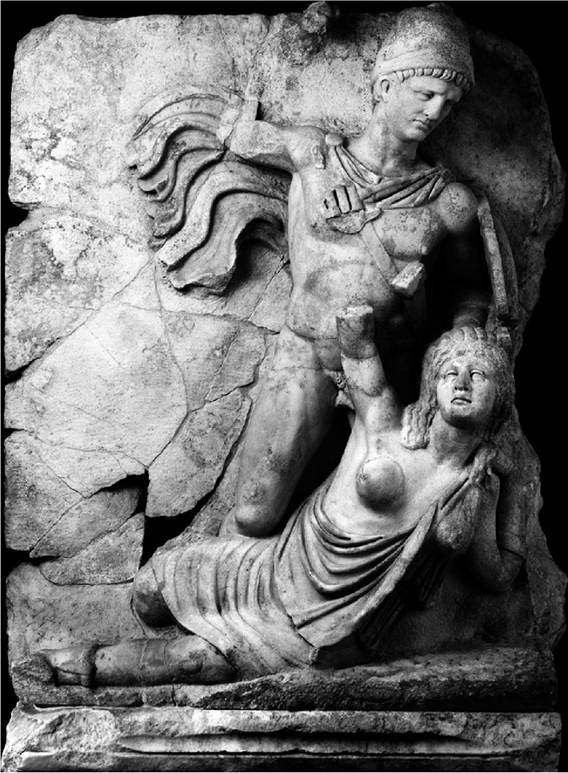
Figure 32.10 Claudius subduing Britannia, marble, first century ce, Sebasteion, Aphrodisias, Turkey.
illustrating a more complex narrative with its helical frieze.[1253] The column offers an unusual mix of scenes, of which battle scenes represent about a quarter, while the rest are scenes of marching, construction, sacrifices, negotiations and other activities. The combatants, Roman and Dacian, are easily distinguished by their clothing, armour and weaponry, and the two sides are generally arrayed ‘in massed and orderly ranks', suggesting that the images may derive from paintings.37 (It is worth noting, too, that the scenes would have been painted and thus their relationship to painted battle scenes would have been even more evident to the viewers.) Despite the orderliness of the battles, brutal realities are portrayed. In the left half of scene 24, two Roman soldiers present severed heads to the emperor Trajan, while on the right a Roman on horseback holds a severed head of a Dacian by the hair with his teeth as he continues his attack (Figure 32.11).
In scene 45 (Figure 32.12) a group of non-Roman women torture a pair of Dacian prisoners, burning them with torches. Sheila Dillon argues that Roman viewers would have understood this scene as doubly humiliating to the enemy because foreign women are attacking the men in a manner usually reserved for the punishment of slaves.38The scenes on the Column of Trajan juxtapose the viciousness of war with the mundane activities of the Roman army, namely gathering materials and contracting camps, the observation of sacrifices, and audiences with the emperor. The Column of Marcus Aurelius, c. 180-193 ce, offers a more brutal and chaotic vision of war. During the second century the depiction of war in Roman reliefs changes, moving away from the influences of the Hellenistic tradition and its more orderly arrays of battle towards massive scenes of swirling violence. Sarcophagus workshops in Rome may have been partly responsible for these trends, but as Martin Beckmann notes, the wars that Marcus Aurelius conducted were of a different nature from those carried out by Trajan.39 The Dacian campaigns were expansionist and pre-emptive, adding new territory to the empire while suppressing a potential threat. Marcus Aurelius was quashing a rebellion, repulsing barbarians who had physically invaded Italy and threatened the safety of Rome. The Column of Marcus Aurelius narrates a punitive war focused on the utter submission or destruction of the enemy.
This difference can be seen best in the portrayal of women and children on the two columns. As Dillon has demonstrated, the women on the Column of
Forum Again: The Column and the Temple of Trajan in the Master Plan Attributed to Apollodorus(?)', Journal of Roman Archaeology 7.1 (1994), 163-82, at 169-70 and n. 29.
37 M. Beckmann, The Column of Marcus Aurelius: The Genesis and Meaning of a Roman Imperial Monument (Chapel Hill: University of North Carolina Press, 2011), pp. 167-8.
38 S. Dillon, ‘Women on the Columns of Trajan and Marcus Aurelius and the Visual Language of Roman Victory', in Dillon and Welch (eds.), Representations of War, pp.
263-71.39 Beckmann, Column of Aurelius, pp. 167-76.
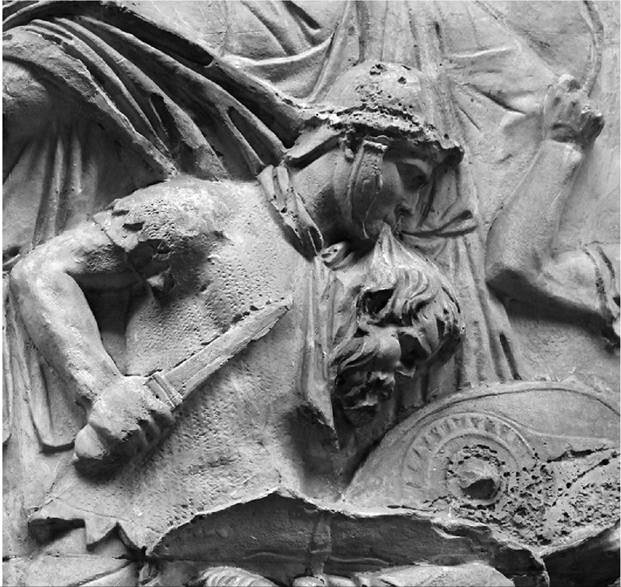
Figure 32.11 Relief from the Column of Trajan, 113 cb, Rome: scene 24, soldier holding severed head in his teeth. From a cast in the Museo della Civiltà Romana, Rome.
Trajan are less dishevelled, dressed more elegantly, and are usually at the edges of scenes. On the Column of Marcus Aurelius, women are often in the middle of battles, ‘forcibly separated from their children, physically and sexually assaulted, and even killed’. Dillon and Beckmann both argue that while these scenes allude to the nature of the campaigns illustrated, they should not be taken as historically accurate snapshots. The kinder treatment of the women on the Column of Trajan, Dillon argues, may also be read in conjunction with the civil, mundane scenes of the army as references to the virtues of a good emperor, such as justice, clemency, discipline and order.[1254] The violent subjugation of women and children on the Column of Marcus Aurelius, then, while certainly a reality, was also intended to symbolise the
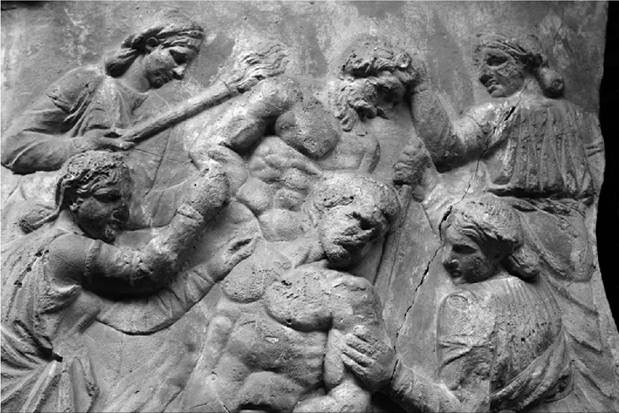
Figure 32.12 Relief from Column of Trajan, 113 ce, Rome: scene 45, women torturing prisoners. From a cast in the Museo della Civiltà Romana, Rome.
utter defeat of a rebellious enemy. Interpreted in this way, the scenes on the two columns become examples of the words of Anchises to Aeneas: ‘spare the submissive, and annihilate the insolent’.[1255]
Battle imagery continued in the third century ce on Severan monuments at Rome and elsewhere, but a new format for violent display was also introduced. The Arch of Septimius Severus in the Roman Forum, dedicated in 203 ce, is the earliest known triumphal arch decorated with battles scenes.[1256] Four large panel reliefs placed over the lateral bays of the triple-bay arch illustrate scenes from the emperor’s campaigns against Parthia and were likely derived from paintings executed by artists travelling on campaign with the emperor.[1257] The paintings may have circulated beyond Rome, possibly serving as models for Severan monuments in Cyrene and Lepcis Magna.44 The use of battle scenes on triumphal arches continues the iconographic trends of the second century ce, but it also served a specific purpose in the legitimation of Severan rule and dynastic succession.
The Parthian victory and the designation of Caracalla, the elder son of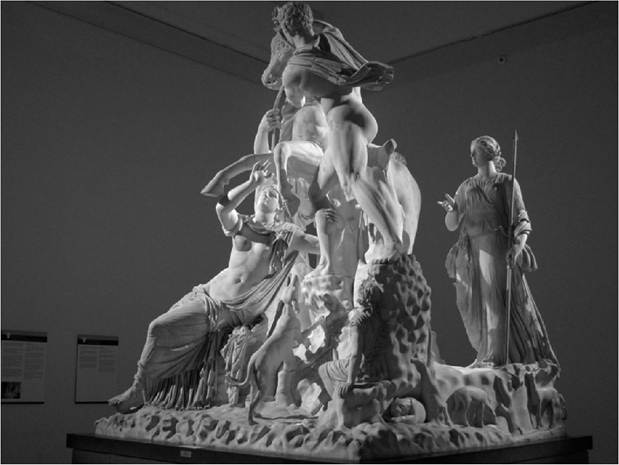
Figure 32.13 Farnese Bull, marble, early third century ce, Baths of Caracalla, Rome.
Severus, as co-emperor were celebrated on the same day, 28 January 198 ce, and thus the dynasty was, in effect, born on the battlefield.[1258] Those campaigns were also connected to the suppression of a rival claim to the imperial throne by Pescennius Niger, who had been supported by the Parthians and their allies. The arch, therefore, not only celebrated the Parthian victory and the creation of the Severan dynasty but also served as a warning to those contemplating rebellion.
The Severan period brought another innovation: colossal sculpture groups of violent myths. The Baths of Caracalla held several of these colossal groups, including the renowned Farnese Bull group, depicting the punishment of Dirce, sculpted of marble and standing 3.7 metres high (Figure 32.13). A second group includes a warrior, about 3 meters tall, holding the leg of a young boy who hangs upside down across the warrior's back. The pair is identified as Achilles and Troilus.[1259] The Farnese Bull probably stood in the east palestra, and Achilles and Troilus probably in the frigidarium. Both compositions required the viewer to move around and take in views from several angles to get the full meaning and effect of the depiction. Only by moving around can one see the wounds on the body of Troilus, for example. The trampling of Dirce and Achilles’ slaughter ofTroilus seem odd, perhaps even uncomfortable, subjects with which to adorn an imperial bath complex. Although public sculptures generally embodied positive messages, Ralf von den Hoff argues that colossal groups such as these are the product of aesthetic concerns cultivated by the Second Sophistic, especially an increased interest in ‘horror and furor', the arousal of emotion in the viewer, and admiration for artists’ technical skills to produce such complex compositions.
He also suggests that these groups in their grandeur were a form of entertainment, too, much like arena spectacles.[1260]The early fourth century ce witnessed a final innovation in the representation of war and violence in the Roman world. For approximately six centuries Romans had avoided the direct commemoration of civil strife and generally refrained from illustrating battles in which they were defeated on their public monuments. The historical battle reliefs on the Arch of Constantine, however, broke the long-standing custom, representing the civil war battles between Constantine and Maxentius on a triumphal arch. The triple-bay arch was constructed as a pastiche, with decorative elements taken from monuments of Trajan, Hadrian and Marcus Aurelius alongside original Constantinian historical and other reliefs.[1261] The historical frieze is broken into six sections and chronicles the war with Maxentius. Four sections are located, one each, above the lateral bays on the north and south faces, with the final two segments, one each, on the east and west sides. The narrative begins with the west segment and moves counter-clockwise along the south face, then to the east side, ending over the north-east lateral bay.
Recent studies of the Arch of Constantine have tended to focus on its reuse of earlier sculpture, the reworking of portraits, and how these features play into memory and viewing.[1262] The battle scenes, located on the south face, have received relatively little attention, despite their remarkable deviation from prior practice in Roman victory monuments. In the scene above the south-west bay the Constantinian forces lay siege to Verona (Figure 32.14a),
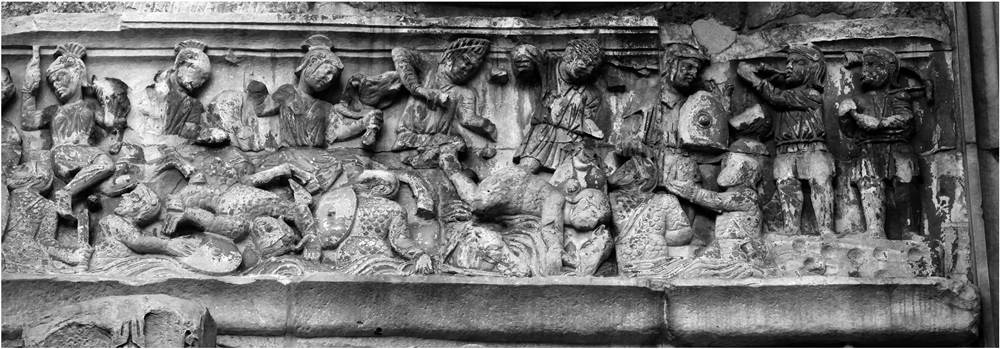
Figure 32.i4a-b Relief, marble, 315 ce, Arch of Constantine, Rome (Italy): (a) Siege at Verona, (b) Battle at the Milvian bridge.
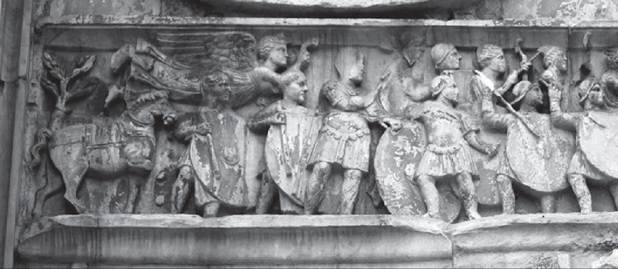
Figure 32.i4a-b (cont.)
the walled city in the right half of the scene. Unlike earlier battle scenes, there is no distinction between the two sides: they wear the same armour and carry the same weapons because both sides are Roman. The Roman inside the city hurl rocks at the attackers, while one figure tumbles from the left corner of the city wall. The scene depicting the decisive battle at the Milvian Bridge (Figure 32.14b), above the south-east bay, epitomises total carnage and utter defeat. Bodies of dead and dying soldiers are floating in the river beneath the bridge while on the left personifications of Rome and Victory once flanked the figure of Constantine observing the battle from a boat as he crosses the river. Such violence depictions had previously been reserved for scenes in which Romans wreaked death and destruction on rebellious barbarians, not on fellow Romans.
How did Roman viewers react to these scenes? Elizabeth Marlowe has noted that Constantine presented himself as liberator urbis suae, ‘liberator of his city', an appropriation of Maxentius' title of conservator urbis suae, ‘preserver of the city', effectively recasting Maxentius as a tyrant from whom Rome had to be liberated while allowing Constantine to continue many of his programmes and building projects.[1263] The dedicatory inscription on the arch refers to Constantine avenging the state from a tyrant and another in the main passageway proclaims him liberator orbis, ‘liberator of the world'.[1264] Although Constantine refrained from purging the senate and administrative
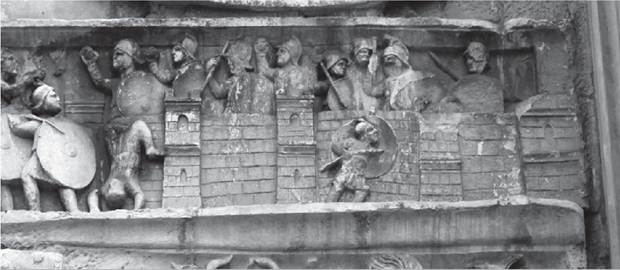
Figure 32.i4a-b (cont.)
elites, except for those closest to Maxentius,[1265] the battle reliefs on the arch may have been a warning to those who had been left in power at Rome - the threat of harsh consequences for usurpers and would-be tyrants.
More on the topic War and Violence on Public Monuments:
- War and Violence on Funerary Monuments
- Representations of war and violence were pervasive throughout the Roman world, displayed in homes and public spaces.
- Public Violence against Women
- Explorations of war commemoration in the Gilded Age of the United States have suggested a growing public infatuation with military history.1
- Social Contract, Prophetic Monotheism and Public Violence
- Political Violence and the Public Eye
- Cultures of Violence in Countries at War
- The Cultural Dimension of Violence as a Reasonable, Legitimate, or Effective Response to Public Offenses
- Monuments and Place Names
- Violence and War in the Middle Ages
- Displays of War and Violence and the Roman House
- MASKS AND MONUMENTS