War and Violence on Funerary Monuments
Romans funerary monuments appear in many forms and employ an extensive repertoire of decorative themes, ranging from military battles and gladiatorial combats to violent mythological scenes.
The scenes appear as paintings, architectural reliefs or on sarcophagi, and, like the domestic images, illustrate Roman concepts of power (and powerlessness) while commemorating the deceased. The earliest examples of violent imagery in Roman funerary contexts depict historical scenes, possibly the conquests and military exploits of the deceased commemorated by the monument.Beginning around the third century bce, the earliest military scenes appeared in Roman tombs; at the same time the first recorded gladiatorial combats were held in the Roman Forum as part of a funeral display.[1235] One of the earliest surviving historical paintings is from the tomb of Quintus Fabius in Rome. This chamber tomb, constructed on the Esquiline Hill and dating to the first half of the third century bce, was discovered in the late nineteenth century. Its occupant may have been Q. Fabius Maximus Rullianus, who led the Roman army and its allies to victory at Sentinum in 295 bce. Inside the tomb was a painted frieze arranged in at least four registers, only the middle two of which are preserved to full height. The scenes are possibly the earliest example of a continuous narrative in Roman art: two standing figures, labelled ‘Fannius' and ‘Fabius', appear in two different scenes in the second and third registers. In the second register, Fabius wears a toga and holds a long spear (hasta), indicators of his Roman identity and social status. Also in the second register at the far left is a wall with towers, perhaps a city or fortification. Fannius and Fabius extend their right hands towards each other, the Roman gesture of dextrarum iunctio, the signal of a truce.
In the fourth register, below these figures, armed men fight in a fragmentary battle scene. Peter Holliday has suggested that the arrangement of the scenes is ‘purposeful', a contrast of calm and orderly peace with the confusion of war, that also symbolises the dual civil and military roles of a Roman magistrate.[1236] These scenes, too, like those in domestic settings, reinforce Roman conceptions of power: in this case, Romans' ability to wield power over non-Romans through military conquest and territorial expansion.The late first century bce saw a concentration of military authority in the hands of a few and eventually those of the emperor. In response to the new social order founded by Augustus, tombs of the elite and the rising middle class in many cities of the empire began to feature gladiatorial scenes and celebrate an individual's life achievements as local benefactor and magistrate. At Teate Marrucinorum, sometime before 40 ce, Lusius Storax, a freedman and sevir augustalis, constructed a tomb within an enclosure on property belonging to a burial society.[1237] The tomb had a temple-like facade with a pediment relief and a frieze depicting gladiatorial combats (Figure 32.7). The pediment features Storax, seated among a group of men on a podium, likely the city magistrates of Teate, along with others, perhaps seviri or members of the city council. Manuel Flecker suggests the scene represents the missio, when Storax, in his role as benefactor, would have spared the fighter(s) in the frieze below.[1238] The frieze itself illustrates a variety of gladiators, but the viewer does not witness death or the fatal blow but rather a series of combative poses anticipating the fatal moment. As in the painting in the tomb of Quintus Fabius, these reliefs highlight Storax's public life, social status and importance in the community. Set on the exterior of the tomb, they were a public memorial to a man whose status in life had shifted
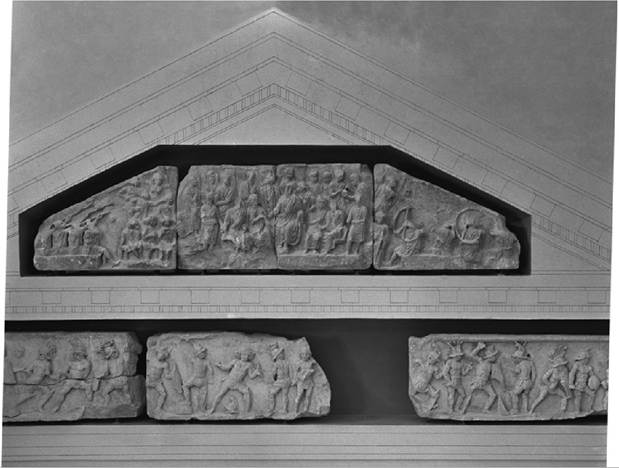
Figure 32.7 Funerary reliefs of C.
Lusius Storax, limestone, mid first century ce, Teate, Chieti, Italy: above, Lusius Storax and magistrates; below, gladiatorial combat.dramatically from slave, once powerless against violence, to successful freedman with the power to stage violence in the form of arena spectacles and hold the power of life and death in that realm by either granting or denying the plea of the fallen gladiator.
Sarcophagi became important funerary monuments in the second century ce. An elaborate marble sarcophagus was a statement of wealth and culture, although not necessarily of social status, since some middle-class Romans had lavish sarcophagi while senatorial elites had simple ones. Located in niches inside chamber tombs with poor lighting, sarcophagi were probably inaccessible and essentially invisible most of the time, yet they were a popular means for commemorating and honouring the dead for several centuries.[1239] The range of decoration on sarcophagi includes simple garlands, channel-cut striations and complex compositions of mythological and biographical narratives populated with multiple figures. Among these later themes are groups of sarcophagi depicting violent myths and battle scenes.
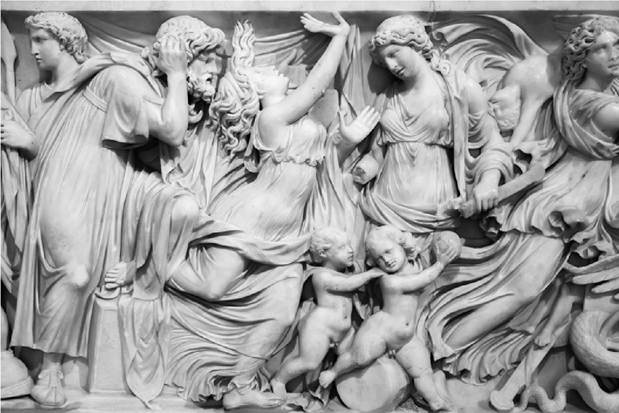
Figure 32.8 Detail of the Medea Sarcophagus, marble, c. 140-50 cb, Antikensammlung, Staatlichen Museen zu Berlin.
Violent mythological scenes appear on a small number of sarcophagi dating to the mid second century ce, c. 140-80. The subjects are similar to those seen in wall paintings or sculptures decorating Roman houses, for example, the slaughter of the Niobids, the fall of Troy and the deaths of Actaeon and Phaethon. These stories can be read as representing tragic losses, allegories for sudden death or loss, extreme grief and pain, the horrors of war or a horrible death, and as such may have provided viewers with a way to contextualise their grief in heroic or tragic ways that elevated their mourning.[1240] A more challenging narrative, however, is that of Medea, seen on the Medea Sarcophagus of c.
140-50 ce, in Berlin (Figure 32.8). The myth unfolds from left to right across the front of the sarcophagus in four scenes. In the first, the sons of Jason and Medea present a wedding gift, the poisoned cloak, to Creusa, for whom Jason has abandoned Medea. The next scene, near the centre of the sarcophagus, illustrates the horrifying death of Creusa, burned alive by the poisoned cloak, as her helpless father looks on from the left. Immediately to the right is Medea gazing down at her two sons in the moment before she kills them. The final scene depicts Medea escaping in herRepresentations of War and Violence: Ancient Rome chariot drawn by winged serpents, with the dead body of one of her sons flung over her left shoulder.
Various attempts have been made to explain this and other violent mythological scenes on sarcophagi. Paul Zanker and Bjorn Ewald have suggested that these horrific stories invited mourners to contemplate worse circumstances than their own and perhaps offered comfort while validating their grief through shared parallels, such as loss of children or spouse.[1241] The Medea narrative, however, which appears on at least sixteen sarcophagi with little variation, proves challenging.[1242] Because of her horrific deeds, Medea does not appear to be a sympathetic or worthy character. Zanker and Ewald suggest that Creusa and her gruesome death might be the intended focus on these sarcophagi, which would suggest interpreting the scene as referring to the deceased in some way. Klaus Fittschen proposes reading them simply as an expression of grief, not as any sort of assimilation or analogy for the deceased.[1243] Genevieve Gessert has argued that Medea's narrative on sarcophagi functioned as a sort of visual consolatio, parallel to the literary letter of consolation, where Medea should be viewed as a negative exemplum, someone who had ‘overstayed her welcome on this earth', in contrast to the deceased.[1244] Many of the myths on sarcophagi also appear in Roman wall paintings, including one scene from the Medea narrative, when Medea contemplates killing her sons.
In household settings, these myths could present messages about power structures of Roman society, including the punishment of transgressors. Perhaps in the funerary context these same myths convey a message of powerlessness, one's ultimate lack of power over death.After the mid second century ce, as the use of violent mythological scenes declined so sarcophagi with battle scenes appeared, reintroducing the theme of military exploits into the repertoire for funerary commemoration. The earliest examples in this genre display battles as a narrative flow from left to right with no clearly identified central figure. The battles are somewhat idealised, featuring enemies of Rome's distant past, such as the Gauls, rather than contemporary subjects. By the end of the century battle scenes develop a centralised focus on a primary figure, who is slightly larger and around whom all activity revolves. The battles also feature contemporary foes.[1245] The
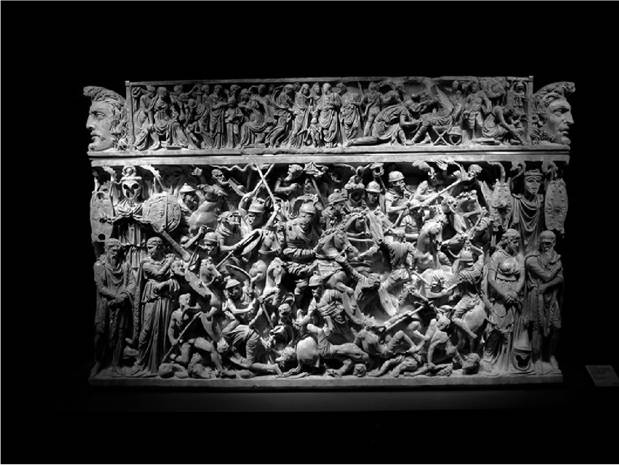
Figure 32.9 Portonaccio Sarcophagus, marble, c. 190-200 ce, Museo Nazionale Romano, Palazzo Massimo, Rome.
scenes depict numerous combatants, overlapping one another, in all manner of poses: triumphant, on horseback, on foot, falling, wounded, dying and dead. The battle scenes are typically framed with trophies and barbarian prisoners, often a male and female pair at each corner. The left and right sides have complementary scenes in lower relief. Common to all these sarcophagi is the depiction of fierce combat between clearly identifiable Romans and barbarians.
A particularly fine example from c. 190-200 ce is the Portonaccio Sarcophagus (Figure 32.9). The main figure in the battle scene, a Roman commander who is helmeted and on horseback, is positioned near the top and slightly to the left of the central axis. He appears about to strike or trample an enemy whose outstretched right arm reaches towards him in a plea for mercy.
Around him are fellow soldiers viciously fighting barbarians who are bearded and helmetless. The inclusion of biographical scenes - birth, marriage and the commander granting clemency to captives - along the front edge of the sarcophagus lid indicate that the battle scene should be understood as an element of the life story of the deceased. However, a curiousRepresentations of War and Violence: Ancient Rome detail of this otherwise exquisitely finished sarcophagus is that the portraits of both the deceased and his wife remain unfinished.
Like most of the battle sarcophagi of the later period, the Portonaccio Sarcophagus can be categorised as a biographical sarcophagus. It has the elements associated with the genre in which episodes of the deceased's life are equated with imperial Roman virtues. The battle scene illustrates virtus, or military valour, while his receiving of a submissive barbarian displays his dementia, or mercy. Concordia, or harmony, is signified by the marriage scene. On other sarcophagi the deceased is also shown making a sacrifice to represent his pietas, or devotion to the gods.[1246] The military, civic and domestic roles of the Roman male are presented, including his power over others: husband over wife, commander over soldiers, and Romans over barbarians. Although the portraits of the deceased and his wife are not finished on the Portonaccio Sarcophagus, it was intended as an individualised monument. Along with their role as personal memorials, the battle sarcophagi of the mid second to early third centuries were also aspects of the competition between the military elite of the period.[1247] Victorious commanders no longer received triumphal monuments for their achievements, as those were reserved for the emperor. The shift to individualised portraits for the central figures and to contemporary adversaries in the battle scenes in these later sarcophagi accentuated the virtus of the deceased in a way that may have implied a ‘private apotheosis' of the individual,[1248] and thus we see an emphasis on the prowess and courage of the deceased as the indicator of his worthiness for commemoration.
More on the topic War and Violence on Funerary Monuments:
- War and Violence on Public Monuments
- Cultures of Violence in Countries at War
- Monuments and Place Names
- Violence and War in the Middle Ages
- Displays of War and Violence and the Roman House
- FUNERARY CULT
- Funerary Rites
- MASKS AND MONUMENTS
- Interpersonal Violence up to the First World War
- Ethos and funerary ideology
- War and the Outsourcing of Imperial Violence
- Insignia and Monuments
- Violence and the First World War
- The Violence of the Cold War