War and the Outsourcing of Imperial Violence
The nature of war fundamentally changed in the Balkans between 1683 and 1688. Belgrade had grown wealthy and important as an Ottoman fortress city. The conquest in 1521 of Sultan Süleyman the Magnificent (r.
1520-66) had made it the key staging post for imperial campaigns against the Hungarian and Habsburg Empires to the north or Venice to the west. Before 1688, no foreign invading army came close to the city. But when Habsburg general Prince Eugene of Savoy crossed the Danube and occupied it during the Great Turkish War, something unprecedented in terms of scale happened: his Catholic officers were successful in coaxing large numbers of Orthodox Serbian, as well as other non-Muslim re‘aya subjects, into a general uprising against the sultanate. They joined Habsburg forces and carried out the same type of morale-sapping violence they had traditionally perpetrated for Istanbul outside of the empire on the soils of imperial rivals, pillaging, enslaving and slaughtering a Muslim population that had already sacrificed a great deal in its long defence against the Holy League's advances.The Orthodox Christian warriors of the Balkans, who traditionally comprised the backbone of Ottoman irregular forces in the West, now defected to Freikorps (volunteer) paramilitary bands led by Habsburg officers and former Ottoman Christian irregulars (martolos) that penetrated deep into the heart of Rumeli, briefly taking important cities like Nis (now in Serbia) and Skopje (now in Macedonia), inciting Christian communities elsewhere to rise up. The Ottomans regrouped nevertheless, taking back Nis and Skopje followed by Vidin, Belgrade and the rest of Serbia by the autumn of 1690.[329] Warrior Catholic (e.g. Uskoks) as well as Orthodox populations (e.g. Serbs, Vlachs and martolos) and other borderland groups had weaved in and out of the service of the Ottomans and their rivals in the past.[330] [331] However, the massive shift in their allegiance after 1688 was unprecedented and henceforth altered the political balance in the region.
Savoy's invasion also displaced thousands of Muslim refugees, who fled Ottoman Hungary and Transylvania in terror. In what would become a recurring Ottoman tradition, Istanbul settled traumatised refugees from recently lost territories in key fortress cities such as Belgrade and Vidin as well as along strategic roadways to secure these areas as Muslim spaces against foreign invasions and treachery from local Christian subjects.11 But complaints and petitions from Belgrade, Vidin and Wallachia after the war point to the great problems the state had in trying to settle Muslim refugees and paramilitary groups, and the disorder they caused when they usurped properties and ransomed and enslaved members of Christian communities well after the wars ended.[332] The protracted violence forced the Serbs to embark on a series of ‘great exoduses' (Velike seobe Srba) across the border into the Habsburg Empire.
In addition to turning a blind eye to peacetime vigilantism against the Serbs after the Ottoman forces retook Belgrade in 1690, Istanbul stripped the Serbian Patriarchate of all the special privileges, lands and tax collection rights it had granted to it in the sixteenth century. The former Patriarch of Ped (now in Kosovo), Arsenije III Carnojevid (1633-1706), consequently led the first wave of Serbs and other Orthodox Christians into the Habsburg Empire. After reclaiming territories they lost to the Russians in 1711, the Ottomans turned to the west to fight the Habsburgs and Venetians between 1714 and 1718, in order to regain the large tracts of territories they had lost there in 1699. However, Eugene of Savoy's Austrian forces routed the Ottoman forces again at the Battle of Petrovaradin in 1716, pushing through to recapture Belgrade, while Serbian Freikorps bands once again drove far south deep into the Balkans. Most significantly, Vienna created the Kingdom of Serbia (Konigreich Serbien) with Belgrade as its administrative centre in 1718. This territory permitted the autonomous Serbian Freikorps to maintain a peacetime system of feuding, plundering and raiding on Muslim lands that helped to sustain the new kingdom until the outbreak of yet
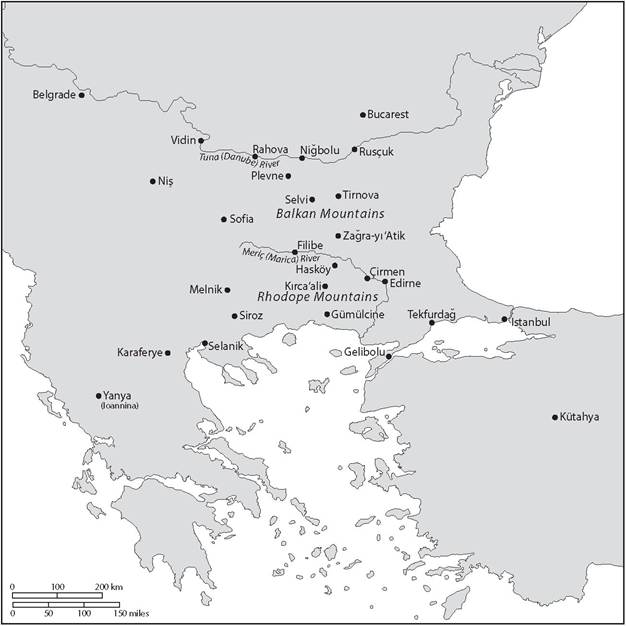
Map 10.2 The Ottoman Rumeli, c.
1800.another long war in 1739, in which the Ottomans fought more successfully against a Habsburg-Russian alliance, retook Serbia and razed ‘Habsburg' Belgrade.[333]
With all hopes of greater Serbian autonomy and liberties thwarted, coupled again with Muslim retributions after the war, the Serbs embarked on a second wave of massive migrations north out of Ottoman territory. To accommodate these large migrations, the Habsburg emperor Leopold I (1657-1705) established a tax-free military border region called the Vojvodina and allowed Serbian and other Orthodox groups from the Ottoman Empire to repopulate the region on the condition that they organise as Freikorps irregular units that served the purpose of defending the region against and launching periodic raids and skirmishes (Kleinkrieg) into the Ottoman Empire.
Although detailed research into these new border dynamics still remains to be done, extant scholarship suggests that the Ottoman response was to bar henceforth Serbs and other Ottoman Christians from serving in the military and make conscientious efforts to Islamise the new borderland along the Danube, removing remaining Christian subjects from these strategic fortress cities. To fill the void left by the Serbs and other Christians who had left the empire, the Ottomans authorised a series of migrations of stockbreeders and pastoral warrior populations from the mountains of what is now Albania, Greece and Montenegro near the Adriatic coast eastwards into southern Serbia, Kosovo, Macedonia and Bulgaria.[334]
These long-term demographic shifts arose from a combination of ecological factors as well as confessional-cum-ethnic-identity politics spurred on by inter-imperial conflict and intrigue. But Istanbul's dire need to populate its frontier defences with reliable and inexpensive Muslim military labourers was the most important factor. Lacking the resources and time to create and train a standing army, the central government was forced to outsource imperial defence and governance to these new recruits.
The rugged terrain and dearth of fertile land in the mountainous regions of Albania and Montenegro made sedentary agriculture difficult; thus, the peoples of these regions were largely pastoral and traditionally served as mercenaries of rival empires that bordered the Adriatic Sea, dating all the way back to Byzantium. This population, often collectively referred to as ‘Arnavut' (‘Albanian' in Turkish) by imperial officials, was in fact divided by myriad local, clan, confessional and ethnic allegiances, making it impossible for the Ottomans to categorise or control. In the past, Istanbul tried to confine the internecine struggles and blood feuds among these communities to the mountains, and was content to tolerate violence so long as the state controlled the imperial roadways, mountain passes and coasts in the western Balkans.Albanian, Macedonian and Serbian scholars have traditionally interpreted the Albanian settlement in Kosovo and its surrounding areas as an Ottoman, state-sponsored attempt to colonise these areas with loyal Muslims. But the Albanian pastoral warrior populations that settled in the Kosovo plain and further north towards Belgrade, and in the Balkan and Rhodope Mountain ranges farther east, can hardly be construed as zealous Muslims of the Ottomans. A large part of the Albanian population up to the eighteenth century was still Catholic.[335] In fact, these migrations ought to be seen as part of a larger phenomenon in which Albanian pastoral warrior populations found a niche as irregular troops who filled the voids left by the Serbs and other Orthodox warrior populations during their flight to the Habsburg Vojvodina. Their settlement appears to have been concomitant with their conversion to Islam; therefore, Albanian migration must be viewed in the context of a larger shift in which confessional, sectarian and even ethnic identity began to play a more important role in Ottoman society as a whole. Indeed, what is discernible is that Istanbul's need to muster more bodies to fight the Russians by the end of the eighteenth century involved the mobilisation of irregular troops who were bound less by dynastic loyalties than they were by regional and ethnic ones, at a time when ethnic identity among Ottoman Christian subject populations also began to matter more.
Virginia Aksan has noted that the Ottoman state found it difficult to effectively negotiate with these mobile, warrior subjects and therefore struggled to reassert its control over the monopoly of legitimate violence.[336] Recent studies suggest that this was not only the case in borderland areas but also in the urban context as well, where migrants were implicated in various forms of disorder. Immediately after the Treaty of Karlowitz, for instance, Balkan migrants came to play a key role in fomenting large-scale peacetime riots and rebellions that affected even the Ottoman capital itself. In the 1703, 1730 and 1740 urban revolts that erupted in Istanbul, the first two of which deposed sultans, unemployed Albanian vagrants and young, unmarried men were singled out in imperial sources as the key instigators. What made the 1730 Patrona Halil revolt, for example, so unique at this point in Ottoman history was its social base. Patrona Halil is said to have been an immigrant Albanian bath attendant and itinerant dealer of used goods who muscled his way into the janissary corps. He led a combination of fruit sellers, coffee shop owners and janissaries, as well as parts of the urban population in Istanbul, in a full-scale rebellion that deposed Sultan Ahmed III (r. 1703-1730). Together with the civil population and urban guilds, imperial authorities singled out Albanian migrants who, with their military experience and reputation for violence, were cited by imperial authorities as a new element in the urban fabric of the imperial capital that undermined the rule of law and sultanic authority. Likewise, in the wake of another costly war in which Ottomans fought the Russians and Habsburgs simultaneously, a crowd allegedly comprised largely of Albanian migrants attacked shops and plundered goods in the Sipahi bazaar in 1740, thus spurring on a riot that spread to the flea market and then to the Bayezid Mosque area. Though the government suppressed these rebellions, imperial sources again attributed public disorder, uprisings, and crimes to Albanian migrants.[337] Whether the state exaggerated their role or not, these migrants became proverbial agents of disorder in the imaginations of Ottoman elites.
More on the topic War and the Outsourcing of Imperial Violence:
- Imperial Overstretch after the Cold War
- THE IMPERIAL DESTABILIZER: WORLD WAR II
- Imperial Chinese society accepted and even lauded certain types of violence. Fundamental views of sanctioned violence developed in reaction to that culture's particular views of masculinity.
- 2 The First World War and Imperial Convulsions
- OUTSOURCING RISK IN E-BANKING
- Representations of Violence in Imperial China
- Cultures of Violence in Countries at War
- Violence and Warfare in Early Imperial China
- Violence and War in the Middle Ages
- Displays of War and Violence and the Roman House