Policy evolution and conflict dynamics
The debate on policy and the implications for SHD or local development is undoubtedly characterized by a fervent discussion involving scholars and practitioners, which sometimes connects the two perspectives in an integrated treatment.3 Underlying this debate is a loose consensus around normative objectives relating to the quality of life and development (e.g.
participation, social justice, democratization, territorial competitiveness), paving the way for different perspectives on policy actions depending on the analytical discipline and level of intervention. Without engaging in such a lively discussion, it is useful to explore the insights that can be derived for the policy realm from the STEHD framework elaborated in Chapter 2 (here represented in Figure 6.1).Put briefly, each element and procedural aspect of the framework can be considered separately as a policy objective per se, with possible actions from different levels (local, national and supranational) that impact SHD. For instance, market and non-market production at the territorial level is a common policy area, as well as actions for a more equal distribution of goods and services and more participatory deliberation mechanisms. The nine feedback loops discussed in Chapter 2 open other areas where dynamic processes of agency expansion or contraction, for instance, can reinforce policy interventions at different levels.
However, two important caveats are worth noting. First, a more dynamic analysis aimed at understanding and anticipating paths of policy change needs to be developed (Bianchi and Labory, 2006; Trigilia, 2009), in order to avoid the risk of losing the value added by the evolutionary perspective we have introduced. This idea is further reinforced by Picchio (2013), who
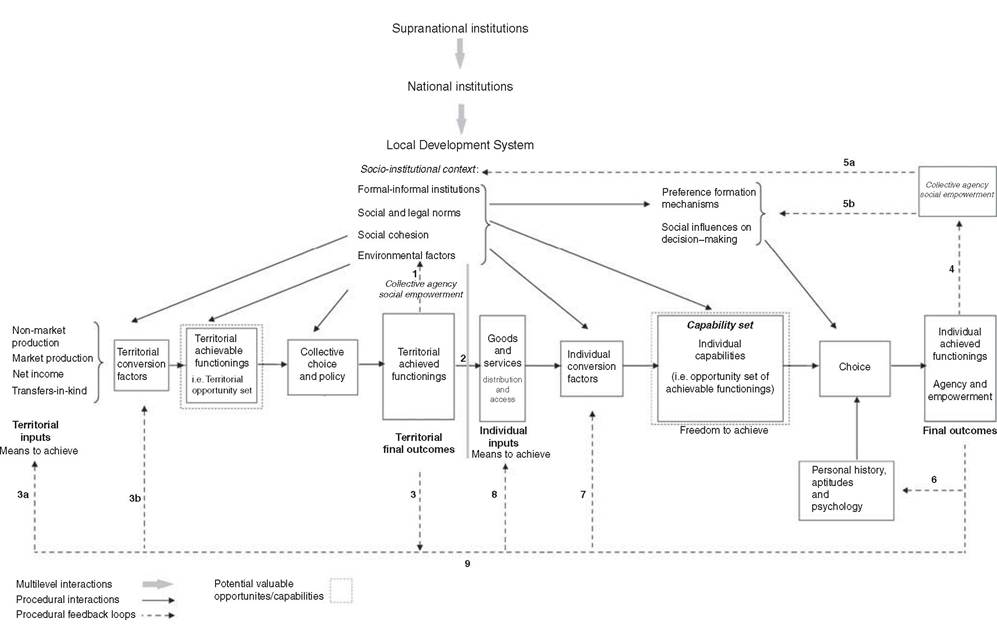
Figtire 6.1 The STEHD framework: A stylized evolutionary framework for SHD at the local level
argues that final results concerning the experience of a good human life cannot be determined on the basis of a technical relation between inputs and outputs.
Second, as Sen (1993) has argued, evolution in itself does not imply progress in terms of well-being or the quality of life for each individual (Clark, 2002). It is therefore necessary to always take account of the interconnectedness among each elements of the STEHD framework and the continuous tension among evolutionary, involutionary and lock-in processes and tendencies. The difficulty of saying under which conditions evolution leads to progress cannot justify separate policy accounts and actions in different areas, but does requires us to prioritize a system with interrelated components and evolving parameters. Indeed, there is a strong and direct interconnection between the well-being and freedom of people, the economic production process and social change (Sen, 1985b; 2005), especially within territories. In this regard, as stressed in chapters 1 and 2, policy design, monitoring and evaluation entail looking beyond their direct objectives and effects, and widening the perspective on the contribution of each action with regards to a territorial system for enabling human flourishing.The following question warrants discussion: what drives the processes of policy change in shaping SHD evolution at the local level?
The starting point relates to the conceptualization of evolution embraced in Chapter 2, conceived as those processes of system change through cumulative complexity and improved adaptation to the environment (Nelson, 1995) involving the selective retention of renewable diversity (Campbell, 1969). It is essential to note the renewable diversity of values, interests, policy ideas and discourses4 within the "socio-economic infrastructure” (Lambooy, 2000), and "policy networks” (Cooke and Morgan, 1998), that involve a plurality of local and extra-local actors. Indeed, according to van den Bergh and Kallis (2009, p. 15), ‘at the hearth of theories of policy evolution is the notion that political and economic environments impose selective pressures upon alternative political strategies and that political actions, through processes of trail, error and learning, continuously adapt their strategies to this selection environment.' Simply put, ideas - emerging from specific interests and needs - make local systems change.
In other words, the process of policy evolution is understood as a neverending interplay of conflicting values, interests, ideas and discourses among social groups (politics), which reproduce, perpetuate or transform the socio- institutional context (polity) and lead to development strategies, practices and trajectories (policy). Within this perspective, conflicts due to the heterogeneity of the system's actors, the diversity of values and the divergence of interests should not be misconceived as detrimental to SHD. The key idea here is renewable diversity (rather than equilibrium), which has origins in the search for new alternatives; and therefore changes and forms of progress more likely to occur in contexts that are not completely harmonious or homogeneous (Ceriani Sebregondi, 1953b). Indeed, when diversity and conflicts are valorized and transformed within spaces for open, transparent and inclusive deliberation, they nurture the expansion of collective agency and social empowerment (Galtung, 1996; Crocker, 2007; Deneulin and McGregor, 2010), activating virtuous feedback loops within the territorial enabling system for human flourishing, thereby driving processes of policy evolution towards SHD paths. Several areas where conflicting relations appear undeniable and central for policy evolution can be identified, for example, relations between private/public objectives, individual/collective interest, micro/macroeconomic behaviour, material/immaterial dimensions of well-being, centre/periphery dynamics, social/productive outputs, effi- ciency/equity goals, local/global processes, ethical/economic concerns, as well as conflicts regarding gender and ethnic equality and inter-generational distribution.5
Two examples connected to the idea that all systems have deep cleavages (Wallerstein, 2000) can help illustrate this point. First, the visions and principles of local development reflect power relations and balances between social classes and groups within Local Development Systems (LDSs) (Trigilia, 2001; Bagchi, 2011), stressing once again the interconnection among the politypolitics-policy domains.
According to Pike et al. (2007, pp. 1260-1261), ‘it is, then, critical to ask whose principles and values are being pursued in local and regional development', if any individual and institution with social power has been seeking to impose their specific interests and visions and how these may be contested (Klandermans, 1997; Harvey, 2000; Deneulin and McGregor, 2010). Similarly, it is important to ask how local power is managed and oriented towards territorial development (Sforzi, 2005). The extent and vigour of the reclaim of policy spaces by minorities or vulnerable groups (Dreze, 2008) is, for instance, an undeniable element of conflict, which can open up or restrain local opportunities for SHD. In addition, participation spaces are socially constructed and not neutral in terms of power relations (Frediani et al., 2015, forthcoming).6 The greater the power asymmetry among social groups, the less the conflict around development values and policy ideas, as a large part of local society are excluded from debate and deliberation. Thus, if held within normative boundaries of social justice (Sen, 2006), conflicts in participatory arenas of consultation and deliberation can foster a valuable dialectic of values and ideas leading to more appropriate policy strategies for SHD at the local level. However, following Sen (2009), it should be emphasized that the “right” criteria for social justice - for example, among utility (utilitarian), primary goods (Rawlsian), personal liberties (liberal) and capabilities (Capability Approach (CA)) - do not exist. Rather, public deliberation accepts the incompleteness of criteria for social justice and gives value to their plurality and the tension among them, leading to specific choices on the basis of contingent and critically scrutinized evaluations, which evolve over time and depend upon the historical and cultural context. In addition, the existence of conflict dialectics is further reinforced within a multilevel governance (MLG) perspective, as discussed in Chapter 3. Indeed, issues such as appropriate degree of decentralization, sub-national equality and provision of global public goods entail diversity of interest, ideas and discourses among levels, and therefore conflicting relationship in decision-making and supply processes.Second, the policy enhancement of individual well-being must take into account the systematic and conflicting ‘ways in which productive forces shape human relations and are in turn shaped by them' (Bagchi, 2011, p. 34). For instance, at the firms' level the tension between profit-maximizing objectives, wages consolidation, workers' dignity and environmental protection shapes the functional distribution of incomes of each entrepreneur (UNEP, 1995; Doni and Ricchiuti, 2013), directly affecting both individual and family well-being and, in aggregated terms, the territorial system for enabling human flourishing as a whole (see Figure 6.2).7
If local firms view their workforce only as means of production (contributing to their vulnerability), or if they degrade the surrounding environment (env) for the sake of profit maximization within race-to-the-bottom processes of competition (profit n vs wages w), conflict would cause ruptures in social relations, whose final effects can be seen in the public expenditure required to repress social conflict and unrest and to mitigate poverty and exclusion (Picchio, 2013). In addition, when firms' production choices are analysed within a group (e.g. ethnic groups, castes) or gender perspective (Addabbo and Picchio, 2004), it emerges that they crucially affect not only groups' working conditions (g) but also families' living conditions and community well-being. If, on the other hand, local firms pay consistent attention to the social and environmental context they are embedded in, conflicts would pave the way for the experimentation of innovative solutions to align productivity objectives with respect for workers' rights and for the environment, allowing policies to deal with longer-term objectives for SHD.
Similar decisions are based on the local and extra-local goods and services each specific firm has access to, and how these goods and services are mediated by the firm's conversion factors. In addition, the provision of goods and services is retrospectively related to territorial achieved and non-achieved functionings, which interact to frame territorial development processes, business management and individual capabilities expansion. For instance, each territory achieves specific functionings in terms of the business environment, leading to the provision of an array of business services (credit, R&D, etc.), which a firm, through its conversion factors (e.g. management capacity, workforce skills), can covert to outcomes distributed between n, w, env and g. This, in turn, affects the processes of expansion (or reduction) of the individual capability set. Detailed empirical accounts of these processes in future research may help clarify these arguments.
To conclude, the way these conflicts are transformed and held within social justice boundaries shape the evolution of policy objectives and
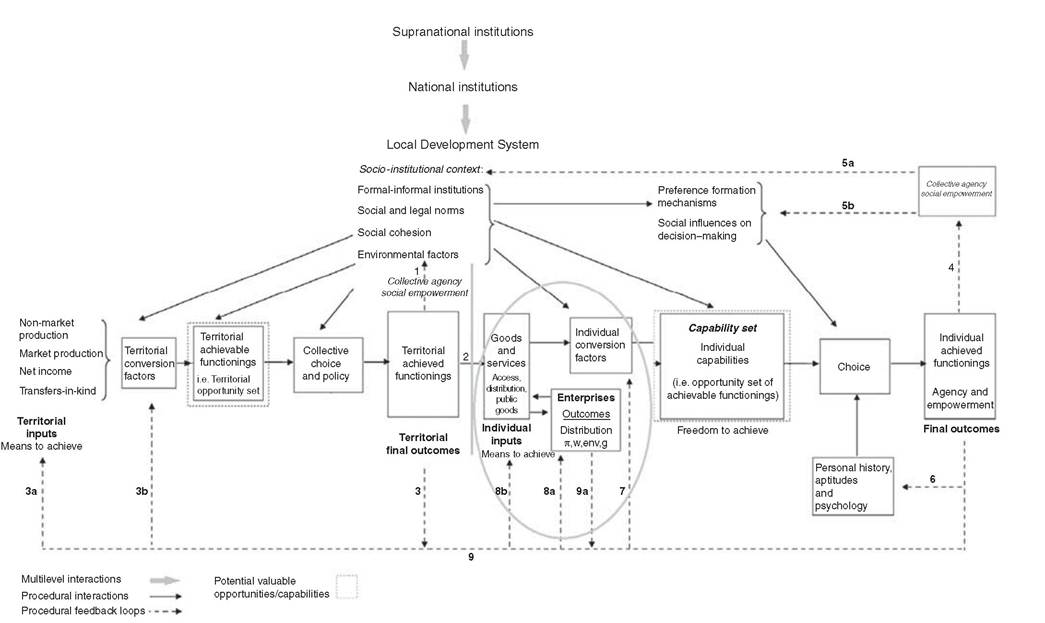
Figtire 6.2 The STEHD framework: The nexus between enterprises' opportunities and individual capabilities
practices. Recognizing the importance of diversity and heterogeneity within local societies, and subsequent conflictual dialectics, is therefore vital to understand the "policy-enabling space” territorial stakeholders can build on to foster SHD trajectories.
6.3
More on the topic Policy evolution and conflict dynamics:
- Distributional Conflict and Economic Growth: Concave Preferences*
- References
- REFERENCES
- A BRIEF HISTORY OF SOCIAL PSYCHOLOGICAL THEORIZING ABOUT CONFLICT
- References
- 7.1 The relevance and novelty of SHD at the local level
- References
- Index
- Future Directions and Conclusions About CMS and Organizing
- REFERENCES