Social Economic Organization
Whether or not Samuelson reacted negatively to the line Gideonse was taking in the lectures, this course was significant as being the first place in his program where he was exposed to the work of Frank Hyndman Knight (1885—1972).
Samuelson provided an affectionate portrait of the professor he described as a “Cracker-barrel Socrates.”A profound philosopher and a superb economic technician, he was also the village atheist and a sage of the Will Rogers vintage. These days professors tend to come from Exeter Academy or the Bronx High School of Science. Knight was of that turn-of-the-century generation who—like Karl and Arthur Compton and Wesley Mitchell—came off the farm.
He used to say in his squeaky voice that he became an economist because his feet hurt him following the plow. Perhaps nearer the truth was the fact that when he was a graduate student at Cornell, he was given an ultimatum: “Stop talking so much, or leave the philosophy department.” This gave Knight no choice but to gravitate down to economics. (It also made him an authority on the laws of talk, as in his dictum: “Sociology is the science of talk, and there is only one law in sociology. Bad talk drives out good.”)39,11
The fruit of Knight’s time at Cornell and the basis for his reputation as an economist was a book, Risk, Uncertainty and Profit (1921), a revised version
g. Gideonse’s teachers at Columbia had included Wesley Mitchell (an enthusiast for Hobson’s welfare economics) and J. M. Clark.
h. Knight’s law of talk was a variant of Gresham’s Law, named after the sixteenth-century Thomas Gresham, that bad money (coins with a low silver content) drives out good of the PhD thesis he had submitted in 1916. In this he had connected profit to uncertainty, arguing that, in the absence of uncertainty, profits would be zero. However, the required reading for the course was not this book, but four chapters Knight had written while at Iowa, printed in the syllabus under the heading of “Social Economic Organization” and taking up well over half the pages devoted to readings.
Samuelson was later to acknowledge the similarity between the view of economics presented in his own textbook and the view Knight had proposed in these readings.40In these chapters, Knight began with the problem of economic organization, a topic that arose because economic activity required many people to cooperate in performing different tasks.
The problem of organization, which sets the problem of economic science, deals with the concrete means or mechanism for dividing the general function of making a living for the people into parts and bringing about the performance of these parts in due proportion and harmony.41
Performing this task required that five functions be performed if the economic system was to work successfully: fixing the standards or values that determine consumption; organizing production; distributing resources among individuals; providing for economic progress; and adjusting con- sumption-to-production within very short periods (accommodating temporary shortages or gluts). Knight explained why organized production would be more efficient than if each person lived in isolation, but like many writers from Adam Smith onward, recognized that the division of labor could have harmful effects.
Taking up a theme that had been developed at length in the previous year's course, Knight outlined different types of economic system (caste, autocracy, anarchy, and democratic socialism) before turning to the system with which he was most concerned: the price system. This achieved organization without planning.
No one ever worked out a plan for such a system, or willed its existence; there is no plan of it anywhere, either on paper or in anybody's mind, and no one directs its operations. Yet in a fairly tolerable way, “it works,” and grows and changes. We have an amazingly elaborate division of labor, yet each person finds his place in the scheme.42
(coins with their full silver content), on the grounds that if they have both, people will choose to spend the bad money and to hoard the good money.
One can understand Knight's taking this view in the mid-1920s, but it would be interesting to know how Samuelson and his fellow students reacted to the claim that the price system “worked” in 1932—33, when the place of many people was in dole lines. A few pages later, Knight explained that in the real world, the system did not work as well as theory suggested. “Much conscious social interference” was needed to counteract monopolies. A further problem was that pecuniary demand did not measure “the real human importance of products”: “desires may be manufactured by fraud or corruption of tastes, and at best it cannot be assumed that what people individually want is uniformly what is best for them or for society.”43 The significance Samuelson attached to these remarks will have depended on whether he read them as minor qualifications to an argument about the virtues of free enterprise, or as substantial points relating to welfare analysis, perhaps drawing out implications of the ethics he had encountered in Hobson's writings the previous year.
Knight then proceeded to outline what is often described as a broadly “Austrian” view of economic activity.i That is, the aim of economic activity is the satisfaction of wants, which can be achieved either directly, through producing goods such as food and housing, or indirectly, through producing machinery and factories that can be used to produce consumption goods. In the course of this, Knight presented the circular flow diagram that Samuelson was later to make central to his introductory macroeconomics teaching— Knight's “Wheel of Wealth,” reproduced here as figure 3.1.j In the 1920s, economists did not distinguish macroeconomics and microeconomics, and Knight was no exception to this rule. He used the Wheel of Wealth to make the point that the price system involved people making their living by selling their “productive power” to businesses, using the income they receive to buy the goods and services they consume.
It was a simplification because it ignored the fact that much business activity involves providing for future consumption and because the distinction between people and businesses is not clear-cut. The flow of money in the diagram represents “total social income,” which has different meanings at different points in its “circular flow.” (Knight used the phrase that Samuelson would later use to describe the [1]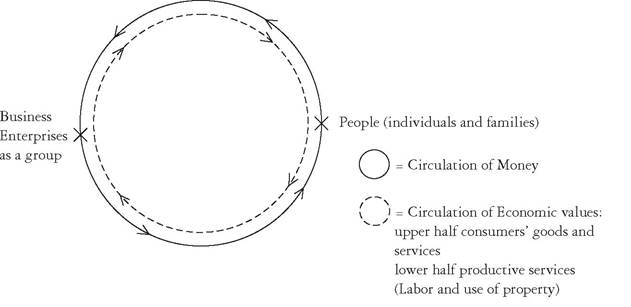
Figure 3.1 Knight's “Wheel of Wealth.”
process.) It measured personal incomes, the aggregate cost of living, the cost of production, and business income.
The remaining two chapters provided a conventional account of supply and demand—an excellent summary of the theories of Alfred Marshall, in the 1920s still the world’s preeminent economist—and an analysis of income distribution. The most remarkable aspect of this account is that it was entirely verbal, without even the diagrams that had become standard in the three decades since Marshall’s textbook. The main principle underlying the theory of distribution was marginal productivity.
Several features of Knight’s chapters are of interest in relation to Samuelson’s later work. Though Knight did not hesitate to talk in terms of “utility” and “marginal utility,” he made it clear that it was the “relative utility” of one commodity in relation to others that determined demand: that levels of utility did not matter.44 He reiterated the point made earlier that “the preferences of individuals, reflected in their price offers, do not always represent what is ‘best’ for the individuals themselves.”45 The notion that Samuelson was later to make his own—that preferences are revealed by consumers’ decisions—was taken for granted by Knight in the course of questioning the significance of those preferences. He drew a clear distinction between the analysis of welfare, resting on ethical judgments, and consumers’ preferences.
Knight also pointed out the existence of externalities—the problem that one person’s actions may directly affect someone else. The free enterprise system might direct resources into uses where they had the “greatest social usefulness,” but there were many exceptions.Knight also argued that there was no clear distinction between monopoly and competition, the point taken up by another of Allyn Young’s doctoral students, Edward Chamberlin, who was to be one of Samuelson’s teachers at Harvard. “Ultimately all commodities compete with each other for the consumers’ money,” Knight wrote, goods differing in the degree (a word that Knight emphasized when he first used it) to which they could be distinguished from each other.46 Notwithstanding this qualification, Knight could write about the “evils” involved in monopoly.47
In contrast, Knight had nothing but praise for speculators who performed the important social function of ensuring uniform prices across time and space, buying when (or where) prices are low and selling when (or where) prices are high.
Most of the popular abuse of speculators is due to failure to understand the function they perform, and especially the failure to see that they can only make money by doing what is to the interest of producers and consumers alike to have them do.48
No doubt drawing on the experience of farm prices gained in Iowa, Knight claimed that speculators did not make excessive gains. To the contrary, speculative middlemen dealing in agricultural markets lost more than they gained, the reason being that they were playing a game much like gambling, and for similar psychological reasons they tended to overreach themselves. No, the real evils of speculation were “due to ‘manipulation’ through misrepresentation of facts by fraudulent reports and the like, and to the operations of ignorant persons whose mere gambling on the market often produces serious effects.”49 Given the dramatic change in his family’s fortune through its involvement in Florida property speculation, Samuelson would no doubt have seen this as more than a theoretical problem.
A significant feature of Knight’s discussion of distribution was that though his theory was traditional in linking the rate of interest to the supply of capital (saving) and demand for capital (investment), he questioned the extent to which saving reflected the choices of optimizing agents. The conventional view was that saving depended on peoples’ attitude toward the future: their preference for consumption now rather than in the future. Knight challenged this:
To some extent this is perhaps true. But the motives underlying saving are very complex and uncertain. One thing is obvious; the great bulk of the social supply of capital comes and must come from saving by persons who do not consume or expect to consume their saving at any time, but die and leave it behind them. It hardly seems real to refer to the motives for leaving an estate after death as a comparison between present and future goods. Other arguments still further weaken the view of psychological discounting [of the future] as a main cause affecting the interest rate, but they cannot be given here.50
Samuelson was later to use similar arguments in his own work on capital theory.
More on the topic Social Economic Organization:
- Contents
- Defining the Terms
- The First Draft, 1945
- Backhouse Roger, Baujard Antoinette. Welfare Theory, Public Action, and Ethical Values: Revisiting the History of Welfare Economics. Cambridge University Press,2021. — 301 p., 2021
- 8.2 RIGHTS AND HARMONY
- Oetzel John, Ting-Toomey Stella. The SAGE Handbook of Conflict Communication: Integrating Theory, Research and Practice. SAGE Publications,2013. — 912 p., 2013
- GHANA