Appendix A
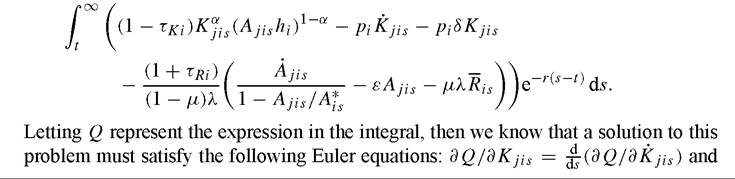
The firm’s maximization problem can be restated as choosing A jis and Kjis to maximize:


References
Acemoglu, D., Ventura, J.
(2002). “The world income distribution”. Quarterly Journal of Economics 117, 659-694.Aghion, P., Howitt, P. (1992). “A model of growth through creative destruction”. Econometrica 60, 323-351.
Aghion, P, Howitt, P. (1998). Endogenous Growth Theory. MIT Press, Cambridge, MA.
Auerbach, A.J. (1996). “Tax reform, capital allocation, efficiency and growth”. In: Aaron, H.J., Gale, W.G. (Eds.), Economic Effects of Fundamental Tax Reform. Brookings Institution Press, Washington, DC, pp. 29-73.
Barro, R.J., Lee, J.W. (2000). “International data on educational attainment: Updates and implications”. National Bureau of Economic Research Working Paper 7911. Cambridge, MA.
Barro, R.J., Sala-i-Martin, X. (1995). Economic Growth. McGraw-Hill, New York.
Baumol, W.J. (1986). “Productivity growth, convergence and welfare: What the long-run data show”. American Economic Review 76, 1072-1085.
Becker, G.S., Philipson, TJ., Soares, R.R. (2003). “The quantity and quality oflife and the evolution of world inequality”. National Bureau of Economic Research Working Paper 9765. Cambridge, MA.
Bils, M., Klenow, PJ. (2000). “Does schooling cause growth?”. American Economic Review 90, 1160-1183.
Caves, R.E. (1996). Multinational Enterprise and Economic Analysis, second ed. Cambridge University Press, New York.
Coe, D.T., Helpman, E. (1995). “International R&D spillovers”. European Economic Review 39, 859-887.
Coe, D.T., Helpman, E., Hoffmaister, A.W. (1997). “North-South R&D spillovers”. Economic Journal 107, 134-139.
DeLong, J.B. (1988). “Productivity growth, convergence and welfare: Comment”. American Economic Review 78, 1138-1154.
Diamond, J. (1997). Guns, Germs, and Steel: The Fates of Human Societies. Norton, New York.
Easterly, W. (2001a). The Elusive Quest for Growth: Economists’ Adventures and Misadventures in the Tropics. MIT Press, Cambridge, MA.
Easterly, W. (2001b). “The lost decades: Explaining developing countries’ stagnation in spite of policy reform 1980-1998”. Journal of Economic Growth 6, 135-157.
Easterly, W., Levine, R. (2001). “It’s not factor accumulation: Stylized facts and growth models”. World Bank Economic Review 15, 177-219.
Easterly, W., Kremer, M., Pritchett, L., Summers, L.H. (1993). “Good policy or good luck? Country growth performance and temporary shocks”. Journal of Monetary Economics 32, 459-484.
Eaton, J., Kortum, S. (1996). “Trade in ideas: Patenting and productivity in the OECD”. Journal of International Economics 40, 251-278.
Eaton, J., Kortum, S. (1999). “International technology diffusion: Theory and measurement”. International Economic Review 40, 537-570.
Evenson, R.E., Gollin, D. (2003). “Assessing the impact of the green revolution, 1960-2000”. Science 300, 758-762.
Fischer, S. (1988). “Symposium on the slowdown in productivity growth”. Journal of Economic Perspectives 2, 3-7.
Gollin, D. (2002). “Getting income shares right”. Journal of Political Economy 110, 458-474.
Griliches, Z. (1992). “The search for R&D spillovers”. Scandinavian Journal of Economics 94, S29-S47. Grossman, G.M., Helpman, E. (1991). Innovation and Growth in the Global Economy. MIT Press, Cambridge. Hall, B.H. (1996). “The private and social returns to research and development”. In: Smith, B.L.R., Barfield, C. (Eds.), Technology R&D and the Economy. Brookings Institution, Washington, DC, pp. 140-183.
Hall, B.H., Van Reenen, J.
(2000). “How effective are fiscal incentives for R&D? A review of the evidence”. Research Policy 29, 449-469.Hall, R.E., Jones, C.I. (1999). “Why do some countries produce so much more output per worker than others?”. Quarterly Journal of Economics 114, 83-116.
Hendricks, L. (2002). “How important is human capital for development? Evidence from immigrant earnings”. American Economic Review 92, 198-219.
Heston, A., Summers, R., Aten, B. (2002). “Penn World Table Version 6.1”. Center for International Comparisons at the University of Pennsylvania (CICUP), Philadelphia, PA.
Howitt, P. (1999). “Steady endogenous growth with population and R&D inputs growing”. Journal of Political Economy 107, 715-730.
Howitt, P. (2000). “Endogenous growth and cross-country income differences”. American Economic Review 90, 829-846.
Hummels, D., Klenow, P.J. (2005). “The variety and quality of a nation’s exports”. American Economic Review 95, 704-723.
Jones, C.I. (1995). “R&D-based models of economic growth”. Journal of Political Economy 103, 759-784.
Jones, C.I. (2001). “Was an industrial revolution inevitable? Economic growth over the very long run”. Advances in Macroeconomics 1, 1-43.
Jones, C.I. (2002). “Sources of U.S. economic growth in a world of ideas”. American Economic Review 92, 220-239.
Jones, C.I. (2005). “Growth and ideas”. In: Aghion, P., Durlauf, S.N. (Eds.), Handbook of Economic Growth, vol. 1A. Elsevier, Amsterdam. This volume, Chapter 10.
Jones, C.I., Williams, J.C. (1998). “Measuring the social return to R&D”. Quarterly Journal of Economics 113, 1119-1135.
Jones, L., Manuelli, R. (1990). “A convex model of equilibrium growth: Theory and policy implications”. Journal of Political Economy 98, 1008-1038.
Keller, W. (2002). “Geographic localization of international technology diffusion”. American Economic Review 92, 120-142.
Keller, W. (2004). “International technology diffusion”. Journal of Economic Literature 42, 752-782.
King, M.A., Fullerton, D. (1984). The Taxation of Income from Capital: A Comparative Study of the U.S., UK, Sweden and West Germany. University of Chicago Press, Chicago.
Klenow, P.J., Rodriguez-Clare, A. (1997). “The neoclassical revival in growth economics: has it gone too far?”. In: Bernanke, B., Rotemberg, J. (Eds.), NBER Macroeconomics Annual. MIT Press, Cambridge, MA, pp. 73-103.
Kortum, S. (1997). “Research, patenting, and technological change”. Econometrica 65, 1389-1419.
Kremer, M. (1993). “Population growth and technological change: one million B.C. to 1990”. Quarterly Journal of Economics 108, 681-716.
Kremer, M., Onatski, A., Stock, J. (2001). “Searchingforprosperity”. Carnegie-RochesterConference Series on Public Policy 55, 275-303.
Lederman, D., Maloney, W.F. (2003). “R&D and development”. Unpublished paper. Office of the Chief Economist for LCR, The World Bank, Washington, DC.
Lederman, D., Saenz, L. (2003). “Innovation around the world: a cross-country data base of innovation indicators”. Unpublished paper. Office of the Chief Economist for LCR, The World Bank, Washington, DC.
Lucas, R.E. (1978). “On the size distribution of business firms”. Bell Journal of Economics, 508-523.
Lucas, R.E. (1988). “On the mechanics of economic development”. Journal of Monetary Economics 22, 3-42.
Lucas, R.E. (1990). “Why doesn’t capital flow from rich to poor countries?” American Economic Review 80, 92-96.
Lucas, R.E. (2002). Lectures on Economic Growth. Harvard University Press, Cambridge.
Lucas, R.E. (2004). “Life earnings and rural-urban migration”. Journal of Political Economy 112, S29-S59.
Mankiw, N.G., Romer, D., Weil, D.N. (1992). “A contribution to the empirics of economic growth”. Quarterly Journal of Economics 107, 407-437.
Parente, S.L., Prescott, E.C. (1994). “Barriers to technology adoption and development”. Journal of Political Economy 102, 298-321.
Parente, S.L., Prescott, E.C. (2005). “A unified theory of the evolution of international income levels”.
In: Aghion, P., Durlauf, S.N. (Eds.), Handbook of Economic Growth, vol. 1A. Elsevier, Amsterdam. This volume, Chapter 21.Pritchett, L. (1997). “Divergence, big time”. Journal of Economic Perspectives 11 (Summer), 3-17.
Pritchett, L. (2005). “Does learning to add up add up? The returns to schooling in aggregate data”. In: Handbook of Education Economics. In press.
Psacharopoulos, G., Patrinos, H.A. (2002). “Returns to investment in education: A further update”. World Bank Policy Research Working Paper 2881.
Rebelo, S. (1991). “Long run policy analysis and long run growth”. Journal of Political Economy 99, 500521.
Rivera-Batiz, L.A., Romer, P.M. (1991). “Economic integration and endogenous growth”. Quarterly Journal of Economics 106, 531-555.
Romer, P.M. (1986). “Increasing returns and long-run growth”. Journal of Political Economy 94, 1002-1037. Romer, P.M. (1990). “Endogenous technological change”. Journal of Political Economy 98, S71-S102.
Romer, P.M. (1994). “New goods, old theory, and the welfare costs of trade restrictions”. Journal of Development Economics 43, 5-38.
Solow, R.M. (1956). “A contribution to the theory of economic growth”. Quarterly Journal of Economics 70, 65-94.
Stokey, N.L. (1988). “Learning by doing and the introduction of new goods”. Journal of Political Economy 96, 701-717.
Stokey, N.L. (1991). “Human capital, product quality, and growth”. Quarterly Journal of Economics 106, 587-617.
Tamura, R.F. (1991). “Income convergence in an endogenous growth model”. Journal of Political Economy 99, 522-540.
Young, A. (1998). “Growth without scale effects”. Journal of Political Economy 106, 41-63.
More on the topic Appendix A:
- Appendix
- APPENDIX
- Appendix: The 21st-Century Workshop
- Appendix Two A Little History: Consequentiae
- Appendix B Infection Control and Isolation Recommendations
- CONTENTS
- Appendix Three Logic Diagrams
- Contents
- Contents
- Chapter 2 About Overeducation and Mismatching