Problems of the S-view
Muller (2011) points out three problems for the S-View. These he describes as the Problem of Lost Beings, the Problem of the Unavailable Stories, and the Problem of the Lost Content.
I will discuss in this section these problems as a preparation for the presentation of my own version of the structuralist theory.Let us start with the Problem of Lost Beings. This problem arises out of the definition of a scientific theory as a class of structures in the universe of set
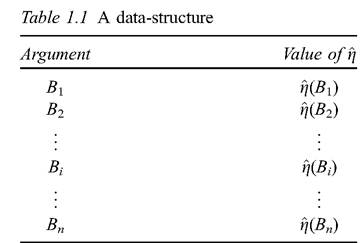
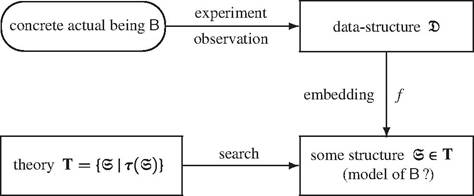
Figure 1.1 The informal ©-view
theory. Asks Muller: “How can any scientific theory T thus reconstructed be about any concrete being in the world, say B (of ‘Being’)?”. He believes that the ©-View ignores (passes over in silence) the fact that a scientific theory must be about “a specific set of actual beings (objects, processes, events, entities, persons, organisms, periods, structures...), frequently called its domain or scope” (Muller 2011: 95, 97). After drawing a picture to illustrate the informal 6-View (ibid.: 98; Figure 1.1 here), Muller claims that
as soon as the data-structure D is obtained, we can forget all about the concrete actual beings at hand, or so it seems. The 6-View says next to nothing about how the models © (the theory T) are related to the concrete beings B they are supposed to provide knowledge of.
Thus, the problem seems to be that of the lack of a doctrine explaining how the set-theoretical structures relate to the elements within the scope of the theory.
The Problem of the Unavailable Stories arises when someone missing the relevant information is presented with a data-structure without any further explanations. According to Muller (2011: 101)
When we arrive with our data-structure in the realm of theories, by telling some story, we know for which scientific theory or theories the data-structure is relevant.
But when we only have rigorous construals of all scientific theories in accordance with the 6-View, to which of the sets or setstructures should we go in order to find a structure that imbeds an obtained data-structure? The ©-View lacks the resources to tell the necessary stories: language.Hence, again, the problem seems to be that of the information available to someone facing a given set-theoretical structure.
Since the aim of modern science is to provide knowledge of concrete actual beings,
A necessary condition any model 6 must pass in order to be considered as a piece of theoretical scientific knowledge about a particular kind of concrete actual being B is that 6 should imbed all the relevant actual data-structures obtained by observing B or performing experiments with B, or both. But what does set-structure 6, or a theory for that matter (T 3 6) say about B? Where has the conceptual and propositional content of the scientific theory T, as used by scientists, gone to when reconstructed as T? Call this the Problem of the Lost Content.
(Muller 2011: 101)
Muller also finds difficult to see where and how does truth fit in the 6-View. He says:
If there are ‘truth-makers’ of propositions that are somehow determined by means of 6 (or of T), then surely they are, or somehow reside in, the concrete actual being B that 6 (or T) is supposed to be about. For if B is neither the truth-maker nor involved in the truth-making of sentences about B, then the concept of truth gets dissociated from the actual concrete beings, and such a concept of truth does not seem to be the concept of truth that is used and understood in science. Surely in science truths and falsehoods are truths and falsehoods about the world. What else could they be about? Well, how does this precisely work, then, according to the 6-View?
(Muller 2011: 101-2)
In forthcoming chapters I will provide a version of the structuralist view that responds to all these questions and solves the three problems posed by Muller, but also additional problems faced by any structuralist theory of science, like the distinction between theoretical and non-theoretical terms, the place of representational measurement within a scientific theory, the problem posed by the Ramsey sentence, and objections specific to the application of the structuralist theory to economics raised by Wade Hands (1985).
In Chapter 2 I will define in a rigorous and complete way the relevant concept of set-theoretical structure, presenting the concept of a model of a first-order language as a special case of the former. svt will be presented in detail in Chapter 3.
In Chapter 5 I will expose the doctrine of representational, in particular fundamental measurement, in order to discuss the role it plays in the structuralist view of scientific theories (SVT). I will try to respond to the objections and criticisms raised against the doctrine of representational measurement by Michell (2007) and, above all, by Boumans (2007, 2008, 2012, 2016).
In Chapter 4 I will provide my own version of Marx’s method of political economy in order to discuss the notions of abstraction, idealization, and concret- ization. A clear distinction will be introduced between the concept of model as an imagined real system and that of a model as set-theoretical structure, but also a doctrine explaining the way the are related. This doctrine should solve the three problems formulated by Muller and prepare the way to a full-fledged structuralist theory of economics.
The terrain will be ready, then, to discuss specific economic theories and their methodology in the remaining chapters. Game theory, Marxian economics, Sraf- fian economics, and econometrics will be treated in corresponding chapters.
Notes
1 See Lowen (1997) for an assessment of the military background underlying the rise of Stanford’s reputation.
2 Other papers on the foundations of physics written with McKinsey are McKinsey and Suppes (1953, 1955). With Rubin (Rubin and Suppes 1954) he wrote a paper on transformations of systems of relativistic particle mechanics, of which he said in 1979 that it was a “a long and very complicated piece of work that has not been read, I suspect, by very many people” (Suppes 1979: 10).
3 The proceedings of this symposium were published by Henkin, Suppes, and Tarski (1959). See the review of this event in Feferman and Feferman (2004: 232-237).
4 The proceedings of this second symposium were published by Nagel, Suppes, and Tarski (1962). For a review of this symposium see Feferman and Feferman (2004: 253-256).
2
More on the topic Problems of the S-view:
- Adolfo Garcia de la Sienra. A Structuralist Theory of Economics. New York, USA: Routledge,2019. — 235 p., 2019
- A new view of scientific theories
- PROBLEMS OF DEFINITIONS
- ADOPTION OF THE REVISIONIST VIEW IN THE UNITED NATIONS
- A VIEW TO A KILL—GENERAL MECHANISMS OF APOPTOSIS
- Conclusions: Some Problems of Classification
- Is the best practice really good enough?
- Findings
- Franciszek Duchinski and His Impact on Ukrainian Political Thought
- The Dialogue That Never Happened