Ecologists use experiments, observations, and models to answer ecological questions
In an ecological experiment, an investigator alters one or more features of the environment and observes the effect of that change, a procedure that allows scientists to test whether one factor has a cause-and-effect relationship with another.
When possible, such experiments include both a control group (which is not subjected to alterations) and one or more experimental groups. When performing experiments, ecologists have a range of types and scales to choose from, including laboratory studies, small-scale field studies that cover a few square meters, and large-scale field studies in which entire ecosystems, such aslakes or forests, are manipulated (FIGURE 1.12).
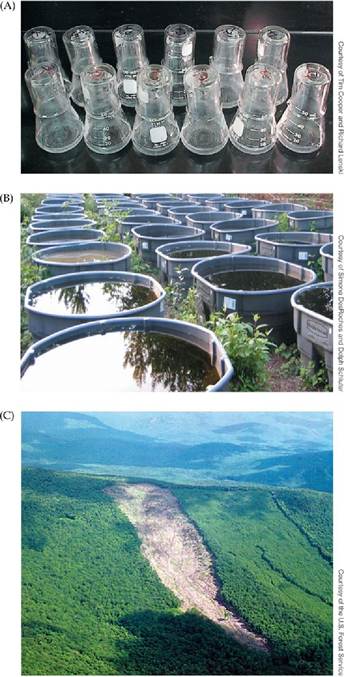
FIGURE 1.12 EcologicalExperiments The spatial scale of experiments in ecology ranges from (A) laboratory experiments to (B) small-scale field experiments conducted in natural or artificial environments to (C) large-scale experiments that alter major components of an ecosystem, as seen in this clear-cut watershed. View larger image
In some cases, however, it can be difficult or impossible to perform an appropriate experiment. For example, when ecologists are seeking to understand events that cover large geographic regions or occur over long periods, experiments can provide useful information, but they cannot provide convincing answers to the underlying questions of interest. As an example, let's consider global warming.
Climate Change Connection
Approaches used to Study Global Warming
As we will see in Figure 25.11, Earth's climate is warming as a result of the emission of greenhouse gases, but the future magnitude and effects of global warming remain uncertain. We are not sure, for example, how the geographic ranges of different species will change as a result of the projected temperature increases.
There is only one Earth, so of course even if we wanted to, we could not apply different levels of global warming to copies of the planet and then observe how the ranges of species change over time in each of our experimental treatments.Instead, we must approach such problems using a mixture of observational studies, experiments, and modeling approaches. Field observations reveal that many species have shifted their ranges poleward or up the sides of mountains in a manner that is consistent with the amount of global warming that has already occurred (Lenoir and Svenning 2015). Field observations can also be used to summarize the environmental conditions under which species are currently found, and experiments can be used to examine the performance of species under different environmental conditions. To put all this information together, scientists can use results from observational studies and experiments to develop quantitative models that predict how the geographic ranges of species will change depending on how much the planet actually warms in the future.
The observation that global warming has already altered the geographic ranges of species brings us to a topic addressed in many chapters of this book: climate change. This term refers to a directional change in climate (such as warming and/or precipitation) that occurs over three decades or longer. As you'll read in later chapters, climate affects nearly all aspects of ecology, such as the growth and survival of individuals, interactions between members of different species, the relative abundances of species in ecological communities, and the functioning of ecosystems. These observations suggest that changes to climate have far-reaching effects, as shown by the changes that have already occurred in the physiology, survival, reproduction, or geographic ranges of hundreds of species (Parmesan 2006).
More on the topic Ecologists use experiments, observations, and models to answer ecological questions:
- CONCEPT 1.3 Ecologists evaluate competing hypotheses about natural systems with observations, experiments, and models.
- When ecologists perform experiments, they often take the three additional steps described in ECOLOGICAL TOOLKIT 1.1: they replicate each treatment, they assign treatments at random, and they analyze the results using statistical methods.
- The studies of amphibian deformities that we discussed earlier in this chapter illustrate several ways in which ecologists seek to answer questions about the natural world.
- Answering Ecological Questions
- Researchers studying animal behavior can seek to answer questions using a variety of approaches focusing on different aspects of the behavior under study.
- ‘But one who is intended coming to the profession might ask where is this code to be found, and how is to be learnt? The answer to the first question is in the traditions of the profession. The answer to the second is in the Schools of the profession, its ancient craft guilds, called the Inns of Court, where all matters of professional conduct are freely and daily discussed, and where the transgressor is answerable for his misconduct. It is, of course, incapable of being stated or written out
- The Milgram obedience experiments
- Answer-oriented education2
- Final and Right Answer
- THE ANSWER TO LIFE, THE UNIVERSE, AND EVERYTHING
- The scale of an ecological study affects what can be learned from it
- Ecologists estimate abundance using a variety of methods
- Ecologists often delineate communities by their physical or biological characteristics