Introduction
In 1942, the journal Ecology published a controversial paper by Raymond Lindeman, describing the nature of energy flow in aquatic ecosystems. Lindeman had studied the energy relationships among the organisms and nonliving components in lakes in Minnesota.
Rather than grouping its component plants, animals, and bacteria according to their taxonomic categories, Lindeman grouped them into categories based primarily on how they obtained their energy (FIGURE 20.3). His views on the importance of the energy base of the system—an “ooze” of particulate and dissolved dead organic matter—and on the efficiency of energy transfer among the system's biological components were groundbreaking. Lindeman's treatment of energy flow in the lake was considered too theoretical at the time, and his paper was initially rejected. The editors later reconsidered their rejection of the paper after Lindeman's mentor, the prominent limnologist G. E. Hutchinson, advocated its acceptance. Lindeman's paper was among the first in the area of ecosystem science, and it is now considered a fundamental paper in the discipline.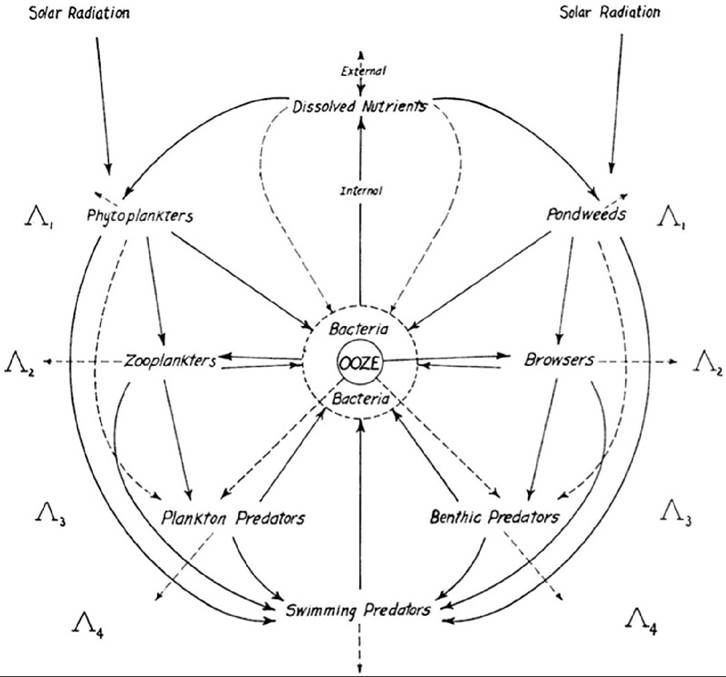
FIGURE 20.3 EnergyFlowinaLake RaymondLindeman1Sdiagramdescribesthe movement of energy among groups of organisms at Cedar Bog Lake, Minnesota. Note the general functional categories of organisms Lindeman used, as well as the central position of “ooze” (organic matter) in the diagram. The subscripts next to the uppercase Greek lambdas represent trophic levels. (From R. L. Lindeman. 1942. Ecology 23: 399-418.) View larger image
The term ecosystem was coined by A. G. Tansley, a plant ecologist, to refer to all of the components of an ecological system, biotic and abiotic, that influence the flow of energy and elements (Tansley 1935). The “elements” considered in ecosystem studies are primarily nutrients, but they also include pollutants; the movements of elements through ecosystems are the topic of Chapter 22. The ecosystem concept is now well established and has become a powerful tool for integrating ecology with other disciplines such as geochemistry, hydrology, and atmospheric science.
In Chapter 5, we described the physiological basis for the capture of energy through photosynthesis and chemosynthesis by autotrophs, and we explained how heterotrophs obtain that energy by consuming autotrophs. In this chapter, we return to the topic of energy as we explore how energy enters ecosystems, how it is measured, and what controls rates of energy flow through ecosystems.
More on the topic Introduction:
- Introduction
- INTRODUCTION TO REASONING IN THE SNAP EXAM
- Introduction
- INTRODUCTION TO REASONING IN THE XAT
- INTRODUCTION
- Introduction
- Introduction
- Introduction
- Introduction
- Introduction