Life in the Deep Blue Sea, How Can It Be? A Case Study
Ecologists once considered the deep sea to be the marine equivalent of a desert. The physical environment at depths between 1,500 and 4,000 m (5,000-13,000 feet) did not seem conducive to life as we knew it.
It is completely dark, so photosynthesis is not possible. The water pressure reaches values 300 times greater than those at the surface of the ocean, similar to the pressure used to crush cars at a junkyard. Organisms living on the floor of the deep sea were thought to obtain energy exclusively from the sparse rain of dead material falling from the upper layers of the ocean where sunlight is sufficient for phytoplankton to carry out photosynthesis. Most of the known deep-sea organisms were detritus feeders such as echinoderms (e.g., sea stars), mollusks, crustaceans, and polychaete worms.Our view of deep-sea life was changed dramatically in 1977, when an expedition led by Robert Ballard of the Woods Hole Oceanographic Institution used the submersible craft Alvin to dive to a mid-ocean ridge near the Galapagos archipelago (FIGURE 20.1). The team aboard the Alvin was in search of the deep-sea hot springs thought to occur along mid-ocean ridges. These ridges lie at the junctions of tectonic plates, where the seafloor spreads as the plates are pushed apart by molten rock rising from Earth's mantle (see Figure 18.10). Because mid-ocean ridges are volcanically active, geologists and oceanographers had hypothesized that seawater seeping into cracks in the ocean floor near the ridges would be superheated by pockets of magma, chemically transformed, and ejected as hot springs. These hot springs were considered potential sources of chemicals for the ocean system as well as sources of heat. Despite their hypothesized existence, no such hot springs had ever been located.
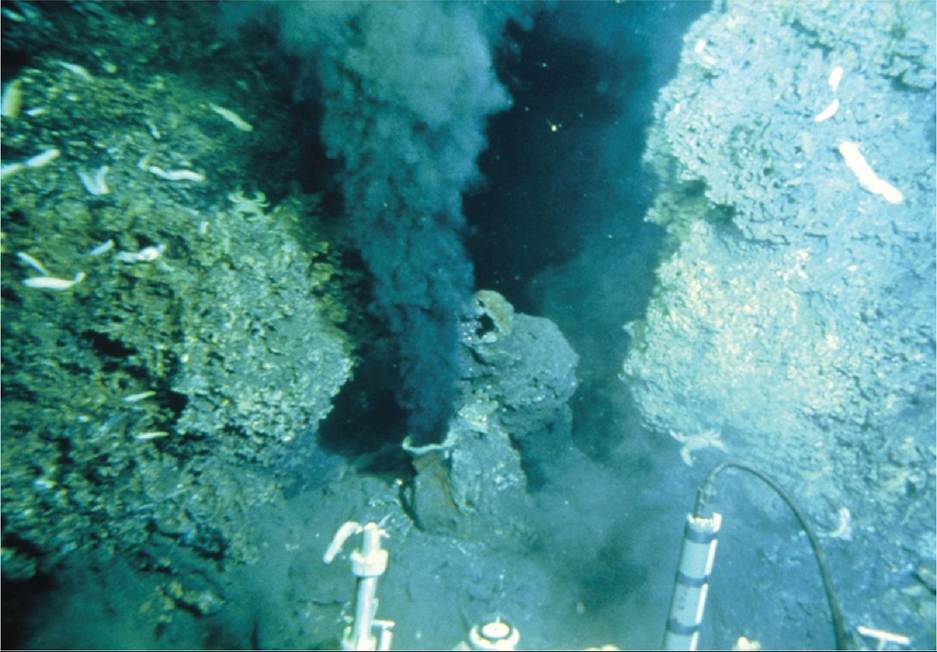
FIGURE 20.1 BlackSmokerVent A hydrothermal vent emits superheated water as hot as 400°C, rich in iron sulfide, known as a “black smoker.” Despite the high temperature and toxic nature of the water, abundant life surrounds these features. © Dr.
Ken MacDonald/Science Source View larger imageBallard's group did indeed find hot springs, known as hydrothermal vents. However, this geochemical finding paled in comparison with their biological discovery: the areas around the hydrothermal vents were teeming with life. Dense assemblages of tube worms (e.g., Riftia spp.), giant clams (e.g., Calyptogena spp.), shrimps, crabs, and polychaete worms were found in the areas surrounding the vents (FIGURE 20.2). The density of organisms was unprecedented for the deep, dark seafloor.
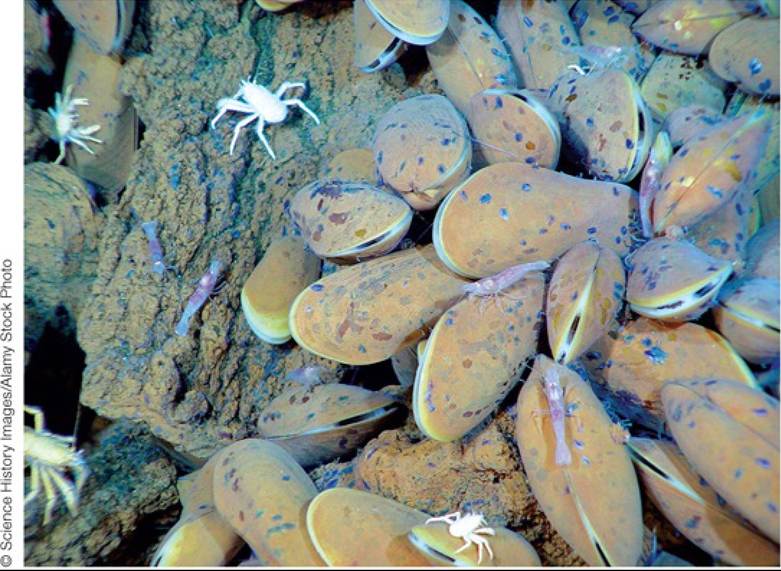
FIGURE 20.2 Life around a Hydrothermal Vent Mussels in the genus Bathymodiolus are scattered near a hydrothermal vent, with several crabs lacking pigmentation in their carapaces. View larger image
The discovery of these diverse and productive hydrothermal vent communities posed an immediate question: How did the organisms obtain the energy needed to sustain themselves in such abundance? The rate at which dead organisms from the upper zones of the ocean accumulate on the seafloor is very low (0.05-0.1 mm/year). The newly formed areas of seafloor where the vents are located are only decades old, and thus the amount of organic material that would have accumulated should not be enough to sustain these high densities of organisms. Photosynthesis in the surface waters therefore did not appear to be the energy source supporting these hydrothermal vent communities. Additionally the water emitted from the hydrothermal vents is rich in poisonous sulfides as well as heavy metals such as lead, cobalt, zinc, copper, and silver, constituting another serious challenge for life in the ocean vents.
Hydrothermal vent communities thus pose two mysteries: First, what is the source of energy that sustains them, and second, how do the organisms tolerate the high concentrations of potentially toxic sulfides in the water? As we shall see, the answers to these two questions are intimately related.
More on the topic Life in the Deep Blue Sea, How Can It Be? A Case Study:
- Located northeast of the Mediterranean Sea, the Black Sea is different from its bigger neighbour, whose sky and water are famed for their hues of blue. Except for days of bright sunshine,
- A Sea in Trouble: A Case Study
- Case Study: Darug Clan, Australia
- Human Population Growth: A Case Study
- Nemo Grows Up: A Case Study
- Case Study: Uruk 3000 B.C
- Frozen Frogs: A Case Study
- “Killer Algae!”: A Case Study
- Case study
- From Kelp Forest to Urchin Barren: A Case Study
- Enslaver Parasites: A Case Study