From Kelp Forest to Urchin Barren: A Case Study
Stretching over 1,600 km of the Pacific Ocean to the west of Alaska, the mountainous Aleutian Islands are often shrouded in fog and battered by violent storms. The islands have few large trees, and except for the eastern islands that once were connected to the mainland, they lack mainland terrestrial mammals such as brown bears, caribou, and lemmings.
There is abundant marine wildlife in the surrounding waters, however, including seabirds, sea otters, whales, and a variety of fishes and invertebrates.Although there are few trees on land, the nearshore waters of some Aleutian islands harbor fascinating marine communities known as kelp forests, made up of brown algae such as Laminaria and Nereocystis. Dense clusters of kelp rise from their holdfasts on the sea bottom toward the surface, producing what feels like an underwater forest (FIGURE 9.1). Other nearby islands do not have kelp forests. Instead, the bottoms of their nearshore waters are carpeted with sea urchins and support few kelp or other large algae. Areas with large numbers of urchins are called “urchin barrens” because they lack kelp forests. Why are some islands surrounded by kelp forests and others by urchin barrens?
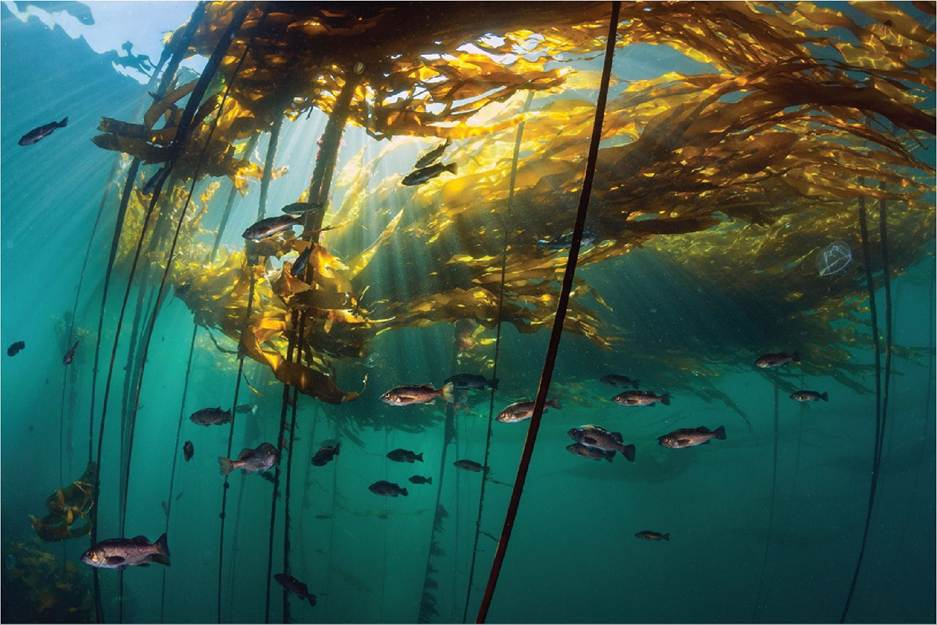
FIGURE 9.1 Kelp Forests Depend on Sea Urchin Population Control Thebullkelp Nereocystis Iuetkeana is one of several species that make up the kelp forests found off the coasts of some Aleutian islands. Research shows that the presence or absence of kelp forests near these islands is influenced by the population control of sea urchins by sea otters. ©Alex Mustard/NPL/Alamy Stock Photo View larger image
One possibility is that islands with kelp forests differ from islands without kelp forests in terms of climate, ocean currents, tidal patterns, or physical features such as underwater rock surfaces.
But no such differences have been found, leaving us to look for other reasons why some islands have kelp forests while others do not. Because urchins feed on algae and can eat vast quantities of it, investigators suspected that grazing by urchins might prevent the formation of kelp forests.This hypothesis was tested in two ways. First, studies in the Aleutian Islands and elsewhere along the Alaskan coast consistently showed that kelp forests were not found in regions where there were many large urchins. Although such correlations did not prove that urchins suppress kelp forests, the fact that a number of studies found the same result suggested that urchins might determine where kelp forests are located. Second, the effect of urchins was tested in an experiment that measured change in kelp densities in several 50-m2 plots containing urchins and in similar, nearby 50-m2 plots from which urchins were removed (Duggins 1980). There were no kelp in any of the plots at the start of the experiment, and kelp densities remained at zero in the plots where urchins remained. In the plots from which urchins had been removed, however, the density of Laminaria rose to 21 individuals per square meter in the first year and reached 105 individuals in the second year (FIGURE 9.2). Laminaria is a dominant member of kelp forest communities, so these results suggested that kelp forests would grow in the absence of urchins.
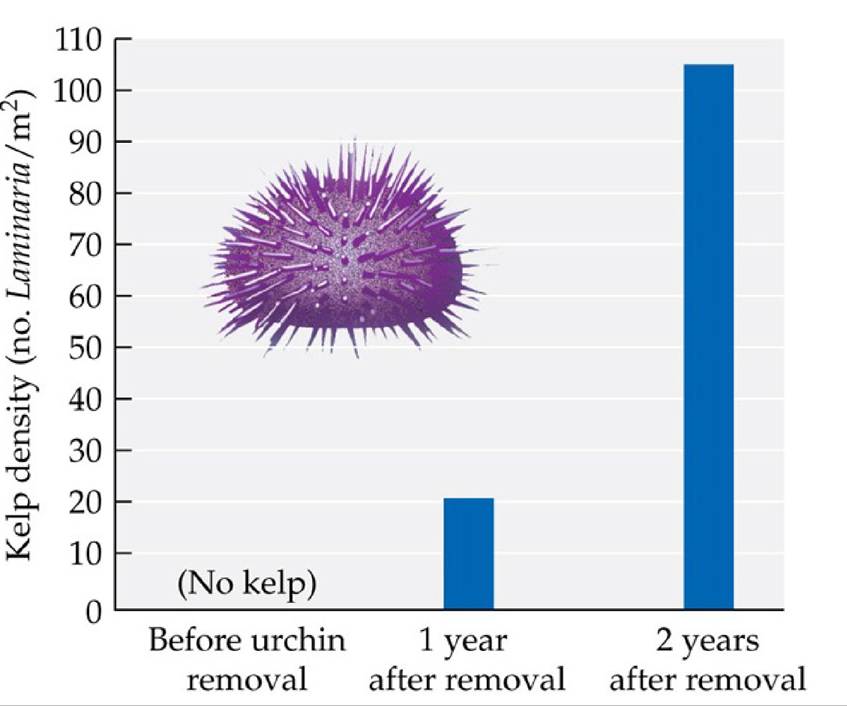
FIGURE 9.2 Do Sea Urchins Limit the Distribution of Kelp Forests? Meandensitiesof the kelp Laminaria in 50-m2 plots increased dramatically after urchins were removed. (After D. O.
Duggins. 1980. Ecology 61: 447-453.) View larger image
These and other results indicated that the presence or absence of urchins is an answer to the question of why some Aleutian islands have kelp forests and others do not. But this answer just shifts the question from what determines the locations of kelp forests to what determines the locations of urchins. As we'll see, a more complete answer to our question about why kelp forests are found in some areas but not others turns out to depend on the voracious feeding habits of sea otters, which themselves may have become a meal of last resort for killer whales.
More on the topic From Kelp Forest to Urchin Barren: A Case Study:
- Case Study: Darug Clan, Australia
- Case study
- A Natural Experiment of Mountainous Proportions: A Case Study
- Case study contributors
- The First Farmers: A Case Study
- A Case Study of Solomon islands
- A Case Study of the Idu Mishmi
- “Killer Algae!”: A Case Study
- Enslaver Parasites: A Case Study
- A Sea in Trouble: A Case Study
- Nemo Grows Up: A Case Study
- Toolmaking Crows: A Case Study
- Frozen Frogs: A Case Study
- A Fragile Crust: A Case Study
- Case Study: Uruk 3000 B.C
- RAIN, FOREST
- Snowshoe Hare Cycles: A Case Study
- Human Population Growth: A Case Study