Let's imagine for a moment that you have the ability to look back in time and follow the change in a typical coral reef community in the Indian Ocean (FIGURE 17.3).
Over the last few decades, you might have seen considerable change, both subtle and catastrophic. Subtle changes might include the slow rise to dominance of certain coral species, and the slow decline of others, due to the effects of competition, predation, and disease.
More catastrophic changes might include the massive deaths of corals in the last decade due to bleaching (loss of symbiotic algae, as described in Concept 3.3) and the great tsunami of 2004, resulting in the replacement of some coral species with other species, or no replacement at all. Taken together, these changes make the community what it is today: a community that has fewer coral species than it did a few decades ago, the effect of a combination of natural and human-caused agents of change.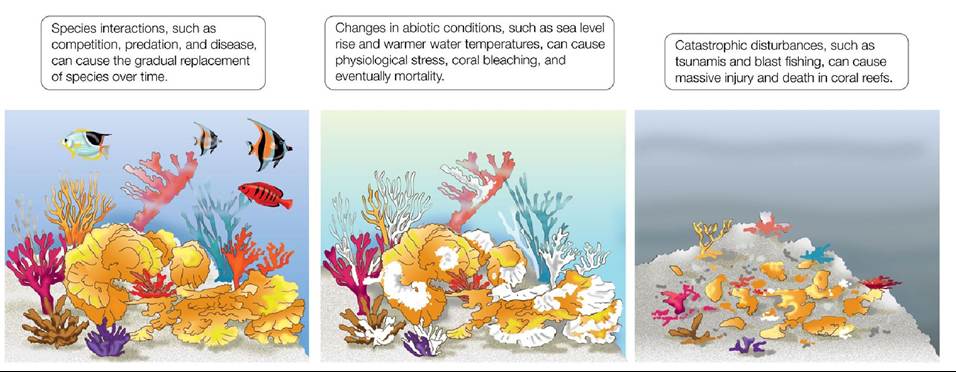
FIGURE 17.3 ChangeHappens Coral reef communities in the Indian Ocean have experienced large changes over the last few decades. The agents of change have been both subtle and catastrophic, natural and human-caused. View larger image
Succession is change in the species composition of communities over time as a result of a variety of abiotic (physical and chemical) and biotic agents of change. In Concepts 17.2, 17.3, and 17.4, we will consider the theory behind succession and examples that illustrate how it works in a variety of systems. But first, in this section, we will identify and define the agents of change that are most responsible for driving succession.
More on the topic Let's imagine for a moment that you have the ability to look back in time and follow the change in a typical coral reef community in the Indian Ocean (FIGURE 17.3).:
- Let's imagine for a moment that you have the ability to look back in time and follow the change in a typical coral reef community in the Indian Ocean (FIGURE 17.3).
- You may have a favorite national park, such as Everglades in Florida, Grand Canyon in Arizona, Bialowieski in Poland, or the Great Barrier Reef in Australia.
- At the most basic level, the term “succession” refers to the process by which the species composition of a community changes over time.
- The Coral Sea
- Colonial partition of the Coral Sea
- The Indian Ocean ranks among the most long-lived spaces of historical memory and the present burst of historiographical attention to this ocean should be interpreted in this context.
- Piracy in the Indian Ocean
- The Australian colonies and the Coral Sea
- The British in the Coral Sea: Fiji
- Narrators of the Indian Ocean