SUMMARY
CONCEPT 8.1 Evolution is the basis for adaptive behavior.
8.1.1 Explain how natural selection can lead to the evolution of adaptive behaviors.
Animal behaviors can be explained in terms of their immediate, or proximate, causes or in terms of their evolutionary, or ultimate, causes.
Most research in behavioral ecology addresses ultimate causes.An individual’s ability to survive and reproduce depends in part on its behavior. This observation suggests that natural selection will favor individuals whose behaviors make them efficient at activities such as foraging, obtaining mates, and avoiding predators.
8.1.2 Illustrate how the environment can interact with genetics to influence behavior.
Animal behaviors are influenced by genes as well as by environmental conditions.
By assuming that genes affect behaviors and that natural selection has shaped behaviors over time, we can predict how animals will behave in particular situations.
CONCEPT 8.2 Animals make behavioral choices that enhance their
energy gain and reduce their risk of becoming prey.
8.2.1 Explain the theory of optimal foraging by outlining the factors that influence the profitability of foraging.
Optimal foraging theory predicts that foraging animals will maximize their net energy gain per unit of feeding time and per unit of energy invested in seeking, capturing, and extracting food resources.
8.2.2 Summarize what determines optimal foraging in an area with different food densities with reference to the marginal value theorem.
The marginal value theorem predicts that animals foraging in an area with patches of food resources of different densities will deplete rich patches first and leave them once the density of food is the same as the average of the entire area.
8.2.3 Describe how the presence of predators can impact foraging behavior.
Individuals often alter their foraging decisions when predators are present.
A perceived risk of predation can also alter foraging patterns, even in the absence of actual predation.Prey exhibit a wide range of behaviors that can help them avoid being seen by predators, detect predators, prevent attack, or escape once attacked.
CONCEPT 8.3 Mating behaviors reflect the costs and benefits of parental investment and mate defense.
8.3.1 Describe examples of the behaviors utilized by animals to increase their access to mates.
Within a species, males are often larger or more brightly colored than females, or they may possess unusual weapons or have gaudy ornaments. Such differences between males and females of the same species can result from sexual selection.
8.3.2 Evaluate the benefits of being choosy with mate selection and the conditions that favor selectivity by females versus males.
A female may receive indirect genetic benefits when she chooses to mate with a male that has certain features, such as a costly and unwieldy ornament. Females benefit when the males' features signal good genes that are passed on to both her sons and her daughters. Females may also receive indirect genetic benefits through her sons, who will themselves be attractive and produce many grandchildren.
In most species, females invest more in their gametes and provide more parental care than males do. In this situation, males and females have different interests: it is to a male's advantage to mate with as many females as possible, whereas a female should “protect” her investment by mating with those males that provide the most resources or that appear to be of high genetic quality.
8.3.3 Describe conditions under which different mating systems would be favored.
In the rare cases in which males typically provide more parental care than females do, it is the male who is the choosy partner.
The rich variety of mating systems seen in nature result from the behaviors of individuals striving to maximize their reproductive success.
CONCEPT 8.4 There are advantages and disadvantages to living in groups.
8.4.1 Describe the potential benefits and costs of species living in groups.
Benefits of group living include access to mates, protection from predators, and improved foraging success.
Costs of group living include greater expenditures of energy, increased competition for food, and higher risks of disease.
8.4.2 Explain how the balance between benefits and costs of living in groups determines the net impact to individual organisms and populations.
Group size may reflect a balance between the costs and benefits of group living; in some cases, this balance appears to have caused groups to be larger than the optimal size.
REVIEW QUESTIONS
Distinguish between proximate and ultimate explanations of animal behavior.
Explain the links between the following: natural selection, heritable behaviors, adaptive evolution, and ultimate explanations of animal behaviors.
Describe how the presence of a predator may alter an individual’s foraging decisions. Can fear of predators have similar effects, even in the absence of actual predators? Explain.
What is sexual selection? Summarize the evidence supporting the claim that differences between males and females can result from sexual selection.
Describe an example in which group living leads to both benefits and costs.
Consider two bird species that forage for insects that live in shrubs. The shrubs have a clumped, patchy distribution throughout their habitat. The two bird species have the same ability to locate, capture, and consume the insects. However, one species (species A) uses less energy to fly from patch to patch than the other species (species B). According to the marginal value theorem, which bird species should spend more time in each patch, and why?
HONE YOUR PROBLEM-SOLVING SKILLS
Animals exhibit diverse mating systems, including monogamy, polygyny, polyandry, and promiscuity (see Table 8.2). Mating systems vary both among and within species. Gray wolves (Canis lupus) typically exhibit monogamy and live in cooperative breeding groups in which nonbreeding members help care for offspring.
Reproductive success of the breeding pair also is tied to acquiring a high-quality territory. In monogamous species, such as gray wolves, how does pair bond duration affect reproductive success? Also, how might pair bond duration affect the likelihood of other mating strategies arising within groups? To address these questions, a researcher monitored 15 groups of gray wolves over 9 years in Idaho. He collected feces for DNA and pedigree analyses. Pedigree analyses allowed the determination of group size and composition; paternity; evidence of polygyny and polyandry; and duration of pair bonds. Pup survival was assessed between 3 and 15 months of age; pups rarely disperse before age 15 months, so apparent pup survival assumes that a pup's absence means it has died. The figure shows the relationship between pair bond duration and apparent pup survival. Error bars are standard errors.1. Summarize the results shown in the figure. What demographic characteristic of breeding pairs is conflated with pair bond duration? Suggest two possible explanations for the relationship between pair bond duration and apparent
pup survival.
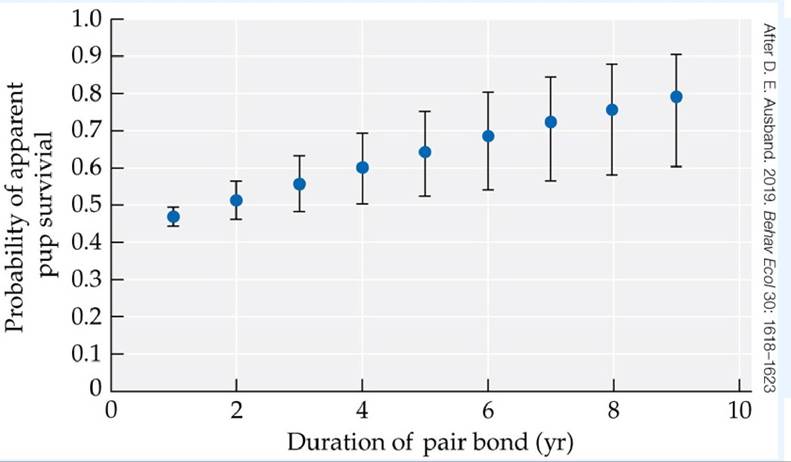
2. Results shown are based on an analysis in which group size was held constant at six adults. Why would it be important to control for group size? Based on the results, can the researcher definitively conclude that increasing pair bond duration resulted in increasing pup survival in his study population?
3. Research with other species links social conflict with the emergence of different mating strategies within populations. Predict how pair bond duration affects the existence of polygyny and polyandry (considered together by the researcher as polygamy) within groups of gray wolves.
LIST OF KEY TERMS
adaptive evolution behavioral ecology dilution effect marginal value theorem mating system
Optimal foraging theory proximate causes sexual selection territories
ultimate causes
More on the topic SUMMARY:
- Abel A.B., Bernanke B., Croushore D.. Macroeconomics. 10th Edition, Global Edition. — Pearson,2021. — 690 pp., 2021
- Molecular Epidemiology of Bovine Tuberculosis in Uganda
- Oetzel John, Ting-Toomey Stella. The SAGE Handbook of Conflict Communication: Integrating Theory, Research and Practice. SAGE Publications,2013. — 912 p., 2013
- REVIEW OF FORENSIC ASSESSMENT INSTRUMENTS
- Conclusion
- Conclusion
- Viola Lynne, Junge Marc-Stephan (eds.). Laboratories of Terror: The Final Act of Stalin's Great Purge in Soviet Ukraine. Oxford University Press,2023. — 565 p., 2023
- FIVE COMPONENTS OF LEGAL COMPETENCIES
- Somalia
- �The order to be observed supposes an end'