NOTATION
Before proceeding, it is useful to introduce the common notation that will be used in the different sections of the chapter. We denote income—or any other cardinal measure of welfare or, more generally, any cardinal measure of “locations” along which individuals can be found and that can therefore be used to measure distances across individuals by y.
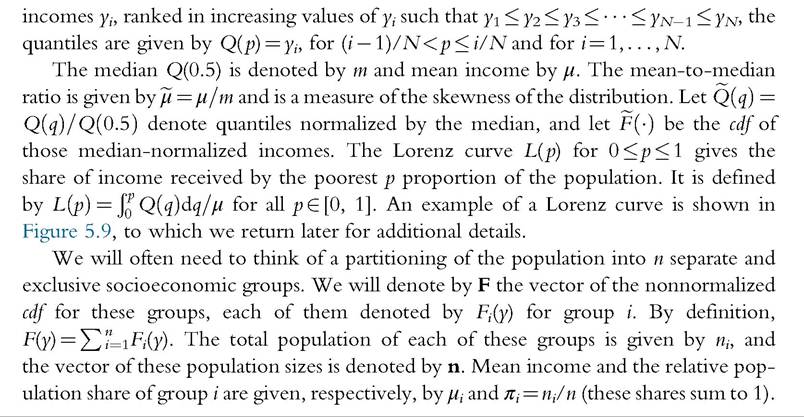
Let F(y) be the cumulative distribution function (cdf) of income and p = F(y) the proportion of individuals in the population that enjoy a level of income that is less than or equal to y. We will often suppose the existence of a density function, which is the first-order derivative of a continuous cdf, denoted as fy) = F (y). For discrete distributions, we will think off(y) as the relative frequency of an income of a value y.We will denote quantiles as Q(p). For a strictly increasing continuous F(y), they can be defined as F(Q(p)) = p, or using the inverse distribution function, as Q(p) = ∕∙( l'i(p). For discrete distributions, Q( p) = inf{y: p ≤ F(y)}. Thus, with a discrete distribution of N
5.4.
More economic literature on Economics.Studio
More on the topic NOTATION:
- Notation and Preliminaries for Multidimensional Poverty Measurement
- What can/ought be done?
- Dashboard of Indicators and Composite Indices
- LOGIC AND LANGUAGE
- CONTENTS
- Empirical studies of the effects of social capital
- AN EXAMPLE OF INDO-EUROPEAN STRUCTURES
- Contents
- Possible World Semantics for FOLP
- Patient Transfers: Stable Versus Unstable
-
Distribution of productive forces -
Economic theory -
General economic issues -
History of economic scientists -
Macroeconomics -
World economy -
-
Conflictology -
Ecology -
Economy -
Finance -
History -
Law -
Medicine -
Philosophy -
Religious studies -