Chapter Three Sheramy D. Bundrick Altars, Astragaloi, Achilles: Picturing Divination on Athenian Vases
On a group of Athenian vases from the mid-late fifth century BCE, scenes of sacrifice draw to a close: the fire is about to be extinguished, and an officiant or another participant near the altar grasps round objects in his hands.
The officiant on a pseudo-Panathenaic amphora in Polygnotan style (fig. 1), dating ca. 420 BCE, wears a long, ungirt chiton embroidered or woven with a wreath, surely indicating him as a priest (Harvard 1960.371, BAPD 9020306, Neils 2004). Holding the round objects in one hand, with the other he extends a kantharos over a low altar, upon which the god's portion (osphys) can be seen. A similar composition appears on a second pseudo-Panathenaic amphora from around the same time, attributed to the Kleophon Painter (Darmstadt A478, BAPD 215188, van Straten 1995, 225, cat. V173). An earlier amphora by the Niobid Painter also shows a bearded man with kantharos and round objects (fig. 2), although here the altar is of a more characteristic shape and lacks a visible osphys (Brooklyn 59.34, BAPD 206996, van Straten 1995, 249, cat. V303, Neils and Oakley 2003, 292-93, cat. 106).Some scholars have identified the round objects as the thulemata described in Attic comedy: barley meal mixed with the god's portion (van Straten 1995, 141-44, Neils 2004, 62-63). The missing osphys on the Niobid Painter's amphora, however, calls this otherwise plausible interpretation into question, for one would expect that detail for clarity. I suggest instead that the vases depict a practice mostly neglected in twentieth-century studies of Greek religion:
Special thanks to Eric Orlin, Sandra Blakely, and the Society for Ancient Mediterranean Religions Program Committee for facilitating my participation in the Emory conference; Sandra Blakely and Billie Jean Collins as editors of this volume for their encouragement and assistance; and the anonymous peer reviewers for their feedback.
Thank you to fellow speakers and audience members at the conference for their responses, especially Jasper Gaunt, who steered me to the Lowe Art Museum's hydria, Peter Bing, and Bonna Wescoat. For assistance with photographs and permissions, thanks are due to Arcangela Carbone-Gross (Martin-von-Wagner Museum, Antikensammlung, Wurzburg); Paola Desantis (Soprintendenza per i Beni Archeologici dell'Emilia Romagna); Jasper Gaunt and Laura Wingfield (Carlos Museum); Lucy Gedrites (Harvard Art Museums); Stefano Santocchini Gerg (Università di Bologna); Ruth Janson (Brooklyn Museum); Gerhard Gruitrooy and Liz Kurtulik Mercuri (Art Resource); and Alexandra Seese (Museum Folkwang Essen). Special thanks to Professor Elisabetta Govi for permission to use her drawing of the Marzabotto cup.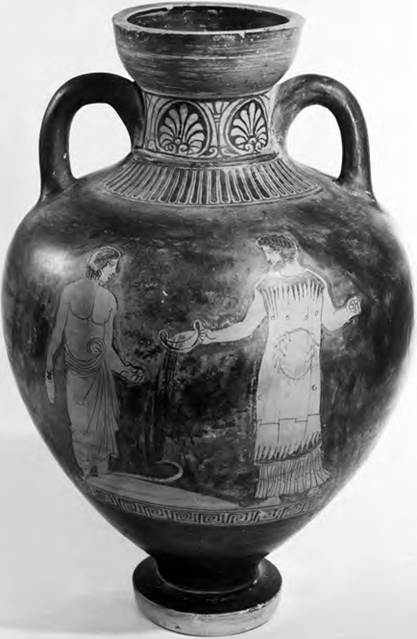
Figure 1. Red-figured pseudo-Panathenaic amphora; Harvard Art Museums/Arthur M. Sackler Museum, Bequest of David M. Robinson, 1960.371; photograph courtesy Imaging Department © President and Fellows of Harvard College.
cleromantic divination, or divination by casting lots. The round objects would then be astragaloi for attaining omens after the sacrifice. Archaeological evidence supports this theory, as will be shown below. Moreover, reading these scenes as images of cleromancy prompts reconsideration of other scenes in which astragaloi, dice, or similar objects are pictured but which have typically been viewed as representations of gaming, namely the well-known scenes of Achilles and Ajax. Cleromantic divination has gained new attention in recent years as scholars have reevaluated what was previously dismissed as “magic”; Athenian vase painting may provide further attestation of this important ritual.
Textual evidence for cleromancy in ancient Greece is spotty but does exist for the period of time closest to the vases. In Pindar's Fourth Pythian Ode (4.189191), the seer Mopsos is said to prophesy for Jason and the crew of the Argo by means of birds and sacred lots, while Teiresias in Euripides's Phoenician Women urges his daughter to guard his lots of divination (kleroi, 834-840).
Although the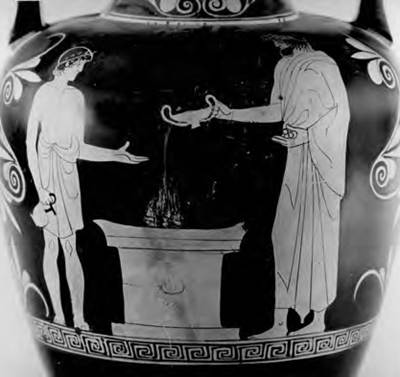
Figure 2. Red-figured amphora attributed to the Niobid Painter; Brooklyn Museum, Museum Collection Fund, 59.34a-b; photograph courtesy the Brooklyn Museum.
word kleros can be used to reference other forms of sortition—as for instance the drawing of lots to elect officials in democratic Athens—the two mythical seers specify that these kleroi are divinatory. It is not clear, however, whether casting or drawing of the kleroi is intended. Earlier in the Iliad and Odyssey, kleroi are used for the drawing of lots from a helmet, in the former to choose a champion to fight Hector (7.170-205), in the latter to decide who will help Odysseus kill the Cyclops (9.331-333). Although undertaken by ordinary men and not seers, in each case the kleros leaps from the helmet as if divinely inspired to do so. In all of these examples, kleroi is a generic enough term that one does not know their form, whether astragaloi, dice (kuboi), or some other type of lot. However, the more specific kuboi is used in some fifth-century texts to reference fate and future-telling. In Euripides’s Rhesus, Dolon asks Hector for the horses of Achilles and proclaims, “It is right for me to work and risk my life in the dice game of fate for a prize that is worthy” (182-183 [Kovacs]) while Aethra speaking to Theseus in Euripides’s Suppliant Women states prophetically—and with seemingly stronger allusion to cleromancy—“I am confident, as I see the people of Kadmos prospering, that their future dice casts will be different. Heaven overturns all things” (328-331 [Kovacs]).
Later sources provide more information and details for cleromantic divination in the Greek world. Pausanias describes a dice-oracle to Herakles near Boura in this way (7.25.10):
When one descends from Bura toward the sea, there is the Buraikos river and a not large image of Herakles... he offers an oracle from a list and from astragaloi.
Whoever intends to consult the divinity, prays in front of the image, and after the prayer, he takes up four astragaloi. and rolls them on the table.For any combination of the astragaloi, the inscription in the list gives an easily accessible explanation of the combination (trans. Graf 2005, 62).
Epigraphic evidence for Roman-era dice oracles is also known from Greek cities in Asia Minor (Graf 2005). The procedures seem to have been similar to those Pausanias describes, albeit with five astragaloi being used.
The selectivity of textual material means that archaeological evidence is potentially more useful for understanding the scenes on vases: thousands of astragaloi have been discovered at shrines and sanctuaries throughout the Greek world, including from the sixth and fifth centuries BCE. Although often explained as the remnants of sacrifice or as votive offerings—for example, by children as they came of age—David Reese, Alan Greaves, and others have forefronted their likely use in divinatory practices. Reese noted the discovery of astragaloi alongside liver and kidney models and incised bone scapulae at the sanctuary of Kition on Cyprus, suggesting that as a group, these objects represent divination tools (Reese 1985, 388-89). Many astragaloi found at Kition and elsewhere were modified, meaning that their sides were filed down or else the astragalos was drilled, then filled with metal; such alterations confirm that they were not sacrificial leftovers. As Greaves has demonstrated through experiments detailed in a 2012 article, modifications like filing or drilling “create a more even spread of results when the bone is thrown,” meaning the odds of the astragalos landing on each of its four sides is made more equitable (Greaves 2012, 186).
Modified and unmodified astragaloi have been found in sixth- and fifthcentury contexts at such far-flung sites as the sanctuary of Demeter and Kore at Acrocorinth, the temple of Poseidon at Isthmia, the sanctuary of Artemis Orthia at Sparta, the sanctuary of Apollo at Halieis, and the sanctuary of Artemis at Ephesos (Gilmour 1997, Reese 2000).
Over twenty thousand astragaloi were found in the Korykeion Cave at Delphi, a shrine to Pan and the Nymphs, with about four thousand modified in some way (Amandry 1984). Just over thirty of the latter were inscribed with names, including Achilles, Ajax, Herakles, and Nike. The Korykeion astragaloi may have been votive offerings but also could have been used for cleromantic divination (Larson 1995, 347-48). Although mantic trance is primarily associated with Delphi, recent scholarship has highlighted the possibility that even the Pythia engaged in cleromancy; visitors to the site may have done the same (Maurizio 1995, 80, Greaves 2012, 190, cf. Robbins 1916).In some cases, modified and unmodified astragaloi were directly associated with altars. A group of astragaloi from sheep and goats, four of them modified, was discovered in the fill deposit of the Altar of Aphrodite Ourania in the Athenian Agora, first erected around 500 BCE but reconstructed in the third quarter of the fifth century (Foster 1984, Reese 1989). Reese suggests that they were “used in astragalomancy... which was probably performed in the area around the altar” (Reese 1989, 64). Greaves emphasizes astragaloi filled with lead in the remains of the Archaic altar in the sanctuary of Apollo at Didyma, reported in the 1911 excavation accounts but unfortunately now lost (Greaves 2012, 193-94, citing Wiegand 1911, 41-43). He argues that cleromancy may have been the dominant form of divination at Archaic Didyma, whereas mantic trance prevailed during the Hellenistic and Roman periods. A more informal type of cleromancy or diceoracle may have persisted at Didyma in the Roman period, however, given the multiple markings that resemble gaming boards on the stylobate of the later temple (Hockmann 1996).
Returning to the sacrifice scenes, archaeological evidence for astragaloi in sanctuaries, and especially at altars, opens the possibility that these officiants with their round objects are preparing to cast lots.
No surviving textual account mentions such a practice, but even the more lengthy descriptions of sacrifice are less than complete and may simply fail to mention it. If this interpretation is correct, then the vases privilege the communicative nature of sacrifice as much as commensality. Whenever the osphys is shown, the curling animal's tail reflects the deity's acceptance of sacrifice—itself a positive omen—while astragaloi, when included, would hint at further interaction between mortals and gods.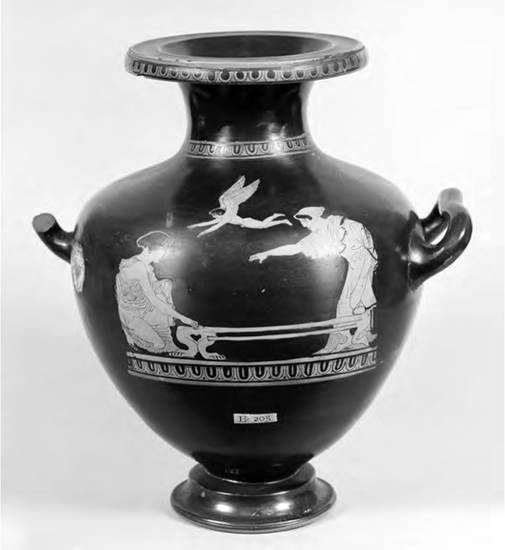
Figure 3. Red- figured hydria attributed to the Washing Painter; British Museum 1865.103.26 (E205); Photograph © Trustees of the British Museum.
Identifying the round objects in sacrifice scenes as astragaloi for divination prompts reconsideration of other images on Athenian vases that may reference cleromancy. A hydria attributed to the Washing Painter from Nola, for instance (fig. 3), could be read as two girls playing a game but could equally show them casting lots as a form of love magic (London E205, BAPD 214985, cf. Dasen 2016 for love magic). The figure of Eros overhead lends credence to this idea, while Viktoria Sabetai, in her dissertation on the Washing Painter, notes the unique inclusion of a long, low table as opposed to the girls playing knucklebones on the ground. Sabetai argues that not only this scene, but other scenes of girls with games by this painter reference future-telling more than childish pastimes (Sabetai 1993, 190). A contemporary, unattributed red-figured pyxis includes girls playing with astragaloi among other games; notable here is the finial of the lid, shaped itself like an astragalos. Perhaps it held astragaloi for an Athenian girl's playtime and/or for divining dreams of the future (New York 06.1021.119a-b, BAPD 4193, Beaumont 2012, 131-32). Actual astragalos-shaped vases may have had similar functions and connotations; an example in the Metropolitan Museum of Art features Eros playing a lyre as its red-figured decoration (New York 40.11.2, BAPD 213127). It is worth observing that astragaloi were found at the sanctuary of Eros and Aphrodite on the north slope of the Athenian Akropolis, albeit in a Hellenistic deposit (Broneer 1933, 335).
Most important for the present discussion are the nearly 170 scenes of warriors seated or crouching at what is usually interpreted as a gaming board, exemplified by the famous black-figured amphora signed by Exekias (fig. 4, Vatican 344/16757, BAPD 310395, Mackay 2010, 327-51). Found at Vulci in the early nineteenth century and dating ca. 530 BCE, Exekias's amphora features Achilles at left and Ajax at right, both identified by inscription, both leaning intently over an upright block with hands outstretched. Achilles wears his helmet perched upon his head, while Ajax's own helmet rests atop his shield at right; each wears full armor and grasps a pair of spears as if on campaign but temporarily away from battle. Inscriptions at their mouths perhaps indicate conversation, with “four” written next to Achilles and “three” beside Ajax. While the amphora's exact findspot is unknown, it certainly came from an Etruscan tomb.
The scene type of “Achilleus und Aias zum Brettspiel” is found on a variety of vase shapes, nearly all dating from the late sixth and early fifth centuries BCE, produced by a range of painters and workshops with a corresponding range of quality (see, e.g., Biers 1989-1990; H. G. Buchholz 1987; Dasen 2015; Diehl 1962; Kenzler 2003-2004; Maggiani 2005; Mommsen 1980; Moore 1980; Romero Mariscal 2011). Indeed, surviving vases with this subject outnumber scenes of every other Trojan War episode save the judgment of Paris, including more tideturning events like the mission to Achilles, ransom of Hektor, and sack of Troy.
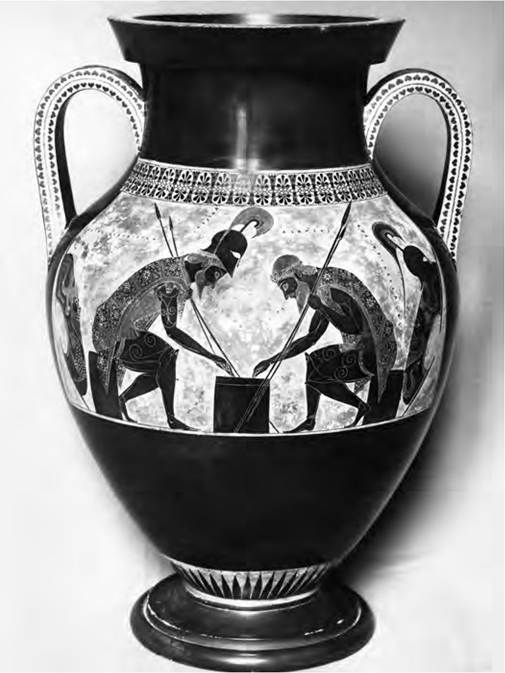
Figure 4. Black-figured amphora by Exekias with scene of Achilles and Ajax; Museo Gregoriano Etrusco, Musei Vaticani, 344/16757; photograph: Alinari/ Art Resource NY.
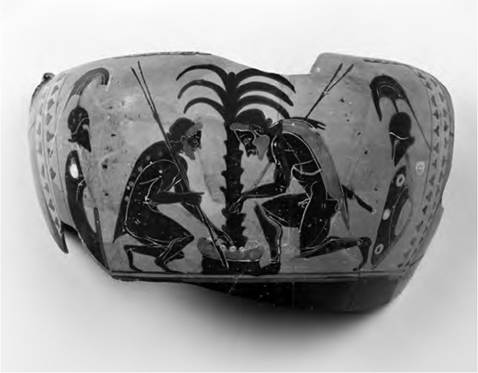
As the most handsome example and one of the earliest, Exekias's amphora has understandably been the focus of attention, although no two scenes are identical. Some painters gave the soldiers names—always Achilles and Ajax—while most omitted inscriptions. Some depicted only the two heroes, while others included a tree in the background to vary the composition; a palm tree, for example, appears on a black-figured column krater fragment said to be from Orvieto (fig. 5, Carlos Museum 2004.33.2, BAPD 9017853, shape reidentified by curator Jasper Gaunt as a column krater rather than a hydria], Woodford 1982, cat. F12). Around 520 BCE, a decade or more after Exekias's amphora was created, the goddess Athena became a frequent figure, always standing between the warriors. A black-figured
Figure 5. Black- figured column krater fragment with scene of Achilles and Ajax; Michael C. Carlos Museum, Gift of Dr. Dietrich von Bothmer, 2004.33.2; photograph by Bruce M. White, 2005 © Michael C. Carlos Museum, Emory University.
amphora attributed to the Leagros Group typifies this latter scheme as Athena, easily identified by her helmet and aegis, raises her left hand and carries a spear in her right (fig. 6, Essen A176/K1049, BAPD 351214, Woodford 1982, cat. D1, Froning 1982, 137-42).
As already noted, these are typically interpreted as gaming scenes, especially in recent decades. Certainly, a variety of games are known from ancient Greece; however, little is understood about their specifics due to the paucity of detailed sources (cf. Austin 1940 and Kurke 1999). Moreover, because of many inconsistencies in representation among the “Brettspielers,” it is unclear what games would be portrayed. Even taking into account the fact that painters might privilege composition over realism, variations exist among the alleged board and game pieces, gestures of the alleged players, and their poses. This in turn affects the interpretation of the scenes, for if these are games of chance using dice (kuboi) or astragaloi, they would evoke the fate of the two heroes and by extension, the fate of the viewer. If these are games of strategy, meaning board games like pessoi or another known from the sources called polis, this should imply the inherent superiority of Achilles over Ajax. In both cases, however, one faces iconographic problems, namely how to distinguish winner from loser. For example, in Greek imagery the winner of a contest typically faces right, but sometimes the figure on the viewer's left is named by inscription as Ajax, as on a black-figured amphora by the Lysippides Painter (London B211/1851.8-6.15, BAPD 302224). Similarly, Athena should be looking toward the winner—just as she always looks to Odysseus in scenes of the contest for the arms of Achilles (Williams 1980, Spivey 1994, Hedreen 2001, 104-9), with Odysseus himself always facing right—but this too is inconsistent. Sometimes she looks to the viewer's left, sometimes the right,
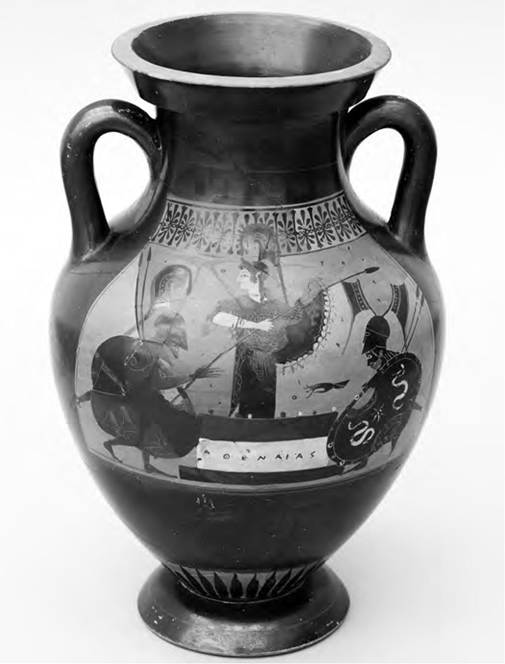
Figure 6. Black-figured amphora attributed to the Leagros Group with scene of Achilles and Ajax; Museum Folkwang, A176/K1049; photograph © Museum Folkwang, Essen.
so that the winner would be unclear (cf. Woodford 1982, cats. D17, D23, D30, D37, D42bis, D44, D46 for looking to viewer's right).
Even inscriptions like the “four” and “three” on Exekias's amphora (fig. 4), and a few other vases that appear to grant numerical superiority to Achilles (cf. Boston 95.15, BAPD 303417, Chase 1946), cannot be verified as indications of winning a game. An unpublished black-figured hydria attributed to the Leagros Group (Lowe Art Museum, University of Miami)—which has not been included in previous catalogues and discussions—contradicts the popular notion that if the scene shows a game, the winner has the higher number. Athena stands between the heroes as on the Leagros Group amphora in Essen (fig. 6), but on the Miami vase all three figures are labeled by inscription, Achilles at left and Ajax at right. Additional inscriptions reveal that Achilles has thrown a one (hen) and Ajax a three (tria). Not only is Achilles' “score” lower than Ajax's, but according to later texts, a one thrown on dice or an astragalos was known as a Chian throw and considered unlucky, indeed the worst of possible throws (cf. Schadler 1996 and Graf 2005, 59). Presuming that this identification existed earlier, it seems unlikely that a painter would show Achilles losing a game to Ajax at all, let alone so badly.
Adding to the difficulty of interpreting these “gaming scenes” is the fact that, unlike most Trojan War scenes in Greek art, they lack a known literary reference, whether pre- or postdating the depictions. Some scholars have suggested that Exekias invented the subject, although as will be shown below, new evidence verifies that this was not the case. Others, namely Carl Robert in 1892, have supported the notion of a lost text or another story unknown today (Robert 1892, 57 n. 36, also cf. Robert 1923, 1126-27, Beazley 1986, 60). Using the many scenes that include Athena for inspiration, Robert suggested that Achilles and Ajax are on guard duty at Troy, but are so immersed in their game that their Trojan foes sneak up on them without warning. Athena therefore appears in order to stop the game and urge them into battle. Variations of this reading have been adopted in more recent scholarship even when abandoning the lost epic (e.g., Hedreen 2001, 96-104), including in the work of John Boardman, who proposed that the images act as a metaphor for Athenian troops caught off-guard by Peisistratos at Pallene (Boardman 1978, 18-24). Leaving aside the question of whether a vase painter would have encoded his scenes with such political propaganda, Boardman's theory has the added complication of the “embarrassing and shameful” nature of the Pallene episode (Boardman's own words, 1978, 24). Boardman explains this away by suggesting Exekias himself was antityrannical and aimed to “both comfort and give warning” (1978, 24), but this raises questions about the many other depictions, including at least one earlier than Exekias (see below). Even without a reference to Pallene, one still wonders why painters would represent the greatest of the Achaians in a careless, even shameful (aiskhros) moment (cf. Roisman 2005, 64-71, 105-13)—especially if the alleged folly had no effect on the war's outcome—and why consumers would buy vases with that subject in such great numbers. Boardman proposes that “we are invited to smile at such weakness and condone it” (1978, 24), but there is no suggestion of humor and no indication that Achilles and Ajax are to be interpreted as anything other than ready for battle. Their armor and spears close at hand belie any idea of surprise, and their intensity belies any impression of leisure.
Given the many inconsistencies surrounding the “gaming” interpretation, I propose returning to a reading from earlier in the nineteenth century that linked the scenes to cleromantic divination: Achilles and Ajax casting lots before battle to determine its outcome or to seek the answer to some other question. In 1851, Friedrich G. Welcker suggested that the heroes were consulting Athena's oracle at Troy (Welcker 1851, 6), while Auguste Bouche-Leclerq supported a similar notion in his magisterial, multivolume Histoire de la divination dans l’antiquite (1879-1882, 2:405):
Il etait naturel de la consulter, à la veille d’une bataille, sur les chances de vie ou de mort qu’allait apporter la terrible journee. L’idee fur certainement mise en pratique car un certain nombre de vases peints representent des guerriers, un genou en terre, jetant des galets en forme de boules aux pieds d’Athena armee qui etende le bras droit ou le bras gauche, suivant que le coup est favorable ou funeste.
When a black-figured amphora showing the scene was found in the Crocifisso del Tufo necropolis of Orvieto in the 1870s, Gustav Korte presented it as evidence for a divinatory interpretation (Korte 1877, 123-25):
La presenza di Atene, rivolta con gesto vivace ed espressivo verso uno dei giocatori, dimostra che non si tratti più di un semplice divertimento, ma di una specie di divinazione mediante piccole pietre inventata da Minerva.
This latter example is unique in including Hermes together with Athena; he can be explained as a messenger of Zeus but perhaps even as psychopompos, an allusion to the deaths that await both Achilles and Ajax by the war’s end (Orvieto 2701/186, BAPD 302093, Woodford 1982, cat. C6, Wojcik 1989, 204-7). It is also worth noting Hermes’s association with cleromantic divination by dice, astragaloi, or other objects in the Greco-Roman world (cf. Apollodorus 3.10.2, Grottanelli 2001), as, for example, in the Hellenistic and Roman Near East (Bar-Oz 2001, Graf 2005). In texts, this association can be traced back at least as far as the fifth century BCE, when in Aristophanes’s Peace Trygaeus says to Hermes about his death, “if my number comes up. Being Hermes, I know you’ll do it by lots” (364-65 [Henderson]). Similarly, a later scholiast to Euripides’s lost play Aeolus mentions that it referenced the kleros Hermou, Hermes’s lottery (Eur. Frag. 24a=39N).
A divinatory interpretation of the Achilles and Ajax scenes fell out of fashion in the late nineteenth and early twentieth centuries, replaced by theories such as Carl Robert’s, discussed above. The cleromantic reading was likely also the victim of an increased tendency to neglect magic and other allegedly superstitious practices as affronts to modern notions of Greek rationality (cf. Fowler 2000, Kindt 2012, 90-122). As Sarah Iles Johnston and others have observed, while interest in the Delphic oracle and similar mantic practices never waned, cleromancy and other divinatory practices fell off the scholarly radar for several decades (Johnston 2005, 1-10, Greaves 2012, 201-3). Greaves has claimed that previous scholars of Greek religion “misrepresented cleromancy as a simplistic device, one not afforded high status, which is contrary to the
Figure 7. Black-figured Little Master band cup with scenes of Achilles and Ajax; Museo Nazionale Etrusco di Marzabotto 489; photograph courtesy Soprintendenza per i Beni Archeologici dell’Emilia Romagna.
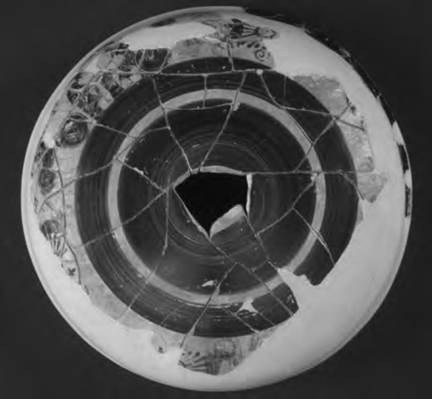
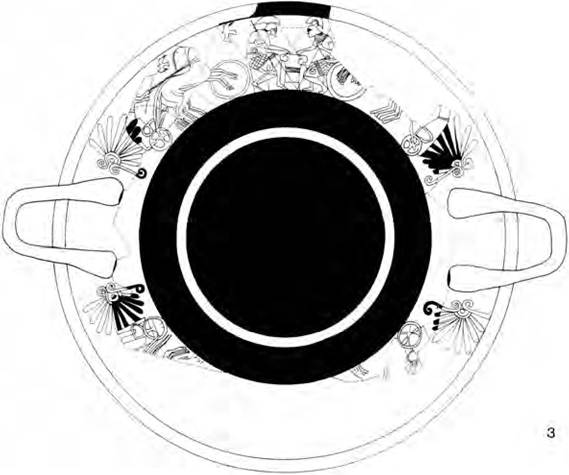
Figure 8. Drawing of the Little Master band cup with scenes of Achilles and Ajax; Museo Nazionale Etrusco di Marzabotto 489; drawing courtesy Elisabetta Govi.
ethnographic record and historical instances of its use in ancient Greece” (Greaves 2012, 201). He adds, “There is no reason to consider cleromancy an inherently lesser form of divination than mantic trance, which is, after all, just another randomizing device, but one in which the diviner's body is the tool of choice” (Greaves 2012, 202). Two scholars should be noted who have advocated a cleromantic interpretation of the Achilles and Ajax scenes in more recent years, although contrary to pervading views and with little attention paid in wider scholarship (Thomas 1985, 88-107, Alvar Nuno 2006). Both rely on the literary and epigraphic evidence for astragalomanteia discussed at the outset of this paper, however, rather than also on the archaeological as here, which strengthens the argument still further.
To bolster a resurrected theory of cleromantic divination for the Achilles and Ajax scenes, I introduce a black-figured Athenian band cup (figs. 7-8) discovered at a fountain sanctuary just outside the northern Etruscan city of Marzabotto (Marzabotto 489, Govi 1995, 69-72). Excavated in the late 1960s and fully published in 1995, it has not yet been considered within the larger corpus of Achilles and Ajax scenes. It comes from a confirmed sanctuary context in Etruria, where it served as a votive offering and/or was used in ritual. Most importantly, it is the earliest known cup depicting this scene—the best-preserved Little Master band cup—and with an approximate date of ca. 540-530 BCE, predates Exekias's amphora from Vulci (fig. 4). The additional space given to the narrative on the Marzabotto cup shows that while Exekias may have brought his own style and iconographic details to the subject, he was not its inventor; rather, he abstracted his two figures from a larger story.
One side of the cup is better preserved than the other, but enough fragments exist to suggest that the same scene appeared on each. Two soldiers, lacking inscriptions that confirm their identities, sit on stools flanking a table, their hands reaching toward the center in parallel movements that foreshadow Exekias's interpretation. In contrast to the latter, however, they wear their helmets and have their faces covered. This, plus the chariots to either side—with charioteers holding the reins and horses prancing—conveys not only readiness for battle, but imminent departure. These soldiers are not distracted by a leisurely game, and their actions appear to be their last before leaving. This alone would support the idea of cleromantic divination, but the unusual form of the table would seem to confirm it. Instead of the plain, block-like table Exekias shows (fig. 4), this one more clearly references an altar, complete with volutes and egg-and-dart moulding. Two birds at left may be space-fillers or may themselves recall omens and divination, especially to the cup's Etruscan viewer.
The Marzabotto cup's painter was not alone in representing details evocative of a sanctuary. A black-figured column krater from Orvieto pairs Athena with a Doric column (Orvieto 2666/46, BAPD 9024648, Woodford 1982, cat. D15, Wojcik 1989, 234-36), while a bilingual amphora attributed to the Andokides Painter—also from Orvieto—includes an altar with volutes between the warriors, similar to that on the Marzabotto cup (Boston 01.8037, BAPD 200007, Woodford 1982, cat. B3). The altar between the warriors and in front of Athena on a red-figured cup attributed to Makron, meanwhile, only has a row of egg-and-dart molding and no volutes; like the Marzabotto example, this cup features an extensive narrative, with a trumpeter next to one of the soldiers indicating the call to arms and running warriors signaling the advent of battle (Florence 3929/New York 1973.171.5, BAPD 204696). Altars can assume many forms on Athenian vases (Ekroth 2001), so other alleged gaming boards in Achilles and Ajax scenes could be read as altars, even when plain and block-like as on Exekias's amphora (fig. 4). On a black-figured hydria attributed to the Leagros Group, the altar of Zeus in the Ilioupersis on the body mirrors the block-like table between Achilles and Ajax on the shoulder, probably deliberately so; the gestures of the women flanking Neoptolemos and Priam likewise echo Athena's emphatic gestures above (Würzburg 311, BAPD 302030, Woodford 1982, cat. C17). If the scene on the shoulder is read as cleromantic divination in progress, then this painter paired the seeking of signs with eventual outcome.
Along with altars and other architectural elements, the inclusion of one or more trees in the scenes—mostly palms, although occasionally a deciduous specimen—could similarly designate a sanctuary setting. The central palm tree on the fragmentary black-figured column krater from Orvieto (fig. 5) is juxtaposed with what appears to be a summarily indicated volute altar; when trees appear elsewhere, they often are shown behind the alleged gaming board as here. Deciduous trees indicate outdoor sanctuaries on some fifth-century sacrifice scenes, while palm trees paired with altars are more frequent on Athenian vases. Hedreen has noted the juxtaposition of palm trees with altars in numerous scenes related to the Trojan cycle, as, for instance, some images of the murder of Priam (2001, 74-79) and others of the murder of Troilos (2001, 122-24)—the former taking place in a shrine of Zeus Herkeios, the latter in a sanctuary of Apollo. Hedreen avoids identifying the setting of the “gaming” scenes as a sanctuary, but perhaps the visual resemblance with other subjects through the repetition of trees and altars would have allowed ancient viewers to make the connection. Given the discovery of the Marzabotto cup at an extraurban fountain sanctuary, it is tempting to link the scenes identified here as divination as related to the Troilos story and the prophecy Achilles fulfilled in killing the boy. Firm evidence to support such a theory, however, is lacking.
One can speculate whether the choice of painters to add Athena to any of these representations was intended to clarify still further that this is no game. On the amphora attributed to the Leagros Group noted earlier (fig. 6), the block/ altar between the warriors features a prominent genitive-case inscription— “Athenaias,” or “of Athena” in the Attic dialect—although the remainder of the inscriptions in the field are nonsense. Since the goddess does not stand upon the block, the inscription cannot identify her as a statue and must instead reference the block itself, perhaps marking the space as her sanctuary. One can compare the genitive-case inscription “Herk[e]io” on the altar in the tondo of an Ilioupersis cup by Onesimos, giving the site of Priam's death as an altar of Zeus Herkeios (Villa Giulia, ex Getty, BAPD 13363, Hedreen 2001, fig. 6c). “Athenaias” certainly implies actions both serious and sacred, while Athena's strong gestures suggest the control of the gods over events; she appears with similar stance in later scenes of the Greeks casting votes for the arms of Achilles (Williams 1980, Spivey 1994, Hedreen 2001, 104-9). Her presence further lends a note of tragic irony, for Achilles will die despite her protection of the Greeks, and Ajax's death will result from her later support of Odysseus.
Potentially significant with regard to Athena is the single known vase with this scene from later in the fifth century, a red-figured column krater attributed to the Hephaistos Painter from Gela, dating ca. 430-420 BCE (Berlin VI 3199, BAPD 214735, Kossatz-Deissmann 1981, 101, cat. 420). Although clearly related to the earlier series, it differs on key details: Athena holds a small figure of Nike, while she, Achilles, and Ajax all appear upon a platform or plinth, the goddess standing and the warriors kneeling. These three figures have been identified as statues rather than narrative participants in a story, which would explain a fourth character at the left, a young man with traveling cloak and hat who does not stand upon the plinth, but who approaches and raises his hand in greeting and reverence. Based on the distinctive and almost Pheidian image of Athena, Karl Schefold and others have gone further to link this image with a lost statue group on the Athenian Akropolis (Schefold 1937, 31-33, Chase 1946, 49-50, Thompson 1976). Although speculative, their case is supported by the discovery of Late Archaic marble fragments in the Akropolis Perserschutt—debris from the Persian sack of 480 BCE—that appear to depict two kneeling male astragalos players and a figure of Athena (cf. Schrader 1909, 67-71, Thompson 1976, and Kossatz-Deissmann 1981, 100, cat. 417, with further references). These have been interpreted as the remains of a freestanding statue group from the last decade of the sixth century, while the Hephaistos Painter krater has been seen as evidence for a completely lost Periklean replacement of the original monument destroyed by the Persians (Schefold 1937, 31-33, Thompson 1976, 35). If a sixth- and possibly also a fifth-century sculpture of this subject did exist on the Akropolis in Athena's sanctuary, again one must ask why an ordinary game— certainly one that would depict Achilles and Ajax in a negative light, surprised by the Trojans—would be considered suitable and important enough for such exposure and expense. A divinatory reading might yield a better explanation.
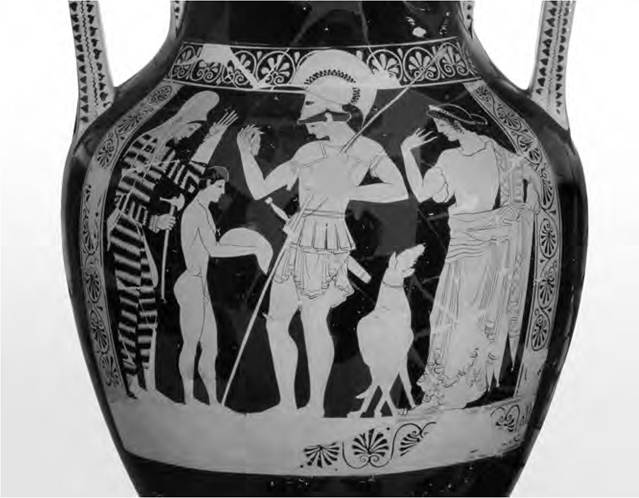
Figure 9. Red-figured amphora attributed to the Kleophrades Painter; Martin-von-Wagner Museum, Würzburg, 507; photograph by E. Oehrlein, © Martin-von-Wagner Museum der Universität Würzburg.
A more easily identified interest in divination in Athenian vase painting at the time of the Achilles and Ajax scenes can be found in the group of black- and red-figured vases depicting one of the best known rites, hieroskopia or the examination of the entrails of a sacrificed animal (Durand and Lissarrague 1979, Lissarrague 1990, 55-59, van Straten 1995, 238-43). These scenes had a restricted period of popularity from ca. 530 BCE until the time of the Persian Wars, although only about twenty-two examples survive today. All depict warriors taking part in divinatory actions, although at home before departure, not at the front. Contrary to typical practice in which a trained mantis would seek the signs, the warrior himself consults the liver, as on a red-figured amphora attributed to the Kleophrades Painter and found at Vulci (fig. 9, Wurzburg 507, BAPD 201654, van Straten 1995, cat. V262). It is interesting to compare the upraised arms of the observers here to those of Athena in the Achilles and Ajax scenes (fig. 6). Nancy de Grummond has noted this gesture in Greek and Etruscan art, including on the Kleophrades Painter's amphora, and has proposed it represents the reception of prophecy (2002, 68-70).
Counting the Kleophrades Painter's amphora, only four hieroskopia vases have a known provenience, all from Etruria. None have a documented findspot but presumably come from tombs, given their condition and collection histories. Another six are in Italian museums with Etruscan collections and presumably come from Etruscan sites, while none of the remaining twelve are in Greek museums. While recognizing the small sample, it is possible that hieroskopia scenes represent targeted marketing to an Etruscan clientele, not surprising given the importance of this ritual to Etruscan cult (cf. Osborne 2001, 283, Gebauer 2002, 351). Such vases would have obvious appeal for deposition in funerary assemblages, where the scenes attained great poignancy and it can be assumed the warriors will not return home.
Vases with Achilles and Ajax scenes, meanwhile, had a wider distribution that includes Greek sites, even with about 50 percent lacking a known provenience (table 1). Some of the vases found in Greece come from graves, especially black- figured lekythoi that comprise the latest in the series. At least six, for instance, have been excavated in the Athenian Kerameikos (BAPD 24563, BAPD 9022973, Woodford 1982, cat. D36, Woodford 1982, cats. E12-14), a few in children’s graves; this latter circumstance, along with the discovery of astragaloi themselves in some Kerameikos tombs, does remind us of the potential multivalence of these objects in referencing both leisure and divination, especially with regard to children (cf. Care 2012). Several Achilles and Ajax vases with known findspots were discovered in Greek sanctuaries, including the Heraion on Delos (BAPD 30109), the sanctuary of Demeter at Selinus (BAPD 28906), and the Athenian Akropolis (BAPD 32402, 200650, 331970). With so many unprovenienced vessels featuring these scenes, remarks about the interaction among function, shape, and image must remain tentative. One can only say that interpreting the scenes as divinatory complements either a votive or funerary context, while vessels used
Table 1. Achilles/Ajax vases with known or suspected proveniences (n = 84 of 170 total scenes, 49%)
| Etruria | South Italy/ Sicily | Greece (mainland) | Other | |
| Amphora | 26 | 5 | 1 | 1 |
| Hydria | 3 | 0 | 0 | 0 |
| Krater | 2 | 1 | 0 | 0 |
| Kylix | 4 | 2 | 4 | 2 |
| Oinochoe/ Olpe | 4 | 0 | 0 | 1 |
| Lekythos | 0 | 5 | 20 | 1 |
| Other | 1 | 0 | 1 | 0 |
| TOTALS | 40 | 13 | 26 | 5 |
Table 2. Achilles/Ajax vases with provenience from a known Etruscan site (n = 31 of 40 vases with known or suspected Etruscan provenience)
| Vulci | Tarquinia | Chiusi | Orvieto | Bologna | |
| Amphora | 11 | 4 | 2 | 2 | 0 |
| Hydria | 2 | 0 | 0 | 1 | 0 |
| Krater | 0 | 0 | 0 | 2 | 0 |
| Kylix | 3 | 0 | 0 | 0 | 0 |
| Oinochoe/ Olpe | 2 | 0 | 0 | 0 | 1 |
| Kyathos | 1 | 0 | 0 | 0 | 0 |
| TOTALS | 19 | 4 | 2 | 5 | 1 |
at a symposion or banquet might have inspired conversation about fate, irony, even death.
The largest proportion of vases with Achilles and Ajax scenes went to Etruria, including most of the earliest examples, the majority likely placed in tombs (table 2). Although little is known of Etruscan cleromancy, archaeological evidence supports the drawing and perhaps casting of lots as a form of divination (Champeaux 1990, Maggiani 1994, Bagnasco Gianni 2001, although note the caution of L. Buchholz 2013). The Etruscan Menerva (or Menrva) was an oracular deity, and the best evidence for cleromancy during the Archaic period comes from two of her sanctuaries: a shrine at Punta della Vipera (or Santa Marinella; Torelli 1966; Torelli and La Regina 1968) and the Portonaccio sanctuary at Veii (e.g., Colonna 1987, 423; Maggiani 2005, cat. 129), where one finds evidence of sortes. Perhaps an Etruscan viewer would have read Athena as oracular in Achilles and Ajax scenes. As for modified astragaloi in Italian sanctuaries that likely served a ritual function, fewer have been discovered compared to Greece: a group of thirty-one astragaloi that had been both modified and pierced were found in a deposit at the sanctuary of Pyrgi (Baglione 1989-1990, 660-62), and others were excavated at the Archaic temple of S. Omobono in Rome and in the shrine under the Lapis Niger in the Forum Romanum (De Grossi Mazzorin and Minniti 2013, 376-77).
Unfortunately, most of the Achilles and Ajax vases from Etruria lack provenience, so it is difficult to ascertain a pattern of deposition among grave assemblages or votive offerings. It is not difficult, however, to postulate eschatological meaning for this theme, as well as subjects paired with it on vases. For example, the scene of Achilles, Ajax, and Athena on one side of a black- figured amphora from Tarquinia is juxtaposed with soldiers' departures on the other—a hoplite and archer standing between two old men—the viewer sensing that none of the warriors on the vase will return (Tarquinia RC1627, BAPD 9009516, Woodford 1982, cat. F3). This is one of the few Achilles and Ajax vases to have a documented findspot in an Etruscan tomb (Notizie degli Scavi 1885, 510); its deposition alongside a second neck amphora with warrior themes and cup with warrior in the tondo may indicate that the grave belonged to a fallen soldier. As for the Exekias amphora itself (fig. 4), for an Etruscan viewer the Achilles and Ajax scene on the obverse may have carried a poignant foreboding of death, while the more uplifting scene of the Dioskouroi on the reverse would have provided a reassuring image, the twins being understood in Etruria as guides for safe passage into the afterworld.
Recognizing scenes of divination on Athenian vases, aside from the obvious depictions of hieroskopia, presents a challenge. In this paper, I have explored the possibility that cleromantic divination is referenced in at least some vases, including a small group of sacrifice images and large group of scenes featuring Achilles and Ajax. Admittedly, one risks a circular argument in undertaking such an analysis, given the scarcity and selectivity of source material. It is also possible, especially with the warrior scenes, that not everyone would have seen divination so readily. Just as astragaloi themselves were multifunctional objects, used in leisure as well as ritual (cf. De Grossi Mazzorin and Minniti 2013), perhaps to some viewers the vases did show just a game, and perhaps the scenes were intended by their painters to be multivalent. Asking these questions, however, acknowledges that ritual practices discounted or dismissed by many modern scholars as superstitious or magical played an important role in Greek (and Etruscan) religion. Even the smallest of objects allowed mortals to speak with the gods.
Bibliography
Alvar Nuno, Anton. 2006. “‘ΑΝΕΡΡΙΦΘΩ ΚΥΒΟΣ: Ayax y Aquiles tiran los dados.” MHNH 6:15-32.
Amandry, Pierre. 1984. “Os et coquilles.” Pages 347-80 in LAntre corycien, II. BCHSup 9. Paris: de Boccard.
Austin, R. G. 1940. “Greek Board Games.” Antiquity 14:257-71.
Baglione, M. Paola. 1989-1990. “Considerazioni sui santuari di Pyrgi e di Veio-Portonac- cio.” Anathema 3-4:651-67.
Bagnasco Gianni, Giovanna. 2001. “Le sortes etrusche.” Pages 197-220 in Sorteggio pubblico e cleromanzia dall’antichità all’età moderna: Atti della tavola rotonda. Edited by Federica Cordano and Cristiano Grottanelli. Milan: ET.
Bar-Oz, Guy. 2001. “An Inscribed Astragalus with a Dedication to Hermes.” NEA 64:215-17. Beaumont, Lesley A. 2012. Childhood in Ancient Athens: Iconography and Social History.
London: Routledge.
Beazley, John D. 1966. The Development of Attic Black Figure. Revised and edited by Dietrich van Bothmer and Mary Moore. Berkeley: University of California Press.
Biers, William R. 1989-1990. “Gaming Heroes: Achilles and Ajax on a Lekythos in Missouri.” Muse 23-24:48-61.
Boardman, John. 1978. “Exekias.” AJA 82:11-25.
Bouche-Leclercq, Auguste. 1879-1882. Histoire de la divination dans lantiquite. 4 vols. Paris: Leroux.
Broneer, Oscar. 1933. “Excavations on the North Slope of the Acropolis, 1931-1932.” Hesperia 2:329-417.
Buchholz, Hans-Günter. 1987. “Brettspielende Helden.” Pages 126-84 in Sport und Spiel. Edited by Siegfried Laser. Vol. 3 in Archaeologia Homerica: Die Denkmäler und das frühgriechische Epos. Edited by Friedrich Matz and Hans Günter Buchholz. Gottingen: Vandenhoeck & Ruprecht.
Buchholz, Laura. 2013. “Identifying the Oracular Sortes of Italy.” Pages 111-44 in Studies in Ancient Oracles and Divination. Edited by Mika Kajava. AIRF 40. Rome: Institutum Romanum Finlandiae.
Care, Barbara. 2012. “L'astragalo in tomba nel mondo greco: Un indicatore infantile? Vecchi problemi e nuove osservazioni a proposito di un aspetto del costume funerario.” Pages 403-16 in Lenfant et la mort dans l’antiquite, III: Le materiel associe aux tombes denfants; Actes de la table ronde internationale organisee a la Maison Mediterraneenne des Sciences de l’Homme d’Aix-en-Provence, 20-22 janvier 2011. Edited by Antoine Hermary and Celine Dubois. BiAMA 12. Aix-en-Provence: Centre Camille Jullian.
Champeaux, Jacqueline. 1990. “Sors oraculi: Les oracles en Italie sous la Republique et l’Empire.” MEFRA 102:271-302.
Chase, George H. 1946. “Two Sixth Century Attic Vases.” BMFA 44/256:45-50.
Colonna, Giovanni. 1987. “Noti preliminari sui culti del santuario di Portonaccio a Veio.” ScAnt 1:419-46.
Dasen, Veronique. 2015. “Achille et Ajax: Quand l’agon s'allie a l'alea.” Revue du MAUSS 46:81-98.
-------. 2016. “Jeux de l'amour et du hasard en Grece ancienne.” Kernos 29:73-100.
De Grossi Mazzorin, Jacopo, and Claudia Minniti. 2013. “Ancient Use of the KnuckleBone for Rituals and Gaming Pieces.” Anthropozoologica 48:371-81.
Diehl, Erika. 1962. “Eine attische Amphora mit brettspielenden Helden.” Berliner Museen 12:32-39.
Durand, Jean-Louis, and Francois Lissarrague. 1979. “Les entrailles de la cite: Lectures de signes; Propositions sur la hieroscopie.” Hephaistos 1:92-108.
Ekroth, Gunnel. 2001. “Altars on Attic Vases: The Identification of Bomos and Eschara” Pages 115-26 in Ceramics in Context: Proceedings of the Internordic Colloquium on Ancient Pottery, Stockholm 1997. Edited by Charlotte Scheffer. SSCA 12. Stockholm: Almqvist and Wiksell.
Foster, Giraud V 1984. “The Bones from the Altar West of the Painted Stoa.” Hesperia 53:73-82.
Fowler, Robert L. 2000. “Greek Magic, Greek Religion.” Pages 317-43 in Oxford Readings in Greek Religion. Edited by Richard Buxton. Oxford: Oxford University Press.
Froning, Heide. 1982. Katalog der grieschichen und italischen Vasen, Museum Folkwang Essen. Essen: Museum Folkwang Essen.
Gebauer, Jorg. 2002. Pompe und Thysia: Attische Tieropferdarstellungen auf schwarz- und rotfigurigen Vasen. Eikon 7. Münster: Ugarit-Verlag.
Gilmour, Garth H. 1997. “The Nature and Function of Astragalus Bones from Archaeological Contexts in the Levant and Eastern Mediterranean.” OJA 16:167-75.
Govi, Elisabetta. 1995. “Vasi attici a figure nere dal santuario per il culto delle acque di Marzabotto.” Ocnus 3:61-76.
Graf, Fritz. 2005. “Rolling the Dice for an Answer” Pages 51-98 in Mantike: Studies in Ancient Divination. Edited by Sarah Iles Johnston and Peter T. Struck. RGRW 155. Leiden: Brill.
Greaves, Alan M. 2012. “Divination at Archaic Branchidai-Didyma: A Critical Review.” Hesperia 81:177-206.
Grottanelli, Cristiano. 2001. “La cleromancie ancienne et le dieu Hermès.” Pages 155-96 in Sorteggio pubblico e cleromanzia dall’antichità all’età moderna. Edited by Federica Cordano and Cristiano Grottanelli. Milan: ET.
Grummond, Nancy T. de. 2002. “Mirrors, Marriage, and Mysteries.” Pages 63-85 in Pompeian Brothels, Pompeii’s Ancient History, Mirrors and Mysteries, Art and Nature at Oplontis, and the Herculaneum “Basilica.” Edited by Homas A. J. McGinn. JRASup 47. Portsmouth, RI: Journal of Roman Archaeology.
Hedreen, Guy M. 2001. Capturing Troy: The Narrative Functions of Landscape in Archaic and Early Classical Greek Art. Ann Arbor: University of Michigan Press.
Henderson, Jeffrey. 1998. Aristophanes: Clouds, Wasps, Peace. LCL 488. Cambridge: Harvard University Press.
Hockmann, Olaf. 1996. “Brettspiele im Didymaion.” IstMitt 46:251-62.
Johnston, Sarah Iles. 2005. “Introduction: Divining Divination.” Pages 1-28 in Mantike: Studies in Ancient Divination. Edited by Sarah Iles Johnston and Peter T. Struck. RGRW 155. Leiden: Brill.
Kenzler, Ulf. 2003-2004. “Helden der Hopliten: Aias und Achill auf attischen Vasen der spätarchaischen Zeit.” Hephaistos 21-22:81-101.
Kindt, Julia. 2012. Rethinking Greek Religion. Cambridge: Cambridge University Press.
Korte, Gustav. 1877. “Sulla necropoli di Orvieto.” Annali dell’Instituto di corrispondenza archeologica 49:95-184.
Kossatz-Deissmann, Anneliese. 1981. “Achilleus.” LIMC 1:37-200.
Kovacs, David, ed. 1998. Euripides 3: Suppliant Women, Electra, Heracles. LCL 9. Cambridge: Harvard University Press.
-----, ed. 2002. Euripides 6: Bacchae, Iphigenia at Aulis, Rhesus. LCL 455. Cambridge: Harvard University Press.
Kurke, Leslie. 1999. “Ancient Greek Board Games and How to Play Them” CP 94:247-67. Larson, Jennifer. 1995. “The Corycian Nymphs and the Bee Maidens of the Homeric Hymn to Hermes” GRBS 36:341-57.
Lissarrague, Francois. 1990. Lautre guerrier: Archers, peltastes, cavaliers dans l’imagerie attique. Images à l'appui 3. Rome: Ecole franqaise de Rome.
Mackay, E. Anne. 2010. Tradition and Originality: A Study of Exekias. BARIS 2092. Oxford: Archaeopress.
Maggiani, Adriano. 1994. “Mantica oracolare in Etruria: Litobolia e sortilegio.” RdA 18:68-78.
-------. 2005. “La divinazione in Etruria.” ThesCRA 3:52-78.
Maurizio, Lisa. 1995. “Anthropology and Spirit Possession: A Reconsideration of the Pythias Role at Delphi.” JHS 115:69-86.
Mommsen, Heide. 1980. “Achill und Aias pflichtvergessen?” Pages 139-52 in Tainia: Roland Hampe zum 70. Geburtstag am 2 Dezember 1978 dargebracht von Mitarbeitern, Schülern und Freunden. Edited by Herbert A. Cahn and Erika Simon. Mainz: von Zabern.
Moore, Mary B. 1980. “Exekias and Telamonian Ajax.” AJA 84:417-34.
Neils, Jenifer. 2004. “Yet Another Red-Figure Panathenaic Amphora.” MeditArch 17:61-64. Neils, Jenifer, and John H. Oakley, eds. 2003. Coming of Age in Ancient Greece: Images of Childhood from the Classical Past. New Haven: Yale University Press.
Osborne, Robin. 2001. “Why Did Athenian Pots Appeal to the Etruscans?” WA 33:277-95. Reese, David S. 1985. “The Kition Astragali.” Pages 382-91 in Excavations at Kition 5: The
Pre-Phoenician Levels Plans and Sections. Edited by Vassos Karageorghis. Nicosia: Department of Antiquities, Cyprus.
-------. 1989. “Faunal Remains from the Altar of Aphrodite Ourania.” Hesperia 58:63-70.. 2000. “Worked Astragali.” Pages 398-401 in Kommos: An Excavation on the South
Coast of Crete, Vol. 4; The Greek Sanctuary. Edited by Joseph W Shaw and Maria C. Shaw. Princeton: Princeton University Press.
Robbins, Frank Egleston. 1916. “The Lot Oracle at Delphi.” CP 11:278-92.
Robert, Carl. 1892. Die Nekyia des Polygnot. Vol. 16 of Hallisches Winckelmannsprogram. Halle: Niemeyer.
-----. 1923. Die griechische Heldensage. Vol. 2 of Griechische Mythologie. Edited by Ludwig Preller. Berlin: Weidmann.
Roisman, Joseph. 2005. The Rhetoric of Manhood: Masculinity in the Attic Orators. Berkeley: University of California Press.
Romero Mariscal, Lucia. 2011. “Achilles and Ajax Playing a Board Game: Revisited from the Literary Tradition.” ClQ 61:394-401.
Sabetai, Viktoria. 1993. “The Washing Painter: A Contribution to Wedding and Genre Iconography in the Second Half of the Fifth Century B.C.” PhD diss., University of Cincinnati.
Schädler, Ulrich. 1996. “Spielen mit Astragalen.” JdI 111:61-73.
Schefold, Karl. 1937. “Statuen auf Vasenbildern.” JdI 52:30-75.
Schrader, Hans. 1909. Archaische Marmorskulpturen im Akropolismuseum zu Athen. Vienna: Holder.
Spivey, Nigel. 1994. “Psephological Heroes.” Pages 39-51 in Ritual, Finance, Politics: Athenian Democratic Accounts Presented to David Lewis. Edited by Robin Osborne and Simon Hornblower. Oxford: Clarendon Press.
Straten, Folkert T van. 1995. Hiera Kala: Images of Animal Sacrifice in Archaic and Classical Greece. RGRW 127. Leiden: Brill.
Thomas, Katerina N. 1985. “Three Repeated Mythological Themes in Attic Black-Figure Vase Painting.” PhD diss., Brown University.
Thompson, David L. 1976. “Exekias and the Brettspieler” ArchCl 28:30-39.
Torelli, Mario. 1966. “Terza campagna di scavi a Punta della Vipera e scoperta di una laminetta plumbea inscritta.” ArchCl 18:283-99.
Torelli, Mario, and Adriano La Regina. 1968. “Due sortes pre-romane.” Archeologia classica 20:221-29.
Welcker, Friedrich G. 1851. Alte Denkmaler, III: Griechische Vasengemälde. Gottingen: Dieterich.
Wiegand, Theodor. 1911. Siebenter vorläufiger Bericht über die von den Koniglichen Museen in Milet und Didyma unternommenen Ausgrabungen. Berlin: Verlag der Koniglichen Akademie der Wissenschaften.
Williams, Dyfri. 1980. “Ajax, Odysseus, and the Arms of Achilles.” AntK 23:137-45. Wojcik, Maria Rita. 1989. Museo Claudio Faina di Orvieto: Ceramica attica a figure nere.
Perugia: Electa Editori Umbri Associati.
Woodford, Susan. 1982. “Ajax and Achilles Playing a Game on an Olpe in Oxford.” JHS 102:173-85.
More on the topic Chapter Three Sheramy D. Bundrick Altars, Astragaloi, Achilles: Picturing Divination on Athenian Vases:
- Chapter Three Sheramy D. Bundrick Altars, Astragaloi, Achilles: Picturing Divination on Athenian Vases
- Blakely S. (ed.). Gods, Objects, and Ritual Practice. Lockwood Press,2017. — 371 p., 2017
- “CANONICAL” TEMPLES AND ALTARS
- Contexts of the Rectangular Limestone Incense Altars
- Divination and seidr
- Violence and the Athenian Legal System
- ACHILLES’ EDUCATION ON THE LIMITS OF DIVINE PROVIDENCE
- Candle, Torch, or Wreath
- Violence onthe Athenian Stage
- Local Production of Small Incense Altars