6.0 Introduction
The strategically located north-eastern frontier of India is a home of ethnic communities with a rich socio-cultural heritage. A region that has been witness to severe internal strife at times, imperial massacres and widespread separatist movements post-independence, the literature of the region has realistically presented the everyday lives of the people at times of strife and during days of self-contentment.
The authors, whether writing in English or in vernacular languages, have attempted to portray the rich folk life in all its contours. Prominent authors of the region like Easterine Kire1 have extensively worked on and portrayed the folk beliefs that shape the lives of the people in the Naga Hills and their relevance in a fast-changing world where different worlds interact and evolve newer patterns of folk belief.The term ‘belief’ can have varied connotations and paradigm on being viewed from diverse critical perspectives though simplistically it can be taken as the assortment of such tenets on which an individual or a folk group expresses faith as being the truths capable of defining and determining the contours of an individual’s or a folk group’s essence and existence. Underlining the relationship between belief and knowledge, Owen Egan opines that “the definition of knowledge or cognition as justified true belief seems to have been particularly successful” (Egan 1986:315). Depending on the parameter of logical basis and adherence/presence of reason or otherwise, belief can be presented as in figure 6.1.
Again it cannot be negated that the entire notion of formation/generation of truth involves parameters more than the personal. As philosophers like Michel Foucault (1977) have pointed out truth is deeply linked with power and the determining elements of truth and subsequently belief can also vary depending on the dominant discourse of a society.
Daniel Goldstick refers to various philosophers to show the different dimensions of the term ‘belief’ in his essay Belief:Philosophers like Descartes and James have made a point of insisting that the according of belief to something is a committing of the will. Others such as Hobbes and Price have made the objection that, in point of psychological fact, it is not really possible as a rule- if ever-to believe something just at will.
(Goldstick 1989:231)
The common man is often confronted with the issue of why exactly he/she clings on to certain ideologies, legends, myths, religious practices, moral duties, socio-cultural traits, and believes in them to the extent of such aspects determining the thought process of an individual which subsequently forms the basis of existence. Thus, every individual is governed by belief systems whether it is religious, social, moral, political, or economic. It is the body of such beliefs that leads to the creation of knowledge and then knowledge systems which then direct the patterns of thought and belief of a folk group. Magnus Osterholm in his essay Beliefs: A Theoretically Unnecessary Construct? has stated that:
if all members of some type of group have a specific belief, then they might not label it as a belief but as knowledge... that for something to be seen as knowledge it has to satisfy some type of truth condition-a condition that is negotiated and agreed upon within a community. Thus, depending on what social community you belong to, you can have different views on what is seen as knowledge and what is seen as belief.
(Osterholm 2009:156)
The determinants of belief can be seen to have numerical as well as socio-political connotations besides having a strong psychological dimension. This shows that what a group ultimately believes to be true is not the result of its subjective concerns only but it also involves factors even beyond the realm of subjectivity that combine together to forge its identity. At this point it can be surmised that the essential being of every individual and by extension the society to which he/she belongs to is governed by belief and knowledge systems. Moreover, despite the belief systems and knowledge systems being inter-linked it would be pertinent to analyse their differences, on the basis of Osterholm’s study, to understand what comprises knowledge and determines a belief which ultimately goes on to determine a folk group’s socio-cultural legacy.
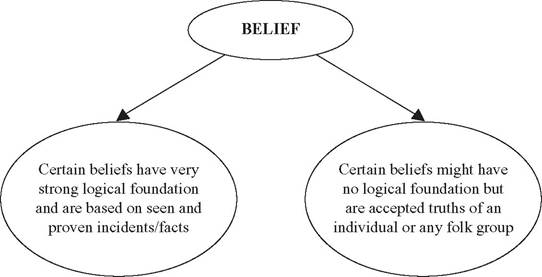
Figure 6.1 Foundation of Beliefs
Source: Author
6.1
More on the topic 6.0 Introduction:
- Introduction The Earliest Times
- 25 Protein losing enteropathy in a dog
- Epidemiology of BTB Caused by M. bovis in Burkina Faso
- The European Union
- Bovine TB in Ethiopia
- Steven L. Guthier Ukrainian Cities during the Revolution and the Interwar Era