Mahayana Buddhism: The Great Vehicle
Mahayana Buddhism is the largest of the Buddhist traditions. This is suggested by its name— Sanskrit mahayana means “great vehicle”—as well as by the many schools and sects that make Mahayana a large and accommodating tradition with room for Buddhists of all kinds.
Today, the majority of the world’s Buddhists belong to the Mahayana tradition, the dominant form of Buddhism in China, Japan, South Korea, Vietnam, Indonesia, Malaysia, and Taiwan.Mahayana differs from Theravada in emphasizing the ability of laypeople to make progress toward enlightenment and an end to suffering even while engaged in family and social life. And unlike Theravada, which says we can attain nirvana only through our own effort, Mahayana teaches that there are buddhas and bodhisattvas who can help us along the way.
The Trikaya Doctrine, the Buddha, and Buddha Nature
The two traditions also differ in their understanding of the Buddha. As we have seen, Theravada Buddhism understands the Buddha as a human being, albeit an extraordinary human being. Mahayana Buddhism’s teaching about the Buddha is more complex.
According to the Mahayana doctrine of trikaya (Sanskrit, “three bodies”), there are three “bodies” or modes of being in which the Buddha is known. At the lowest level is the nirmanakaya or “transformation body” in which the Buddha can be seen and heard in the everyday world by ordinary people. This is the body of the historical Buddha who taught the Dharma as he traveled across northern India. It is also the body, in various forms, of all other buddhas who appear in this world. More subtle and existing at a higher level is the samboghakaya or “bliss body” of the Buddha. This is the Buddha to whom Mahayana Buddhists direct their devotion, the Buddha who is described as teaching higher doctrines in Mahayana sutras, and the Buddha who is said to dwell in countless universes and pure lands from which he reaches out to bring others to liberation.
The highest body of the Buddha is the dharmakaya or “truth body.” This is ultimate reality as it truly is and as it is experienced by enlightened minds. It is the source of the transformation and bliss bodies of the Buddha, which emanate from it. It is the true nature of the Buddha.The concept of Buddha nature is central to Mahayana Buddhism, which teaches that the enlightened consciousness of the Buddha is found within all sentient beings. Thus, enlightenment is not something outside of us that we must strive to acquire. Instead, it is already present within us. The experience of enlightenment is ours if we will only uncover it by sweeping away all of the false notions about reality that cloud our vision.
Bodhisattvas and Buddhas
One of the most distinctive features of Mahayana Buddhism is its emphasis on compassion. Whereas the heroic figure in Theravada Buddhism is the arhat who attains enlightenment for his own sake, the Mahayana ideal is the compassionate bodhisattva who is devoted to helping others attain enlightenment.
The Mahayana Trikaya Doctrine
According to the trikaya doctrine, there are three “bodies” or modes of being in which the Buddha is known.
The true nature of the Buddha is the dharmakaya or “truth body,” which is ultimate reality itself. Void or empty of any distinguishing qualities and beyond rational comprehension or description, this is reality as it truly is and as it is perceived by enlightened minds. All phenomena are emanations of the dharmakaya.
The samboghakaya or “bliss body” is a manifestation of the Buddha at a level that is supramundane yet still within space and time. The five transcendent buddhas pictured here— Vairocana, Amitabha, Akshobya, Ratnasambhava, and Amoghasiddi—represent aspects of the dharmakaya and preside over pure lands in the directions they face. There are countless other buddhas as well. Although they exist as dharmakaya after their parinirvana, for the sake of others they manifest as samboghakaya and create their own pure lands where they teach the Dharma surrounded by crowds of bodhisattvas.
Among these are great bodhisattvas such as Maitreya, a future buddha, and Avalokiteshvara, the bodhisattva of compassion.The nirmanakaya or “transformation body,” the lowest manifestation of the Buddha, is the body of buddhas who appear in the material world. These include buddhas of the past—such as Gautama Buddha and Dipankara, who is said to have attained enlightenment eons before Gautama Buddha—and buddhas still to come.
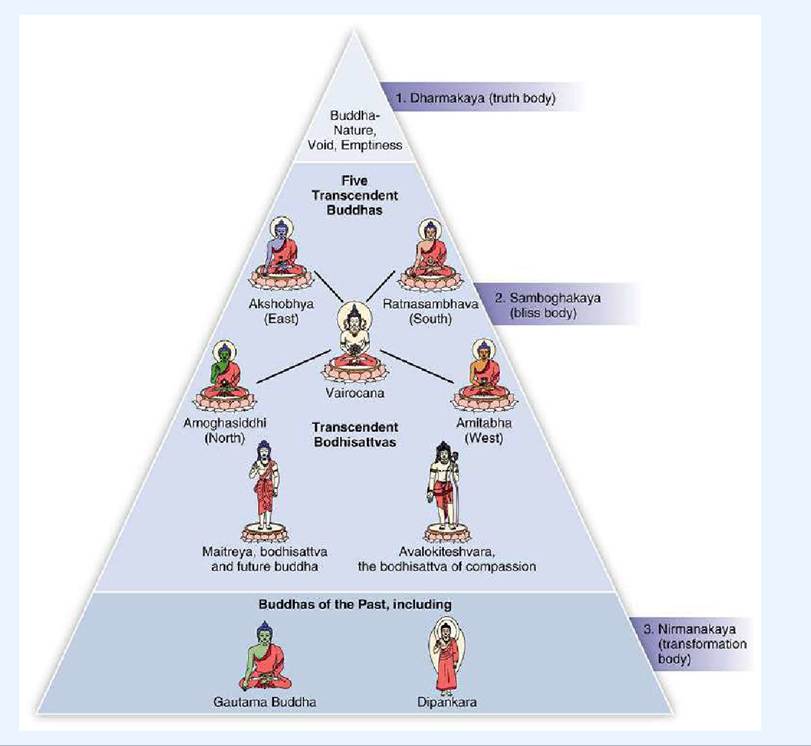
Mahayana Trikaya diagram.
Originally, “bodhisattva” (Sanskrit, “enlightenment being” or “one who is on the path to enlightenment”) was used to describe the Buddha in lives he lived prior to his enlightenment. But Mahayana Buddhism gives this term a new interpretation. In the Mahayana view, a bodhisattva is anyone who takes a “bodhisattva vow” to seek enlightenment for the sake of all other beings.
But how do bodhisattvas work for the enlightenment of other beings? By cultivating virtues such as the Six Perfections (generosity, morality, patience, energy, meditation, and wisdom), bodhisattvas accumulate merit. Mahayana Buddhists think of merit as a beneficent force that brings positive developments in one’s present and future lives and contributes to one’s progress to enlightenment. In addition, merit can be transferred to others by means of wishes, intentions, and rituals and without any depletion of one’s own accumulation. For example, a daughter might transfer merit to a deceased father in the hope of giving him a good rebirth—and without diminishing her own store of merit.
Many bodhisattvas are ordinary people who have taken a bodhisattva vow. Your best friend, the person who sits next to you in class, the checker at the grocery store—any of these might be a bodhisattva. But there are also transcendent bodhisattvas who manifest as samboghakaya in pure lands. With limitless stores of merit, infinite wisdom and compassion, and miraculous powers, they have the ability to alleviate the suffering of others and help them along the path to enlightenment.
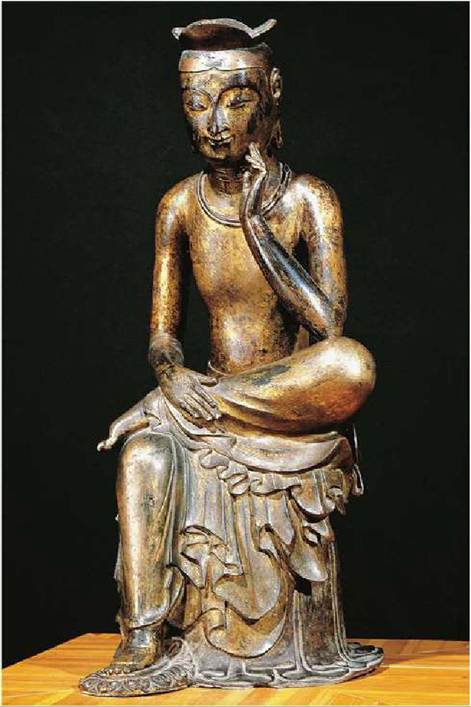
Gilded bronze sitting Maitreya icon. Maitreya (“Loving-kindness”) is the future Buddha. Like Rodin’s Thinker, he is seated on his throne in deep contemplation with his hand touching his chin. Three Kingdoms period, seventh century. National Museum, Seoul, Korea.
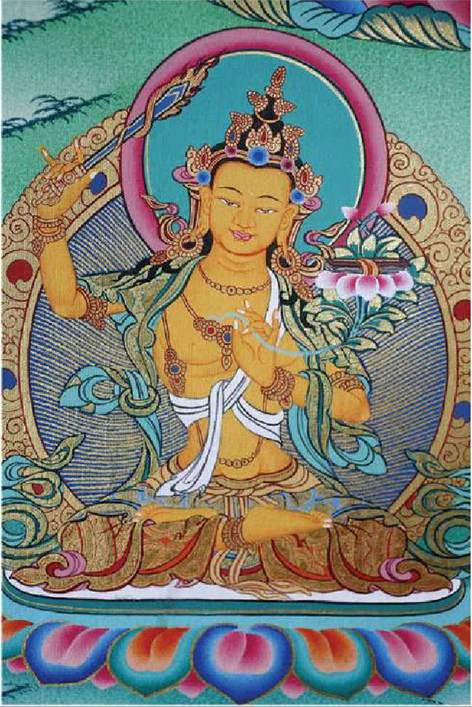
“Manjushri, Bodhisattva of Wisdom” appearing with the flaming sword of discrimination and a copy of the Prajnaparamita Sutras in the blooming lotus of enlightenment. Kopan monastery, Kathmandu, Nepal.
The most widely venerated of these bodhisattvas is Avalokiteshvara, the bodhisattva of infinite compassion. A male figure in South Asia, in East Asia this bodhisattva is Guanyin, a compassionate goddess of mercy who uses her supernatural powers to assist those who call upon her for help. Another popular bodhisattva is Manjushri, who symbolizes supreme wisdom. Manjushri has manifested himself in many ways in this world—in dreams, as a pilgrim, as a monk, and even as the emperor of China—in order to work for the liberation of others from suffering.
In addition to its bodhisattvas, Mahayana Buddhism recognizes a multitude of buddhas. Some have preceded Gautama Buddha in this world. Others have yet to come. The most prominent of future buddhas is Maitreya. Existing now as a bodhisattva, he will appear on earth at a time when the teachings of Gautama Buddha are no longer followed, attain enlightenment and buddhahood, and then restore the pure Dharma to the world. There are also many buddhas who manifest as samboghokoya. Among them are five transcendent buddhas who represent aspects of the dharmakaya: Vairocana, Amitabha, Amoghasiddi, Akshobhya, and Ratnasambhava. These are said to have manifested themselves at various times as earthly buddhas and bodhisattvas. They have also created pure lands or buddha-fields to which they bring those who call upon them for salvation from suffering.
In these ideal realms the pure Dharma is taught and one can make greater progress to liberation.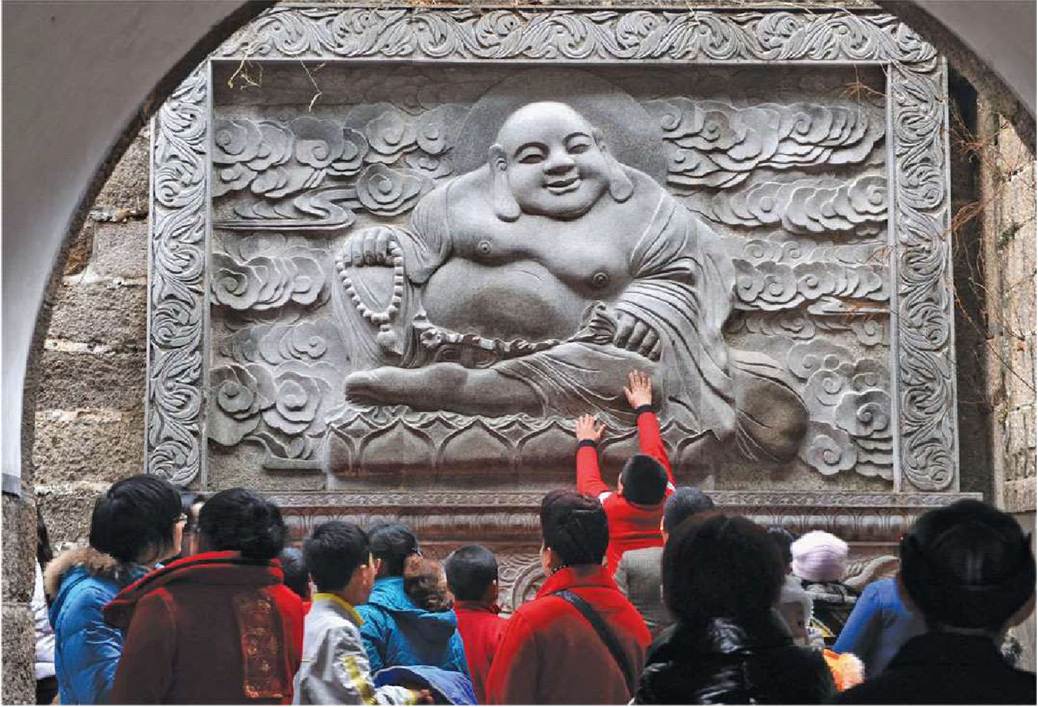
"The Laughing Buddha.” This form of Maitreya is popular in China, where his fatness symbolizes prosperity and joy. It is customary for Buddhists to rub his belly for good luck. Here, people try to improve their luck by touching an image of Maitreya during the New Year fair at the Huayan Temple on the Laoshan Mountain in Qingdao, China.
Skillful Means
Early Buddhist texts describe the Buddha as a teacher who employed skillful means. Drawing upon his compassion and wisdom, he skillfully adapted his words and actions to the particular needs and capacity for understanding of the many different kinds of people he sought to guide along the path to enlightenment. When explaining his teachings to Indian Brahmins, for example, the Buddha made skillful use of their doctrines, using them as helpful points of comparison with his own. On another occasion, he described the bodhisattva Avalokiteshvara as employing skillful means in taking the form of a student to help students and that of a monk to assist monks.
In Mahayana Buddhism, skillful means is more than a guiding principle for those who wish to help others. It also explains and justifies the existence of Buddhism’s various schools and sects. The Buddha illustrated both functions in a famous parable about a father who discovers a fire spreading quickly through his house. He calls to his children, begging them to flee, but they are absorbed in playing with their toys and pay no attention. Realizing there is no time to carry them all to safety, the father skillfully exploits his children’s love of toys in devising a means for saving their lives. He tells them he has toys they have always wanted—little carts drawn by goats, deer, and oxen—waiting for them. In doing so, he succeeds in persuading them to run outside. Once there, they do not find the little carts their father had promised.
Instead, they find something far greater than what they had imagined: a magnificent cart covered in jewels and drawn by a pure white ox. Commenting on his parable, the Buddha explained that just as the little carts are skillful means for saving the children from the fire, Buddhism’s different “vehicles” or paths to enlightenment are skillful means of saving people from suffering. They are effective, but they are not worthy of attachment. Like rafts used to cross some great sea, they are meant to be abandoned when we reach the distant shore and find something far beyond our imagination: nirvana.Emptiness
We have seen that in his doctrine of interdependent origination the Buddha taught that things do not exist in their own right. Instead, all things depend on all other things for their existence. Reflecting on the meaning of this teaching, a third-century Indian monk named Nagaijuna, perhaps the greatest of all Buddhist philosophers, formulated a doctrine of emptiness or shunyata (from Sanskrit shunya, “empty”) that became a foundational feature of Mahayana Buddhism. According to this doctrine, all things are empty of self-existence. This is not to say they do not exist at all. They do exist, but only as transitory phenomena that are in every way dependent upon all other things.
In teaching that all things are empty of self-existence, the doctrine of emptiness includes nirvana as well as samsara, the world of our everyday experience. It holds that since both are empty of self-existence they are, in fact, the same. According to Nagarjuna, it is impossible to find even the slightest difference between them. They are a single system of interdependent phenomena that are continually arising and passing away.
The doctrine of emptiness can be unsettling because it teaches that reality is empty of anything solid or enduring that we can hold onto. Seen from a Buddhist perspective, however, it is good news. It tells us that nirvana is not some distant reality but one that is already all around and within us. The experience of nirvana is ours if we will only set aside our ignorance.
Mahayana Texts
Mahayana Buddhism makes use of texts found in the Pali Canon as well as many others. Some investigate profound states of consciousness reached in meditation. Others elaborate on the implications of doctrines such as interdependent origination and emptiness. Still others describe the qualities of bodhisattvas and explain the benefits of calling upon various buddhas. All are said to be grounded in the teachings of the Buddha, whose implications they identify and explain.
Among the earliest Mahayana texts are the Perfection of Wisdom Sutras. Written between 100 and 600 ce, these texts represent the Buddha in dialogue with others on themes related to the acquisition of wisdom, understood here as a perfected understanding of the nature of reality. The most important of these texts are the Diamond Sutra and the Heart Sutra. Both emphasize concepts that were to become foundational in the Mahayana tradition, including the bodhisattva ideal, no-self, and emptiness.
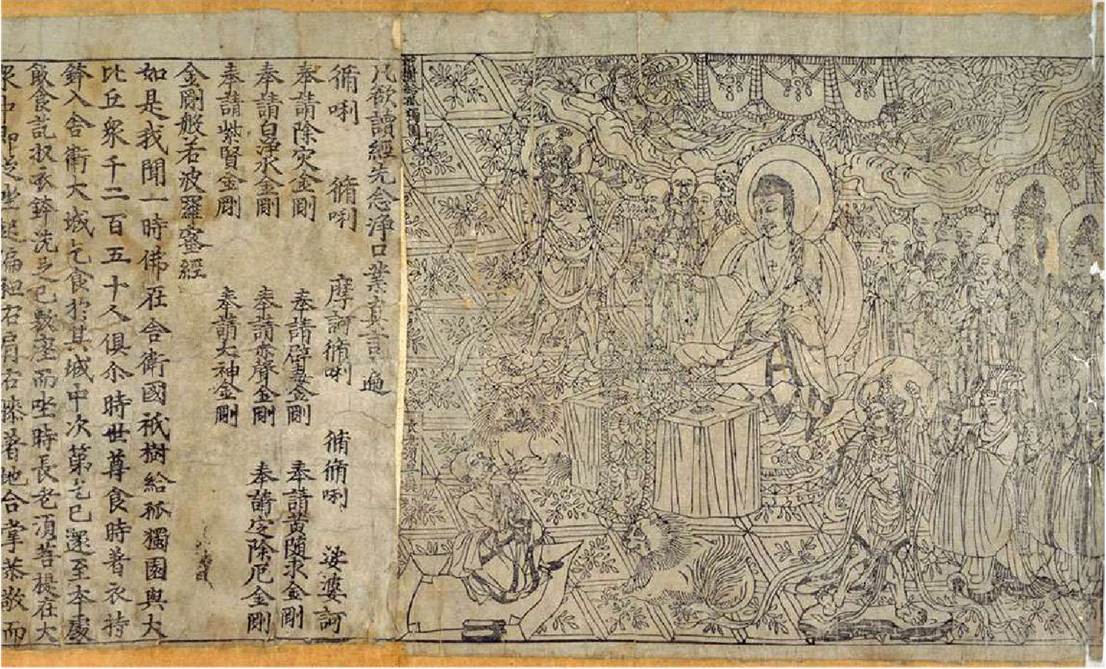
Frontispiece of the Diamond Sutra of Dunhuang, 868 ce. This manuscript is the oldest known printed book in the world; it appeared 587 years before the Gutenberg Bible.
Advanced bodhisattvas are understood as intermediary figures who serve others. What kinds of intermediary figures exist in other religions, and what are their functions?
Another influential Mahayana text is the Lotus Sutra. Written in the second century ce, it represents the Buddha as giving his final and ultimate teaching to thousands of monks, nuns, and bodhisattvas. Making frequent use of parables, the Buddha describes the doctrine of skillful means, teaches that all beings have Buddha nature and the potential to become buddhas, and states that the bodhisattva ideal is greater than that of the arhat. The Lotus Sutra also describes the Buddha as far more than a merely historical figure. Instead, he is a glorious figure whose existence is beyond time.
Mahayana Buddhism’s emphasis on compassion is especially evident in the Pure Land sutras, and especially in the Longer Sukhavativyuha Sutra, theAmitayurdhyana Sutra, and the Shorter Sukhavativyuha Sutra. Appearing as early as the second century ce, these texts focus on Amitabha, “the Buddha of Boundless Light,” a compassionate figure who brings those who call upon him to rebirth in his pure land and works through Avalokiteshvara, the bodhisattva of infinite compassion, to alleviate the suffering of all beings.
Four Mahayana Schools: Pure Land, Tiantai, Nichiren, and Zen We noted at the beginning of this section that Mahayana Buddhism is a great vehicle with room for Buddhists of all kinds. This is especially evident in the great number of Mahayana schools and sects, all of which are seen as skillful means of presenting the Dharma. The four major Mahayana schools we will describe here illustrate the range of Mahayana beliefs and practices.
Pure Land Buddhism is one of the most widely practiced forms of Mahayana Buddhism and is the dominant form in China and Japan. It emphasizes devotion to Amitabha Buddha and faith that he will bring his devotees to a blissful rebirth in his own pure land, the Western Pure Land known as Sukhavati.
According to the Pure Land sutras, conditions in this world obstruct the teaching and practice of the Dharma. In order to save suffering beings, Amitabha Buddha created his pure land as a place of respite. Those who are reborn there live comfortably and receive instruction from Amitabha Buddha and his many bodhisattvas until they are ready to attain enlightenment. In order to be reborn in Amitabha Buddha’s pure land, one must strive to keep the thought of him always in mind. This is most commonly done by reciting the phrase “Praise to Amitabha Buddha” throughout each day. Ideally, one will also look to Amitabha at the moment of death when the process leading to rebirth begins.
Pure Land Buddhism has been called “the easy path,” and perhaps with good reason. No commitment to the rigors of monastic life is necessary. One need only have faith that the compassionate Amitabha Buddha will smooth the way to a happy rebirth and enlightenment and express it by making the thought of him a feature of everyday life. For this reason, Pure Land Buddhism has always had immense appeal for laypeople.
Tiantai Buddhism takes its name from Tiantai Mountain in southeastern China where its founders lived and taught. It later spead to Japan, where it is known as Tendai, and to Korea and Vietnam.
By the time of Tiantai’s early development, hundreds of sutras attributed to the Buddha had been brought from India to China, many of them with different interpretations of the Dharma. Tiantai began as an effort to harmonize these in a single unified system of Buddhist thought. It asserted that the Buddha always taught the same truths but at different levels of difficulty intended for different audiences. It also claimed that the highest form of Buddhist teaching is found in the Lotus Sutra, which is the basis for all Tiantai doctrine.
Tiantai is an elastic form of Buddhism that has absorbed features of other Buddhist schools and makes room for both monastics and laypeople. Many adherents follow the Pure Land practice of reciting the name of Amitabha Buddha, some practice forms of meditation, others focus on study of the Lotus Sutra, and still others look to ceremonies and rituals for a heightened sense of the Buddha nature that lies within themselves and throughout the natural world.
Nichiren Buddhism is a Japanese school founded by Nichiren, a thirteenth-century monk who left the Tendai movement when he became convinced that the Lotus Sutra is the supreme manifestation of Buddhist wisdom and a source of spiritual power that can transform individual lives and society as a whole. In Nichiren’s view, no other sutra was worthy of attention. Believing that neglect of the Lotus Sutra was the cause of Japan’s troubles in his time, Nichiren became an activist who fiercely condemned corruption and called upon government officials, monastics, and laypeople to make the
Lotus Sutra the basis of Japanese national life. He enjoined his followers to venerate the Lotus Sutra by reciting the daimoku, a phrase (Namu myoho renge kyo) that means “Homage to the Scripture of the Lotus of the Good Teaching.”

A Nichiren Buddhist performs her devotions.
Some Nichiren Buddhists regard Nichiren as a master teacher, others as a bodhisattva, and still others as an incarnation of the Buddha. Their tradition teaches that veneration of the Lotus Sutra and its title, as found in the daimoku, are sufficient for the attainment of enlightenment. They typically express their devotion to the Lotus Sutra each morning and evening, reverently chanting the words of the daimoku. As they chant, they direct their devotion to the Gohonzon, a replica of an inscription once carved by Nichiren that features the daimoku along with symbols of the trikaya and various buddhas and bodhisattvas. This practice is said to activate the Buddha nature within oneself, bringing positive change and, ultimately, enlightenment. Nichiren Buddhism also preserves its tradition of political and social activism that reaches back to Nichiren himself. Its Soka Gakkai (“Value Creation Society”) sect is influential in Japanese politics and in social and environmental causes throughout the West, where its adherents are growing in number.
Zen Buddhism traces its unique teachings back to the Buddha and credits Bodhidharma, a legendary Indian monk, with bringing them to China in the fifth century. From China, where it is known as Chan Buddhism, Zen spread to Japan, where Chan (“meditation”) is pronounced as Zen, and to the rest of East Asia.
Zen emphasizes meditation (Japanese, zazen) as a means of looking into one’s own nature in order to attain the realization that it is identical with Buddha nature. This realization brings enlightenment. As we have seen, Buddha nature—the pure and essential nature of reality—is empty of independent phenomena. And yet our minds seem to insist that independent phenomena do exist, always making distinctions between you and I, this and that, having and not having, and so forth.
How can we get past this tendency of the mind? Zen teaches that doctrines, sutras, good works, and faith in buddhas are of little help in the attainment of satori, the Zen term for enlightenment. Instead, it urges reliance on individual effort made in meditation. One approach is simply to sit still, observing the workings of the mind and gradually eliminating false views of reality until the truth becomes clear. This slow-but-steady path is favored by Zen’s Soto school. According to the Rinzai school, one can also attain satori suddenly in a flash of insight by presenting the mind with some problem it cannot solve by means of rational analysis. Both schools make use of koans, paradoxical riddles designed to astound the mind. Presented with a koan such as “What is the sound of one hand clapping?” or “How did my face appear before my parents were born?” the rational mind falters, allowing awareness to settle into a deeper, intuitive experience of one’s own nature as Buddha nature.
Today, Zen is known worldwide and has become especially popular in the West. Zen has a strong monastic tradition, but laypeople practice zazen as well. Many combine zazen at home with meditation at weekly meetings of a local Zen group.
More on the topic Mahayana Buddhism: The Great Vehicle:
- Mahayana Buddhism: The Great Vehicle
- Buddhism and the Environment
- Buddhism in India
- The Great Drought
- Buddhism, Concord, and Conflict
- Developments in Buddhism
- Buddhism Beyond India
- Buddhism as a Way of Life
- The Great Awakening