Vajrayana Buddhism: Tantric Buddhism in the Mahayana Tradition
Vajrayana Buddhism is the most prominent form of Buddhism in Tibet, Nepal, Bhutan, and Mongolia. It also has a presence in Japan, China, Indonesia, and the Philippines. Usually understood as a form of Mahayana Buddhism, Vajrayana began in India but much of its early development occurred in Tibet.
Vajrayana is also known as the Thunderbolt Vehicle and the Diamond Vehicle, both of which translate the Sanskrit vajrayana. These suggest Vajrayana’s power to smash or cut through false notions about reality and to do so suddenly.Vajrayana derives its qualities of power and the possibility of sudden enlightenment from Buddhist Tantra. We saw in Chapter 4 that Tantra was a religious movement in India that took both Buddhist and Hindu forms. Buddhist Tantrists made use of secret knowledge and practiced special forms of meditation and magic rituals in order to break through delusion into enlightenment. With this in mind, one scholar has described Tantra as “a technique for magically storming the gates of Buddhahood.”3
Vajrayana Buddhism sees the material world as a manifestation of divine energy it identifies with buddhas and advanced bodhisattvas and with gods and goddesses from Tibetan folk religion. Making use of the esoteric knowledge found in Tantric texts and practicing the rituals they prescribe, adherents seek to gain control of this energy and channel it in ways that allow them to shatter the illusion of self. The most fundamental practice in Vajrayana Buddhism is “deity yoga.” This exercise, which involves visualizing oneself as a buddha in the form of a deity, brings a heightened understanding of the true nature of reality. In “guru yoga,” the practitioner seeks to unite his mind with that of his teacher and experience his higher level of awareness. Other Vajrayana practices take advantage of states in which the mind is more attuned than usual to the true nature of reality and capable of attaining enlightenment suddenly.
These states occur in meditation, while dreaming, and during sex and death. Death yoga, for example, is based on the belief that there are moments during the death process when the mind’s vision is especially clear. If a dying person is able in such a moment to recognize and embrace the emptiness of all things—that is, reality as it truly is—then enlightenment can be achieved.Mantras and Mandalas
Mantras and mandalas play a central role in the Vajrayana tradition. Mantras are words and sounds thought to have spiritual power. The chanting of mantras can bring a heightened awareness of the true nature of reality and protect the mind from disturbing influences. The most popular Tibetan mantra is the Sanskrit phrase, Om manipadme hum! Found everywhere—on walls, rocks, and prayer flags—it combines the sacred sound Om found in Indian religions with the words for jewel (mani) and the lotus flower (padme), a symbol of purity and spiritual awakening, and hum, a mystical syllable that denotes wisdom and enlightenment. There is no commonly accepted translation, but tradition says the mantra represents the whole of Buddhist teaching in just six syllables.
Just as mantras express the true nature of reality in sound, mandalas describe reality visually. Usually painted on cloth, they are diagrams of the universe filled with colorful images of buddhas, bodhisattvas, rainbows, flames, clouds, mountains, and charnel grounds where bodies of the dead are left to decay. Each symbolic element illustrates some region of the trikaya universe. Mandalas are used in public rituals and in mediation where, as representations of the true nature of reality, they guide the meditator along the path to enlightenment.
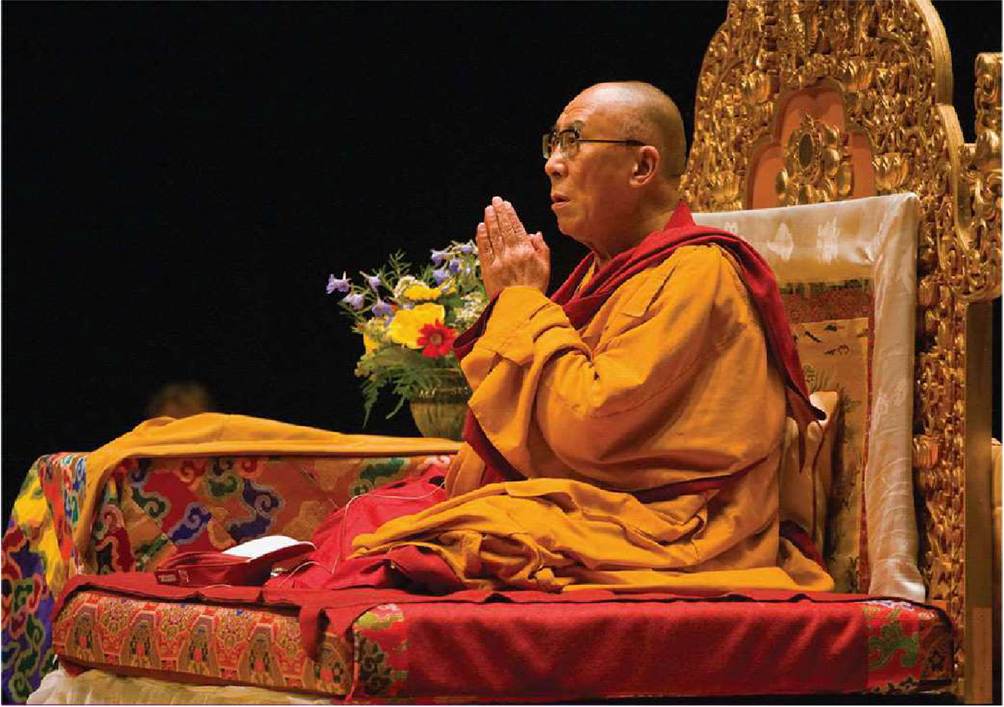
The Dalai Lama.
Tibetan Monasticism and Lamas
Monasticism is the most visible feature of Tibetan Buddhism. There are four major schools of Tibetan Buddhism, each with its own monasteries and monastic orders.
With room for hundreds of monks, Tibet’s greatest monasteries are immense and have massive walls that offer protection from extreme winter cold. Some seem to dominate peaks of the Himalayas and defy their most frightening cliffs. The lives of monks and nuns are focused on meditation, study, chanting of sutras, and participation in rituals. Although celibacy is common, it is not universal.Tibet’s spiritual leaders are lamas, the Tibetan equivalent of “gurus.” Although this title was once reserved for heads of monasteries and spiritual masters, in recent years it has been extended to monks and nuns whose achievements have earned them recognition as authoritative teachers. The most prestigious lamas are tulkus, individuals said to be reincarnations of earlier lamas and other figures. Of these, the best known is the Dalai Lama, the head of Tibetan Buddhism’s leading order of monks, the Yellow Hat sect, who is believed to be the incarnation of Avalokiteshvara, the bodhisattva of compassion. Traditionally, the Dalai Lamas have been temporal as well as spiritual leaders, but their authority as rulers of Tibet has been uncertain since 1959 when conflict with China forced the current Dalai Lama to flee his country. He now lives as a refugee in India, where he leads a government in exile.
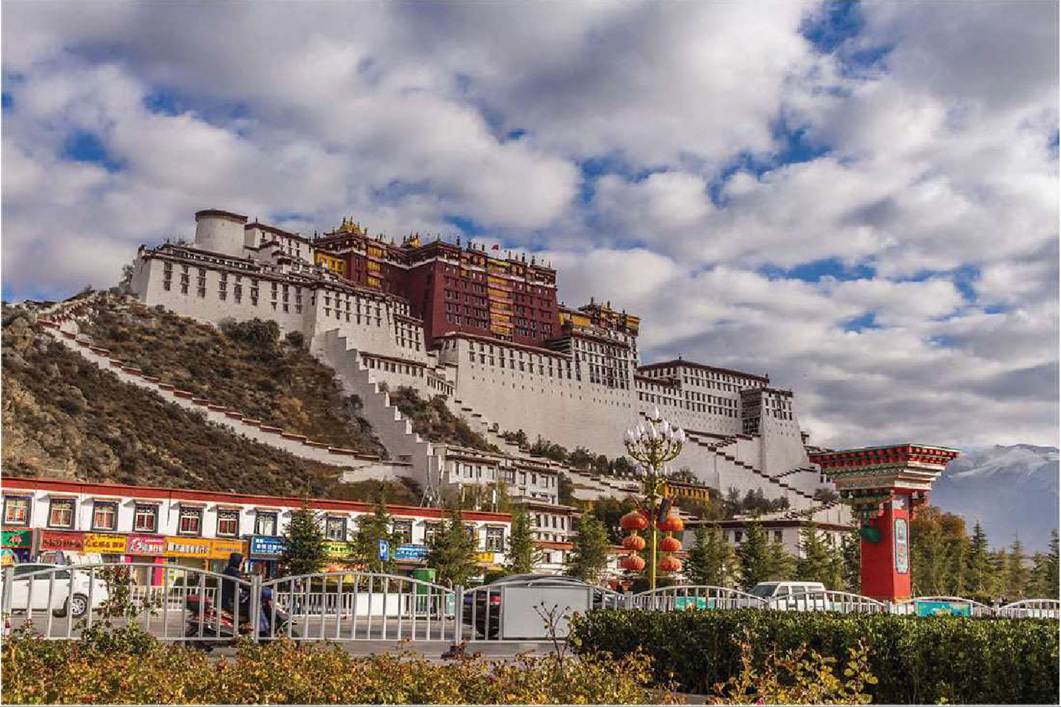
The Potala Palace in Lhasa, Tibet, was the winter home of the Dalai Lamas from 1649 until 1959.
Vajrayana Texts
The textual foundation of Vajrayana Buddhism consists of major Mahayana sutras and a large body of Buddhist Tantras. It is these Tantric texts that give Vajrayana its most distinctive features. Some Tantras offer highly detailed descriptions of buddhas and bodhisattvas, others focus on the roles of mantras and mandalas in the quest for enlightenment, and still others explain how alcohol, sex, and other things often associated with unwholesome desire actually offer opportunities to transcend it and find enlightenment.
In addition, Tibetan Buddhism honors hidden texts attributed to Padmasambhava, a legendary Tantric master who is said to have brought Vajrayana Buddhism from India to Tibet. According to tradition, Padmasambhava hid these texts away with the intention that each would be found at the proper time.
The “treasure finders* who discover them do so only when Padmasambhava’s “time-lock spells* unravel —always at a time when the world is ready for a new revelation.
Perhaps the most famous of Vajrayana texts is the Bardo Thodol, known in the West as the Tibetan Book of the Dead. Traditionally attributed to Padmasambhava, the Bardo Thodol is a guide to the experience of dying. It describes the intermediate state (bardo) between death and rebirth, the phenomena one experiences after death, and how these phenomena offer opportunities for a good rebirth or, ideally, the attainment of enlightenment and an end to the samsaric cycle of birth-death- rebirth.
What general tendencies do you see in the Theravada, Mahayana, and Vajrayana forms of Buddhism? Do you see similar tendencies in divisions within other religions?
Comparison of the Theravada, Mahayana, and Vajrayana Traditions
Scriptures
THERAVADA: The Pali Canon, or Tipitaka
MAHAYANA: Foundational Mahayana sutras include the Lotus Sutra and the Prajnaparamita Sutras (Perfection of Wisdom Sutras), which include the Heart Sutra and the Diamond Sutra. There is no single and exclusive Mahayana canon acknowledged by all Mahayana groups.
VAJRAYANA: In addition to foundational Mahayana sutras, there is a Tibetan canon that includes two collections of texts: the Kangyur (texts said to contain the Buddha’s own words) and the Tangyur (commentaries and other treatises). Vajrayana also makes extensive use of Tantric texts. There is no single and exclusive Vajrayana canon acknowledged by all Vajrayana groups.
Reality
THERAVADA: Reality is a system in which all things are in constant flux. All phenomena are interdependent and interrelated.
MAHAYANA: The Mahayana doctrine of emptiness states that phenomena are absolutely devoid of fixed identities and qualities.
VAJRAYANA: As a form of Mahayana Buddhism, Vajrayana makes the doctrine of emptiness a central feature of its understanding of reality.
The Buddha
THERAVADA: Acknowledges the historical Buddha, Siddhartha Gautama, as a man whose teachings have been of great benefit to others. The Buddha is a model to be emulated and venerated.
MAHAYANA: According to the trikaya doctrine, the Buddha exists as dharmakaya and manifests for the sake of others as samboghakaya and nirmanakaya. The Buddha, in all forms of the trikaya, is to be worshiped.
VAJRAYANA: As a form of Mahayana Buddhism, Vajrayana makes the trikaya doctrine the basis of its understanding of the Buddha. As in Mahayana Buddhism, the Buddha is to be worshiped.
Bodhisattvas
THERAVADA: The Buddha in his previous lives is considered a bodhisattva, as is Maitreya, a buddha who is still to come.
MAHAYANA: Bodhisattvas are those who take a “bodhisattva vow” to attain enlightenment for the sake of others. Advanced bodhisattvas make use of their vast stores of accumulated merit to help those who call upon them, often in miraculous ways.
VAJRAYANA: As a form of Mahayana Buddhism, Vajryana Buddhism shares the beliefs described above.
Ultimate Goal
THERAVADA: The attainment of enlightenment and nirvana solely through one’s own effort.
MAHAYANA: The attainment of enlightenment for all beings. In accordance with the bodhisattva ideal, which emphasizes compassion for others, their attainment of nirvana should precede one’s own. Reliance on the compassion of others is emphasized.
VAJRAYANA: Vajrayana beliefs are essentially the same as those of Mahayana.
Practices
THERAVADA: Taking the Three Refuges, making offerings on altars to honor the Buddha, meditation, chanting sutras, observing holidays, participating in rituals that mark important life events, and making pilgrimages.
MAHAYANA: In addition to Theravada practices: chanting mantras and the name of the Buddha; honoring buddhas and bodhisattvas in devotional practices; taking the bodhisattva vow; and, with the exception of Zen, proclaiming faith in and seeking the saving power of the Buddha and the bodhisattvas.
VAJRAYANA: In addition to Theravada and Mahayana practices: deity yoga, guru yoga, and other Tantric practices; contemplation of mandalas; turning of prayer wheels.
More on the topic Vajrayana Buddhism: Tantric Buddhism in the Mahayana Tradition:
- Buddhism in India
- Buddhism and the Environment
- Buddhism, Concord, and Conflict
- Buddhism in America
- Buddhism as a Way of Life
- Buddhism, Gender, and Inclusion
- Developments in Buddhism
- Mahayana Buddhism and Buddhist Philosophy
- Buddhism Beyond India
- Buddhism and the context of humility