The Iseum Campense as a Memory Site
Martin Bommas
Isis owns a cultural biography. Deeply rooted in Egyptian myth, she became the most successfully syncretized goddess of the eastern and western Mediterranean after her transformation in Hellenistic times, long before she was patronized by the Flavian dynasty.
Over a period of 686 years from the founding of the first temple for Egyptian gods in Piraeus until the persecution of pagan cults in ad 354, the cult of Isis was the most widespread religious cult practised in the then known world: cult centres reached from the modern Republic of Sudan to Germany and from the Indian subcontinent to Great Britain. Isis was never a local deity but already during her time as an Egyptian goddess, through her role in the myth of Osiris, she became a prominent part of civic religion. Outside Egypt, she was incorporated in the religious agenda of numerous cities in the Greek and Roman world. As such, Isis and with her Serapis, Harpokrates and Anubis were celebrated in communal festivals held in spring and autumn in all provinces of the Roman Empire.First, this article aims at identifying various strategies through which Isis was introduced to the religious map of ancient Rome after the Battle of Actium. Second, it will address the patterns that helped to transform Isis into a communal goddess. Third, this contribution tries to answer the question of how fictitious memories of Egypt were set in place to back up Isis' cultic role and more importantly help her transform from a bogey to a placatory image. This development by no means represents an isolated case: at the beginning of Augustus's reign, imagery of a new religious programme emerged that soon caught the imagination of the well-off whose behaviour inspired imitation.1 Unable to approach ancient Egyptian theology through primary sources written in hieroglyphs and the hieratic script unknown to them, the Romans struck a new course.
By allowing images to gain importance over written sources, Egypt's physical past became key for furnishing recollection of a distant land which most of them only knew from hearsay. Objects linked with the worship of Isis witnessed in processions or inside temples for Egyptian gods stimulated remembering in a way that Marcel Proust (1871-1922) described as ‘involuntary'.2 And last, record objects which stored information beyond individual experience were analogues to living memory. As such they played a crucial role in what can be described as cultural memory.Interpretatio Romana
By the time of Augustus, the exotic touch of Egypt had caught the imagination of Roman citizens on a large scale. In order to fulfil the demand of Romans wanting to experience real Egypt, initially genuine aegyptiaca were transported from Egypt to Rome to underline Rome's newly gained splendour.3 To fuel this growing market and in order to satisfy the increasing interest in all things Egyptian,4 neoaegyptiaca were soon produced by Italian workshops. This materialistic approach, however, should not detract from the genuine and productive altercation with the few leftovers from ancient Egyptian religion. It would be wrong to label the Greek and Roman interpretations of Egyptian religion as misleading or thin substrates of original thinking and downplay the Greek and Roman effort to translate ancient Egyptian religious practice into concepts digestible for Roman citizens. In fact, a highly intellectual discourse took place within higher levels of society where limited knowledge or even the complete lack of Egyptian was compensated for by contemporary thoughts on Greek philosophy and religion. Obviously, the upper class preferred a happy- go-lucky approach to theological debates and were more interested in joy (Dionysos) and an everlasting easy life rather than grief and sorrow (Osiris). Customized religious beliefs are clearly apparent in a birthday poem that Tibullus dedicated to his patron M.
Valerius Messalla Corvinus, celebrating his several military and administrative successes.5 Probably because Messalla had visited Egypt himself,6 the poem contains a kletic hymn to Osiris which describes him as a benefactor to mankind, the inventor of wine and someone who is able to disperse solicitudes:Not sorrow or dull care, but song and dance, Osiris,
and fickle love suit you,
and flowers of every colour, brows with ivy-berries bound,
robes of saffron flowing down to tender feet,
Tyrian fabrics, dulcet melodies upon the pipe,
And the wicker casket for your holy mysteries. (Tibullus 1.7.21-8)7
The Spread of Isis in the Mediterranean
Ancient Egyptian religion is an ethnic religion which by definition cannot be exported and does not follow the aim of proselytization. The Egyptian cults as reinvented by the ancient Greeks, on the other hand, follow the model of universal religions which can be transferred regardless of the issues of time and space,8 such as Christianity or Islam. After Augustus, Egyptian cults as performed in Rome were - from the ritualistic point of view - a far cry from their Egyptian origin. This transformation did not come suddenly, but was rather the result of a constant and smooth development over two preceding centuries.
Isis, Serapis, Harpokrates and Anubis had enjoyed independent cults on the island of Delos since the last quarter of the third century bc, when Egyptian cults conquered Italy via the harbour cities of Puteoli and later Misene and Ostia.9 This development started after the Third Macedonian War (171-168 bc) after Rhodes lost its importance as a Roman free port in the Aegean in favour of Delos. Until the Battle of Actium, traditional Egyptian cults, when transferred to the Aegean, were transformed by what is known as interpretatio graeca. However, this model was not found suitable when these cults were introduced to Italy by merchants and sailors based at Delos.10 As fully laid out in the sanctuary for Egyptian gods at Pompeii - re-established after an earthquake had destroyed a previous temple of Isis 31 years before the Battle of Actium -a new and additional interpretation had to be introduced, exclusively defined by Roman taste and the wish to indulge in the exotic.
Egyptian cults in Italy
Only a few contemporary and oriental cultures have influenced Roman public and even private life as inclusively as did the Egyptian way of life after the Battle of Actium, so central to Augustus’s self-presentation. Augustus’s personal rejection of the display of Egyptian art and culture must not detract from the fact that the emperor was not only surrounded by Egyptianizing art in his private home11 but also indirectly promoted Egyptian cults. Encouraging the worship of the Egyptian gods outside the pomerium in 28 bc, Augustus not only set them apart from Roman cults but also marked Egyptian cults as non-Roman.
As the example of Pompeii shows, the intrusion of Isis was hardly a by-product of Roman-Egyptian ties resulting from the events after 31 bc. A most probably official sanctuary for Isis is attested already in c. 100 bc on the Capitol Hill,12 and in c. 80 bc Quintus Caecilius Metellus Pius erected a private sanctuary for Isis within Regio tertia in order to celebrate his father’s victory over Jughurtha.13 The founding of a new Iseum at the Campus Martius between 20 and 10 bc14 especially gave way to a largely accessible new sanctuary for Isis which - while being officially discredited between 28 and 21 bc15 and perhaps even later - had to close down under Tiberius after a series of misconducts in relation to priestly duties came to light in ad 19. Before this event, Egyptian cults were publicly recognized, although at the same time they faced senatorial restrictions.16 This does not mean, though, that they were openly accepted, especially not by traditionalists, such as Cicero. In De natura Deorum 3.47 he sarcastically says:
Then, if the traditional gods whom we worship are really divine, what reason can you give why we should not include Isis and Osiris in the same category? And if we do so, why should we repudiate the gods of the barbarians? We shall therefore have to admit to the list oxen and horses, ibises, hawks, asps, crocodiles, fishes, dogs, wolves, cats and many beasts beside.17
Nothing is known about a re-erection or rededication of this sanctuary during the following 50 years.18 However, according to Josephus, Titus and Vespasian are said to have spent the night there in ad 71, before the triumph over Judaea (Josephus, Bell.
Iud. 7.123-4). Once severely controlled and even reduced during the Republican era,19 Egyptian gods were now integrated into a new system which, nevertheless, was not completely free from restrictions.20Why Isis?
Less is known about the Roman cult of Serapis at this early stage and before the reign of Hadrian.21 It is Isis, the long-serving Egyptian goddess, who was first absorbed into the pattern of municipal religious life.22 Two main reasons can be made out which supported the thriving new cult and helped to transform Isis into a public deity: fascination and social integration. While the first of these two aspects - often leading to what is nowadays referred to as Egyptomania23 - was frequently addressed,24 social integration is a less observable component of the cult of Isis within the surviving sources. Like anywhere else, the secrecy and initiation which are focal ingredients of mystery religions as a whole25 soon led to a sworn-in community of followers of Isis in Rome. As persons initiated into the same mystic rituals, these symmystai were bonded by shared knowledge rather than co-dependence. Plato in his letters describes the merits of social ties among initiates as resulting ultimately in friendship,
... not acquired through philosophy but by the sort of chance acquaintance which forms the basis of most friendships, and which is exercised in mutual hospitality and participation in the rites and ceremonies of the mysteries. (Plato, Letters, 7.333e).26
Ancient community life depended on those social bonds which can be seen as an instrument to create identity and to amplify personal influence and power. Obviously, none of these two main aspects of Isis's biography have anything to do with religion. In Egypt, Isis was surrounded by absolute secrecy adhered to by her priesthood which is why outsiders were successfully restricted from accessing theological knowledge.
In Greece and Rome, however, the secrets of the mysteries of Isis were generally more accessible as outsiders knew about the existence of secrets but lacked any detailed knowledge. The most obvious focus for this relative secrecy27 was on Isea where Isis was not only worshipped by her followers but also played an important role in community life during festivals and other events of ceremonial character.The Iseum Campense
From the Gulf of Naples, the Egyptian gods reached Rome by way of Campania. Apuleius in his second-century ad novel Metamorphoses (11.30) refers to a collegium ofpastophori having been in existence from as early as the time of Sulla;28 however, no epigraphic evidence supports this view.29 Once the cult of Isis was extradited from the pomerium, altars dedicated to the goddess below the Capitoline Hill formed the hotbed for the introduction of initially minor cult centres such as the Iseum at the forum boarium which grew fast and still existed and was even renewed under Claudius.30 Excavations led to the discovery of a number of Egyptian res sacrae,31 including a marble head of Serapis,32 which support the view of a publicly accessible Egyptian cult at this highly frequented place for trading cattle.33 Together with the Iseum in Regio tertia, this is the only sanctuary for Egyptian gods known to have existed before the building of the Iseum at Campus Martius, the building history34 of which can be summarized as a three-step development:
1. After the expulsion of Egyptian cults from inside the pomerium, the first sanctuary established in Regio IX in the name of Egyptian gods represented an island of self-indulgent religious extravaganza rather than showing any similarity to the sacella and luci scattered around the city. Since the second century bc, public buildings and temples - first built of local stone, later of marble - had been squeezed together at this once open field which appeared to bear the hallmarks more of the nobles' search for fame than of religious devotion,35 although the Pantheon from the time of Augustus and founded in the Iseum's vicinity calls upon religious traditions and the idea of pietas3 Nothing is known about this sanctuary's design or structure and a certain amount of ink has been spilt over its date. Scholars generally agree on a date after 20 bc but before 10 bc,37 more or less coinciding with the building of the Cestius Pyramid38 and Tibullus 1.7. As noted already, this sanctuary was closed down under Tiberius in ad 19.
2. The second Iseum Campense must have been operational in ad 71, when Titus and Vespasian spent the night there (see above). According to a coin dating to the reign of Vespasian,39 this Iseum was designed as a podium temple showing the Hellenized Isis holding a patera and situla. This second Iseum fell victim to the fire of ad 80.40
3. The third temple for Isis at the Campus Martius was in use by ad 85/86, after it was restored by Domitian. It became the main Iseum for Rome and the empire until the post-Severan era, when the temple started to fall into decay. It was dismantled by local builders during the fourth century ad. According to the forma urbis Romae (FUR), the Severan marble plan, the ‘Serapaeum’,41 was located in the centre of the northern main part of the Campus Martius, strictly oriented to the north and alongside the street porticus meleagri (today Via del Gesù).42 The area between the later Iseum and the Pantheon was once occupied by the saepta Iulia, the Roman polling station that was changed into a mere monumental square in Augustan times. According to Martial, this place was used as a market for books and crafts, among other goods.43 Today, this area is occupied by the church of St Maria Sopra Minerva north of the crossroad of Via Piè di Marmo and Via del Gesù. In ancient times, from here, a gate erected under Hadrian led to the entrance to the sanctuary for the Egyptian gods. Where this entrance once was, the forma urbis locates a row of dots, which - according to Coarelli - can hardly be taken as columns,44 as their spans were much too irregular. It was recently argued that obelisks were placed there, most probably those that have a height of six metres, some of which were later reused by Pope Sixtus V to create his new vision of Rome. Six of these obelisks have survived, one of which was decorated by Ramesses II and now marks the centre of Piazza della Rotonda in front of the Pantheon (Fig 1). 45 Another object that is nearly in situ today is a colossal marble foot (Fig. 2) - probably a monumental votive offering and intentionally made as a body part46 - from which the Via Piè di Marmo took its name.
Visitors and the Exterior View
The Iseum Campense was the second largest sanctuary for Egyptian gods in Rome, outclassed in size and splendour only by the Serapeum on the Quirinal.47 However, in cultic terms the Iseum Campense served as the main
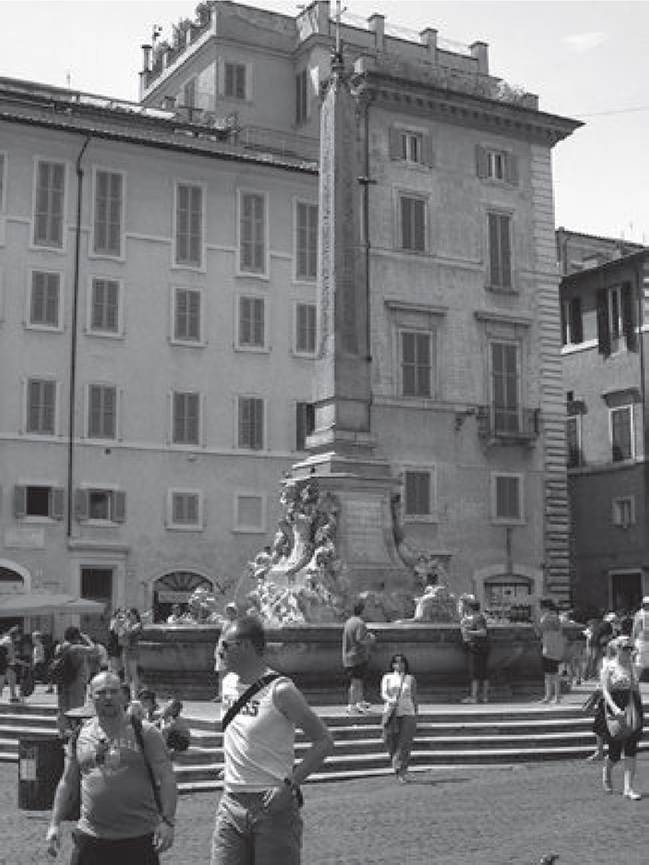
Fig. 1. Obelisk of the Piazza della Rotonda. Originally dedicated to the temple of Ra at Heliopolis by Ramesses II, this obelisk together with a second obelisk from the same location (today at the Villa Celimontana) once stood in the Iseum Campense probably after its renovation after AD 85/86 (photograph: author).
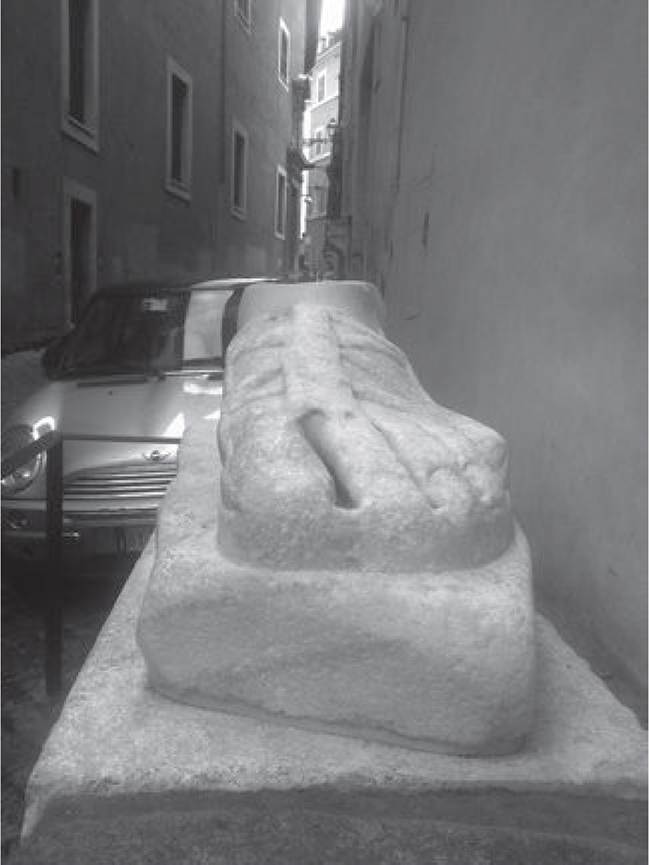
Fig. 2. Monumental votive offering of a marble foot, from the Iseum Campense, after its restoration in 2011 (photograph: author).
point of reference in the entire Imperium Romanum. In his Metamorphoses, Apuleius describes his travel to Rome as follows (Met. 11.26):
However, after a few days, at the prompting of the mighty goddess, I hurriedly packed and took ship to Rome... I arrived safely at Ostia; from there I took a fast carriage and reached the holy city on the evening of the twelfth of December. My urgent desire was then to offer my prayers daily to the supreme power of Queen Isis, to her who from the site of her temple is called Isis of the Fields and is the subject of special veneration and adoration. I was from then on a constant worshipper, a newcomer it is true to this shrine but no stranger to the faith.48
Also, native Roman authors have repeatedly commented on this temple. In his Satires (6.526-8), Juvenal gives a description of bigots he observed visiting the temple, such as a Roman lady:
If the white Io commands it, she’ll go to the ends of Egypt and fetch from the Nile at tropic Meroe the sought-for water with which to sprinkle Isis’s temple
49
Not only pious followers but also lovers seeking out a romantic place and sad dogs with nowhere to go were visitors to the Iseum Campense. Ovid recommends:
Avoid not the Memphian shrine of the linen-clothed heifer:50 many a maid does she make what she was herself to Jove. (Ovid, Ars Amatoria, 1.77-80)51
Martial, referring to the initial phase of the third Iseum Campense in c. ad 85/86, describes the temple as being part of the lively part of the Campus Martius. Here, the saepta Iulia was located as a fashionable shopping district, ‘the enclosure’, where Selius heads for a would-be diner, perhaps expecting to snatch some bites when the temple closes:52
Selius leaves nothing untried, nothing unventured, whenever he sees that he has to dine at home... If Europa does nothing, he heads for the Enclosure (saepta) to see whether the son of Phillyra and the son of Aeson will furnish anything. Disappointed here too, he goes and hangs around the goddess of Memphis’ temple and seats himself beside your chairs, sorrowful heifer.53
Surrounded by a high temenos wall which probably showed little decoration (if any), the Iseum Campense must have made an impressive sight due to
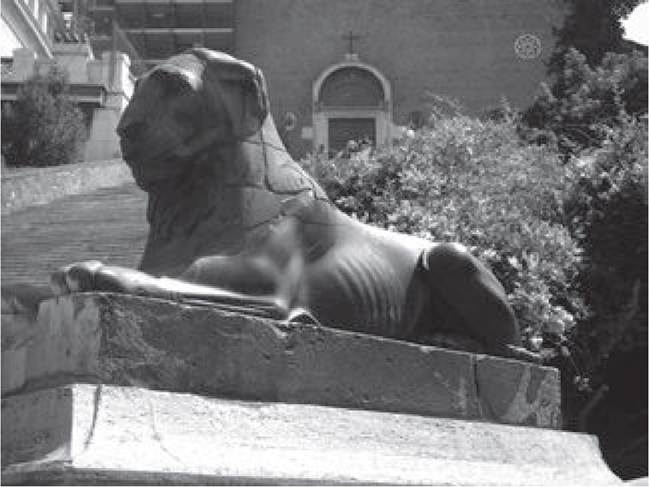
Fig. 3. Recumbent lion made of black granite dating to the early Ptolemaic Period, today at the foot of the cordonata, Capitol Hill (photograph: author).
its monolithic outer appearance. Whether passers-by were able to catch a glimpse of the dramas, most probably flanked by obelisks and recumbent lions (Fig. 3), both leading to the main sanctuary,54 is difficult to say.
Inside the Iseum Campense
Less is known of the interior of the Iseum Campense. To achieve a clearer picture of the layout of this sanctuary, the above mentioned depiction of the FUR55 is of little help due to its fragmented state. Nevertheless, the marble plan was used to produce a reconstruction of the ground plan in 1893 by Rodolfo Lanciani56 which has kicked-off a number of alternative reconstructions in recent years (Fig. 4). In addition, intensive excavations in the area have revealed a high number of objects that can be linked with the temple and its cult. According to these objects, it becomes evident that the Iseum was a multi-purpose building that fulfilled
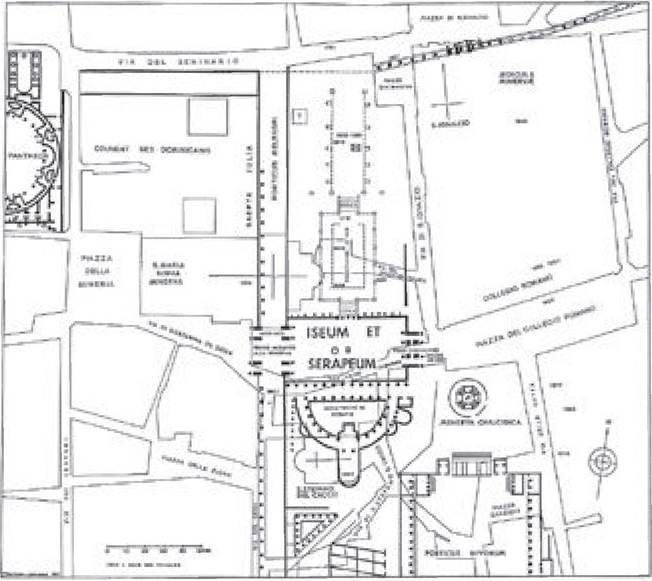
Fig. 4. Reconstruction of the Iseum Campense (after Lollio Barberi, Parola and Totti 1995: 60, Pl. 26).
many functions rather than being limited exclusively to being a place for worship.
One of the Iseum's additional functions was to accommodate worshippers of Isis and initiates57 from all over the known world. Incubation rooms but also let accommodation are features of nearly all decent sized temples for Egyptian gods from the beginning of Isis's arrival in Greece and during the Roman Empire.58 Given the size of the Iseum Campense and more importantly based on the remarks of Apuleius mentioned above, there can be no doubt that initiates- to-be and possibly also devotees awaiting initiation lived within the temple precinct. As will be shown below, not only the architecture but also the contents of the temple largely contributed to the successful recreation and display of an Egyptian aura, obviously in order to support the visitors' desire to submerge themselves in a recreated Egypt, experiencing travel in time and space.
How ancient collections were used as crowd pullers in ancient times
The place for this attraction was well chosen within a marketplace where people came to congregate. According to Vitruvius, temples for Isis were preferably established in business centres: Th To Mercury, however, in the forum, or also, as to Isis and Serapis in the business quarter'(Vitruvius 1.7.1).59 It is difficult to think of a more delightful way to attract businessmen, city slickers and future worshippers of Isis than to promise them a time-out in a peaceful environment. Literary evidence suggests that even modest places were frequently visited, such as the incipit of Apuleius's Florida:
It is the custom of religious travellers, whenever they come across a sacred grove or holy place along their way, to make a vow, offer fruit, and sit for a while. (Apuleius, Florida, 1.1).60
Apuleius's remarks on what religious people do in holy places can probably be equalled with praying, making offerings, but most importantly relaxation. Juvenal's remarks about the water offering lady mentioned above support this view. Whether the Roman citizens and followers of Isis from all over the world really wanted to ‘sit for a while' inside the Iseum Campense and contemplate is a question impossible to answer with accuracy, although authors like Juvenal, Ovid and Martial all seem point into this direction. What one can be sure of, however, is that what they saw and experienced was certainly worth the visit.
The nymphaeum
The southern part of the Iseum Campense from which the temple was best entered was occupied by a hemispherical exedra as shown on the FUR,61 surrounded by a roofed porticus. It included an open space that can be identified as a water basin,62 supported by five water figures excavated at the site. Waves depicted on their bases support the view that these figures supposedly stood in the water.63 Cult chambers as identified in the ground plan of the apsis are most likely to be connected with Isis, Serapis and Harpokrates or/and Anubis, the worship of whom is well attested in this temple. Altars found in this area underneath the church of St Stefano del Cacco further confirm that this exedra was a sacred building.
North of the exedra an open court of 68 by 27 metres was laid out, the southern part of which is also recorded on the FUR. This court was accessible through the porticus Meleagri opposite the saepta Iulia in the west, including the Giano accanto alla Minerva. The Arco di Camilliano in the east, celebrating the triumph over Judaea in ad 70, served as the main entrance into the sanctuary.
The main building
The northern part of the temple was the main building, accessible via the open court where the main entrance was located. At the southern end of this entrance, the fragment of the FUR shows several dots which have been interpreted by scholars as obelisks64 and papyrus columns.65 No other details about the layout of the main temple can be deduced from the Severan marble plan. Any further reconstruction of the remaining main part of the temple therefore has to exclusively rest on the finds made in the surrounding area and comparison with other Isea.
Ancient passers-by traversing the open court would have been able to see the monumental exedra including the nymphaeum on the south side, with the main temple opposite. Both sacred buildings were easily identifiable by statuary within the nymphaeum and possibly a number of inscriptions identifying the northern part as the main sanctuary. In referring to the restoration in Severan times, one of these inscriptions seems either to allude to the nymphaeum or more plausibly to the main temple.66 By favouring such an open layout, the Iseum Campense was not intended to be a secluded temple but served as a short cut for businessmen, local inhabitants and shoppers who used the open court as a street that connected the saepta Iulia with the area east of the modern street Via di S. Ignazio.67 What lay north of this street must have consisted of at least four separate sections: an ancient visitor would have observed an open court, let accommodation possibly flanking this court, a dromos and the main sanctuary - possibly on a podium (Fig. 4).68
The garden inside the Iseum Campense
Even with its main gates closed, the Iseum Campense must have made an impressive sight just because it was so massive.69 It can be argued that this nymphaeum as well as other immobile structures opposite the main building, such as altars and the like, marked this area unmistakably as a place of worship of Egyptian gods. It must be stated, however, that Egyptian cults were already widely accepted in the Roman Empire and a familiar sight when the third Iseum Campense was established. Since the temple's architecture followed the Hellenized Roman design and not Egyptian temples,70 the sanctuary's undecorated outer walls would not have set the identification of the temple at risk, even if the gates of the main temple were closed. According to Martial, these gates remained open during the day until 8.00 p.m.,71 which leads to the question of what passers-by and visitors were actually able to see.
The drilled dots visible on the Roman marble plan are not located in front of the temple but on the inside of its surrounding wall. Given their height of only six metres, it seems very unlikely that any passer-by would have seen the obelisks mentioned above in their full glory, had they indeed been hidden away behind the temple facade. Also, no parallel exists for this unusual practice. On a second thought, however, these irregular drilled dots might not refer to architectural elements at all, but to potted plants. These would not only have helped to transform an open court into a voluptuous garden, but also helped to partly cover the outer brick walls that otherwise would have distracted from experiencing nature, an essential aspect of the mysteries of Isis.
Plant pots, usually halved amphorae, are well attested to in Roman sacred gardens and helped the landscaping of gardens featuring large monuments,72 such as the temple of Elagabalus in Rome. Excavations have revealed its foundation walls and a pavement that was interrupted by rectangular planting beds made of halved amphorae.73
Drilled dots are also attested for the temple of Adonis as displayed on the FUR, also interpreted as perhaps trees or shrubs.74 Although, like the Iseum Campense, the temple of Adonis has not been excavated, the similar treatment on both ground plans makes the interpretation of planting inside the open court of the temple of Isis very likely. Gardens within Isea, their role and functions, have never been discussed in detail75 and this article does not aim to do so for lack of space. The resulting picture, impressionistic as it is now, should demonstrate that gardens were major components of religious landscapes in temples for Isis in Rome, as supported by frescoes of the fourth style found in Herculaneum.76 I do suggest that the gardens of the Iseum Campense were well-known attractions in Rome, and the temple - or at least parts of it - were accessible even to those who were not devotees of Isis, as outlined in the above mentioned passage of Apuleius, but who for a short while came to take a rest. If the evidence from Herculaneum can be transferred, it seems at least likely that gardens within temples for Isis were equipped with exotic plants such as palm trees and shrubs from Africa that probably were imported to Rome on a large scale.77 In addition, the sacred landscape was inhabited by statues of recumbent lions or sphinxes, adding to the Egyptian ‘feel’ of the gardens in the eyes of those who were not initiated into the mysteries of Isis
Live Animals in Roman Isea
Those who decorated the interiors of temples for Isis in Rome did not limit themselves to statues of recumbent lions and other animals. There is ample evidence that living animals also had a role to play in the cult for Egyptian gods.
Crocodiles
One of the outstanding objects that support this view is a column found in situ on which various priestly activities are depicted. Since those columns were found in the area where the exedra was located, their place of discovery should be identical with their original location. While those columns that depict largely stereotypical scenes of priestly processions are made of granite, one sandstone column stands out for its rather unusual decoration:78 a priest, wearing an Egyptian kilt, bends down in order to feed two hungry croco- diles,79 who are ready to jump out of the water. But how likely is it that live crocodiles were kept in Roman temples and what function - if any - did they have? At first glance, it seems difficult to maintain a basin for live crocodiles inside a sacred building. On the other hand, it certainly makes sense not to hide such a pond from casual visitors stiff-legged with curiosity and to create an exclusive attraction within the ancient city of Rome. In fact, crocodiles are cold-blooded animals which are dependent on high temperature and sunlight in order to function properly. Since the latter was not available throughout the day due to its location in the north of the exedra,80 these crocodiles were probably slow-moving beasts whose limited actions were quite foreseeable. The Red Hall in Pergamum, built during the reign of Hadrian, also contains two deep outside basins and a large pond in front of the altar which were either used for miniature naval battles81 or keeping crocodiles, or both. The so-called Canopus at the Villa Adriana, today mostly deprived of its luxurious inter-columnar decoration, still has a statue of a crocodile in place. It is probably fair to say that tamed crocodiles, of which Herodotus speaks in his Histories (2.69), made up part of the equipment of temples for Egyptian gods of a certain size. Together with hippopotami, crocodiles were widely regarded as animals emblematic of Egypt, as the Nile mosaic from Preneste, created by Italian workshops under Alexandrian influence, shows.82 The numerous so-called Campana reliefs that were produced in Rome and used as decorative art in architecture depict crocodiles within romantic Egyptian landscapes.83
Ibises and mammals
Among the other animals that were more usually kept within sanctuaries for Egyptian gods as part of their furnishing were free moving ibises, exotic birds which added to the flavour of recreated African wildlife.84 Even smaller sanctuaries could easily care and provide necessary maintenance for these rather undemanding birds.85 Probably often regarded as gems,86 these birds also represented the Egyptian god Thoth (Hermes) and stood for priestly knowledge and wisdom. The baboon, another beastly equivalent of Thoth, is also commonly found within temples of Egyptian gods, such as in the depiction of a funerary rite on the panel of a stone coffin from Ariccia nearby Rome.87 In the upper register, an architectural prospectus is laid out which contains seven spans, two of which are inhabited by baboons sitting on pedestals. Whether or not living baboons were kept within the holy precincts is difficult to assess. Two statues of baboons made of black granite were found in the area of the former Iseum Campense.88
Returning to the passage from Cicero, De natura deorum, in which he compared the cult of Isis and Osiris to the worship of various beasts, it now becomes evident that Cicero probably based this on his own experience which led him to observe oxen and horses, ibises, hawks, asps, crocodiles, fishes, dogs, wolves (jackals?) and cats in Egyptian contexts. Apart from horses, all these animals are attested as inhabitants of the Iseum Campense, whether as live animals or in the form of statues. If Cicero indeed referred to his own personal experience where else had he been able to observe crocodiles or crocodile-gods, if not in temples for Egyptian gods? If this is true, and also given the fact that Cicero wrote De natura deorum two years before his death in 43 bc,89 he was unable to witness personally the new Iseum Campense established between 20 and 10 bc. Although Egyptian motifs made their way to the imperial villas where they were included in paintings of the second and third Pompeiian style immediately after the Battle of Actium, it is equally unlikely that Cicero referred to animals he observed on paintings. Most probably, he witnessed live animals in one of the Isea in Rome, for instance at the forum boarium or in the private sanctuary for Isis within Regio tertia. If this assumption is correct, the presence of live animals within Roman Isea was more widespread than one would guess from the evidence from Herculaneum and the Iseum Campense.
Collections of Egyptian Art in Ancient Rome
Apart from zoological gardens functioning as ‘living museums’, what other spectacular exhibitions would have attracted the inhabitants of Rome? Starting with the two statues of baboons already mentioned, it should be noted that their authentic inscriptions mention the temple of Thoth erected by Nectanebos I at Hermopolis Parva as their place of origin. As a consequence, this means that they derive from Egypt, and were actually antiquities by the time they arrived in Rome.90 A block from a wall of the temple of Behbet el-Hagar, obelisks, several sphinxes from the New Kingdom and later, a statue of a striking Horus, statues of naophoroi, so-called Horus-cippi and several fragments of monumental statues were all unearthed in the area of the Iseum Campense.91 Obviously shipped to Rome on a large scale, original ancient Egyptian artefacts displayed in the centres of cities of the Imperium Romanum must have been a common sight. Earlier scholars have satisfied themselves by producing more or less complete catalogues of the finds but showed little to no interest in contextualizing this highly remarkable feature. Karl Parlasca dismissed them as ‘having certainly no particular function in the cult',92 and he is probably right to some extent: revisiting the original meaning of aegyptiaca was not necessarily a priority, due to their obvious decontextu- alization. On the other hand, the high number of authentic objects can hardly be rationalized away. Because the Romans spared no costs to import these bulky and heavy objects,93 they must have had a function - and if not cultic, what else? Unfortunately, this question was never really addressed94 and this contribution, limited as it is, can only dig some trenches rather than offering clear-cut solutions.
Traces of a physical past
A total of 30 objects found in the area of the Iseum Campense are known to have been imported to Rome.95 This number of objects is high enough to exclude a fortunate coincidence. It seems obvious that these objects were exported from Egypt on purpose, in order to play a new and significant role in a new context. Quite obviously, their new role is not linked with ancient Egyptian religious belief or cult practice. Other aegyptiaca, for instance those that were excavated in the former horti Sallustiana, did not serve the same purpose and were instead displayed by their rich new owners as garden accessories.
What is important to stress is that none of these genuine Egyptian objects seem to have served an identifiable purpose at first sight, but on a second look it becomes evident that a number of them were willingly chosen from the same location: two baboons96 and two recumbent lions97 derive from the temple of Thoth at Hermopolis Parva, while a pair of obelisks from the temple of Ra at Heliopolis98 was also transported to the Iseum Campense unseparated. The fact that several Egyptian sites were deliberately exploited to furnish the Iseum at Rome with pairs of objects makes clear that the views of recent scholars who dismissed the Roman interest in aegyptiaca as ‘illogical’99 are unjustified.
Due to the limitation of space, this contribution does not aim at fully investigating the function of aegyptiaca other than the role they played in the eyes of those who occasionally passed by or visited sanctuaries for Egyptian gods. In addition, those who were initiated into the mysteries of Isis certainly had well-defined expectations of the interaction between ancient Egyptian artefacts and religious landscape. Everyone else marvelled at the splendour that was Egypt and indulged in the exotic feel of Egypt. Faint memories of Egypt certainly played an important role even for those who knew about the mysterious land only from hearsay.
The remaking of Egypt’s past in ancient Rome
In order to define the vital role memory played when Rome encountered Egypt in its very own streets, one has first to address the question of how temple collections were brought together and how they were maintained. Unfortunately, the number of similar institutions the collection of the Iseum Campense can be compared with is limited. As things currently stand, only the ancient Greek site of Delphi, where 20 treasuries where built during sixth century bc and occasionally displayed their objects, can possibly been seen as a forerunner.100 The most important museion of the ancient world was certainly the one in Alexandria but this is also the most unlikely candidate to match the Iseum Campense.101
In accordance with modern museum concepts, four key functions102 have to be identified and taken into consideration, if the collection of aegyptiaca in the Iseum Campense is to be labelled as a museum:
1. Collecting and defining criteria for a collection; that is, how ancient Egyptian objects were chosen in Egypt and transported to Rome.
2. Maintaining and displaying the objects; that is, how ancient Egyptian artefacts were made accessible within their new context.
3. Researching and communicating to a public; that is, how the temple personnel tried to choose appropriate objects to - perhaps - reinvoke the ambiance of a genuine Egyptian temple and explained this concept to an audience.
4. Reconstructing culture: how Roman priests of Isis tried to evoke an Egyptian aura.
All these tasks of modern museums can also be identified for the collection of aegyptiaca of the Iseum Campense. This, however, does not allow us to unreservedly suggest that the Roman collections of ancient Egyptian art kept in temples for Egyptian gods can be described as a museum in the modern sense. Whether museums of Egyptian art in ancient Rome can be regarded as the first museums ever built is difficult to ascertain due to the lack of evidence from similar places.
As has been stated before, in addition to these four bullet points, the collections of aegyptiaca in Rome were often embedded in identifying contexts where they served a religious purpose. Only those parts of the Iseum Campense that were open to the public qualify as museums. What seems to be important, though, is to understand whether cult officials in the temple designed this museum purposefully rather than serving the sensation-seeking public with a place of entertainment103 as seems to be the case with regard to the testimonies of the ancient authors cited above.
The Iseum Campense as a Museum
Besides the building’s prime function as a sanctuary for the Egyptian gods, the Iseum Campense was presented as a place where memorabilia, statues and reliefs taken from Egypt were displayed alongside exotic and non-indigenous animals. Like no other place in Rome, the Iseum Campense epitomized Egyptian decor, exotic customs and the abundance of the Nile valley.104 Frescoes from Herculaneum105 point to the fact that Egyptian cults in Italy were indeed set up within an exotic environment consisting of palm trees, ibises and Nubian celebrants. If the recreations of Egypt in Rome, Italy and the Imperium Romanum as a whole were not randomly chosen as a medium to create an exotic feel but can be seen as a common feature of every sanctuary for Isis, the question is who orchestrated the strategy to create impact by using pharaonica as crowd pullers?
Unfortunately, evidence for the early years of Imperial Rome is lacking, but during the second century ad, when the cult of Isis became increasingly popular, a larger number of people actively practised it. In Apuleius’s description of an Isis procession, a hierogrammateus (keeper of the holy books), an unspecified priestess of Isis (sacerdos), a horoscopus (astronomer), paianistes (singers), stolistai who dressed the divine image and pausarii, presumably responsible for ritual stops during the processions of Isis, are mentioned.106 Most probably, followers of Isis with similar functions were involved in preceding periods, too. Both the earliest Isea in Rome, the Iseum on the Capitol Hill and the one at the forum boarium, were very lavishly furnished with genuine aegyptiaca.107 It seems at least likely that all nine temples for Egyptian gods in Rome and others throughout Italy - such as the one in Benevento108 - were enriched by original artefacts from Egypt to match with common standards. Being prerequisites for temples of Egyptian gods, original artefacts from Egypt, as well as Egyptianizing art, made up an essential part of the experience of visitors. Employees of Isea also included these objects - obviously regarded as res sacrae - in their daily work routine which followed ancient daily temple rituals to some extent.109
Museum and Memory
One of the reasons why - different from other oriental cults in ancient Rome - temples for Isis were preferably equipped with original artefacts from their place of origin has to do with the fact that Isis was perceived as the embodiment of nature,110 which she would only reveal to those who took on the complex and expensive111 process of initiation into her mysteries. Obviously, the recreation of an Egyptian religious landscape played a vital role in modelling an inspiring ambience. To the non-initiated on the other hand, ancient Egyptian reliefs and sculpture on display added to the impression of willingly designed zoological gardens or museum collections, linking the victorious ancient Roman presence with the Egyptian past.
In such a context, pharaonica would not only serve as cult objects but as media which allowed for storing knowledge and memories of the past. Cultural memory is especially dependent on storage facilities of oral, written or visual knowledge.112 To the ancient Romans, Egyptian wisdom was already lost in the ‘very deep well of the past', to use a phrase coined by the German writer Thomas Mann at the beginning of his novel Joseph And His Brothers. The Romans were unable to create archives of written documents in Hieratic, Demotic or Hieroglyphs, simply because they were not able to read the ancient Egyptian scripts. With religious texts inaccessible to both Greeks and Romans, the promoters of Hellenized Isis had to take an archaeological approach, using material memories instead.113
Roman collections of aegyptiaca - although they were decontextualized at first view - allowed curators to precisely create a memory of Egypt that was based on visual impressions. Especially during the reign of Augustus, images started to play a crucial role in the reformation of Roman society by creating monuments as media114 that linked presence and past.115 The spread of the cult of Isis benefited largely from this development, which helps to explain the successful development of Isis in Greece and Rome during a time of transition and reformation in the first century ad.116 In doing so, cult communities not only successfully recontextualized their own beliefs within the existing framework of Rome's civic religions but also prevented the cult of Isis from descending into popular culture. Escaping their emotions through a focus on intellectual concepts and rational explanations devoid of personal significance, the followers of Isis were able to renovate the cult of Isis originating from Greece and filled with content what had been deprived of meaning.117 Those responsible for this shift not only continued to celebrate the exotic status of Egyptian cults in Rome externally, but aimed at creating a memory that pointed at inclusion rather than exclusion of those who were not initiated into the mysteries of Isis. Festivals like the Navigium Isidis (ploiapharia) - a spring festival to celebrate the annual reopening of seafaring after the hibernal storms - helped to further couple the memory of Egypt's past with ancient Rome's present. Shortly after the Battle of Actium, Rome officially and consciously remodelled the Egyptian past not only by adopting its legacy but also by amplifying its own splendour.
It is in the light of this newly created and politically motivated memory that strategic thinkers sniffed a change to re-establish the cult of Isis on the religious map of Rome, at the same time amplifying the eternity of Roman power, or in Vergil's words (Aeneid 1.279), imperium sine fine. Different from obelisks that often remained decontextualized, zoological gardens and museums like the one accessible in the Iseum Campense became the new epitome of Egyptian culture, politically in line with the ruling class and more attractive than ever before. The way its collections started to function as archives, temples for Egyptian gods became not only ambassadors for the new Egypt under Roman rule but also places of memory. Vital for the image of Egypt as Rome saw it, these memory places kept Egypt at a controllable distance and at the same time painted a picture of Rome's successful rise to power, with the political elite spearheading this development.118 With the relevant media archived in Isea, the interpretatio Romana of Egyptian religion slowly embraced all levels of Roman society, or in other words, by realizing memory, the Iseum Campense as a place of memory transformed history.119
The Iseum Campense as a Site of Memory
Apart from functioning as a place of cultic worship, the Iseum Campense, Rome's most important temple for Isis, played the role of embodied memory:120 all things Egyptian worth remembering were stored in the Iseum, just like in a museion. In doing so, the Iseum at the Field of Mars became the place where Egypt was remembered, ready to recall Egypt's rich religious past through cult practice. However, how reliable is this kind of memory? Susan Sontag described this phenomenon in a similar context as follows:
Photographs that everyone recognizes are now a constituent part of what society chooses to think about, or declares that it has chosen to think about. It calls these ideas ‘memories', and that is, over the long run, a fiction... Ideologies create substantiating archives of images, representative images, which encapsulate common ideas of significance and trigger predictable thoughts, feelings.121
The Egyptian past created by those who designed the Iseum Campense is such a fiction. Romans hardly ever shared individual memories of Egypt, apart - perhaps - from Cleopatra's visits to Rome in 46 bc and 44 bc,122 which the Romans remembered as a group. Other than that, the Romans did not remember Egypt because as individuals they had next to nothing to remember: before the Battle of Actium, cults of Egyptian gods were local affairs and hardly any encounter with the distant land on the Nile took place. It was only after 31 bc that Egypt became a political and religious issue that mattered to all Roman citizens in equal measure because it hallmarked a victory that drastically changed the lives of the Romans for the better.
Against the background of this ambivalent picture shaped by the dichotomy between religious and political interests, the Iseum Campense was re-established as a place of memory of national achievements. To this extent, the Iseum Campense indeed qualifies as a lieu de memoire a term suggested by Pierre Nora in his ground-breaking seven-volume series of the same title: there, places of memory are (among others) the Marseillaise, the Eiffel Tower and the Tour de France,123 all pointing to national achievements of international relevance, imprinted on the world's memory.
There can be little doubt that Rome reinvented herself as a city of past grandeur at a very early stage, due to her rich heritage amplified by a highly visible wealth of monuments and ancient art. Usually this process is thought to have started during the early Middle Ages, making Rome a place of memory of the ancient world as suggested by Luca Giuliani who described Rome as a ‘Museumsstadt', museum city.124 With a look at temples for Egyptian gods, it is fair to say that Rome was already a museum city in ancient times. As such, not only she did celebrate her victorious presence but also the past of the others. Thus, inscribing the Egyptian gods in the long-term memory of Roman society,125 Rome continued writing the cultural biography of Isis.
Notes
1 Zanker 1987: 267.
2Kwint 1999: 2.
3 A comprehensive collection of objects can be found in Lollio Barberi, Parola and Totti 1995.
4 Palma Venetucci 2008 offers a general introduction into the function and understanding of cult objects and decoration in oriental cults in Italy.
5 Lee 1982: 125; Merkelbach 2001; Bommas 2012a.
6 For more details about Messalla's life, see Trankle 1990: 12. Lyne 2001:
188-9 compares Horace's Epode 9 - a celebration of Actium - and Epode 1 - addressed to Maecenas - with Tibullus' poem for Messalla.
7 Transl. Lee 1982: 57.
8 Bommas 2011a.
9 Tomorad 2005: 241-53.
10 Bommas 2005a: 77-8.
11 In a mural in the house of Livia at the Palatine Hill at Rome, Isis Tyche was depicted. See Moormann 1988: 232-3; Sirano 2007: 153. Clarke 1991:
52 describes this ambience as follows: ‘a whole panoply of Egyptianizing ornament, already present in the House of Livia and found in more developed form in some rooms of the House of Augustus, seems to take precedence over the architecture. Carefully painted lotus-bud capitals and friezes, palmettes, rosettes, and symbols of the cult of Isis appear everywhere.' For a similarly Egyptianizing room decoration in the Aula Isiaca, see lacopio 1997.
12 Coarelli 1982: 53-65; Coarelli 1984, 461-75.
13 Ensoli 1997: 309; Coarelli 1982: 53-7.
14 Cassius Dio, 47.15.4. Sist 1997: 298 rightly pointed out that this early sanctuary can hardly have been as elaborate as its successor at the same location but might be seen as a response to the destruction of the Iseum at the Capitol Hill and Caesar's order not to allow collegia isiaca within Rome.
15 Lembke 1994: 66.
16 Takacs 1995: 56-8; Dyck 2004: 293.
17 Rackham 1979: 331-3; see also Bodel 2008: 250.
18 Despite inconclusive evidence (Lembke 1994: 67; Donalson 2003: 146), some scholars believe the re-erection of the Iseum Campense took place during the reign of Caligula (ad 37-41). See Sist 1997: 298; Salzman 1990: 171 and n. 203; Turcan 1996: 123; Roullet 1972: 23-35; Witt 1971: 223 and 254; Lollio Barberi, Parola and Totti 1995, 43; Manera and Mazza 2001: 34-5. Barrett 1998, 117-18 and 220, questions Caligula's involvement.
19 For the actions against Egyptian cults during the years 59, 58, 53, 50 and 48 bc, see K. Lembke 1994: 85.
20 Lembke 1994: 88.
21 Hornbostel 1973: 210-14. The nickname Serapiones adopted by the two Cornelii Scipiones Nasicae, consuls in 138 and 111 bc respectively, gives a hint to the acceptance of Serapis among the well-off of the time.
22 Gordon 1990: 246.
23 See the excellent and ground-breaking catalogue of De Caro 2006.
24 See, e.g. Merkelbach 2001: 134-7.
25 See Bowden 2010: 137-47. Dowden 2011: 285 coined the term ‘secret promise' as a crucial aspect of soteriological myths.
26 Letters transl. Hamilton 1973: 125-6.
27 I have borrowed these terms from Johnston 2007: 108.
28 Kenney 2004: 214; Turcan 2000: 121.
29 Lipka 2009: 54. On Apuleius' visit to the Iseum Campense, see also Juliette Harrisson's article in this volume.
Ensoli 1997: 313-14. For the private nature of the Iseum on the Capitol, see Lipka 2009, 19.
Coarelli 1982: 64, no. 10; Lollio Barberi, Parola and Totti 1995, 78-9.
Coarelli 1982, 53-67, esp. 61; Egelhaaf-Gaiser 2000, 183.
It is probably this sanctuary Catullus referred to when he cited a girl: ‘I beg you, my dear Catullus, do lend me those slaves you speak of for a moment;
I want just now to be taken to the temple of Serapis', Cat., 10.25-7, trans. Cornish 1976: 15.
The building history of the Iseum Campense has been unclear for a quite long time. See, e.g. Malaise 1972: 242 who was mainly guessing what the Iseum Campense once looked like: ‘On peut aussi songer aux chapiteaux hathorique
Although intensive studies led Gatti 1943-4: 117-63 to a reliable gound plan of the temple some 65 years earlier, his work was ignored by Malaise 1972. For a more recent building history, see Lembke 1994: esp. 66-8; Lollio Barberi, Parola and Totti 1995: 60-1; Coarelli 2002: 286.
Rüpke 2001: 174.
Grüner 2004: 511.
Lembke 1994: 67; Egelhaaf-Gaiser 2000: 175; Versluys 2004: 421-48, esp. 446-8. Coarelli 2002: 258-64 more recently suggested 43 bc.
Bommas 2012a.
Lembke 1994: 179-80 and Pl. 4, 1-2.
Cas. Dio 66, 24, 1. See Lembke 1994: 68.
Almeida 2003: 46.
Lollio Barberi, Parola and Totti 1995: 58-60. Most useful is the exact plan published by Lembke 1994: 255, giving detailed information about the find spots within the former temple. Lollio Barberi, Parola and Totti 1995: 58-60. Coarelli 2002: 286; Almeida 2003: 53-5.
Coarelli 2002: 286. This is communis opinion. See, e.g. Almeida 2003: fig. 7. Ciampini 2004: 121-7.
See a similar object in the Brooklyn Museum 19.170. Body parts, even large-size feet like the ones discussed here, were offered as votives in gratitude for Serapis' healing power. I am grateful to Dr Yekaterina Barbash, Brooklyn, for her useful comments.
Negro 1993: 14, 40-6; Lollio Barberi, Parola and Totti 1995: 79-89. Although only a few structures have survived between Piazza delle Pilotta and Palazzo Colonna that once made part of this temple dedicated to Sarapis, it was already identified as a temple of Sol in the sixteenth century. Malaise 1972 limits himself to stating that the temple was erected under Caracalla. Also see my introduction to this volume, p. xxxiii.
48 Transl. Kenney 2004: 211. See also Juliette Harrisson's contribution to this volume.
49 Creekmore 1963: 112.
50 A reference to Isis as a cow, Isis-Io.
51 Ed. Goold 1985: 18-19.
52 Martial, Epigrams 10.48 (trans. Goold 1993: 369) points out that the followers of Isis - ‘the Pharian heifer' alluding to her Alexandrian roots - announce the temple's closure at 8 o'clock in the evening.
53 Epigrams II 14, 13-20, transl. Goold 1993: 143-5.
54 See the convincing reconstruction of Lollio Barberi, Parola and Totti 1995: 66 and Pl. 31
55 Lembke 1994: Pl. 2.3-4.
56 Lembke 1994: Pl. 2.1-2.
57 Apuleius' final initiation takes place in the Iseum Campense, a temple to which he is called by a ‘gentle image' (clemens imago): ‘Moreover, this third initiation of yours is necessarily called for, if you remember that the goddess's holy symbols which you received at Cenchreae are still in the temple there where you left them, so that here in Rome you cannot wear them...', trans. Kenney 2004: 213.
58 Bommas 2005a: 234; Kleibl 2009: 122.
59 Trans. Granger 1983: 67-9; Bommas 2005a: 114.
60 Trans. after the Latin edition of Helm 1910: 1.
61 See Lembke 1994: Pl. 2.3-4. The width of this exedra could have measured 50 metres. See Lembke 1994: 20.
62 Lembke 1994: 18.
63 These are depictions of the Nile, Tiber, Okeanos (twice) and a water god. Lembke 1994: Pl. 19-22.
64 Coarelli 2002: 286; Almeida 2003: fig. 7.
65 Lembke 1994: 25.
66 For this restoration inscription, see Lembke 1994: 71 and 143 (ad 12). Also above the main entrance into the temple for Isis at Pompeii a buidling inscription was set up; see Hoffmann 1993: 24.
67 See Lembke 1994: 255 for an overview.
68 A similar layout can be observed in the temple of Dion of Severan times (Bommas 2005a: 100-1), the Red Hall in Pergamon (Bommas 2005a: 113-16) and many more.
69 Zanker 1987: 115 (Engl. trans. 111) based himself on Ovid Fast. 5.553 (deus est ingens et opus) when he stated that the grandeur of each temple corresponded with that of the divinity.
Tschudin 1962: 25-6. Lembke 1994: 67 suggested that the second building phase included Alexandrian architectural elements.
See above, Martial, Epigrams, 2.14.13-20
Carroll 2004: 91.
Thebert et al. 2001: 84-98 and figs. 76-80.
Carroll 2004: 91-2.
Kleibl 2009 does not address this topic although her study exclusively deals with interior decoration of Isea.
The most recent publication is Friggeri, Nava and Paris 2008: 150-1.
For the import of exotic plants and fruits to Rome, see Carroll 2004: 42-4 and 96-100.
Museo Vaticano, Merkelbach 2001: 127n. 4.
On images of crocodiles in the Egyptian and Roman world, see Hoffmann 2005: 428-33.
This location will certainly have reduced the ferocity of these crocodiles on display which might in any case have been adolescent if not younger animals that could be kept among humans as described by Herodotus, Hist. 2.69. Bommas 2005a: 114-15.
Meyboom 1995: 93-4. For the depicting of the hippopotamus hunt watched by crocodiles, see Meyboom 1995: 31-2 and Pl. 19.
Hoffmann 2005: 739.
Examples come from Herculaneum. See Nava, Paris and Friggeri 2007: 151-2. Ibises were the most common exotic animals within temples for Egyptian gods and therefore frequently depicted.
See Lucker 1997.
Bommas 2005c: 640-1 (with bibliography).
Lembke 1994: 228-9.
Rackham 1979: xiii.
Parlasca 2004: 405-19, esp. 406, has labelled these artefacts as ‘ “second-hand”- Aegyptiaca, a clumsy term that moreover discredits the importance of these artefacts as cult objects.
Lollio Barberi, Parola and Totti 1995; Lembke 1994: 195-8, 202-10, 221-38. Parlasca 2004: 406.
Wirsching 2002.
Sist 2008: 69 with regard to the Iseum Campense pointed out that ‘more careful analysis of decorative functions can help to understand contexts of still uncertain assignments’.
See fn. 91.
This pair of baboons dates to the reign of Nectanebos I (Lembke 1994: 228-9). This pair of lions can be dated to Nectanebos I (Lembke 1994: 223-4).
The obelisk which today stands in front of the pantheon (Fig. 3) and its counterpart, today in the garden of the Villa Celimontana.
Alfano 2001: 287. Against this view, see now Swetnam-Burland 2007: 114 and n. 3.
Whether the structures recently unearthed under the Baths of Trajan in Rome qualify as a musaeum as suggested by the excavators in July 2011 (see Lorenzi 2011) cannot be decided with certainty unless clearer evidence is presented. One part was occupied by the well-known royal library of Alexandria, a centre of research perhaps equivalent to modern-day universities which might have included a zoological garden according to Pearce and Bounia 2000: 87. There is, however, no evidence that supports this view.
Vieregg 2008.
As noted by Malaise 2005: 205: ‘Que les Romains etrangers aux cultes isiaques aient apprecie les pharaonica de ce temple comme une sorte de parc ou muse de l’art egyptien est bien possible, mais ce netait pas leur raison d’etre.’ Roullet 1972; Lembke 1994: 25-50; Bommas 2005c: 321. For a general overview of aegyptiaca in Rome, see Roullet 1972; Lollio Barberi, Parola and Totti 1995: 131-224 (63 objects recorded), while Lembke refers to 64 objects from the Iseum Campense alone. Manera and Mazza 2001 is incomplete but offers a wide spectrum of res sacrae.
Friggeri, Nava and Paris 2008: 151-2.
Lipka 2009: 55.
Lollio Barberi, Parola and Totti 1995: 51-4 and 78-9.
Muller 1969 is still the most comprehensive study of this site.
The extent to which daily rituals of cults for Egyptian gods in Greece and Rome followed ancient Egyptian routine is still a matter of debate. See Bommas 2005b: 234-7.
For the ancient sources on this function of Isis, see Assmann, J. 2010.
As narrated in Apuleius, Metamorphoses, Book 11.
Bommas 2011b.
For the shaping of memories through material data, see Kwint et al. 1999.
This methodological approach is still favoured today for exhibitions of ancient Egyptian artefacts.
Zanker 2003.
One of the most prominent examples for strategy is the ara pacis. See Dalheim 1989: 11 and 22; Zanker 2003: 179.
116 Bommas 2005a: 86-8.
117 The quest for meaning was the driving force behind Plutarchus's study De Iside et Osiride as stated in his foreword. See Griffiths 1970: 119.
118 Bommas 2012a.
119 See Wilson 2000. For the close link between cultural memory and history, see Bommas 2011c.
120 For the this term, see Assmann, A. 2006: 185.
121 Sontag 2003: 85-6.
122 According to Cicero, ad Atticum 14.8.1 and 14.20.2, Cleopatra was living in Rome when Caesar was murdered.
123 Nora 2005. Within the field of Egyptology, lieux de memoire have not yet been studied apart from occasional references. See Bommas 2012b: 48 and 102.
124 Giuliani 2006.
125 Rüpke 2006.
Bibliography
Alfano, C., 2001. ‘Eyptian influences in Italy', in S. Walker and P. Higgs (eds), Cleopatra of Egypt: From History to Myth. Princeton, NJ, 276-91.
Almeida, E. R., 2003. Terrarum dea gentiumque. Marziale e Roma: un poeta e la sua città. Rome.
Assmann, A., 2006. Einführung in die Kulturwissenschaft. Grundbegriffe, Themen, Fragestellungen. Berlin.
Assmann, J., 2010. Religio duplex. Ägyptische Mysterien und europäische Aufklärung. Berlin.
Barrett, A. A., 1998. Caligula. The Corruption of Power. Yale, CT.
Bodel, J., 2008. ‘Cicero's Minerva, Penates, and the Mother of the Lares: An Outline of Roman Domestic Religion', in J. Bodel and S. M. Olyab (eds), Household and Family Religion in Antiquity. Oxford, 248-75.
Bommas, M., 2005a. Heiligtum und Mysterium, Griechenland und seine ägyptischen Gottheiten. Mainz.
—2005b. ‘Das Isisbuch des Apuleius und die Rote Halle von Pergamon.
Überlegungen zum Kultverlauf in den Heiligtümern für ägyptische Gottheiten und seinen Ursprüngen', in A. Hoffmann (ed.), Ägyptische Kulte und ihre Heiligtümer im Osten des Romischen Reiches, Internationales Kolloquium, 5-6 September 2003, Bergama, Turkey, 227-45.
—2005c. ‘Heiligtümer ägyptischer Gottheiten und ihre Ausstattung in hellenistischer und romischer Zeit', in H. Beck, P. C. Bol and M. Bückling (eds), Ägypten Griechenland Rom, Abwehr und Berührung. Frankfurt a. Main, 315-22.
—2011a. ‘La trasformazione della religione egizia da etnica a universale', in
S. Francocci and R. Murgano (eds), La cultura egizia ed I suoi rapporti con Ipopoli del Mediterraneo durante il I millenio a. C., conference Viterbo, San Martino al Cimino - Palazzo Doria-Pamphilj, 6-7 November 2008, Sutri, 55-60.
—2011b. ‘Pausanias' Egypt', in M. Bommas (ed.), Cultural Memory and Identity in Ancient Societies. London, 79-108.
—2011c. ‘Introduction', in M. Bommas (ed.), Cultural Memory and Identity in Ancient Societies. London, 1-9.
—2012a. ‘Pyramids in Rome' in M. M. Luiselli, S. Gripentrog and J. Mohn (eds), Bild und Kult. Die bildliche Dimension des Kultes von der Antike bis zur Gegenwart. Würzburg (forthcoming).
—2012b. Das Alte Ägypten, Darmstadt.
Bowden, H., 2010. Mystery Cults in the Ancient World. London.
Carroll, M., 2004. Earthly Paradises. Ancient Gardens in History and Archaeology. London.
Ciampini, E., 2004. Gli obelischi iscritti di Roma. Rome.
Clarke, J. R., 1991. The Houses of Roman Italy, 100 B.C.-A.D. 250: Ritual, Space, and Decoration. Berkeley, CA.
Coarelli, F., 1982. ‘I monumenti dei culti orientali a Roma', in La Soteriologia dei culti orientali nell’Impero romano. Leiden, 33-67.
—1984. ‘Iside Capitolina, Clodio e I mercanti di schiavi', in Alessandria e il mondo ellenistico-romano: Studi in onore di A. Adriani 3. Rome, 461-75.
—2002. Rom. Ein archäologischer Führer. Mainz.
Cornish, F. W. 1976. The Poems of Gaius Valerius Catullus. London.
Creekmore, H., 1963. The Satires of Juvenal. New York.
Dalheim, W., 1989. Geschichte der Romischen Kaiserzeit. Munich.
De Caro, S. (ed.), 2006. Egittomania. Iside e il mister. Milan.
Donalson, M. D., 2003. The Cult of Isis in the Roman Empire. Isis Invicta. Lewistone, NY.
Dowden, K., 2011. ‘The Myth That Saves Mysteries and Mysteriosophies', in
K. Dowden and N. Livingstone (eds), A Companion to Greek Mythology. Singapore, 283-300.
Dyck, A. R., 2004. Commentary on Cicero, De Legibus. Ann Arbor, MI.
Egelhaaf-Gaiser, U., 2000. Kulträume im romischen Alltag: das Isisbuch des Apuleius und der Ort von Religion im kaiserzeitlichen Rom. Stuttgart.
Ensoli, S., 1997. ‘I santuari isiaci a Roma e I contesti non cultuali: religione pubblica, devozioni private e impiego ideologico del culto', in E. A. Arslan (ed.), Iside. Il mito, il mistero, la magia. Milan, 306-21.
Friggeri, R., M. L. Nava and R. Paris (eds), 2008. Rosso Pompeiano. La decorazione pittorica nelle collezioni del Museo di Napoli e a Pompei. Milan.
Gatti, G., 1943-4. ‘Topographia dell'Iseo Campense', Atti della Pontificia Accademia Romana di Archeologia: Rendiconti 20, 117-63.
Giuliani, L., 2006. ‘Zerstorte, wiederverwendete und konservierte Antike - Rom auf dem Weg zur Museumsstadt', in E. Stein-Holkeskamp and K.-J. Holkeskamp (eds), Erinnerungen der Antike. Die romische Welt. Munich, 677-700.
Goold, G. P., 1985. Ovid II. The Art of Love, and other poems. London.
—1993. Martial I. London.
Gordon, R., 1990. ‘Religion in the Roman Empire: the civic compromise and its limits', in M. Beard and J. North (eds), Pagan Priests. Religion and Power in the Ancient World. London, 235-55.
Granger, F., 1983. Vitruvius on Architecture I. London.
Griffiths, J. G., 1970. Plutarch’s De Iside et Osiride. Cambridge.
Grüner, A., 2004. ‘Das Pantheon und seine Vorbilder', Romische Mitteilungen 111, 495-512.
Hamilton, W., 1973. Plato. Phaedrus and Letters VII and VIII. St Ives.
Helm, R., 1910. Apulei Platonici Madaurensis Florida. Leipzig.
Hoffmann, F., 2005. ‘Krokodildarstellungen in Ägypten und Rom', in H. Beck, P. C. Bol and M. Bückling (eds), Ägypten Griechenland Rom, Abwehr und Berührung. Frankfurt a. Main, 428-33.
Hoffmann, P., 1993. Der Isis-Tempel in Pompeji. Munster.
Hornbostel, W., 1973. Sarapis. Studien zur Überlieferungsgeschichte, den Erscheinungsformen und Wandlungen der Gestalt eines Gottes. Leiden.
lacopio, I., 1997. La decorazione pittorica dell’Aula Isiaca. Milan.
Johnston, A. I., 2007. ‘Mysteries', in S. I. Johnston (ed.), Ancient Religions. Cambridge, MA/London, 98-111.
Kenney, E. J., 2004. Apuleius. The Golden Ass or Metamorphoses. St Ives.
Kleibl, K., 2009. Iseion. Raumgestaltung und Kultpraxis in den Heiligtümern gräco- ägyptischer Gotter im Mittelmeerraum. Worms.
Kwint, M., 1999. ‘Introduction: The Physical Past', in M. Kwint et al. (eds), Material Memories. Design and Evocation. Oxford/New York.
Kwint, M. et al., 1999. Material Memories. Design and Evocation. Oxford/New York.
Lee, G., 1982. Tibullus: Elegies. Introduction, Text, Translation and Notes. Liverpool. Lembke, K., 1994. Das Iseum Campense in Rom. Studie über den Isiskult unter Domitian. Heidelberg.
Lipka, M., 2009. Roman Gods. A Conceptual Approach. Leiden/Boston.
Lollio Barberi, O., G. Parola and M. P. Totti, 1995. Le Antichità Egiziane di Roma Imperiale. Rome.
Lorenzi, R., 2011. ‘Apollo Mosaic Found in Rome Tunnel’. Available at http://news. discovery.com/history/apollo-mosaic-rome-archaeology-110729.html (accessed 8 November 2011).
Lücker, H., 1997. ‘Optimierung der Haltung von Ibissen im Zoo Dresden’. Available at http://library.vetmed.fu-berlin.de/resources/global/contents/VET164623/ IZW/Z%C3%BCrich%20PDF/L%C3%BCcker.pdf (accessed 7 November 2011).
Lyne, R. O. A. M., 2001. ‘Augustan Poetry and Society’, in J. Boardman et al. (eds), The Oxford Illustrated History of the Roman World. Oxford, 182-205.
Malaise, M., 1972. Les conditions de penetration et de diffusion des cultes egyptiens en Italie. Leiden.
—2002. ‘Nova Isiaca documentata Italiae. Un premier bilan (1978-2001)’, in L. Bricault (ed.), Isis en occident. Actes du IIème Colloque international sure les etudes isiaques, Lyon III, 16-17May 2002, Leiden, 1-68.
—2005. Pour une terminologie et une anayse des cultes isiaques. Brussels.
Manera, F. and C. Mazza, 2001. Le collezioni egizie del Museo Nazionale Romano. Milan.
Merkelbach, R., 2001. Isis regina - Zeus Sarapis. Munich/Leipzig.
Meyboom, P. G. P., 1995. The Nile Mosaic of Palestrina, Early Evidence of Egyptian Religion in Italy. Leiden/New York/Cologne.
Moormann, M., 1988. La pittura parietale romana come fonte di conoscenza per la scultura antica. Assen/Maastricht-Wolfeboro.
Müller, H.-W., 1969. Der Isiskult im antiken Benevent und Katalog der Skulpturen aus den ägyptischen Heiligtümern im Museo del Sannio. Berlin.
Nava, M. L., R. Paris and R. Friggeri, R., 2007. Rosso Pompeiiano. La decorazione pittorica nelle collezioni del Museo di Napoli e a Pompeii, Museo Nazionale Romano, 20 December 2007-31 March 2008, Milan.
Negro, A., 1993. Rione II Trevi.3. Rome.
Nora, P. (ed.), 2005. Erinnerungsorte Frankreichs. Munich.
Palma Venetucci, B., 2008. Culti orientali a Roma. Tra scavo e collezionismo. Rome.
Parlasca, K., 2004. ‘Ägyptisierende Tempelreliefs und Architekturelemente aus Rom’, in L. Bricault (ed.), Isis en occident. Actes du IPme Colloque international sure les etudes isiaques, Lyon III, 16-17 May 2002, Leiden, 405-19
Pearce, S. and A. Bounia, 2000. The Collectors Voice I. Aldershot.
Rackham, H., 1979. Cicero, De natura deorum. Harvard, MA
Roullet, A., 1972. The Egyptian and Egyptianizing Monuments of Imperial Rome. Leiden.
Rüpke, J. 2001. Die Religion der Romer. Munich.
—2006. ‘Tempel, Daten, Rituale - die Gotter als Langzeitgedächtnis der Gesellschaft', in E. Stein Holkeskamp and K.-J. Holkeskamp (eds), Erinnerungsorte der Antike. Die romische Welt. Munich, 554-69.
Salzman, M. R., 1990. On Roman Time: The Codex Calendar of 354 and the Rhythms of Urban Life in Late Antiquity. Berkeley, CA.
Sirano, F., 2007. ‘Erma femminile con attributi isiaci', in M. L. Nava et al. (eds), Rosso Pompeiiano. La decorazione pittorica nelle collezioni del Museo di Napoli e a Pompeii, Museo Nazionale Romano, 20 December 2007-31 March 2008, Milan, 153
Sist, L., 1997. ‘L'Iseo-Serapeo Campense, in E. A. Arslan (ed.), Iside. Il mito, il mistero, la magia. Milan, 297-305.
—2008. ‘Gli Isei: funzioni e significati delle decorazioni', in B. Palma Venetucci (ed.), Culti orientali a Roma. Tra scavo e collezionismo. Rome, 65-72.
Sontag, S., 2003. On Photographs. St Yves.
Stein-Holkeskamp, E. and K.-J. Holkeskamp (eds), 2006. Erinnerungsorte der Antike. Die romische Welt. Munich.
Swetnam-Burland, M., 2007. ‘Egyptian Objects, Roman Contexts: A Taste for Aegyptiaca in Italy', in L. Bricault, M. J. Versluys and P. G. P. Meyboom (eds), Nile into Tiber. Egypt in the Roman World. Proceedings of the IIL' International Conference of Isis Studies, Faculty of Archaeology, Leiden University, 11-14 May 2005, Leiden/Boston.
Takacs, S., 1995. Isis and Sarapis in the Roman World. New York.
Thebert, Y., et al., 2001. ‘Il santuario di Elagabalus: un giardino sacro', in F. Villedieu (ed.), Il giardino dei Cesari, Dai palazzi antichi alla vigna Barberini, sul monte Palatino. Rome, 107-27.
Tomorad, M., 2005. ‘Egyptian Cults of Isis and Serapis in Roman Fleets', in A. Amenta et al. (eds), lacqua dell’antico Egitto, Proceedings of the First International Conference For Young Egyptologists, Chianciano Terme, 15-18 October, Rome, 241-53.
Tränkle, H., 1990. Appendix Tibulliana. Berlin/New York.
Tschudin, P. F., 1962. Isis in Rom, PhD dissertation, Basel.
Turcan, R., 1996. The Cults of the Roman Empire (trans. from the French edition by A. Nevill). Padstow.
—2000. The Gods of Ancient Rome. Religion in Everyday Life from Archaic to Imperial Times (trans. A. Nevill). Edinburgh.
Versluys, H. S., 2004. ‘Isis Capitolina and the Egyptian Cults in the Late Republican Rome', in L. Bricault (ed.), Isis en occident. Actes du IIime Colloque international sure les etudes isiaques, Lyon III, 16-17 May 2002, Leiden, 421-48.
Vieregg, H. K., 2008. Geschichte des Museums. Eine Einführung. Munich.
Wilson, D. D., 2000. ‘Realizing Memory, Transforming History: Euro/American/ Indians', in S. A. Crane, Museums and Memory. Stanford, 115-36.
Wirsching, A., 2002. ‘Die Obelisken auf dem Seeweg nach Rom', Romische Mitteilungen 109, 141-56.
Witt, R. E., 1971. Isis in the Ancient World. Baltimore, MD.
Zanker, P., 1987. Augustus und die Macht der Bilder. Munich. (Engl. Trans.
A. Shapiro, 1990. The Power of Images in the Age of Augustus. Ann Arbor, MI.)
More on the topic The Iseum Campense as a Memory Site:
- The Iseum Campense as a Memory Site
- Contents
- Bommas M., Harrisson J., Roy Ph. (Eds.). Memory and Urban Religion in the Ancient World. Bloomsbury Academic,2012. — 312 p., 2012
- The 950 manuscripts found in eleven caves around the site of Khirbet Qumran, located at the North-West of the Dead Sea shore, constitute one of the most amazing discoveries of the twentieth century
- THE BA OF OSIRIS
- THE EGYPTIAN AKH AND SAH
- ISIS IN GREECE
- Index
- Illustrations
- Egyptian connections