DEATH RECEPTOR/LIGANDS AND INTRINSIC APOPTOTIC MACHINERY IN HIV INFECTION
The death program can be set in motion by the binding of ligands to members of the TNF superfamily of death receptors. AICD occurs as a result of sequential activation of T cells.
The death receptors/ligands best studied in HIV infection are depicted in Figure 11.1. This includes the Fas/FasL, TNFR/TNF, and tumor necrosis factor-related apoptosis-inducing ligand-receptor (TRAILR)∕tumor necrosis factor-related apoptosis-inducing ligand (TRAIL) pathways of apoptosis. Upon binding of their respective ligands, the death receptors recruit adaptors and initiator caspases sequentially through specific interaction domains to form the death-inducing signaling complex (DISC) at the plasma membrane.55The Fas/FasL death signaling pathway constitutes one of the major apoptotic pathways in lymphocytes.61 Although Fas is expressed in resting lymphocytes, the sensitivity to apoptosis by Fas ligation is induced only upon cell activation, which also upregulates Fas expression.62 Whether the primary stimulus involves the CD3/T cell receptor (TCR),63 sole stimulation through the CD4 receptor,64 activation without costimulation,65 or infection with HIV,66 stimulation results in an increase in the expression of Fas and increased susceptibility to Fas-mediated apoptosis.67-71 Phenotypic analysis of cells undergoing apoptosis has revealed that a population of activated lymphocytes with the memory phenotype lacking the co-stimulatory molecule CD28 is especially prone
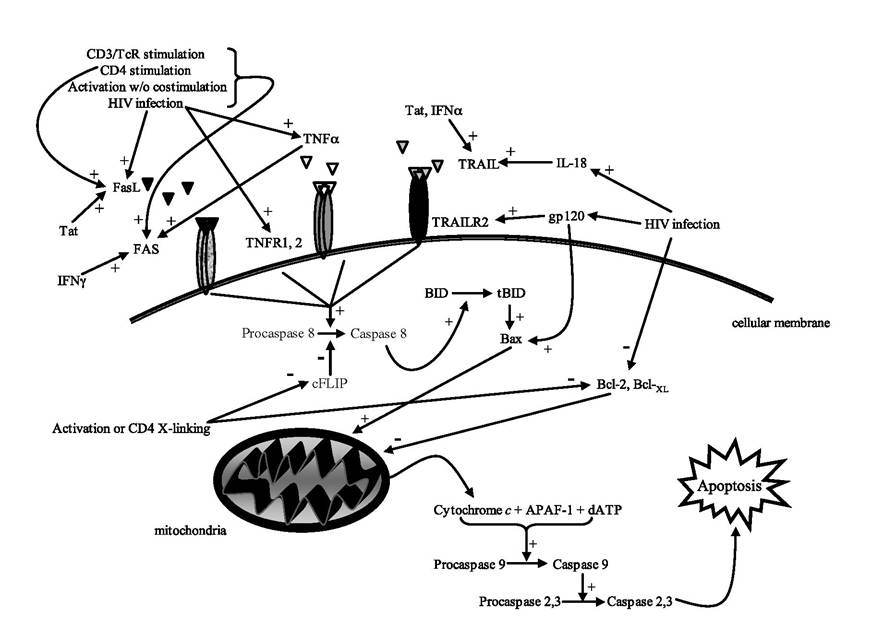
FIGURE 11.1 The direct and indirect influences of HIV on pathways of AICD, showing both the extrinsic pathway, mediated at the level of the cellular membrane by members of the TNF family of death-inducing receptors, and the intrinsic pathway of AICD, involving targeting of mitochondria.
to undergoing apoptosis. Evidence also exists for both Fas-dependent and Fas-independent pathways of apoptosis in HIV disease in children.72
Regulation of Fas and FasL expression can be affected by a variety of different factors within the context of HIV infection. CD4 cross-linking by viral glycoprotein (gp)120 triggers increases in Fas expression, upregulation of FasL, and CD4 and CD8 T cell apoptosis.73’74 Both IFNγ and TNFα were found to contribute to Fas upregulation, suggesting that aberrant cytokine secretion induced by CD4 cross-linking contributes to HIV disease pathogenesis.73 However, it was also suggested that it is the lateral association of CD4 with Fas after gp120 binding that triggers apoptosis.75 Thus, an early FasL-independent effect of gp120 could lead to Fas triggering, followed by a secondary upregulation of FasL. Of note is the fact that gp120s from diverse HIV-1 strains display different capacities to induce cell death.75 Tat and Nef, two virally-encoded proteins, were also shown to upregulate FasL expression,60,77 the former via effects on nuclear factor (NF) κB,76 and the latter via activation of the T cell receptor (reviewed in Fackler, 2002).
In addition to upregulating FasL expression, the expression of other death receptors, including TNFR1 and TNFR2, is also dysregulated in HIV infection. CD8+ bronchioalveolar (BAL) T cells accumulating in the alveolar spaces of patients infected with HIV express more phenotypic markers of activation (CD45RA, CD69) and demonstrate increased expression of TNFR2 than do BAL T cells from uninfected donors.78 In one study, both TNFR2 and TNFR1 were found to be expressed at higher levels in lymphocytes from HIV-infected persons, although expression of the former was higher than the latter. These and other observations suggest that apoptosis mediated by the TNFRs may play a substantial role in the AICD of T cells observed in HIV.79 Increased production of TNFα occurs early in HIV infection and may further increase with the development of opportunistic infections.
A correlation exists between serum TNFα levels and progression to AIDS, suggesting a role for this cytokine in HIV pathogenesis.80In addition to Fas and TNFR, apoptosis mediated by TRAIL also plays a role in the AICD associated with HIV infection. TRAIL expression is increased in peripheral blood mononuclear cells (PBMCs) from HIV-infected persons experiencing virologic failure and has been attributed to persistently high-serum IL-18 levels.81 HIV-infected monocytes are activated indirectly via IFNα or directly via extracellular Tat protein82-85 and express several soluble mediators of apoptosis, including TRAIL.86 Research into potential dysregulation of TRAIL receptor expression identified increases in TRAILR2 in both CD4 and CD8 T cells from HIV-infected individuals. A similar increase was observed in vitro after gp120 stimulation of uninfected Jurkat and primary cells, indicating a potential mechanism for upregulation. Although TRAIL does not induce apoptosis in normal peripheral blood T and B cells, a neutralizing monoclonal antibody to TRAIL effectively inhibits AICD in some, but not all, HIV-infected patients. TRAIL agonists also induce apoptosis of in vitro HIV-infected monocyte-derived macrophages (MDMs) as well as peripheral blood lymphocytes (PBLs) from HIV-infected patients.87
Members of the Bcl-2 family of molecules are key regulators of apoptosis and include both pro- and antiapoptotic molecules. It is the ratio between these two subsets that helps determine, in part, the susceptibility of a cell to undergo apoptosis.88 Regulation of Bcl-2, an antiapoptotic protein, seems to be altered in CD8 T cells in HIV infection.89 Downmodulation of Bcl-2 expression in CD4 T cells occurs after CD4 cross-linking.90 The important role of immune activation in altering the ratio of pro- and antiapoptotic molecules is evident from the expression of activation markers CD45RO, HLA-DR, and CD38 and increased levels of Fas in the low Bcl-2 expressing fraction of CD8 T cells.89 Induction of Bcl-xL, another antiapoptotic member of the Bcl-2 family, is also impaired in HIV-infected individuals.91 In HIV-specific CD8 T cells, expression of both Bcl-2 and Bcl-xL is markedly reduced.92 In addition to downmodulating Bcl-2 expression, engagement of CD4 by HIV gp120 leads to an increase in the expression of Bax, a proapoptotic member of the Bcl-2 family,93 further biasing the intracellular milieu toward promotion of apoptosis. Altered expression of Bcl-2 may account for the increased sensitivity of T cells to TNFRl- and TNFR2- mediated apoptosis.79
More on the topic DEATH RECEPTOR/LIGANDS AND INTRINSIC APOPTOTIC MACHINERY IN HIV INFECTION:
- GP120 RECEPTOR BINDING
- Death and dying
- ALL REVVED UP WITH NO PLACE TO GROW—ACTIVATION- INDUCED CELL DEATH (AICD) and peripheral deletion