Canonical Models and Completeness
Canonical models for modal logics are constructed with possible worlds that are maximally consistent sets of formulas and with accessibility defined in a standard way. Logics for which canonical models suffice to establish axiomatic completeness are called canonical logics.
Most common modal logics are canonical, though there are important exceptions. All the modal logics we have considered here are canonical. The methodology developed for canonical modal logics carries over to justification logics and plays a fundamental role. For reference, we begin with a review of canonical machinery in the modal setting before moving to justification logics.4.4.1 Canonical Modal Logics
Let KL be a normal modal logic, which we assume is axiomatized by adding a set of axioms to K. Call a set S of modal formulas KL-consistent provided 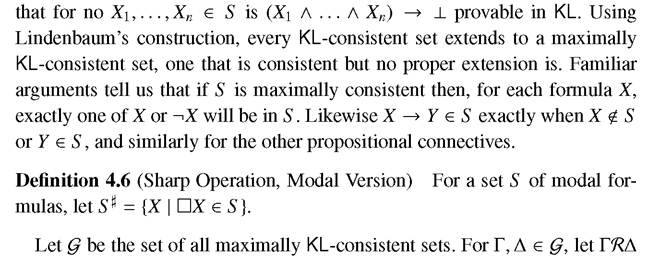
4.4 CanonicalModelsandCompleteness 61

The key fact about modal canonical models is the following. It is very well- known, but is included for reference.
Theorem 4.7 (Modal Truth Lemma)
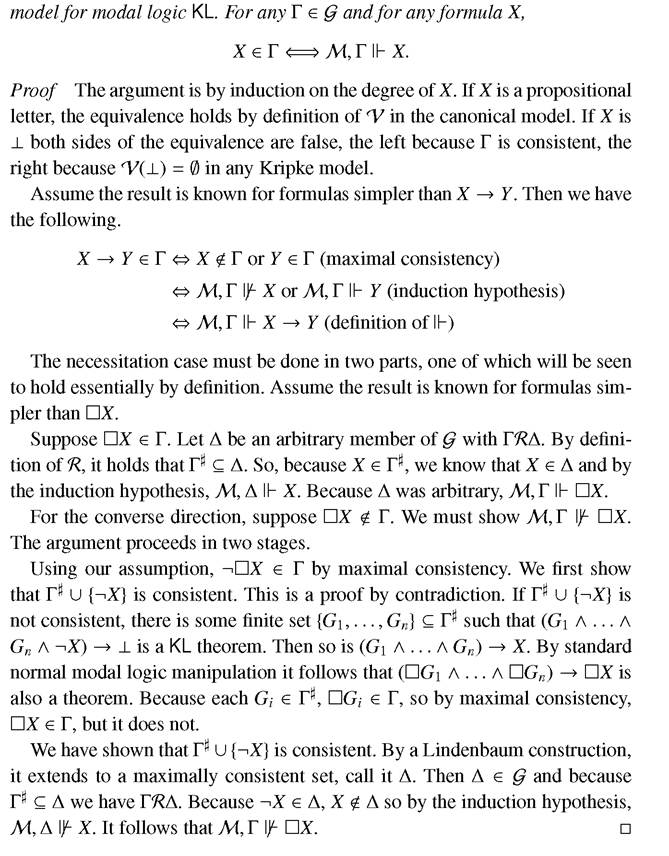
A canonical model is a universal countermodel. For, suppose X is not provable in KL. Then is KL-consistent and so can be extended to a maximally
consistent set Γ. Then Γ є G and, by the Truth Lemma,
What has been shown is that if X is not provable in KL, then X is falsifiable in the canonical model.
Now we have a very important point. It can happen that the canonical model is not actually a model that meets the intended semantic conditions for its logic. For instance, this happens with Godel-Lob logic, GL. This logic is characterized independently by two different sets of frames; for one of them frames must be finite. Because any canonical model is infinite, it is not built on such a frame. The other kind of frame is a bit more complicated to describe, but the canonical model is not built on one of these either. Completeness can be proved for GL, but a direct canonical model argument won’t work.An axiomatic modal logic KL is canonical if its canonical model meets the semantic conditions adopted for KL. This is stated loosely because it requires an independent determination of what we want to count as a model for KL. The statement can be cleaned up, but we don’t need the resulting complications here. We will simply assume the modal logics we discuss come with intended semantics. Then GL is not canonical, but most common modal logics are. Indeed, all the modal logics considered in Sections 2.7 and 4.3 are canon-
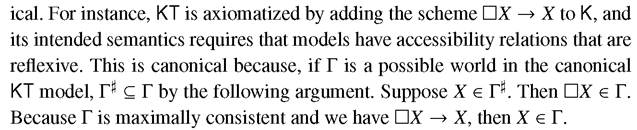
The key fact to take away is that canonical modal logics have axiomatic completeness proofs that are uniform across a broad range of modal logics.
4.4.2 Canonical Justification Models
Canonical models for justification logics were introduced in Fitting (2005). Until recently all known justification logics were counterparts of canonical modal logics, but recently Shamkanov (2016) has shown a realization theorem for the Godel-Ldb modal logic, and this is not canonical. Nonetheless, canonical justification models supply the main semantic machinery behind almost all realization proofs, as we will see in Chapters 7 and 8.
Definition 4.8 (Consistency) Let JL(CS) be some axiomatically formulated justification logic, with constant specification CS.
We say a set S of formulas is JL(CS)-inconsistent if S and S is JL(CS)-Consistent if it is not
 JL(CS)-inconsistent.
We need an analog of the modal sharp operation, Definition 4.6, which was used in the previous section.
Definition 4.9 (Sharp Operation, Justification Version) For a set S of formu-

The following definition is directly analogous to that for modal canonical models—only part (4) is new.
Definition 4.10 (Canonical Justification Model) The canonical Fitting model
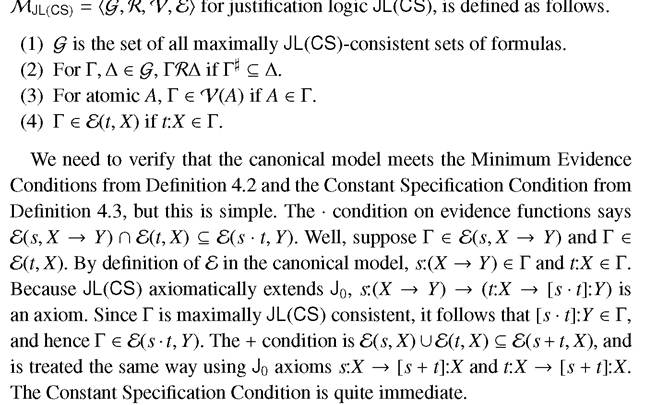
As with modal canonical models, the key item to show is a truth lemma, analogous to Theorem 4.7. Curiously, for justification logics the proof is simpler than in the modal case.
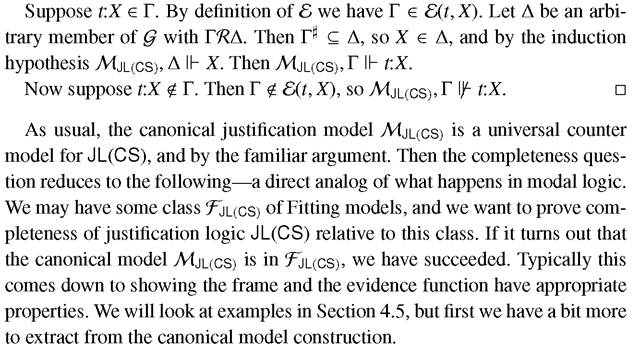
Theorem 4.11 (Justification Truth Lemma)

Proof The proof is by induction on the degree of X. The atomic case is by definition. Propositional connective cases are the same as in the modal proof for Theorem 4.7, making use of maximal consistency of Γ. This leaves the justification case. Assume as induction hypothesis that the result holds for for the formula X.
4.4.3 Strong Evidence and Fully Explanatory
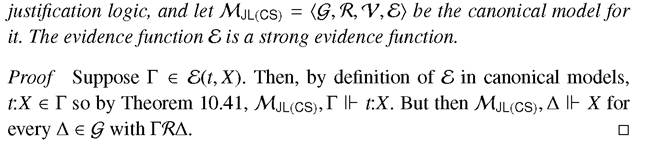
In Definition 4.4 Fully Explanatory Fitting models were characterized, and in Definition 4.5 Strong Evidence Functions as well. As we are about to see, the second of these comes for free, while the first requires a familiar argument already seen in the proof of Theorem 4.7. We begin with Strong Evidence. Recall that an evidence function in a Fitting model is strong if the Evidence condition for it implies the Modal condition.
Theorem 4.12 (Strong Evidence) Let JL(CS) be an axiomatically presented
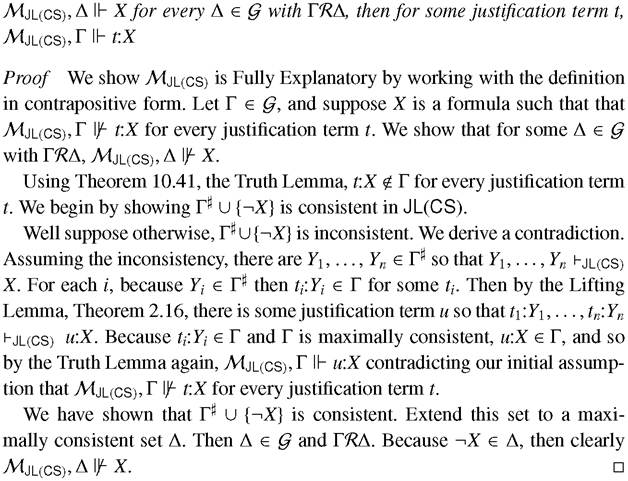
We move on to Fully Explanatory. Speaking informally, suppose we say a formula is knowable at a possible world of a Fitting model if it is true at all accessible possible worlds. Then Fully Explanatory says: Any formula that is knowable at a possible world has a justification at that possible world.
Theorem 4.13 (Fully Explanatory) Again let JL(CS) be an axiomatically presented justification logic, and let be the canoni
cal model for it. Assume JL has the internalization property relative to constant specification CS (by Theorem 2.14, this is the case if CS is axiomati- cally appropriate). Then the canonical model is fully explanatory. That is, if
4.5
More on the topic Canonical Models and Completeness:
- Artemov S., Fitting M.. Justification Logic: Reasoning with Reasons. Cambridge: Cambridge University Press,2019. — 271 p., 2019
- Possible World Semantics for FOLP
- Legacy
- The polity and humankind on the island
- MAINSTREAM ISLAM REJECTS FREEDOM OF CONSCIENCE
- International comparisons
- Rule Through the Rise of Local Elites
- 39 Theravada Buddhism in South-East Asia
- PHYSIOGNOMY
- The Religious Crisis